Work record
Shakuntala
KalidasaAbhijnanasakuntalam; The Recognition of Shakuntala; Sakoontala; SakuntalaShakuntala by Kalidasa (c. 4th–5th century AD)Shakuntala, or The Recognition of Shakuntala, is Kalidasa’s most famous play, a Sanskrit drama in seven acts about a king, a hermitage, a secret marriage, a curse, a lost ring, and a son.Also known as: Abhijnanasakuntalam · The Recognition of Shakuntala · Sakoontala · Sakuntala
c. 4th–5th century AD (date uncertain); English 1912 · Ancient · Drama · Sanskrit
Read this when a promise is forgotten, and a ring must speak.
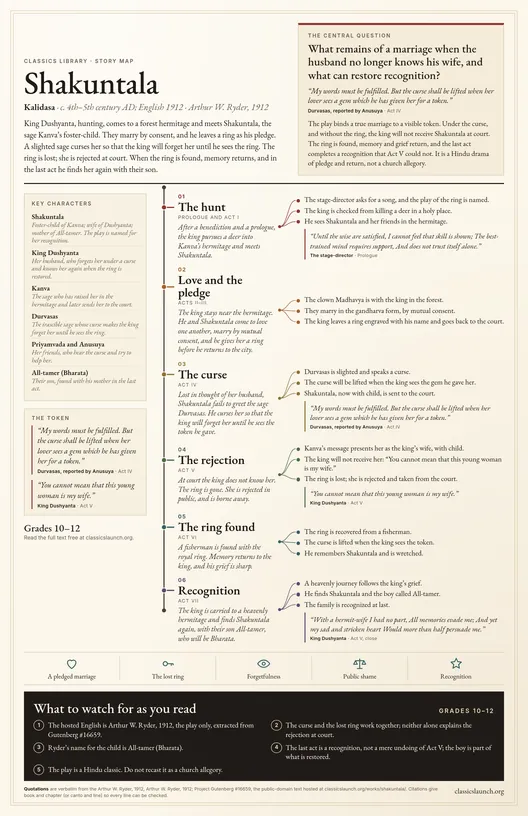 Story mapSee the story mapThe whole book on one page: the story in movements, the characters, and what to watch for. Free to print.
Abstract
Background. Kalidasa’s Shakuntala is the most famous play in classical Sanskrit, usually dated to the Gupta age. This page hosts Ryder’s 1912 English (Gutenberg #16659), taken from a volume that also held other Kalidasa pieces, which are omitted here.
Plot. King Dushyanta meets Shakuntala in a forest hermitage, marries her, and leaves a ring as his pledge. A sage’s curse makes the king forget her until he sees the ring. She is rejected at court. The ring is found, memory returns, and in the last act he finds her again with their son.
Ideas. The play is about a pledged marriage, a forgotten token, and recognition. A Christian class can honor its picture of faithfulness and of public shame without turning a Hindu drama into a church allegory. Courtesy, memory, and a kept word are all at stake.
Text. Ryder’s 1912 English is in the public domain in the United States. It is a literary rendering, not a word-for-word crib. Monier-Williams’s earlier version was also considered; Ryder is the hosted text because the play stands alone in a clear English, taken from a volume whose other contents are omitted and named. A class can follow the seven acts in order and should keep the curse, the lost ring, and the last recognition distinct.
Main characters
- Shakuntala: the hermitage-raised heroine who must be recognized
- King Dushyanta: her husband, who forgets her under a curse
- All-tamer (Bharata): their son, found in the last act
Summary
Shakuntala, or The Recognition of Shakuntala, is Kalidasa’s most famous play, a Sanskrit drama in seven acts about a king, a hermitage, a secret marriage, a curse, a lost ring, and a son. King Dushyanta, hunting, comes to the forest hermitage of the sage Kanva and sees Shakuntala, Kanva’s foster-child. They fall in love and marry in the gandharva form, a union by mutual consent without the public rites. The king returns to his city and gives her a ring as a pledge. In his absence the irascible sage Durvasas comes to the hermitage; Shakuntala, lost in thought of her husband, fails to greet him, and he curses her so that the king will not remember her until he sees the ring. Her friends obtain a modification of the curse, but they cannot lift it. When Shakuntala, now with child, is taken to the court, the king does not know her. The ring has been lost. She is rejected in public, and is borne away. Later a fisherman is found with the royal ring; memory returns to the king, and his grief is sharp. In the last act he is taken to a heavenly hermitage and finds Shakuntala again, with their son, the boy called All-tamer, who will be Bharata, ancestor of a great line. The play is tender, comic in the clown Madhavya, and serious in its trial of recognition. It is not Scripture, and this library does not present it as a Christian allegory. It is a classic of Indian drama, hosted here in Arthur W. Ryder’s public-domain English of 1912, extracted from a Gutenberg volume that also contains other works of Kalidasa, which are not included on this page. A class can read the plot clearly, notice the difference between a vow remembered and a vow forgotten, and compare the play, carefully, with other books on promise, exile, and return.
Virtues in this work
- Faith: Shakuntala goes to the court trusting the king’s pledge, even when she is not believed.
- Justice: The last act restores name, wife, and son after a public wrong.
- Friendship: Priyamvada and Anusuya try to shield Shakuntala from the curse and to help her on her way.
Plot or Argument
- Prologue and Act I: the hunt
After a benediction and a prologue, the king pursues a deer into Kanva’s hermitage, meets Shakuntala and her friends, and is checked from killing the deer in a holy place.
- Acts II–III: love and the secret marriage
The king stays near the hermitage. He and Shakuntala come to love one another and marry by mutual consent. He gives her a ring and returns to the city.
- Act IV: the curse and the departure
Durvasas, slighted, curses Shakuntala so that the king will forget her until he sees the ring. She is sent to the court, now carrying the king’s child.
- Acts V–VI: rejection and the ring recovered
At court the king does not know her; the ring is gone; she is rejected. A fisherman is later found with the ring, and the king’s memory and grief return.
- Act VII: recognition
The king is carried to a heavenly mountain hermitage, finds Shakuntala and their son All-tamer, and is recognized at last.
Characters
- Shakuntala, heroine
Foster-child of the sage Kanva; wife of Dushyanta; mother of All-tamer. The play is named for her recognition.
- King Dushyanta, king and husband
A king who marries Shakuntala, forgets her under a curse, and recognizes her when the ring is restored.
- Kanva, hermit-father
The sage who has raised Shakuntala in the forest hermitage and later sends her to the court.
- Priyamvada and Anusuya, friends
Shakuntala’s companions in the hermitage, who hear the curse and try to help her.
- Durvasas, irascible sage
A visitor whose anger, when Shakuntala fails to greet him, brings the curse of forgetfulness.
- Madhavya, clown and companion
The king’s comic companion, who lightens the court scenes and speaks plainly.
- All-tamer (Bharata), son
The child of Shakuntala and Dushyanta, found with his mother in the last act.
Lessons
A pledge must be kept in more than words
The king’s ring is a sign of a real marriage. When memory fails, the sign is needed; when the sign is lost, a woman is left without defense at court. The play makes the cost of a forgotten pledge visible.
- What does the ring do in the plot that a mere feeling could not do?
- Where is the king to blame, and where is he acting under the curse?
Hospitality and attention have a moral weight
Shakuntala’s failure to greet Durvasas is a lapse of welcome, and it costs her dearly. The class can discuss attention, courtesy, and the danger of an irascible judgment, without turning the sage into a mere villain.
- Why does the play make so much of a missed greeting?
- Is the curse just, even if it is later softened?
Honor a Hindu classic without baptizing it
The play belongs to a Hindu world of hermitages, sages, and heavenly courts. A Christian student can honor its picture of faithfulness and recognition, and must not pretend that Kalidasa wrote a parable of the church.
- What in the play is simply human loyalty and grief?
- What belongs to its own religious world and should be named as such?
Context
Kalidasa is the great name in classical Sanskrit poetry and drama. His date is not certain; he is commonly placed in the Gupta period, in the fourth or fifth century AD. Shakuntala draws on a story also found in the Mahabharata, and it became, in later centuries, the Indian play best known in Europe, especially after Sir William Jones’s English of 1789.
Composition
The Sanskrit play is in seven acts, with a prologue. The hosted English is Arthur W. Ryder’s 1912 version, extracted from Project Gutenberg #16659, a volume that also contains other works of Kalidasa, which are not hosted on this page. Ryder’s English aims at readable verse and prose, not a word-for-word crib.
Reception
Goethe praised the play; it has been translated many times. Ryder is later than Jones and Monier-Williams, still public domain, and clear enough for a high-school class with notes. This library does not offer a modern copyrighted translation.
Comparisons
- The Ramayana
Another Sanskrit classic in this library, an epic of exile, faithfulness, and return; the play is shorter, more intimate, and confined to a marriage and a recognition.
- The Mahabharata
The story of Shakuntala and Bharata is also told in the great epic; Dutt’s condensed verse and this play may be read beside one another once both are on the shelf.
- The Bhagavad Gita
A very different Sanskrit work, a battlefield dialogue on duty; useful only to show the range of the tradition, not as a key to this play.
- Oedipus the King (Sophocles)
Another drama of recognition, though tragic and of a different kind; Shakuntala’s last act restores a family rather than destroying one.
Quotes
“Until the wise are satisfied, I cannot feel that skill is shown; The best-trained mind requires support, And does not trust itself alone”
“Your charming song had carried me away As the deer enticed the hero of our play”
“My words must be fulfilled. But the curse shall be lifted when her lover sees a gem which he has given her for a token”
“You cannot mean that this young woman is my wife”
“With a hermit-wife I had no part, All memories evade me; And yet my sad and stricken heart Would more than half persuade me”
For Students
A reading companion for classical Christian high school students. See the student guide.
Reading Guide
Watch for
- The difference between the secret marriage and the public rejection
- How the curse and the lost ring work together
- The clown’s plain speech beside the king’s poetry
- The last act’s reunion, which is not a mere undoing of Act V
Key terms and names
- Gandharva marriage
- A union by mutual consent, without the full public ceremony; the form of Dushyanta and Shakuntala’s marriage.
- Durvasas
- The short-tempered sage whose curse makes the king forget Shakuntala until he sees the ring.
- Ring of recognition
- The king’s pledge, lost and later found, without which memory and proof fail at court.
- All-tamer
- Ryder’s English for the boy Bharata, son of Shakuntala and Dushyanta, in the last act.
- Ryder 1912
- The public-domain English hosted here, extracted from Gutenberg #16659.
Seminar Questions
- Comprehension How do the king and Shakuntala first meet, and what token does he leave with her?
- Comprehension What does Durvasas curse, and what later condition can lift it?
- Interpretation Why is the rejection at court so public, and what does that publicity do to Shakuntala?
- Interpretation Is Dushyanta guilty, cursed, or both, and how does the play want us to weigh those?
- Interpretation What kind of recognition happens in Act VII that did not happen in Act V?
- Big Question What is a marriage if the husband no longer knows his wife, and what restores it here?
- Big Question How should a Christian class honor a Hindu classic without turning it into a church parable?
Faith Connections
- Genesis 29–30, 41 (Scripture)
Scripture also knows tokens, forgotten and remembered kin, and the long road by which a family is recognized; the comparison must stay honest and not force the plots together.
- Luke 15:11–32 (Scripture)
A story of a child recognized and received; the differences of plot and faith should be named, not smoothed away.
- The Mahabharata’s tale of Shakuntala (Great Conversation)
The epic tells a related story of Shakuntala and Bharata; reading both, when both are in the library, shows what the play uniquely does.
Logic and Rhetoric
Central argument: The play shows a true marriage almost destroyed by a curse, a lost token, and a public forgetting, and then restored when the ring and the child make recognition possible.
Rhetorical device: token and recognition (anagnorisis). The king’s ring, lost and found, is the condition under which memory and public proof return.
Debate: Resolved: That the play is a drama of recognition and pledged faithfulness, and that it should be read as a Hindu classic, not recast as a Christian allegory.
Memory Work
Until the wise are satisfied, I cannot feel that skill is shown; The best-trained mind requires support, And does not trust itself alone
Writing Prompts
Essay: Trace the ring from the hermitage to the court to the fisherman and back to the king. What does each stage prove?
Comparison with The Ramayana: Compare Shakuntala’s exile from recognition with an episode of exile and return in the Ramayana, honoring both plots and naming differences of form and faith.
Medical Lens
The play’s sharpest pain is the king’s forgetfulness and Shakuntala’s public rejection, then his grief when memory returns. These are dramatic, not clinical, states.
- Act V
Shakuntala is not recognized at court and is rejected while carrying the king’s child.
- Act VI
After the ring is found, the king remembers and is wretched.
Creative Prompts
- Essay
Explain the work of the ring in the plot: what it promises, what happens when it is lost, and what returns with it.
- Dialogue
Write a short original scene, not copied from Kalidasa, in which two friends try to warn a girl who is about to travel to a court that may not know her.
- Classroom
Have students map the seven acts on one page, marking where the curse is spoken, where the ring is lost, and where it is found.
Further Reading
- The Ramayana, Valmiki (English by Ralph T. H. Griffith in this library)
The other great Sanskrit epic hosted here, for comparison of exile and faithfulness.
- The Mahabharata, condensed into English verse, Romesh Chunder Dutt
The epic tradition in which Shakuntala’s story also appears.
Verification notes
The English is Ryder 1912, extracted from Gutenberg #16659; only the play is hosted. Kalidasa’s date is uncertain and is so marked. Quotations will be verified against the hosted file. A second comparison to the Mahabharata work assumes that work is added in this same batch.
- Kalidasa’s century is traditional and not certain; the sort year 400 is for catalogue order.
- Ryder sometimes uses Anglicized names (Dushyanta, Shakuntala, All-tamer); these are the translator’s forms.