Work record
The Exploits of Brigadier Gerard
Arthur Conan DoyleBrigadier Gerard; Etienne Gerard; Exploits of Brigadier Gerard; Gerard of the HussarsThe Exploits of Brigadier Gerard by Arthur Conan Doyle (1896)The Exploits of Brigadier Gerard is a series of eight stories by Arthur Conan Doyle about a brave, vain and cheerful French cavalry officer in Napoleon's army.Also known as: Brigadier Gerard · Etienne Gerard · Exploits of Brigadier Gerard · Gerard of the Hussars
1896 · 19th Century · Short Stories · English
Read this when you want comic, quick stories of a vain, brave French cavalry officer under Napoleon.
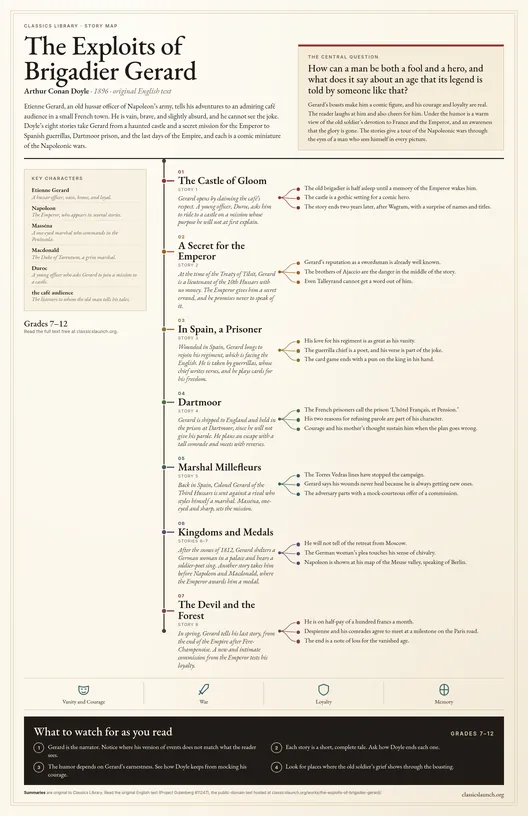 Story mapSee the story mapThe whole book on one page: the story in movements, the characters, and what to watch for. Free to print.
Abstract
Background. Conan Doyle wrote these stories in the mid-1890s, between his Holmes series and his later historical novels. They are often thought to draw on the real memoirs of Napoleonic cavalry officers for their detail.
Plot. An old hussar tells his café friends how he carried messages, escaped from prison and outwitted enemies from Poland to Portugal. Many of the tales turn on a joke at his own expense, and the last brings him into the presence of the Emperor near the end of the Empire.
Ideas. The book is a comedy of pride. Gerard is a model of courage and a model of conceit, and the stories ask the reader to see both. They also show respect for the soldiers of an enemy army and a sad tenderness for an age that is gone.
Text. The hosted text is the full book from Project Gutenberg. Use it for reading aloud, for studying a narrator whose view differs from the author's, and for pairing with a serious account of the same wars. Teachers can use the library's study guide, seminar questions and memory-work selection to prepare a discussion, a short essay or a recitation. Every quotation in the guide has been checked against the hosted text.
Main characters
- Etienne Gerard: A vain, brave cavalry officer
- Napoleon: The Emperor and giver of missions
- Lord Wellington: The English general in the Peninsula
- Marshal Millefleurs: An English robber chief in French uniform
- Duroc: An officer of the Emperor
Summary
The Exploits of Brigadier Gerard is a series of eight stories by Arthur Conan Doyle about a brave, vain and cheerful French cavalry officer in Napoleon's army. Etienne Gerard is an old man at a café in the opening pages and tells his adventures to his friends, who listen. A footnote in the first story says that the word Brigadier is used in its English and not in its French sense, so that it means a commander of a brigade. Gerard's tales are full of heroism, but they are told with such innocent conceit that the reader sees, as Gerard does not, how much of the credit he gives himself. In the first story, in the winter of 1807, Gerard is sent to bring four hundred horses to the army across the Vistula, and his journey ends at the Castle of Gloom and with a surprise about its owner, the Baron Straubenthal, and the Emperor's officer Duroc. The second story shows him as the Emperor's agent against two Corsican brothers. In the third he is taken prisoner by Lord Wellington and makes a joke with the playing-cards in his hand, and Wellington answers it. In the fourth he is a prisoner in England at Dartmoor. The fifth sends him against Marshal Millefleurs, who is in fact an English ex-officer named Alexis Morgan, broken for cheating at cards, and who commands a band of robbers near the French army. The sixth story sends him with papers to a German prince, and in the seventh he is at last given the special medal of honor by Napoleon, after he has reported on a mission in disguise in which he met a Cossack officer. In the last story, set in the closing years of the Empire, Gerard stands in the presence of the Emperor, Berthier and Macdonald, and the old soldier then ends the book with a farewell to his friends in the spring sunshine. The stories are light and quick, and they make a very good introduction to Doyle's historical fiction. They also give a respectful picture of the courage of Napoleon's soldiers and a gentle satire of the pride that often accompanies courage.
Virtues in this work
- Fortitude: Gerard rides through danger on his missions without hesitation, and the Emperor honors him for his stout heart.
- Honor: He holds his duty to the Emperor and to France above his own interest, even when he is tempted to turn aside.
- Humility: The book teaches by contrast. Gerard's vanity is the thing the reader is meant to smile at, and Proverbs 27:2 gives the rule against it.
Plot or Argument
- 1. The Castle of Gloom
In February 1807 Gerard is sent with four hundred remounts toward the army at the Vistula, and the story ends with the ruins of the Castle of Gloom and a surprise about the Baron Straubenthal and Duroc.
- 2. The Brothers of Ajaccio
Gerard is the Emperor's agent in a secret matter and fights two Corsican brothers, with Lasalle and the court at Fontainebleau in the background.
- 3-4. The King and the Brigadier
Gerard is taken by Wellington, who answers a joke about the playing-cards in his hand, and in the next story he is a prisoner on Dartmoor.
- 5. Marshal Millefleurs
Marshal Massena sends Gerard against the English robber chief Alexis Morgan, called Marshal Millefleurs, who has made himself a power on the French flank in Portugal.
- 6-7. A kingdom and a medal
Gerard carries papers to a German prince, and after another mission he reports to Napoleon, Berthier and Macdonald and is given the special medal of honor.
- 8. Tempted by the Devil
Gerard is now among the great events, in the Emperor's presence, and the book closes with his farewell to his friends.
Characters
- Etienne Gerard, narrator and hero
A French cavalry officer, colonel of the Third Hussars and later a brigade commander, who is brave, vain and good-hearted.
- Napoleon, the Emperor
The Emperor, who sends Gerard on missions and rewards him with a medal in the end.
- Lord Wellington, English general
The English commander who takes Gerard prisoner in the third story and answers his joke with one of his own.
- Duroc, Napoleon's officer
An officer of the Emperor who appears at the end of the story of the Castle of Gloom.
- Lasalle, cavalry general
A dashing general of hussars under whom Gerard serves.
- Alexis Morgan, robber chief
An English ex-officer who plays the part of 'Marshal Millefleurs' and leads a band of robbers.
- Berthier, marshal
Napoleon's chief of staff, who appears in the later stories.
Lessons
The comedy of vanity
Gerard is courageous and proud, and his pride is the engine of the comedy. The reader laughs at his conceit and likes him for his courage. A classical Christian reader can think of Proverbs 16:18 and 27:2, on pride and self-praise, and can ask where the line between honest courage and vanity falls.
- How does Gerard describe himself in the opening pages?
- What does Gerard's sentence about talking of what interests himself tell us about him?
- Why does Doyle choose a vain narrator for tales of heroism?
Courage and its limits
Gerard fears nothing in a charge but sometimes behaves like a child when he is flattered. Doyle shows a courage that is real and a judgment that is often poor. The stories ask what makes a brave man wise.
- Which of Gerard's exploits show real courage?
- Where does he show poor judgment?
- What does the Emperor mean when he says Gerard has a thick head and a stout heart?
Soldiers and memory
Gerard tells his stories as an old soldier to young friends and sees himself as a fragment of history. The book is a gentle study of how old men look back on the wars of their youth, with pride, comedy and a little sadness.
- How does the café setting shape the stories?
- What does Gerard's farewell in the spring sunshine suggest about memory?
- How do old soldiers tell their stories differently from historians?
Enemies seen with respect
Doyle shows Wellington, the English officers and the Cossacks as brave and intelligent, and he has Gerard admire them while he boasts. The book shows how a brave man can honor an enemy and still love his own country.
- How does Gerard treat Wellington in the third story?
- How does Gerard speak of his English enemies?
- Why does a respectful picture of the enemy make the stories better?
Context
The stories are set during the Napoleonic wars, between 1807 and 1814, in Poland and Prussia, France, Spain and Portugal, England and Russia. The French cavalry, and especially the hussars of Murat and Lasalle, were famous for dash and reckless courage, and the memoirs of Napoleonic officers such as Marbot supplied Doyle with many of the details of dress, horses and campaigns. Gerard is a fictional figure.
Composition
Doyle wrote the Gerard stories in the 1890s and published them in The Strand Magazine; the first collection of eight stories appeared in book form in 1896. A second collection, The Adventures of Gerard, followed in 1903. The stories are often thought to have drawn on the memoirs of General Marbot.
Reception
The stories were popular at once, and Gerard became, after Holmes, Doyle's best-known creation. They have remained in print and have been adapted for stage, radio and film, including a 1970 film with Peter McEnery.
Comparisons
- The Adventures of Sherlock Holmes
Doyle's other Strand series from the same years, in which the hero is a calm reasoner and not a hot-headed soldier.
- The Three Musketeers
Dumas's novel has the same love of swordplay and the same brave and boastful heroes, though in the seventeenth century.
- War and Peace
Tolstoy shows the Napoleonic wars on a great scale and in a serious mode, where Gerard shows them in comic anecdotes.
- The Scarlet Pimpernel
Orczy's story of an English hero against the French has the same enjoyment of disguise and boldness.
- Letters of Napoleon
The Emperor's own letters give the real voice of the commander who appears in Gerard's stories as a character.
- The Charterhouse of Parma
Stendhal's novel opens with a young man who is lost on the field of Waterloo and shows another side of the Napoleonic soldier.
- Micah Clarke
Doyle's earlier historical novel is another tale of a soldier's adventures, told by an old man to his listeners.
Quotes
Frequently cited
“You do very well, my friends, to treat me with some little reverence, for in honouring me you are honouring both France and yourselves.”
Frequently cited
“it is I who won, for, as you perceive, my King holds you.”
Frequently cited
“The buds are bursting and the birds are calling, my friends. You may find better things to do in the sunlight than listening to the stories of an old, broken soldier.”
“For twenty years we were teaching Europe how to fight, and even when they had learned their lesson it was only the thermometer, and never the bayonet, which could break the Grand Army down.”
“It is my habit, you see, to talk of that which interests myself and so I hope that I may interest you.”
“My wounds never heal, Marshal,' I answered. 'And why?' 'Because I have always new ones.”
“if he has the thickest head he has also the stoutest heart in my army.”
For Students
A reading companion for classical Christian high school students. See the student guide.
Reading Guide
Watch for
- Each time Gerard praises himself, and what the events of the story show about his claim.
- How Doyle makes the reader laugh at Gerard and respect him in the same paragraph.
- How the café setting and the audience of friends shape the way each story is told.
- How the English, the Russians and the Germans are shown in a French soldier's account.
Key terms and names
- Brigadier
- In the book, a commander of a brigade; Doyle's footnote says the word is used in its English sense and not in its French sense.
- Hussar
- A light cavalry soldier, known for dash, bright uniform and daring raids.
- Grand Army
- The name for Napoleon's main army, which Gerard says was taught fighting to the whole of Europe.
- Unreliable narrator
- A storyteller whose account the reader cannot take at face value, as with Gerard's boasting.
- Peninsula
- The war in Spain and Portugal between the French and the English, Spanish and Portuguese from 1808 to 1814.
Seminar Questions
- Comprehension Who is Gerard speaking to, and in what setting does he tell the stories?
- Comprehension What happens in the third story when Gerard is brought before Wellington?
- Interpretation How does Doyle make Gerard likeable despite his vanity?
- Interpretation What does the Emperor mean when he praises Gerard's thick head and stout heart?
- Interpretation What does Gerard's farewell to his friends in the last story add to the book?
- Big Question Can a man be truly brave and also vain, and does the vanity spoil the courage?
- Big Question How should we remember soldiers of an army that fought for a cause we judge differently?
Faith Connections
- Proverbs 27:2 (Scripture)
Let another man praise thee, and not thine own mouth. The verse is a plain commentary on Gerard's habit of praising himself.
- Proverbs 16:18 (Scripture)
Pride goeth before destruction, and an haughty spirit before a fall. Gerard's vanity gets him into many scrapes, which the stories treat with comedy.
- the-three-musketeers (Great Conversation)
Dumas's heroes share Gerard's love of honor and swordplay, and the two books can be compared as French tales of brave and boastful men.
Logic and Rhetoric
Central argument: Courage is a real virtue and deserves respect, but a man who tells his own story is not a safe judge of it, and the reader should honor the brave deed while smiling at the boaster.
Rhetorical device: the unreliable narrator. Gerard tells his friends that he is a fragment of history and then spends the story on his own wonderful conduct, so that the reader sees the gap between his claims and the events.
Debate: Resolved: That a soldier who boasts of his courage deserves less honor than one who is silent.
Memory Work
it is I who won, for, as you perceive, my King holds you.
The buds are bursting and the birds are calling, my friends. You may find better things to do in the sunlight than listening to the stories of an old, broken soldier.
Writing Prompts
Essay: Explain how Doyle uses Gerard's own voice to make the reader laugh at the narrator and still admire his courage, and decide which effect is stronger.
Comparison with The Three Musketeers: Compare Gerard with Dumas's d'Artagnan as comic and brave heroes, and say what each book thinks makes a good soldier.
Medical Lens
The stories are comic and do not dwell on medical detail, but Gerard's talk of his many wounds, and the passages on the retreat and the Emperor's armies in winter, give glimpses of the cost of campaigning; General Rapp's wounds and the surgeon Larrey's knives and probes are mentioned with a grim joke.
- Story 5
Gerard says his wounds never heal because he always has new ones, and the Marshal jokes about General Rapp's twenty-one wounds and the surgeon Larrey's knives.
- Story 1
Gerard names the thermometer as the enemy that finally broke the Grand Army, a reference to the cold of the retreat.
Creative Prompts
- Essay
Explain how Doyle uses a vain narrator to make the reader laugh at Gerard and admire him at once, with at least two passages from the stories.
- Fiction
Write a new short Gerard story in his voice in which he tells his café friends of one more mission for the Emperor and takes too much credit.
- Dialogue
Write a conversation between Gerard and Wellington on the way to the rear after the card joke, in which each speaks in character.
- Classroom
Read one story aloud in parts and have the class mark each place where Gerard praises himself and each place where the plot shows something different.
Further Reading
- The Adventures of Gerard, Arthur Conan Doyle
The second collection of Gerard stories, from 1903.
- The Memoirs of Baron de Marbot, Jean-Baptiste Antoine Marcellin de Marbot
A real cavalry officer's memoirs, often named as a source for Gerard.
- Memories and Adventures, Arthur Conan Doyle
- Teller of Tales: The Life of Arthur Conan Doyle, Daniel Stashower
Verification notes
The stories, the names and the quotations are checked against the hosted Project Gutenberg text. The dates of the Strand publication, the link to Marbot's memoirs and the film adaptation follow standard reference accounts and should be checked before they are quoted.
- The dates of the first Strand appearance of the Gerard stories and of the 1896 book.
- Whether Doyle drew directly on the memoirs of General Marbot.
- The details of the 1970 film adaptation.