Work record
Micah Clarke
Arthur Conan DoyleMicah Clarke (Doyle); Monmouth's Rebellion novel; The Monmouth rising; Micah Clarke and Decimus SaxonMicah Clarke by Arthur Conan Doyle (1889)Micah Clarke is Arthur Conan Doyle's first historical novel, the story of a young man who joins the Duke of Monmouth's rising against King James II in 1685.Also known as: Micah Clarke (Doyle) · Monmouth's Rebellion novel · The Monmouth rising · Micah Clarke and Decimus Saxon
1889 · 19th Century · Novel · English
Read this when you want a long tale of a Puritan's son and the lost rising of 1685.
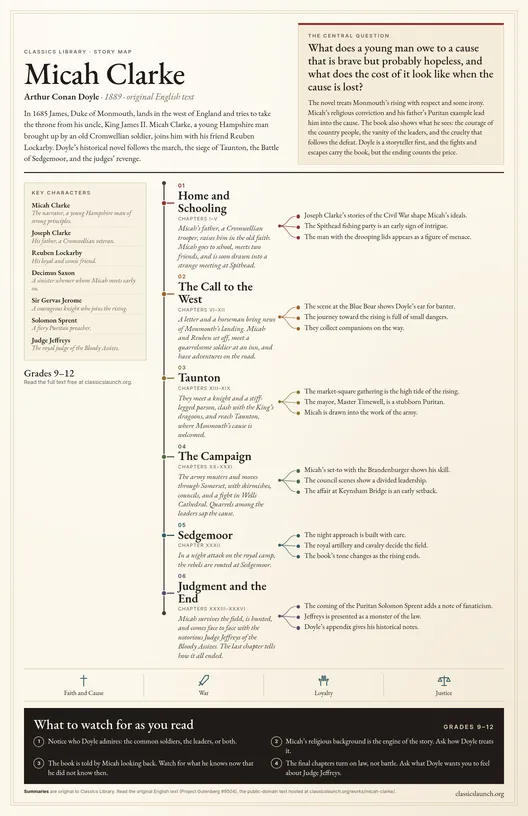 Story mapSee the story mapThe whole book on one page: the story in movements, the characters, and what to watch for. Free to print.
Abstract
Background. Conan Doyle's first historical novel, published in 1889, takes a real episode from the reign of James II. He added notes at the end to point to the history behind the story.
Plot. A young man from a Puritan home goes west with a veteran soldier to join Monmouth's army. After many skirmishes, councils and a night battle, he is taken prisoner, escapes the plantation ship through a friend's help and sails for the Continent.
Ideas. The book weighs conscience against loyalty to a king and honors the courage of the defeated. Its last pages hope that two English religious parties will compete only in doing good, and they take their strongest example from the narrator's own parents. Readers see the rising from the ranks, with its muster, its councils and its prisoners, and then from the calm of an old man's chair.
Text. The hosted text is the complete novel from Project Gutenberg, including the author's historical notes. Use it for reading aloud, for studying a first-person historical narrative and for pairing with a history of the Monmouth rising. Teachers can use the library's study guide, seminar questions and memory-work selection to prepare a discussion, a short essay or a recitation. Every quotation in the guide has been checked against the hosted text.
Main characters
- Micah Clarke: A Puritan's son and the old narrator
- Decimus Saxon: A soldier of fortune and guide
- Reuben Lockarby: His friend from Havant
- Sir Gervas Jerome: A courteous knight of Surrey
- Stephen Timewell: The Puritan mayor of Taunton
Summary
Micah Clarke is Arthur Conan Doyle's first historical novel, the story of a young man who joins the Duke of Monmouth's rising against King James II in 1685. It is presented as the statement of old Micah Clarke to his three grandchildren, Joseph, Gervas and Reuben, in the hard winter of 1734. Micah is the son of Joseph Clarke, a Puritan who had served as a cornet in Cromwell's Ironsides, and a mother who belongs to the Church of England. He grows up in Havant in Hampshire with his friend Reuben Lockarby, borrows books from the village carpenter Zachariah Palmer, and reads in secret. When the news arrives in June 1685 that Monmouth has landed at Lyme, Micah and Reuben set out for the West with Decimus Saxon, a veteran soldier of fortune. On the road they meet the courtly Sir Gervas Jerome, and they gather with the other volunteers at Taunton, where the Mayor, Stephen Timewell, has called the men of the West to arms. The rising grows in numbers, but it is poorly led, and the book follows its quarrels in council, its skirmishes near Keynsham Bridge and in Wells Cathedral, and Micah's errand to the Duke of Beaufort at Badminton. The novel's high point is the night attack on the king's army at Sedgemoor, which ends the rising. Micah is taken prisoner and held with other captives in a village church. He is brought before Lord Chief Justice Jeffreys, whom he calls the Devil in Wig and Gown, and is sentenced with other prisoners to be shipped to the plantations of Barbados. At the last Saxon buys his freedom from the captain of the ship at Poole, gives him back his father's sword, and puts him in a fishing-boat for the Continent. Micah's closing chapter calls the rising a brave and noble failure. He returns to Havant three years later and finds his parents, the Puritan and the Church woman, still living together in love. The book is an adventure, a picture of the country, and an even-handed picture of the two religious parties of England.
Virtues in this work
- Fortitude: The prisoners at Taunton face the Chief Justice and the gallows with a cool and cheerful bravery that Micah calls more admirable than their courage in battle.
- Charity: Micah's parents hold to different creeds and love each other, and Micah hopes that the Church and the Chapel may be elder and younger brothers.
- Friendship: Reuben and Saxon stand by Micah, and Saxon frees him from the prison ship at Poole.
- Faith: The Puritans of the West, and the old seaman Sprent on his deathbed, hold to their faith under persecution and at the end of life.
Plot or Argument
- Chapters I-V: Havant and the soldier
Micah describes his father the Ironside, his mother and his schooling, and his friends Reuben Lockarby and the carpenter Zachariah Palmer. He meets the soldier of fortune Decimus Saxon.
- Chapters VI-XII: The call to the West
A letter and a horseman bring news of Monmouth's landing at Lyme. Micah, Reuben and Saxon set out, and meet adventures on the road and on the moor.
- Chapters XIII-XIX: Sir Gervas and Taunton
Micah's party meets Sir Gervas Jerome, has a skirmish with the King's dragoons, and the gathering in the market-square at Taunton, where they meet Mayor Stephen Timewell.
- Chapters XX-XXVIII: The rising and its quarrels
The muster of the men of the West, Micah's fight with the Brandenburger, news from Havant, the errand to Badminton, strife in the council, the affair at Keynsham Bridge and the fight in Wells Cathedral.
- Chapters XXIX-XXXIII: Sedgemoor
The chapters of this stretch include the great cry from the lonely house, the swordsman with the brown jacket, the Maid of the Marsh, the onfall at Sedgemoor and a perilous adventure at the mill.
- Chapters XXXIV-XXXVI: Captivity and flight
Micah is taken prisoner and held in the church at Gommatch. Jeffreys holds his court, and Saxon frees Micah from the ship at Poole. Micah goes abroad and later returns to Havant.
Characters
- Micah Clarke, narrator
The Puritan's son from Havant, who joins the rising in 1685 and tells the story as an old man to his grandchildren.
- Joseph Clarke, father
A Puritan who served as a cornet in Cromwell's Ironsides, stern and devout, and the head of the household.
- Decimus Saxon, soldier of fortune
A veteran soldier who trains and guides Micah, and in the end sets him free.
- Reuben Lockarby, friend
The innkeeper's son from Havant, Micah's lifelong friend and his companion in the rising.
- Sir Gervas Jerome, knight
A courtly knight of Surrey whom Micah and his friends meet at an inn on the road.
- Stephen Timewell, mayor of Taunton
A stern Puritan magistrate who stands for the cause at Taunton.
- Solomon Sprent, old seaman
A retired sailor of Havant whose simple faith is shown in his last speech, with Micah's father at his bedside.
- Zachariah Palmer, village carpenter
The kindly carpenter who lends Micah books and who is, in Micah's own words, a village philosopher with a child's heart.
- Judge Jeffreys, Lord Chief Justice
The Lord Chief Justice who presides at the trials after the rising, which the book calls the Devil in Wig and Gown.
Lessons
Conscience and the state
The Puritans of the West rise because they believe the King is a danger to their faith, and Micah goes with them. The book asks when a Christian may take up arms against a ruler. Acts 5:29 and Romans 13:1-7 give the two sides of the question, and Doyle keeps both in view.
- Why do Micah and his friends join the rising?
- What arguments does Doyle give for and against rebellion?
- How do Acts 5:29 and Romans 13 bear on the story?
Two kinds of English Christian
Micah's father is a Puritan, his mother a member of the Church, and they have lived in love for years. Doyle uses this household to show that people who differ deeply in their beliefs can respect one another. His closing hope is that the Church and the Chapel may become elder and younger brothers.
- How do Micah's father and mother differ, and what do they share?
- What does Micah mean by the Church and the Chapel as younger and elder brothers?
- How might this household teach Christians in a divided country today?
The soldier of fortune
Decimus Saxon is a professional soldier who fights for pay and for the love of a fight. He is Micah's teacher and, in the end, his rescuer. The book compares the soldier's code with the Puritan's faith and shows that each has a loyalty the other lacks.
- What does Saxon teach Micah?
- How does Saxon's code differ from the faith of Micah's father?
- Why does Saxon free Micah at the end?
Failure and its dignity
The rising fails, and Micah calls it a brave and noble failure. He sees courage in the prisoners and admires their conduct before the judge. The book argues that an honorable cause is not made worthless by defeat.
- What does Micah admire in the prisoners?
- What does he mean by calling the rising a 'noble' failure?
- Does the book think the rising was right or wrong?
Context
In 1685 James II, a Catholic, succeeded his brother Charles II. The Protestant Duke of Monmouth, an illegitimate son of Charles, landed at Lyme in June and gathered thousands of volunteers in Somerset and Dorset, many of them Dissenters. The rising was crushed at Sedgemoor in July, and Lord Chief Justice Jeffreys held the trials known as the Bloody Assizes, in which many were hanged and many more sent to the plantations. Monmouth was executed on Tower Hill. Three years later James was driven from the throne in the Revolution of 1688.
Composition
Doyle wrote Micah Clarke in 1888 while living at Southsea, and it was published in 1889. It was his first historical novel and came between A Study in Scarlet and The Sign of the Four. He added a series of historical notes at the end of the book, to which the text refers at several points.
Reception
The book was well received and encouraged Doyle to write more historical fiction, including The White Company. It is now less read than his later work but is valued as a vivid and fair picture of a crucial moment in English religious and political history.
Comparisons
- The White Company
Doyle's next historical novel, set in the fourteenth century, which carries over the picture of a young man leaving home to find adventure.
- Sir Nigel
Doyle's later novel of the same age of chivalry shows another young man's education through war.
- The Pilgrim's Progress
Bunyan's allegory is the great book of the Puritan faith that Micah's father holds, and the world of the Dissenters in the novel is Bunyan's world.
- Areopagitica
Milton's plea for free speech in the Puritan age shows the same belief in conscience that moves the men of Taunton.
- Grace Abounding to the Chief of Sinners
Bunyan's own spiritual autobiography gives the inward side of the Puritan faith whose public side the novel shows.
- Kidnapped
Stevenson's tale of a young man caught up in the Jacobite troubles has the same blend of history, flight and friendship.
- A Tale of Two Cities
Dickens shows another case of political upheaval seen through the eyes of private people.
- The Exploits of Brigadier Gerard
Doyle's tales of the Napoleonic wars are told by another old soldier looking back.
Quotes
Frequently cited
“Never have I seen anything so admirable as the cool and cheerful bravery wherewith these poor clowns faced their fate. Their courage on the battlefield paled before that which they showed in the shambles of the law.”
Frequently cited
“And so, my dear children, I come to the end of the history of a failure--a brave failure and a noble one, but a failure none the less.”
Frequently cited
“I have never despaired of the healing of religious feud in England since I have seen how easy it is for two folks to retain the strongest belief in their own creeds, and yet to bear the heartiest love and respect for the professor of another.”
Frequently cited
“The days may come when the Church and the Chapel may be as a younger and an elder brother, each working to one end, and each joying in the other’s success. Let the contest between them be not with pike and pistol, not with court and prison; but let the strife be which shall lead the higher life, which shall take the broader view, which shall boast the happiest and best cared-for poor. Then their rivalry shall be not a curse, but a blessing to this land of England.”
“It may be, my dear grandchildren, that at one time or another I have told you nearly all the incidents which have occurred during my adventurous life.”
“one of the old and honourable guild of soldiers of fortune.”
For Students
A reading companion for classical Christian high school students. See the student guide.
Reading Guide
Watch for
- How Micah's father, mother and teachers shape his faith before he leaves home.
- What Decimus Saxon says about the rising and how he judges its leaders.
- How the Puritan volunteers behave in camp, in the council and before the judge.
- Where Doyle's historical notes at the end give the facts behind a scene in the story.
Key terms and names
- Ironsides
- The disciplined Puritan cavalry of Cromwell's army in the civil war, in which Micah's father served as a cornet.
- Dissenter
- A Protestant who did not belong to the Church of England, such as the Puritans and Baptists of the West Country.
- Soldier of fortune
- A professional fighter who serves for pay in any army, as Saxon does.
- Sedgemoor
- The marshy plain in Somerset where the royal army defeated Monmouth's volunteers in July 1685.
- Bloody Assizes
- The trials under Judge Jeffreys after the rising, in which hundreds were hanged and many were sent to the plantations.
Seminar Questions
- Comprehension Who is telling the story, to whom, and in what year?
- Comprehension How does Micah escape being sent to the plantations after he is sentenced?
- Interpretation Why does Doyle make Micah's father a Puritan and his mother a member of the Church?
- Interpretation What does Micah see in the courage of the prisoners that he did not see in the battle?
- Interpretation Does Doyle think the rising was right, or only brave?
- Big Question When may a Christian take up arms against an unjust ruler, and when must he obey?
- Big Question How can people who differ deeply in religion live together in love and good order?
Faith Connections
- Acts 5:29 (Scripture)
We ought to obey God rather than men. The verse is the Puritan answer in the book to the King's orders and the cause of the men of the West.
- Romans 13:1-7 (Scripture)
Let every soul be subject unto the higher powers. The passage gives the other side of the question, which Doyle keeps in view through the characters who counsel patience.
- Matthew 5:10 (Scripture)
Blessed are they which are persecuted for righteousness' sake. The book's picture of the prisoners at Taunton recalls this beatitude.
- the-pilgrims-progress (Great Conversation)
Bunyan's allegory is the great book of the Puritan faith that Micah's father holds, and the book's picture of faithful men under persecution echoes Christian and Faithful.
Logic and Rhetoric
Central argument: A cause may be brave and noble and still fail, and the quarrels of English Christians are best healed by respect between people who hold different creeds and by a rivalry in good works rather than in arms.
Rhetorical device: the old man's frame. Micah addresses his grandchildren throughout, and the closing chapter returns to them with a hope for the healing of the religious feud, so the past is judged from a calmer time.
Debate: Resolved: That a brave but failed rising may still be judged honorable.
Memory Work
The days may come when the Church and the Chapel may be as a younger and an elder brother, each working to one end, and each joying in the other’s success. Let the contest between them be not with pike and pistol, not with court and prison; but let the strife be which shall lead the higher life, which shall take the broader view, which shall boast the happiest and best cared-for poor. Then their rivalry shall be not a curse, but a blessing to this land of England.
And so, my dear children, I come to the end of the history of a failure--a brave failure and a noble one, but a failure none the less.
Writing Prompts
Essay: Explain how Doyle uses the Clarke household to give a balanced view of the Puritans and the Church, and say whether the closing plea for peace is earned by the story.
Comparison with The Pilgrim's Progress: Compare the faith of Micah's father with the faith of Bunyan's Christian, and say what each owes to the struggle with authority.
Medical Lens
The novel is a war story, and its skirmishes, the fight at Sedgemoor and the sufferings of the prisoners in the churches and ships give many wounds and deaths. Doyle writes these matter-of-factly. Solomon Sprent's last sickness and death are told with a seaman's faith.
- Chapter XXXIV
Micah finds the church at Gommatch filled with prisoners, many of them wounded and some dying, on the stone floor.
- Chapter XXXVI
The death of old Solomon Sprent is told as a calm seaman's end with his own words of faith.
Creative Prompts
- Essay
Explain how Micah's household, with a Puritan father and a mother of the Church, prepares the book's closing plea for peace between the Church and the Chapel.
- Fiction
Write a chapter of Micah's statement, in his voice, in which he tells his grandchildren about the night before Sedgemoor.
- Dialogue
Write a conversation between Micah's father and Decimus Saxon about whether a good man may take up a sword against the King.
- Classroom
Hold a debate between the men of Taunton on the question whether a Christian may rebel against an unjust king, using Acts 5:29 and Romans 13.
Further Reading
- Memories and Adventures, Arthur Conan Doyle
- Teller of Tales: The Life of Arthur Conan Doyle, Daniel Stashower
- The History of England from the Accession of James the Second, Thomas Babington Macaulay
A Victorian account of Monmouth's rising and the Bloody Assizes that Doyle's readers would have known.
- The White Company, Arthur Conan Doyle
Doyle's next historical novel.
Verification notes
The plot, the names and the quotations are checked against the hosted Project Gutenberg text, which includes Doyle's own historical notes at the end. The dates of composition and publication, and the account of the rising, follow standard reference works and should be checked before they are quoted.
- Where and when Doyle wrote the book (the text says nothing about it) and the exact date of the first book edition.
- The size of Monmouth's army and the number of prisoners hanged or transported.
- Which of Doyle's historical notes cite which sources.