Great Art · Neoclassicism
Jacques-Louis David
The painter of the French Revolution and of Napoleon, who made ancient Rome a school for modern virtue and modern power.
His life
Jacques-Louis David was born in Paris in 1748, won the Prix de Rome, and in the 1780s made his name with stern, clear pictures of Roman and Greek history — the Horatii, Socrates, Brutus — that seemed to teach a public lesson about duty. He became a deputy in the Convention, organised republican festivals, and later, after the Terror, gave his art to Napoleon, painting the crossing of the Alps, the coronation, and the emperor in his study.
After Napoleon's fall he went into exile in Brussels, where he died in 1825. His gift was moral theatre in a hard, even light. A sworn oath, a dying philosopher, or a crucified journalist in his bath can be arranged like a relief, and still cut to the quick.
Key works
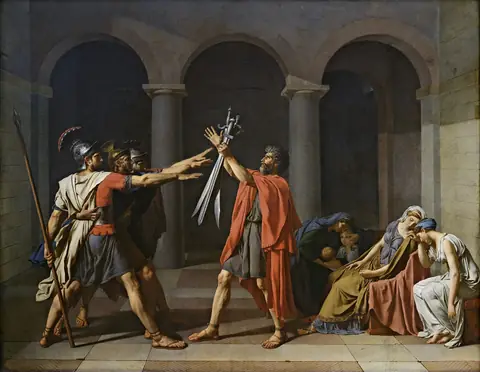
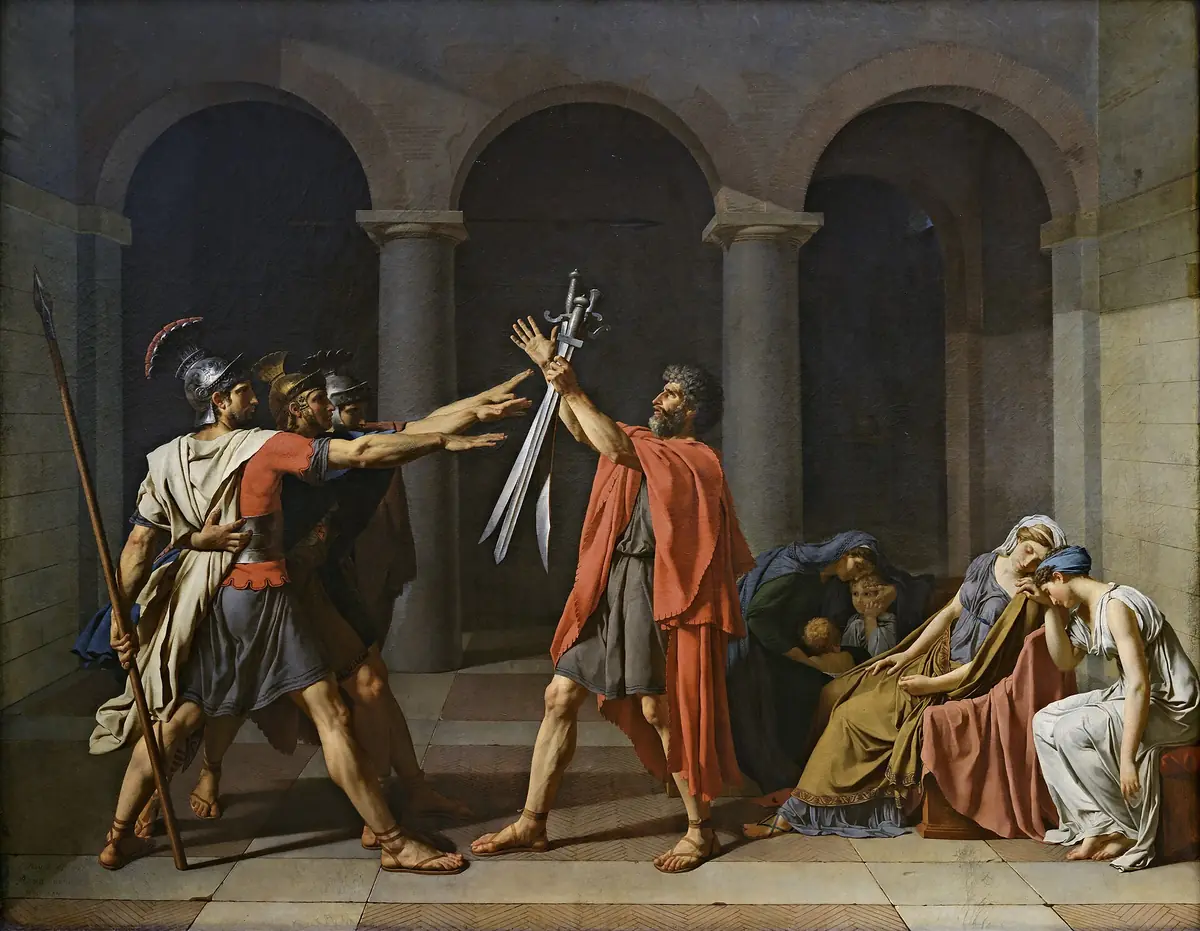
Image: Wikimedia Commons · Public domain (PD-Art) The Oath of the Horatii
Look closely. Three brothers reach toward the swords held out by their father, their bodies a tight row of sworn arms, while the women of the family sink in grief at the right, under a severe arcade. Look at the contrast between the rigid, masculine oath and the curved, grieving group, at the bare stone floor, and at how a Roman legend is staged as a public lesson about duty.
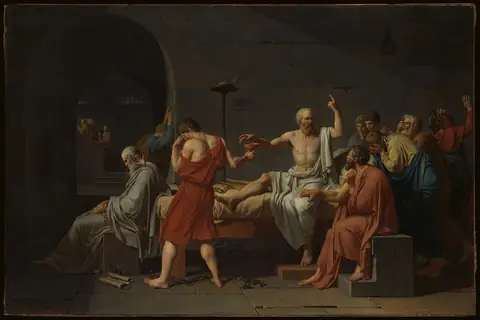
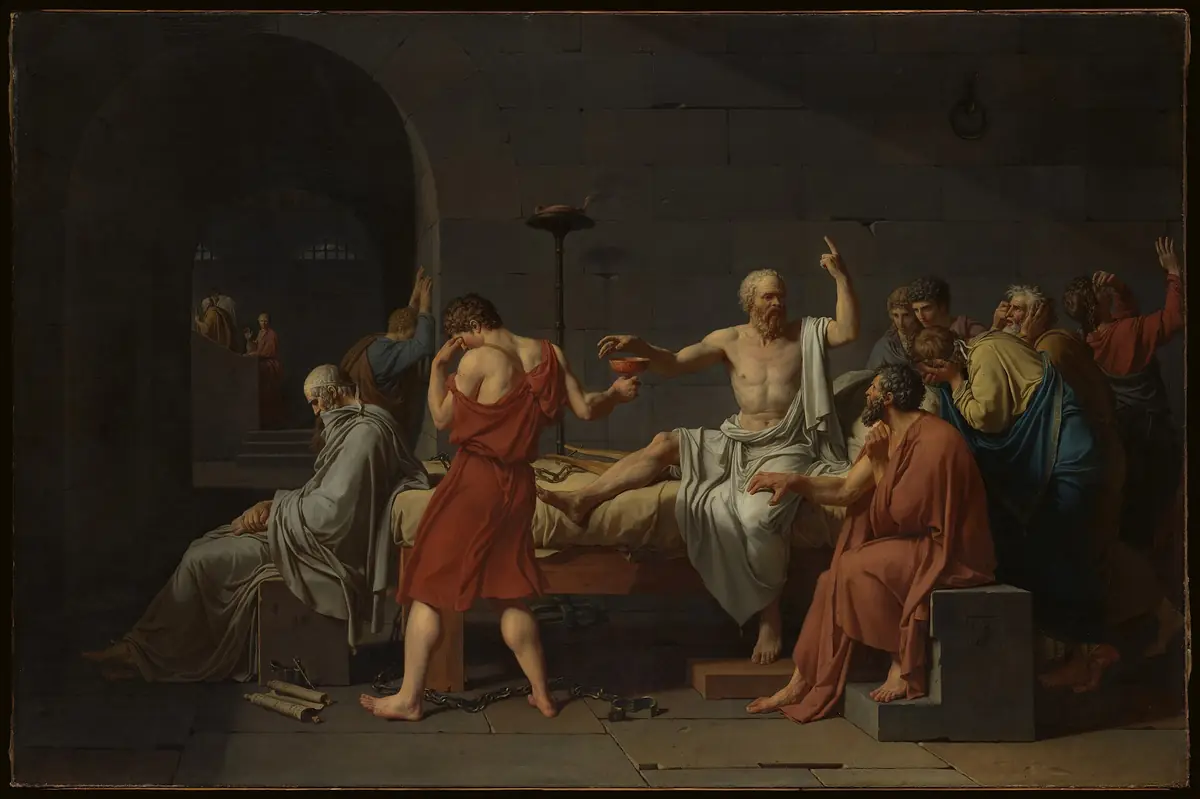
Image: Wikimedia Commons · CC0 (public domain) The Death of Socrates
Look closely. Socrates, already bare-chested, sits on a prison bed and reaches for the cup of hemlock while still teaching, one finger raised; his disciples break down around him in a bare, classical room. Look at the calm of the philosopher against the grief of the others, at the chains on the floor, and at how a dying argument is made as clear as a geometric proof.
In the library: Socrates · Plato · The Last Days of Socrates
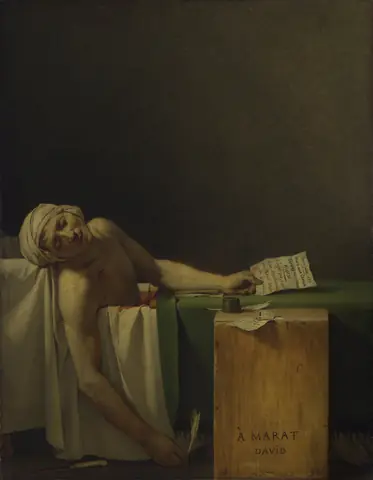
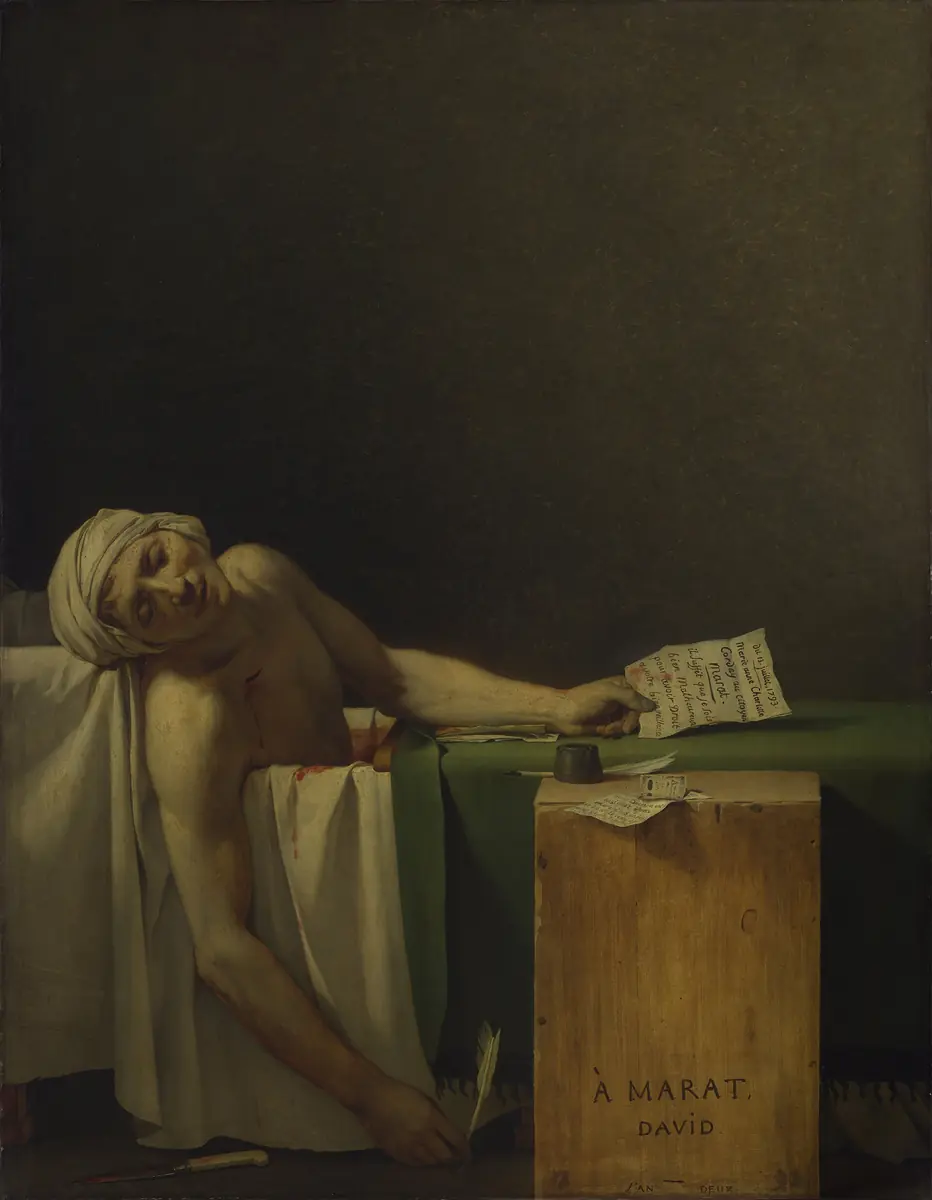
Image: Wikimedia Commons · Public domain (PD-Art) The Death of Marat
Look closely. The murdered journalist-deputy lies in his bath, a wound in the chest, a note still in one hand and a quill falling from the other, a wooden box beside him inscribed as a kind of tomb. Look at the bare, almost sacred emptiness of the upper half, at the slant of the arm, and at how a political killing is given the stillness of a lamentation. Teachers of younger children may wish to look first.
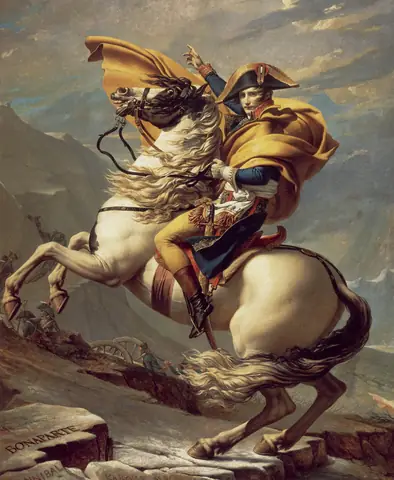
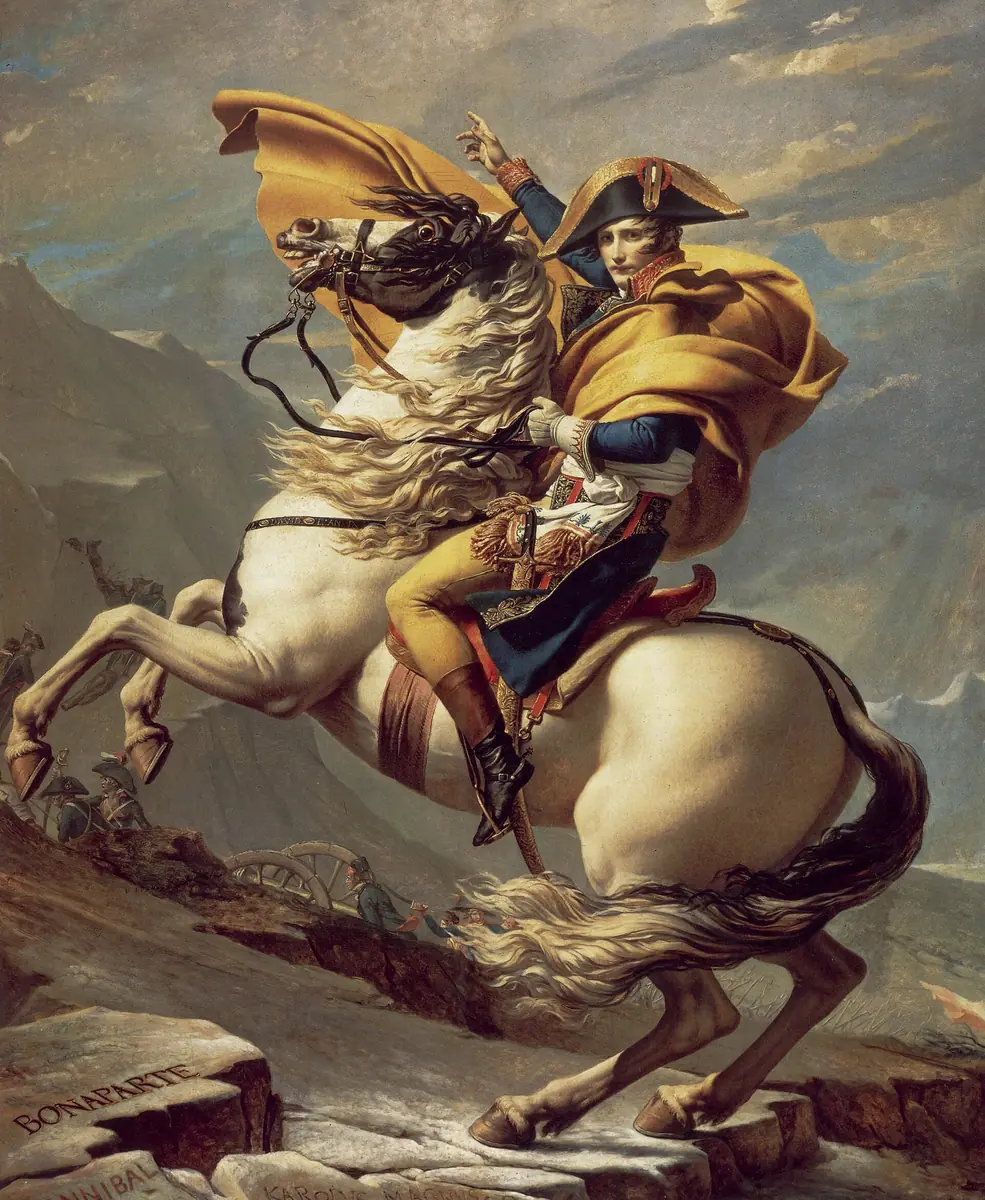
Image: Wikimedia Commons · Public domain (PD-Art) Napoleon Crossing the Alps
Look closely. Bonaparte turns on a rearing horse on a mountain path, a cloak blown back, the names of Hannibal and Charlemagne cut into the rocks below. Look at the impossible, almost sculptural calm of the rider, at the wind in the cloak, and at how a difficult alpine crossing is turned into an emblem of command. (This is the Malmaison version, the first of several.)
In the library: Napoleon
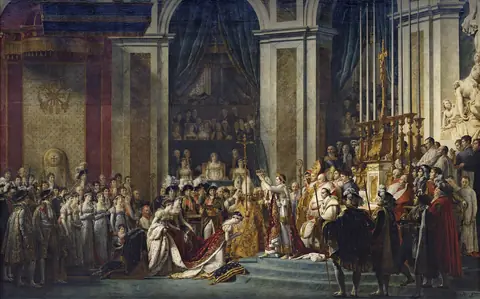
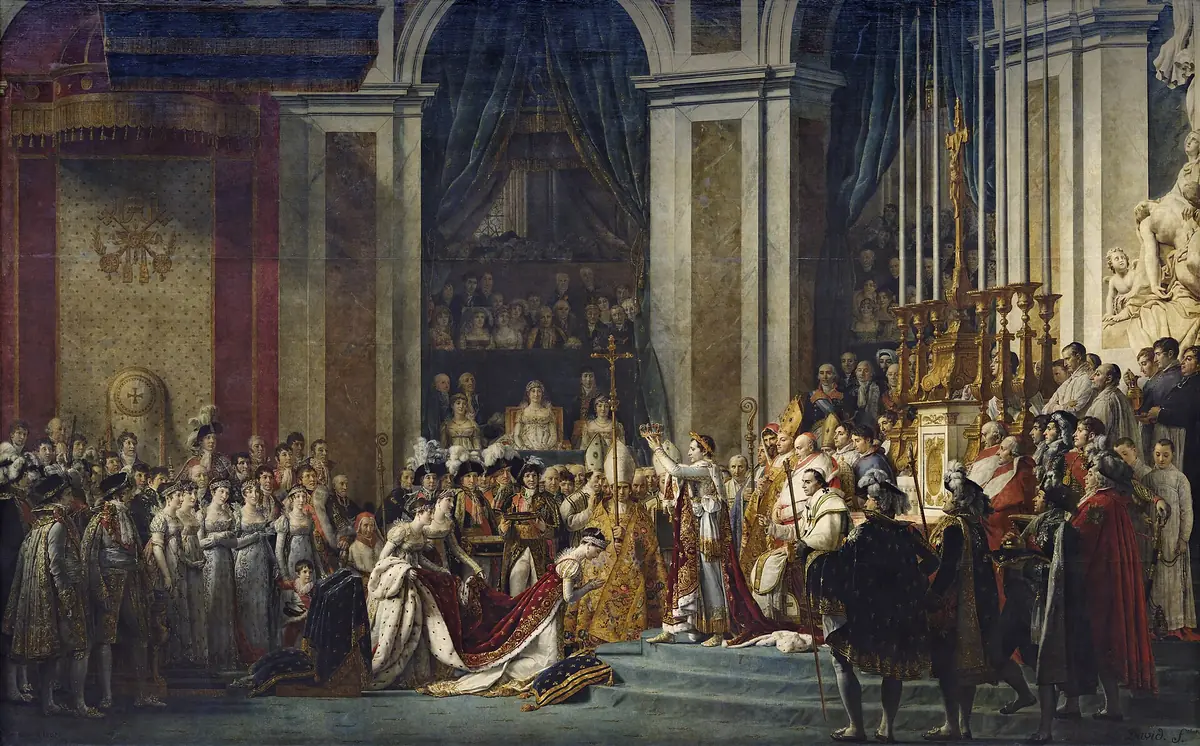
Image: Wikimedia Commons · Public domain (PD-Art) The Coronation of Napoleon
Look closely. In Notre-Dame, Napoleon, already crowned, lifts a crown toward Josephine, who kneels; the pope sits behind, and a great theatre of court, clergy and family fills the nave. Look at the central gesture, at the flood of white and gold, and at how a huge ceremonial machine is organised so that one act — a coronation performed by the emperor himself — can be read at a glance.
In the library: Napoleon
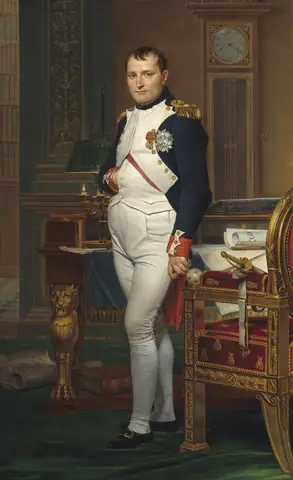
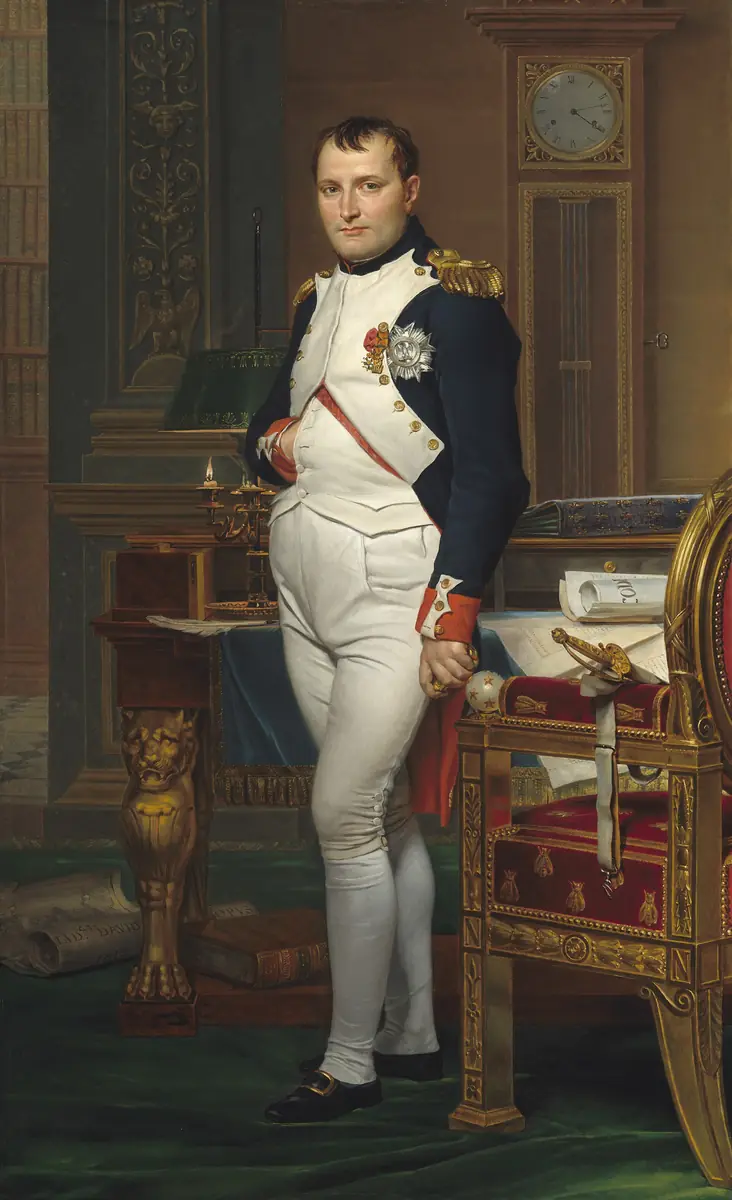
Image: Wikimedia Commons · Public domain (PD-Art) The Emperor Napoleon in His Study at the Tuileries
Look closely. Napoleon stands in his study at dawn, a hand in his waistcoat, the candles burned down, papers on the desk, a clock showing a little after four. Look at the tired but still upright face, at the codes and the maps, and at a portrait of power presented as sleepless work rather than as a battle.
In the library: Napoleon
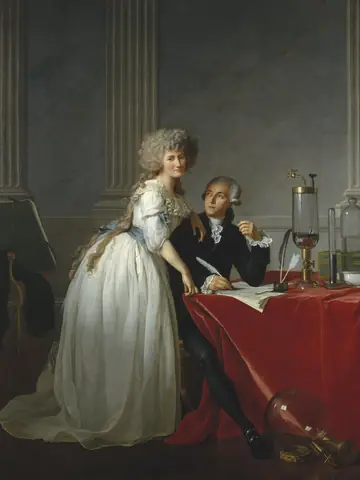
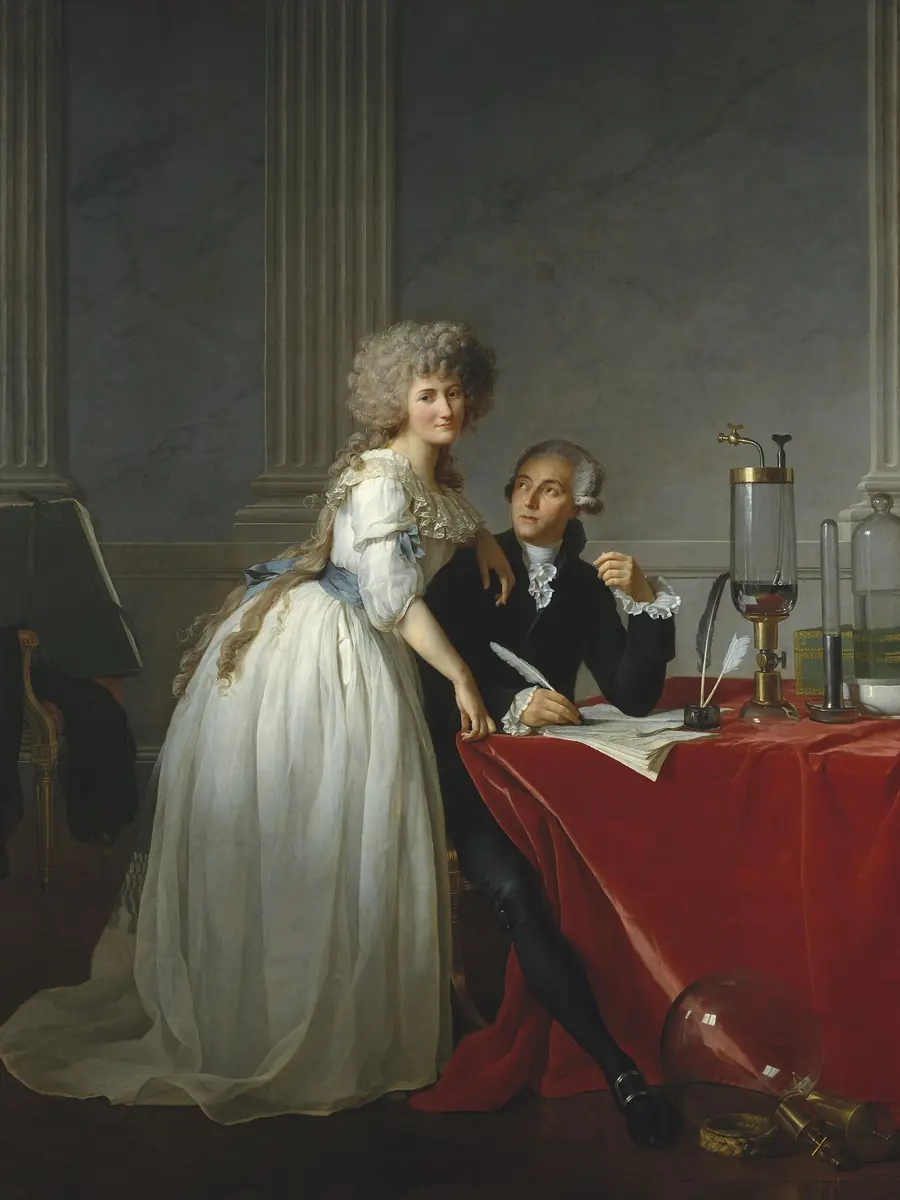
Image: Wikimedia Commons · Public domain (PD-Art) Portrait of Antoine-Laurent Lavoisier and his Wife
Look closely. The chemist sits at a table of instruments, a pen in his hand, while his wife, who worked with him and illustrated his books, stands beside him, her arm on his shoulder, a portfolio in her hand. Look at the gleam of the glass apparatus, at the red table, and at the partnership the portrait insists on: a marriage of science, not only of rank.
In the library: Antoine Lavoisier · Elements of Chemistry


What to watch for in Jacques-Louis David
Look slowly- A shallow stage and a hard light. Figures often stand on a stone floor, with arches or a bare wall behind.
- Gesture as speech. Pointing hands, sworn arms, and a dropped quill do the talking.
- The antique used as a lesson. Rome and Athens are brought in to teach a modern public.
- An unflattered hero. Even Napoleon can be still, tired, or carefully staged rather than simply glorious.
- Drawing underneath the paint. Edges are firm; look for the line that holds the drama together.
For older students
These famous works include nudity, so they are named here but not shown. Teachers and parents can decide when to look at them together.
- The Intervention of the Sabine Women, 1799, Louvre, Paris. A large classical scene with struggling, partly unclothed figures. Named here but not shown.
Dates and collections follow the holding museums and Wikidata. Images of paintings are photographs of public-domain pictures from Wikimedia Commons or museum open-access releases; photographs of sculpture are used only when the photograph itself is Public domain, CC0, or CC BY with a named credit. Each picture links to its source page with full licence details.