Work record
Tabby's Tablecloth
Louisa May AlcottTabby's Tablecloth by Louisa May Alcott (1884)On 20 March 1775, fourteen-year-old Tabitha Tarbell carries eggs along a Concord road with a secret message beneath them.1884 · 19th Century · Short Stories · English
Read this when a treasured family cloth can become both a brave girl's reward and a bandage.
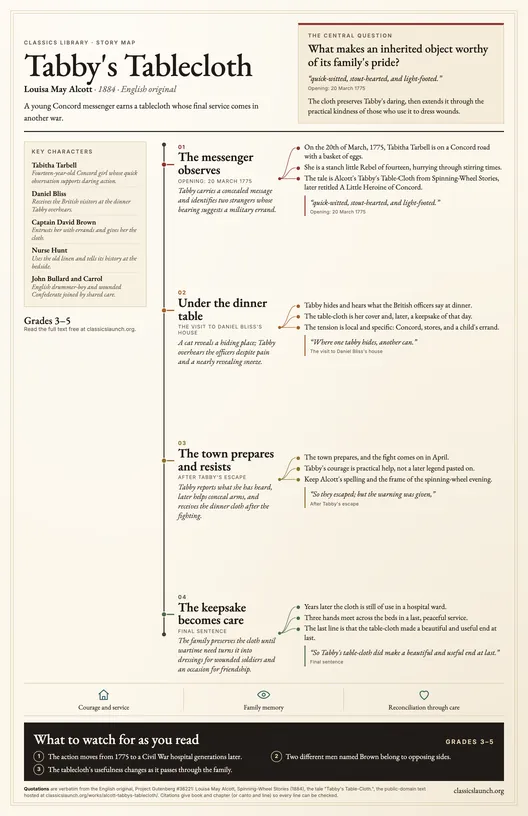 Story mapSee the story mapThe whole book on one page: the story in movements, the characters, and what to watch for. Free to print.
Abstract
Background. Alcott included this tale in Spinning-Wheel Stories in 1884; it was later reprinted under another title, A Little Heroine of Concord. The narrative draws on the Revolutionary setting of her hometown and carries a household object forward into Civil War nursing. The hosted selection contains the whole linked account.
Content. An adventurous messenger follows suspected officers to a Loyalist dinner and conceals herself beneath the table. Her report contributes to local preparations, and further quick thinking helps protect hidden arms. Awarded the cloth that sheltered her, she preserves it through family occasions. Its descendants eventually turn the worn linen into hospital supplies.
Themes. The story brings youthful daring and mature charity into a single line of inheritance. Memory survives through an object, but the object's highest service arrives when it is divided and used. The later patients also give the old adventure a new audience, allowing shared admiration to become the beginning of friendship.
Significance. A suspenseful sequence of hiding, near discovery, and escape gives younger readers access to a historical setting. The quieter hospital ending then asks them to reconsider what makes an heirloom valuable. Alcott's experience of nursing helps explain the attention to dressings and bedside conversation, while the tale itself makes practical tenderness an extension of courage across several generations.
Main characters
- Tabitha Tarbell: Fourteen-year-old Concord girl whose quick observation supports daring action.
- Daniel Bliss: Receives the British visitors at the dinner Tabby overhears.
- Captain David Brown: Entrusts her with errands and gives her the cloth.
- Nurse Hunt: Uses the old linen and tells its history at the bedside.
- John Bullard and Carrol: English drummer-boy and wounded Confederate joined by shared care.
Summary
On 20 March 1775, fourteen-year-old Tabitha Tarbell carries eggs along a Concord road with a secret message beneath them. The town is gathering military supplies and watching for information that might reach British officers. Tabby, proud of earlier errands, wants a larger part in the danger around her. When two strangers ask the way to a known Loyalist's house, her sharp observation identifies them as soldiers. After delivering her message, she returns in a different cloak with eggs for the household of Daniel Bliss. Refused a chance to linger in the kitchen, she notices the family cat slipping from beneath a long tablecloth. The hiding place gives her an idea. She climbs through a window and conceals herself under the dinner table, where she overhears the visitors discussing stores and routes. A boot painfully crushes her hand, and a sneeze almost exposes her. The cat's timely emergence supplies an innocent explanation, allowing her to remain hidden until she can escape. Her report helps the town prepare. When the soldiers come in April, Tabby recognizes one officer and douses him with water. She then takes part in another stratagem at her aunt's house, pretending to be sick while weapons lie concealed in the bed. The soldiers withdraw, fearing smallpox. The narrative moves through the fighting at the North Bridge and afterward gives Tabby a tangible reward: the cloth under which she hid, bought from confiscated property. That reward becomes a family heirloom, used for weddings, christenings, and holiday meals. Generations later, during the Civil War, its worn fabric is cut into lint and dressings. Nurse Hunt uses it while caring for an English drummer-boy and a wounded Confederate. She tells Tabby's story as she works, and the cloth now brings relief to men on different sides of inherited quarrels. The final handshake gives the earlier adventure a second conclusion. A keepsake of resistance has become an instrument of healing, and the family's pride finds its fullest expression in useful generosity.
Virtues in this work
- Fortitude: Tabby keeps silent despite pain while she is hidden beneath the table.
- Charity: The old cloth finally supplies comfort to wounded men across the lines of battle.
- Friendship: The closing handshake makes mutual goodwill a concrete answer to shared suffering.
Plot or Argument
- The messenger observes
Tabby carries a concealed message and identifies two strangers whose bearing suggests a military errand.
- Under the dinner table
A cat reveals a hiding place; Tabby overhears the officers despite pain and a nearly revealing sneeze.
- The town prepares and resists
Tabby reports what she has heard, later helps conceal arms, and receives the dinner cloth after the fighting.
- The keepsake becomes care
The family preserves the cloth until wartime need turns it into dressings for wounded soldiers and an occasion for friendship.
Characters
- Tabitha Tarbell, Young messenger
Fourteen-year-old Concord girl whose quick observation supports daring action.
- Daniel Bliss, Loyalist host
Receives the British visitors at the dinner Tabby overhears.
- Captain David Brown, Tabby's uncle
Entrusts her with errands and gives her the cloth.
- Nurse Hunt, Wartime caregiver
Uses the old linen and tells its history at the bedside.
- John Bullard and Carrol, Hospital patients
English drummer-boy and wounded Confederate joined by shared care.
Lessons
Courage needs attention
Tabby's success depends on noticing clothing, movement, and a hiding place. Her eagerness becomes useful when joined to careful observation.
- What makes her suspect the strangers?
- How does the cat help twice?
An object can carry a history
The cloth passes through family celebrations before reaching a hospital. Each use adds a different kind of value to the same fabric.
- Why does the family keep it?
- What changes when it is cut apart?
Service can enlarge loyalty
The nurse honors the young messenger while caring for a former enemy. The last encounter makes kindness an active form of courage.
- How does the patient answer the nurse's care?
- Why does a handshake complete the story?
Context
Alcott sets the first action around Concord's preparations before the fighting of April 1775, then follows descendants into the Civil War. The account is historical fiction, with dramatic dialogue and a family relic linking its periods.
Composition
The hosted tale is Tabby's Table-Cloth from Spinning-Wheel Stories (1884), later reprinted as A Little Heroine of Concord.
Reception
The story suits reading beside Alcott's other accounts of purposeful girls and wartime service; its complete ending reaches beyond the Revolutionary adventure into hospital care.
Comparisons
- Paul Revere's Ride
Both center on warning and preparation in Massachusetts, while Alcott follows a household object into a later war.
- Little Women
Compare Tabby's spirited wish for distinction with Alcott's interest in turning youthful energy toward useful service.
Quotes
“quick-witted, stout-hearted, and light-footed.”
“Where one tabby hides, another can.”
“So they escaped; but the warning was given,”
“So Tabby's table-cloth did make a beautiful and useful end at last.”
For Students
A reading companion for classical Christian high school students. See the student guide.
Reading Guide
Watch for
- The action moves from 1775 to a Civil War hospital generations later.
- Two different men named Brown belong to opposing sides.
- The tablecloth's usefulness changes as it passes through the family.
Key terms and names
- Loyalist
- A supporter of the British Crown during the American Revolution.
- damask
- A patterned woven fabric used for fine household linen.
- lint
- Soft fibers prepared from cloth for use in dressing wounds.
- heirloom
- An object kept and passed down within a family.
Seminar Questions
- Comprehension How does Tabby first recognize the strangers as soldiers?
- Comprehension How does the cloth reach the hospital?
- Interpretation Why does Alcott give the cat such an important role?
- Interpretation What does the final use add to the cloth's earlier history?
- Big Question When can giving away a keepsake honor its history?
- Big Question Can service to an enemy continue a family's tradition of courage?
Faith Connections
- Luke 10:33–37 (Scripture)
The Samaritan's practical care for wounds gives a strong companion to the nurse's treatment of a former enemy.
- Isaiah 2:4 (Scripture)
The image of instruments given a new peaceful use offers a comparison for the transformation of a wartime relic into supplies for healing.
Logic and Rhetoric
Central argument: A family's courage is preserved most fully when its cherished relic becomes useful care for living people.
Rhetorical device: symbolic object. The same cloth shelters a listener, decorates family ceremonies, and finally becomes material for wound dressings.
Debate: Resolved: cutting up the tablecloth fulfills its history better than preserving it unused.
Memory Work
So Tabby's table-cloth did make a beautiful and useful end at last.
Writing Prompts
Essay: Trace the tablecloth's changing purposes and explain why the hospital scene completes the earlier adventure.
Comparison with Paul Revere's Ride: Compare the work of carrying a warning in Alcott's story and Paul Revere's Ride, including the role of local cooperation.
Medical Lens
The final section explicitly describes linen dressings, an amputated arm, and care for a chest wound. Earlier, a pretended smallpox illness protects concealed arms.
- Civil War hospital ending
Nurse Hunt turns the heirloom into lint and compresses while using storytelling to comfort wounded patients.
Creative Prompts
- Fiction
Write the history of an ordinary family object through three uses, ending with an unexpected gift.
- Dialogue
Imagine Tabby telling the cat what happened after she escaped from beneath the dinner table.
- Classroom
Build a timeline with separate tracks for Tabby's life, the cloth's uses, and the hospital ending.
Further Reading
- Spinning-Wheel Stories, Louisa May Alcott
- Hospital Sketches, Louisa May Alcott
Verification notes
The complete hosted tale from Project Gutenberg #36221 supplies all quotations and the two-period structure. Tabby's exploits are summarized as Alcott's story, without treating every conversation or stratagem as independently documented history.
No verification flags recorded.