Work record
Beau Geste
P. C. WrenP. C. Wren; PC Wren; P.C. Wren; P C Wren; PCWren; Percival Christopher Wren; Beau Geste; Beau Geste (Wren); The Geste brothers; Fort ZinderneufBeau Geste by P. C. Wren (1924)Beau Geste opens in French West Africa, where Major Henri de Beaujolais of the Spahis tells his English friend George Lawrence a strange tale.Also known as: Beau Geste · Beau Geste (Wren) · The Geste brothers · Fort Zinderneuf
1924 · Early 20th Century · Novel · English
Read this when you want a desert siege that turns on a brother’s secret sacrifice.
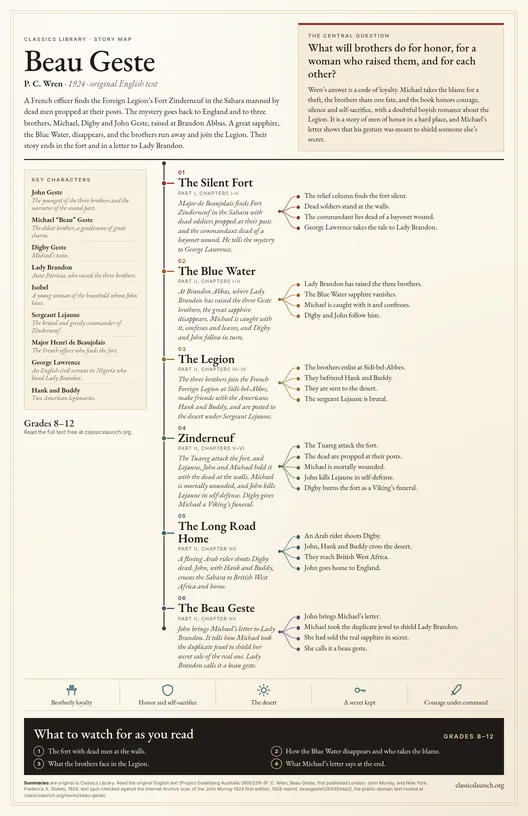 Story mapSee the story mapThe whole book on one page: the story in movements, the characters, and what to watch for. Free to print.
Abstract
The silent fort. Major de Beaujolais finds Fort Zinderneuf in the Sahara manned by dead soldiers propped at their posts, and its commandant dead with a bayonet in his heart. The mystery goes to George Lawrence and Lady Brandon, and the story is taken up by John Geste.
The brothers. The three Geste brothers grow up at Brandon Abbas. The Blue Water sapphire is taken, Michael confesses and vanishes, and Digby and John follow him into the French Foreign Legion. They are sent to Fort Zinderneuf under the brutal Lejaune.
The beau geste. At Zinderneuf Michael dies of his wounds, and John, who has shot the brutal Lejaune to save himself, is left alone with the dead. Digby comes, gives Michael a Viking’s funeral by burning the fort, and is shot dead by a fleeing Arab rider. John crosses the desert with his American friends and gets home, bearing his brother’s last letter and packet. Michael’s letter shows that he took a duplicate to shield his aunt’s secret sale of the real stone. Lady Brandon calls it a beau geste, and John is to marry Isobel. It is a tale of a silent sacrifice told in two voices, and of the way a brother’s love can be known only when the whole story is told.
Main characters
- John Geste: narrator and youngest brother
- Michael Geste: the elder brother called Beau
- Digby Geste: the twin who follows
- Lady Brandon: their guardian
Summary
Beau Geste opens in French West Africa, where Major Henri de Beaujolais of the Spahis tells his English friend George Lawrence a strange tale. Riding to relieve Fort Zinderneuf, a Legion post in the Sahara which a messenger reported under attack by thousands of Tuareg, the Major finds the fort flying the tricolor and its walls manned by silent soldiers. They are all dead, propped up at their posts. Inside lies the commandant, killed by a bayonet in the heart, with a revolver in his hand and a crushed letter, and the fort is empty of the living. Lawrence takes the Major’s mystery to Lady Brandon of Brandon Abbas, whom he once loved, and the story passes to John Geste, one of three brothers whom she adopted. John tells how the Gestes, Michael, called Beau, Digby and himself, grew up at Brandon Abbas with their cousin Isobel and played at being Vikings and soldiers. The great sapphire, the Blue Water, vanishes from the house one night. Michael, who has been seen with it, leaves a confession and vanishes, and Digby and then John, thinking he has shamed the family, run away in turn. All three join the French Foreign Legion, meet at Sidi-bel-Abbes, and are sent to Fort Zinderneuf under a sadistic sergeant, Lejaune, who drives the garrison towards mutiny. When the fort is attacked by Tuareg, Lejaune, John and Michael hold it by propping the dead at the walls. Michael is mortally wounded, and John kills Lejaune in self-defense. Digby, who comes to the fort, gives his twin a Viking’s funeral by burning it, and is shot dead by a fleeing Arab rider soon after. John, with his American friends Hank and Buddy, makes a long and terrible journey to Nigeria and then home. At Brandon Abbas he gives Lady Brandon Michael’s letter. It reveals that she had secretly sold the real sapphire to a maharajah to save the estate and its tenants, that Michael overheard it and took the duplicate so that he would be thought a thief and her secret kept. She calls it a beau geste. John is to marry Isobel. The book is a vigorous desert romance with a deep heart, and gives teachers a good case of loyalty carried to the edge of sacrifice.
Virtues in this work
- Honor: Michael takes disgrace upon himself to protect the aunt who raised him.
- Friendship: The brothers and their American friends stand by one another to the end.
- Fortitude: John crosses the desert to carry out his brother’s last wish.
- Humility: Michael wants no credit for what he has done.
Plot or Argument
- The silent fort
Major de Beaujolais finds Fort Zinderneuf in the Sahara manned by dead soldiers propped at their posts, with the commandant dead of a bayonet wound. He tells the mystery to George Lawrence, who takes it to Lady Brandon.
- The Blue Water
At Brandon Abbas, where Lady Brandon has raised the three Geste brothers, the great sapphire disappears. Michael is caught with it, confesses and leaves, and Digby and John follow in turn.
- The Legion
The three brothers join the French Foreign Legion at Sidi-bel-Abbes, make friends with the Americans Hank and Buddy, and are posted to the desert, to the fort under the sergeant Lejaune.
- Zinderneuf
The Tuareg attack the fort, and Lejaune, John and Michael hold it with the dead at the walls. Michael is mortally wounded, and John kills the brutal Lejaune in self-defense. Digby comes to the fort and gives Michael a Viking’s funeral by burning it.
- The long road home
A fleeing Arab rider shoots Digby dead. John, with Hank and Buddy, crosses the Sahara to British West Africa and home.
- The beau geste
John brings Michael’s letter to Lady Brandon. It tells how Michael took the duplicate jewel to shield her secret sale of the real one. Lady Brandon calls it a beau geste.
Characters
- John Geste, youngest of the three brothers and the narrator of the second part
The youngest of the three brothers and the narrator of the second part.
- Michael “Beau” Geste, eldest brother
The eldest brother, who takes the jewel and dies at Zinderneuf.
- Digby Geste, Michael’s twin
Michael’s twin, a cheerful joker who follows his brothers into the Legion.
- Lady Brandon, Aunt Patricia
Aunt Patricia, who raised the brothers and had secretly sold the real Blue Water.
- Isobel, young woman of the household
A young woman of the household whom John loves.
- Sergeant Lejaune, brutal and greedy commander of Zinderneuf
The brutal and greedy commander of Zinderneuf.
- Major Henri de Beaujolais, french officer of the Spahis
A French officer of the Spahis who finds the silent fort.
- George Lawrence, english civil servant in Nigeria
An English civil servant in Nigeria who loved Lady Brandon.
- Hank and Buddy, Two American soldiers of fortune
Two American soldiers of fortune who befriend John.
Lessons
A brother’s secret sacrifice
Michael takes the blame for a theft that was no theft, to shield the aunt who raised him. He never explains himself, and his brothers think the worst of him. The book is a study of a sacrifice made silently, and Michael’s act gives the title its meaning.
- What does Michael do with the Blue Water, and why?
- Why does he keep silent even with his brothers?
- What does Lady Brandon mean by calling it a beau geste?
Brutality and command
Lejaune is a petty tyrant who drives his men to the edge of mutiny and who robs the dead. The Legion chapters show what absolute power does to a small and cruel man, and how loyalty and courage appear in the men under him.
- How does Lejaune treat his men?
- What does he do when the fort is attacked?
- What qualities make the Gestes different from him?
Brothers and loyalty
The Geste brothers are very close and each follows another into exile. The book asks what loyalty requires, and whether the brothers’ habit of flight was brave or foolish.
- Why do Digby and John follow Michael into the Legion?
- What do they give up?
- Is their loyalty a virtue or a mistake?
The desert and the empire
The book is full of the casual views of 1924 about Arabs, Tuareg and Africans. Teachers can use it to discuss how adventure stories of the age drew the people of the Sahara, and what a modern reader ought to notice and question.
- How does the book describe the Tuareg and the Arabs?
- Where does the book show respect for people who are not French or English?
- What did readers of 1924 expect of such an adventure?
Context
Beau Geste was published in 1924 by John Murray, and was an immediate success. It was written when the French Foreign Legion, founded in 1831 and based at Sidi-bel-Abbes in Algeria, had come to stand in the British imagination for adventure and hardship in the Sahara, and when memories of the First World War made tales of brotherhood and sacrifice popular.
Composition
Wren, a schoolmaster and a soldier in India, put into the book his love of the desert and of the code of the English public school, and the three Gestes are in many ways schoolboys at heart. His claim to have served in the Foreign Legion is doubted, and his picture of the Legion is a romance, not a record.
Reception
The novel inspired two sequels and many films, among them the 1926 silent film and the 1939 version with Gary Cooper, and gave the English language the phrase beau geste for a noble and gracious gesture.
Comparisons
- King Solomon's Mines
Another African adventure in which Englishmen face a hard land, with a similar tone toward the peoples of the region.
- Kim
Kipling’s novel of boyhood, loyalty and empire, with a much deeper regard for the people of the country.
- Lord Jim
Conrad’s study of a young man’s honor and the long effort to redeem a failure.
- The Thirty-Nine Steps
A fast adventure of an Englishman under pressure, with a similar love of the chase.
- The Red Badge of Courage
Crane’s study of a young soldier’s fear and courage in battle.
- The Prisoner of Zenda
Another romance of honor, silence and a sacrifice made for another.
- Captain Blood: His Odyssey
Another tale of a man who bears a shame he did not earn, and of sea and desert adventure.
Quotes
Frequently cited
“Greater love hath no man than this, That a man lay down his life for his friends.”
Frequently cited
“I shall have failed to shield you from trouble and annoyance.”
Frequently cited
“A beau geste, indeed”
“The place was silent and aware.”
For Students
A reading companion for classical Christian high school students. See the student guide.
Reading Guide
Watch for
- How the silent fort of Part I is explained in Part II.
- How Wren makes Lejaune a villain, and what the men do to resist him.
- What Michael’s letter reveals about his character.
- How the book speaks of Arabs and Tuareg, and where it tries to be fair.
Key terms and names
- Beau geste
- A fine or gracious deed; the title is the French phrase.
- Foreign Legion
- The French army corps of foreign volunteers, based in Algeria.
- Cafard
- The Legion’s name for the despair and madness of the desert.
- Tuareg
- A nomadic people of the Sahara, spelled Touareg in the book.
- Spahis
- French cavalry regiments raised in North Africa.
- Viking’s funeral
- The burning of a dead chieftain on a pyre in a ship.
Seminar Questions
- Comprehension What is the mystery of Fort Zinderneuf in the first part?
- Comprehension What does Aunt Patricia do with the Blue Water, and what does Michael do?
- Interpretation Why does Wren tell the story in two parts?
- Interpretation How does Lejaune show the abuse of power?
- Big Question Is it right to take blame on yourself to shield another?
- Big Question What does loyalty to a brother require, and what are its limits?
Faith Connections
- John 15:13 (Scripture)
Greater love has no one than this, that one lay down his life for his friends. The book prints this verse as an epigraph, and teachers may ask which characters keep it and how.
- Matthew 6:3–4 (Scripture)
Do not let your left hand know what your right hand is doing, so that your giving may be in secret. Michael’s secret sacrifice may be read in this light, with care to distinguish it from a deception.
- Cicero, On Duties III (Great Conversation)
Cicero asks when the honorable and the useful may seem to conflict, and says they never truly do. It gives a frame for the question whether Michael’s plan was honorable.
Logic and Rhetoric
Central argument: A deed done in silence to protect another may be a high kind of honor, and may also bring pain to those who do not know the reason.
Rhetorical device: dramatic irony. The reader of Part I sees a silent fort and a dead commandant before the reader of Part II knows why.
Debate: Resolved: That Michael was right to keep his secret even from his brothers.
Memory Work
Greater love hath no man than this, That a man lay down his life for his friends.
A beau geste, indeed
Writing Prompts
Essay: How does the structure of Beau Geste, with its two parts and its letter at the end, change the meaning of the sacrifice? Answer with three scenes.
Comparison with Lord Jim: Compare Michael Geste’s silent sacrifice with Lord Jim’s long effort to redeem a failure, and say which book gives a better picture of honor.
Medical Lens
The book names the cafard, the desert madness of isolated garrisons, and shows war wounds, thirst and fever, and the strain of life in the Legion. It is told as adventure, and the medical detail is slight.
- Part I, Chapter I: Of the Strange Events at Zinderneuf
The Major describes the cafard that attacks European soldiers in remote posts.
- Part II, Chapter VII: Ishmaelites
The long desert journey with thirst, fever and hunger.
Creative Prompts
- Essay
Explain how Michael’s letter changes what the reader thinks of everything that has gone before.
- Dialogue
Write a conversation between John and Digby on the night they decide to follow Michael into the Legion.
- Fiction
Write the scene at Brandon Abbas in which Aunt Patricia decides to sell the Blue Water.
- Classroom
Map the journey from Brandon Abbas to Sidi-bel-Abbes, Zinderneuf and Kano, and mark the chief events at each.
Further Reading
- Lord Jim, Joseph Conrad
A novel of honor and a young man’s failure, in this library.
- Kim, Rudyard Kipling
A novel of loyalty and empire, in this library.
- The Red Badge of Courage, Stephen Crane
A study of a young soldier’s courage, in this library.
Verification notes
The text is the whole novel as first published, in two parts and nine chapters, taken from Project Gutenberg Australia’s edition and spot-checked against an Internet Archive scan of the 1924 John Murray printing. The plot was read against the key chapters. Some details of the desert chapters have not been read word for word.
- The text comes from Project Gutenberg Australia and was spot-checked, not compared line by line, with a scan of the 1924 John Murray edition.
- The film dates, 1926 and 1939, should be checked in a film reference before they are given in class.
- Wren’s biography, including his teaching in India and his claim of service in the French Foreign Legion, follows standard references and should be checked in a biography.