Work record
The Pied Piper of Hamelin
Robert BrowningThe Pied Piper of Hamelin by Robert Browning (1842)The Pied Piper of Hamelin is a narrative poem of fifteen sections by Robert Browning, first printed in 1842 in Bells and Pomegranates, No. III (Dramatic Lyrics).1842 · 19th Century · Poetry · English
Read this when a promise has been broken, or you want a rollicking tale that ends in loss.
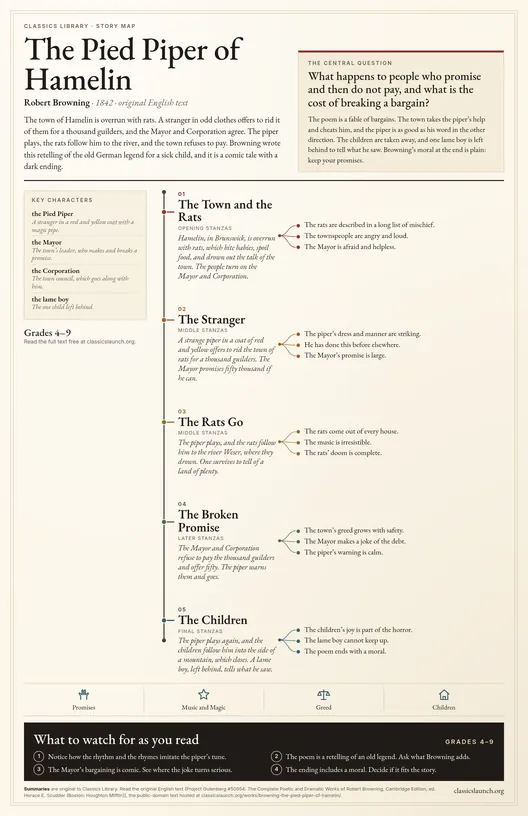 Story mapSee the story mapThe whole book on one page: the story in movements, the characters, and what to watch for. Free to print.
Abstract
Background. Browning wrote the poem in 1842 for the small son of the actor William Macready, his friend, and printed it in Bells and Pomegranates, No. III. It retells the old German legend of the rat-catcher of Hamelin, and it carries a plain moral for the boy.
Content. Rats overrun the town of Hamelin, and the Mayor promises a thousand guilders to a stranger in a coat half yellow and half red who can rid the town of them. The Piper's music draws the rats into the Weser, but the Mayor refuses to pay. The Piper then pipes the town's children into the side of Koppelberg Hill, leaving only a lame boy behind, and the poem ends with the moral that promises must be kept.
Form. A comic narrative poem of fifteen sections, built of irregular lines and bold rhymes, with sound effects that imitate the rats and the children. It is full of lively lists, jokes and surprising rhymes, and ends with a short address to the boy.
Themes. Keeping promises, greed in leaders, the loss of children, magic and justice, and the power of music and words.
Significance. It is one of the best-known poems for children in English, and an excellent example of how verse can combine comedy with a serious moral.
Summary
The Pied Piper of Hamelin is a narrative poem of fifteen sections by Robert Browning, first printed in 1842 in Bells and Pomegranates, No. III (Dramatic Lyrics). The poet wrote it for the young son of his friend, the actor William Macready, and the poem ends with a playful address to Willy. It retells an old German legend. The town of Hamelin, in Brunswick on the river Weser, is overrun by rats that fight the dogs, kill the cats, bite babies in their cradles and drown out the women's talk with their squeaking. The people march to the Town Hall and tell the Mayor and Corporation to find a remedy or be sent packing. As the Mayor wishes aloud for a trap, a tall thin stranger in a coat half yellow and half red comes in and offers to draw all creatures that creep or swim or fly or run for a thousand guilders. The Mayor and Corporation cry that they would give fifty thousand. The Piper plays, and the rats pour out of the houses and follow him into the Weser, where they drown. Only one survives, to tell the story. But the Mayor, relieved of the rats, refuses to pay, laughs that what is dead can't come to life, and offers fifty guilders for a drink. The Piper warns that those who put him in a passion may find him pipe after another fashion. He plays again, and the children of Hamelin dance out of the houses and follow him to Koppelberg Hill, where a door in the mountain opens and closes behind them. Only one lame boy is left behind, and he mourns the joyous land he was promised. The Mayor sends messengers east and west to offer the Piper any riches if he will return the way he went, but it is too late. The town records the date of the loss, and the poem ends with a moral for Willy: if we have promised, let us keep our promise. The poem is a lesson in keeping one's word, and Christians may see in it a warning about the cost of breaking a bargain and about the love of money.
Virtues in this work
Plot or Argument
- Section I: Hamelin Town
Hamelin Town, on the river Weser in Brunswick, suffers from vermin almost five hundred years before the poet's day.
- Section II: Rats!
The rats fight the dogs, kill the cats, bite babies in their cradles and drown out all speech.
- Sections III-IV: the Mayor in council
The people threaten the Mayor and Corporation, who sit an hour in council; the Mayor cries for a trap, and a gentle tap comes at the door.
- Sections V-VI: the Piper's offer
A tall thin figure in a coat half yellow and half red offers to rid the town of rats for a thousand guilders, and the Mayor promises fifty thousand.
- Section VII: the rats are drowned
The Piper's pipe draws all the rats into the Weser, and one survivor tells what he heard.
- Sections VIII-XI: the broken promise
The Mayor refuses the thousand guilders and offers fifty; the Piper warns that he may pipe after another fashion.
- Sections XII-XIII: the children are taken
The Piper pipes again, the children follow him to Koppelberg Hill, and a door in the mountain closes behind them, leaving one lame child.
- Sections XIV-XV: the aftermath and the moral
The Mayor's offers come too late, the town records the date, and the poet tells Willy to keep a promise.
Characters
- The Piper, The stranger
A tall thin musician in a coat half yellow and half red, who rids the town of rats and then takes its children when the town breaks faith.
- The Mayor, The head of Hamelin
A fat and fearful official who promises the thousand guilders and then refuses to pay.
- The Corporation, The council
The town council, who agree with the Mayor and care more for their dinners than their promise.
- The lame child, The boy left behind
The one child who could not keep up and who mourns the country he was promised.
Lessons
Keep your promises
The town's loss follows from one broken bargain, and the poem ends with a plain moral. The comedy of the Mayor's excuses is turned into a warning.
- Why does the Mayor break his promise?
- What does the Piper's warning tell us about those who break their word?
Greed makes fools of leaders
The Mayor and Corporation care more for their ermine, their wine and their dinners than for the town. The poem's jokes at their expense expose the cost of selfishness.
- What do we learn about the Corporation from the poem's details?
- How does the poem make the Mayor ridiculous?
Sound and rhythm tell a story
Browning builds the rats' charge and the children's rush out of sound, and the verse itself seems to dance and rumble.
- Which lines make the rats seem to move?
- How do the rhymes and repeated sounds add to the humor?
Context
The legend is of German origin: a piper is said to have taken the children of Hamelin in the Middle Ages. Browning's poem gives the date as 22 July 1376, following the tradition he had read; scholars date the original event differently.
Composition
The poem was written in 1842 for Willy, the young son of the actor William Macready, who was ill; the editor's headnote says Browning wrote it to amuse the child and give him a subject for illustrative drawings. It was printed that year in Bells and Pomegranates, No. III.
Reception
The poem became a children's classic of English verse and has often been recited and illustrated; its comic rhymes and rushing rhythms have made it popular for reading aloud.
Comparisons
- My Last Duchess
Both are Browning narratives about powerful men who care more for their rank and money than for people, but the Piper's tale is comic and the Duke's is chilling.
- The Rime of the Ancient Mariner
Both poems are ballad-like tales of a broken moral order and its price, told with strong rhythm.
- Paul Revere's Ride
Both are galloping narrative poems made for reading aloud, though Longfellow's tells a patriotic tale and Browning's a comic one.
- The Canterbury Tales
Chaucer's tales also use comic stories to expose greed and hypocrisy in officials.
Quotes
Frequently cited
“And the muttering grew to a grumbling; And the grumbling grew to a mighty rumbling;”
Frequently cited
“And folks who put me in a passion May find me pipe after another fashion.”
Frequently cited
“If we 've promised them aught, let us keep our promise!”
“Hamelin Town's in Brunswick, By famous Hanover city;”
“And what 's dead can't come to life, I think.”
“The door in the mountain-side shut fast.”
“So, Willy, let me and you be wipers Of scores out with all men--especially pipers!”
For Students
A reading companion for classical Christian high school students. See the student guide.
Reading Guide
Watch for
- The rush of rhyme and sound that makes the rats and children seem to move.
- The Mayor's excuses and how comic they are.
- The moral at the end, and the lame child's longing.
Key terms and names
- Corporation
- The town council that governs Hamelin.
- Guilder
- A Dutch and German coin; the sum promised to the Piper is a thousand guilders.
- Pied
- Of two or more colors in patches; the Piper's coat is half yellow and half red.
- Koppelberg Hill
- The hill outside Hamelin into which the Piper leads the children.
Seminar Questions
- Comprehension What does the Mayor promise the Piper, and what does he later offer?
- Comprehension What happens to the rats, and what happens to the children?
- Interpretation How does the poet make the Mayor a figure of fun?
- Interpretation Why is the lame child spared, and what does he say?
- Big Question What does a broken promise cost a community?
- Big Question Is the Piper just or cruel?
Faith Connections
- Matthew 5:37 (Scripture)
Jesus tells his hearers to let their yes be yes and their no be no; the Mayor's broken bargain is a comic and sad example of the opposite.
- Matthew 19:24 (Scripture)
The poem refers to the text about the needle's eye and the camel, as the burghers consider whether the rich can enter heaven.
- Psalm 15:4 (Scripture)
The righteous man swears to his own hurt and does not change; the poem teaches the same lesson in verse for children.
Logic and Rhetoric
Central argument: The story argues from a broken promise to a heavy penalty, so that any bargain made in need must be kept even when the need is past.
Rhetorical device: Narrative and moral. The poem uses a fable to teach a plain lesson, and ends with the moral stated directly to the boy for whom it was written.
Debate: Resolved: A promise made in need must be kept in plenty.
Memory Work
So, Willy, let me and you be wipers Of scores out with all men--especially pipers!
If we 've promised them aught, let us keep our promise!
Writing Prompts
Essay: Write an essay on how Browning uses humor, sound and rhyme in The Pied Piper of Hamelin to teach a moral lesson.
Comparison with My Last Duchess: Compare how Browning uses a speaker's own words to expose the fault of a powerful man in the Piper and the Duke.
Medical Lens
The poem concerns plague-like vermin and the disappearance of children, but contains no medical material.
Creative Prompts
- Classroom
Perform the poem as a group reading, with different voices for the narrator, the Mayor, the Piper and the rat.
- Poetry
Write a stanza in which the Piper plays a tune that draws a different creature or crowd, using strong rhymes.
- Essay
Write an essay on whether the town of Hamelin deserved its fate.
- Adaptation
Illustrate the Piper's coat and the street of Hamelin, using the poem's own details.
Further Reading
- The Pied Piper of Hamelin, Robert Browning
The poem as published in Bells and Pomegranates, No. III, 1842.
- The Complete Poetic and Dramatic Works of Robert Browning, Robert Browning
The Cambridge Edition used for this text.
- Deutsche Sagen, Brothers Grimm
The Grimms printed the German legend of the Rat Catcher of Hamelin in their collection of German legends.
Verification notes
The text follows the Cambridge Edition, ed. Horace E. Scudder, Project Gutenberg #50954, with the editor's headnote omitted. Section numerals and line numbers (counting the 303 non-blank lines of the hosted text) follow the Cambridge Edition's numbered sections. The Macready detail follows the editor's headnote in the Cambridge Edition and the date 22 July 1376 is from the poem's own text. The Brothers Grimm reference is to their Deutsche Sagen and has not been matched to a page here. Quotes were checked against the hosted text.
No verification flags recorded.