Work record
The Eternal Husband
Fyodor DostoevskyThe Permanent Husband; The Perpetual Husband; The Eternal Husband (Dostoevsky)The Eternal Husband by Fyodor Dostoevsky (1870)The Eternal Husband, which the hosted 1888 translation by Fred Whishaw calls The Permanent Husband, is one of Dostoevsky's shortest and sharpest works.Also known as: The Permanent Husband · The Perpetual Husband · The Eternal Husband (Dostoevsky)
1870 · 19th Century · Novella · Russian
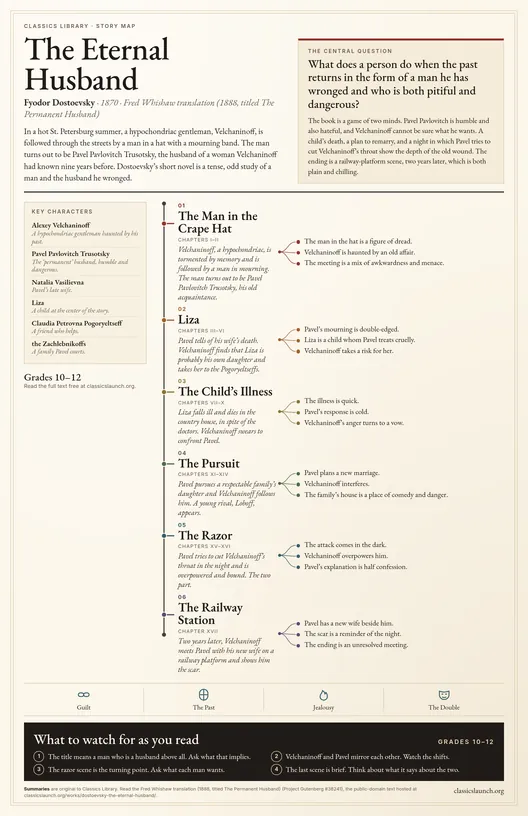 Story mapSee the story mapThe whole book on one page: the story in movements, the characters, and what to watch for. Free to print.
Abstract
Background. Dostoevsky wrote the novella in 1869 and published it in 1870. It is among the shortest of his major works and shows his gift for comedy and horror together.
Plot. A gentleman who is tormented by memories is visited by the husband of a woman he once had an affair with. The woman has died, and her daughter, who may be his own child, falls ill and dies. The husband tries to murder him with a razor.
Ideas. The novella is a study of an old wrong that returns and of the strange tie between the wronger and the wronged. It asks whether hatred and love are separate, and what forgiveness would cost.
Text. The Whishaw translation is of 1888 and is called The Permanent Husband. It is short, quick and funny, and can be read in a day. It contains an attempted murder and a child's death. Teachers can pair this work with the library's study guide, seminar questions and memory-work selection to prepare a discussion, a short essay or a recitation. The full text is hosted on this site, and each quotation in the guide has been checked against the hosted translation.
Main characters
- Velchaninoff: A hypochondriac gentleman
- Pavel Pavlovitch: The deceived husband
- Liza: A young girl
- Natalia Vasilievna: The late wife
- Claudia Petrovna: A kind friend

Summary
The Eternal Husband, which the hosted 1888 translation by Fred Whishaw calls The Permanent Husband, is one of Dostoevsky's shortest and sharpest works. It opens in the summer in St. Petersburg, where a hypochondriac gentleman of about thirty-eight named Alexey Ivanovitch Velchaninoff has been kept in town by a lawsuit. He is haunted by a man in a hat with a mourning band of crape, who seems always to be following him. One night, after a visit, Velchaninoff finds the man in his own rooms. He is Pavel Pavlovitch Trusotsky, whom Velchaninoff knew nine years earlier in a provincial town, T——, where he had an affair with Pavel's wife, Natalia Vasilievna. Pavel tells him in a rambling and tearful way that Natalia died last March of consumption. Pavel has a daughter, Liza, about eight years old, who was born, as Velchaninoff slowly realises from the dates, some months after he left T——. The child is unhappy and is treated by her father with bitter irritability. Velchaninoff, struck by a rush of tenderness, takes her to the country house of his friend Claudia Petrovna Pogoryeltseff and her family. Liza falls ill, grows worse in spite of the best doctors, and dies, and Velchaninoff, who has watched her die, is convinced that Pavel is the murderer of the child. The central quarrel of the novella is between the two men. Pavel says that he loved Velchaninoff in the old days, that he knew all about the affair, and that he does not know whether to embrace him or to kill him. He drinks, he cries, he plays the fool, he sets out to marry a girl of a respectable family, and one night he tries to cut Velchaninoff's throat with a razor. Velchaninoff, who is much stronger, binds him, and the two spend a long and strange night together. In the morning Pavel is humble and gentle, as though nothing has happened. Two years later the two meet by chance at a railway station. Pavel is with a new wife, a young officer, and the wife's friends; he is again the husband in the ‘permanent’ sense. The final conversation, in which Velchaninoff mentions the razor and offers his scarred hand, and Pavel, who will not take it, whispers ‘And—Liza?’, is one of the strangest endings in Dostoevsky. The hosted text is Whishaw's complete translation of the novella, and it does not include the other story that Whishaw printed in the same volume, Uncle's Dream.
Virtues in this work
- Justice: The story shows that a wrong does not go away, and the long delay is itself a kind of justice.
- Charity: Velchaninoff's kindness to Liza is the one charitable act in the story.
- Temperance: Pavel's drinking and self-pity are the opposite of temperance.
- Humility: The final scene shows pride on both sides.
Plot or Argument
- Chapters I–II: The man in the crape hat
Velchaninoff, a hypochondriac, is tormented by memory and is followed by a man in mourning. The man turns out to be Pavel Pavlovitch Trusotsky, his old acquaintance.
- Chapters III–VI: Liza
Pavel tells of his wife's death. Velchaninoff finds that Liza is probably his own daughter and takes her to the Pogoryeltseffs.
- Chapters VII–X: The child's illness
Liza falls ill and dies in the country house, in spite of consultations of doctors. Velchaninoff swears to confront Pavel.
- Chapters XI–XIV: The pursuit
Pavel pursues a respectable family's daughter and Velchaninoff follows him. A young rival, Loboff, appears.
- Chapters XV–XVI: The razor
Pavel tries to cut Velchaninoff's throat in the night, and is overpowered and bound. The two part.
- Chapter XVII: The railway station
Two years later, Velchaninoff meets Pavel with his new wife on a railway platform and shows him the scar.
Characters
- Alexey Ivanovitch Velchaninoff, the hypochondriac
A well-off, clever bachelor of about thirty-eight who has led a pleasant life, and who is now troubled by memories.
- Pavel Pavlovitch Trusotsky, the ‘permanent’ husband
A small, bald, timid, resentful official who had been deceived by his wife and now lives for revenge and for self-pity.
- Natalia Vasilievna, the late wife
A beauty of the province, who was the mistress of Velchaninoff for a year and who has died of consumption.
- Liza, the daughter
A proud, unhappy child of about eight who clings to the memory of her mother.
- Claudia Petrovna Pogoryeltseff, the friend
A shrewd, kind-hearted woman who takes in Liza and looks after her.
- The Zachlebnikoffs, the family
A respectable household with several daughters whom Pavel visits in search of a new wife.
Lessons
The wrong that is not forgotten
Velchaninoff has forgotten the affair, and Pavel has not. The novella is a study of a wrong that is carried for years by the one who was wronged, and of its slow poison.
- How long ago was the affair, and how does Pavel speak of it?
- What does Velchaninoff realise about himself?
The innocent victim
Liza is the child who pays for the faults of her father and her mother. Her death is the center of the book, and the two men are both guilty in different ways.
- How does Pavel treat Liza?
- How does Velchaninoff react when she dies?
Love and hatred
Pavel says that he loved Velchaninoff and that his friendship and his hate are bound together. The scene of the razor shows how close these feelings can be, and how little each man understands.
- What does Pavel mean when he says he loved Velchaninoff?
- Why does Pavel try to kill him?
Context
The story is set in St. Petersburg and in a country house nearby in the 1860s, among the middle ranks of provincial society, in the days when a lawsuit could keep a gentleman in town through the summer. The town of T—— is an imaginary provincial town where the earlier events took place.
Composition
Dostoevsky wrote the novella in 1869 and published it in 1870 in the journal Zaria. The hosted translation, by Fred Whishaw, was published in 1888 as The Permanent Husband, together with Uncle's Dream, in a volume from Vizetelly & Co. The title ‘eternal husband’ is used by later translators.
Reception
The novella was little noticed at first but has been admired by later readers for its psychological exactness and its mixture of comedy and horror. The ‘eternal husband’ has become a type in Russian literature.
Comparisons
- Notes from Underground
Pavel's spite and wounded pride are close relatives of the underground man's.
- The Double
Velchaninoff and Pavel are a pair of doubles, bound to each other by hatred and love.
- Crime and Punishment
The theme of a guilt that cannot be shaken off and a man haunted by his own deed.
- The Meek One
Dostoevsky's later tale of a husband's responsibility for a death in his house.
- Anna Karenina
Tolstoy's novel treats adultery at much greater length and with more moral weight.
Quotes
Frequently cited
“In his opinion the mission of such men was to be, so to speak, “permanent husbands,”—that is, to be husbands all their lives, and nothing else.”
Frequently cited
“I loved you, Alexey Ivanovitch; all that year at T—— I loved you—you did not observe it,”
“Summer had come, and Velchaninoff, contrary to his expectations, was still in St. Petersburg.”
“you are quite a different type to what I believed. I thought you were nothing but a ‘permanent husband,’ but I find you are a sort of bird of prey.”
“Shall I go and tell your wife how you tried to cut my throat?”
For Students
A reading companion for classical Christian high school students. See the student guide.
Reading Guide
Watch for
- What the man in the crape hat wants.
- How Velchaninoff and Pavel speak of Natalia.
- The way Pavel's mood changes in the course of one conversation.
Key terms and names
- Hypochondria
- A habit of fearing illness; here a state of mind that Velchaninoff both mocks and suffers.
- Crape
- A band of black cloth worn on a hat or sleeve as a sign of mourning.
- Permanent husband
- Velchaninoff's phrase for a man who is a husband all his life and nothing else.
- Consumption
- The older word for tuberculosis, the cause of Natalia's death.
Seminar Questions
- Comprehension Who is the man in the crape hat?
- Comprehension What happens to Liza?
- Interpretation Why does Velchaninoff blame himself for Liza's death?
- Interpretation What does Pavel mean by his friendship for Velchaninoff?
- Interpretation Why is the ending at the railway station so strange?
- Big Question Is revenge a sign of love or of hatred?
- Big Question Can a wrong be forgiven when the wronged person has never spoken of it?
Faith Connections
- Matthew 5:23–24 (Scripture)
'Leave your gift... first be reconciled to your brother.' The novella shows what happens when no one is reconciled.
- Exodus 20:14 (Scripture)
The wrong that began the story is the breaking of the commandment, and its long consequences.
- Romans 12:19–21 (Scripture)
'Never avenge yourselves.' Pavel's revenge is a negative picture of this teaching.
Logic and Rhetoric
Central argument: A wrong committed lightly can poison two lives and destroy a third, and it cannot be mended by the passage of time or by forgetting.
Rhetorical device: irony. Pavel's tearful mock-friendship in the early chapters conceals the hatred that comes out with the razor.
Debate: Resolved: That the person who has done a wrong is bound to remember it.
Memory Work
I loved you, Alexey Ivanovitch; all that year at T—— I loved you—you did not observe it,
In his opinion the mission of such men was to be, so to speak, “permanent husbands,”—that is, to be husbands all their lives, and nothing else.
Writing Prompts
Essay: Show how Dostoevsky blends comedy and horror in the scene of the razor.
Comparison with Notes from Underground: Compare the spite of Pavel with that of the underground man.
Medical Lens
The first chapter is a clinical sketch of a hypochondriac gentleman whose nights are sleepless and whose memories return. Pavel's wife has died of consumption; his daughter dies in spite of consultations of ‘the most eminent doctors’; and Pavel drinks heavily. The scene of the razor and the bound man shows violence, restraint and the care of a wound, and the child's death is described with restraint.
- Chapter I, Velchaninoff's illness
Velchaninoff is a hypochondriac who thinks himself ill, sleeps badly and fears he is growing old.
- Chapter III, Natalia's death
Pavel says his wife died of consumption in a few months.
- Chapter X, Liza's illness
Liza grows worse and doctors are consulted, but she dies.
Creative Prompts
- Essay
Why does Pavel say that he loved Velchaninoff? Is he telling the truth?
- Fiction
Write the night of the razor from Pavel's point of view.
- Classroom
Discuss with a teacher how the novella treats a child's death and a husband's revenge.
- Essay
What does the ending, with the refused hand, say about forgiveness?
Further Reading
- Notes from Underground, Fyodor Dostoevsky
A related study of spite and wounded pride; hosted in this library.
- The Double, Fyodor Dostoevsky
An earlier tale of doubles; hosted in this library.
- Crime and Punishment, Fyodor Dostoevsky
A longer novel of guilt; hosted in this library.
- Dostoevsky: A Writer in His Time, Joseph Frank
The standard modern life of the author.
Verification notes
Full text from Project Gutenberg #38241, Fred Whishaw's 1888 translation titled The Permanent Husband, public domain. The library title follows the modern English title; the hosted translation and its spelling (Velchaninoff, Pavel Pavlovitch) are Whishaw's. The hosted text is the novella only, not Uncle's Dream. Quotes were checked against the hosted text. The first publication in Zaria in 1870 is a standard report and is not verified here.
- Publication in Zaria in 1870.
- Liza's paternity, which the text implies through dates but does not state.