Work record
The Mistress of the Inn (La locandiera)
Carlo GoldoniLa locandiera; The Innkeeper; The Mistress of the Inn (Goldoni); Mirandolina; La Locandiera (Pierson); The HostessThe Mistress of the Inn (La locandiera) by Carlo Goldoni (1753)The Mistress of the Inn (La locandiera, 1753) is a comedy in three acts set at the inn of Mirandolina in Florence.Also known as: La locandiera · The Innkeeper · The Mistress of the Inn (Goldoni) · Mirandolina · La Locandiera (Pierson) · The Hostess
1753 · 18th Century · Drama · Italian
Read this when vanity and a clever tongue lead a trifler to play with other hearts.
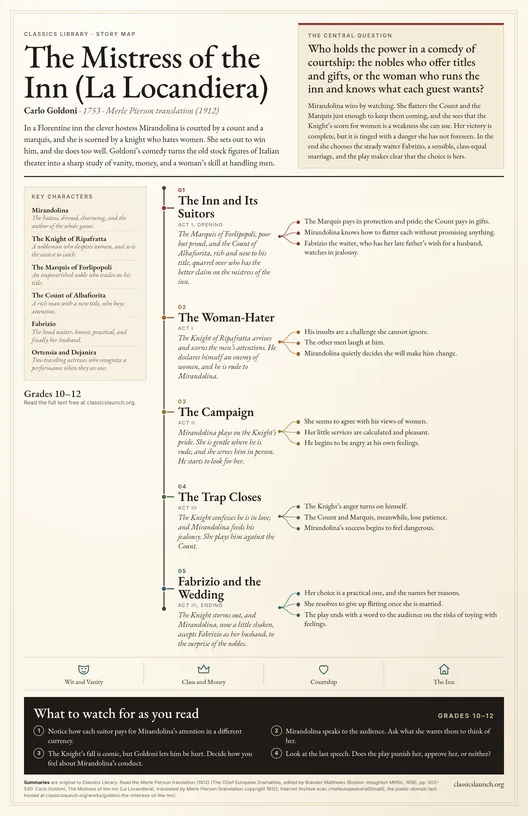 Story mapSee the story mapThe whole book on one page: the story in movements, the characters, and what to watch for. Free to print.
Abstract
Background. Goldoni wrote this play for the Venetian carnival of 1753. He wished to bring real people onto the comic stage in place of the masks of the older comedy, and he chose as his heroine a working woman who owns her own business and has a mind of her own.
Plot. Three men lodge at the inn of the young hostess Mirandolina. Two court her with their rank and their gifts, and the third, a Cavalier, scorns women. Piqued, she makes him fall in love, then laughs at him and marries her faithful waiter Fabricius. The Cavalier leaves in anger, and she confesses that her game was wrong and asks the gentlemen to remember the lesson of the Mistress of the Inn.
Method. Goldoni gives each character a clear manner of speech, and the plot moves by quick talk and by the heroine's asides to the audience.
Why it matters. The play is the best known of Goldoni's comedies and a model of the reformed Italian stage. It laughs at the follies of pride and shows a woman who chooses her husband in her own station, and it ends on a note of modest repentance, so that the comedy carries a moral that a school audience can discuss.
Main characters
- Mirandolina: The clever mistress of the inn
- The Cavalier: A proud woman-hater
- The Marquis: A poor and proud nobleman
- The Count: A rich man with a bought title
- Fabricius: The faithful waiter
Summary
The Mistress of the Inn (La locandiera, 1753) is a comedy in three acts set at the inn of Mirandolina in Florence. Mirandolina is a young, lively and sensible woman who has inherited the inn from her father and who runs it well. Her guests include two rivals for her favour, the Marquis di Forlipopoli, a poor man who is proud of his title and offers her his protection, and the Count d'Albafiorita, who bought his title and offers her gifts of jewels. Her waiter Fabricius is faithful to her and to the wish of her dying father, who wanted her to marry him. A third guest is the Cavalier di Ripafratta, a man of rank who despises women and says so. His scorn stings Mirandolina's pride. She decides to make him fall in love with her, and she goes about it with great skill. She brings him better linen, praises his taste, shows him she wants nothing, cooks for him with her own hands, and pretends to be indifferent. The Cavalier softens, then grows jealous of the Count and the Marquis and of Fabricius, and at last he is deeply in love and tells her so. At a moment when he asks for pity, Mirandolina pretends to faint. Having caught him, she turns on him, laughs at his declaration, and makes her chosen husband plain: she will marry Fabricius. The Cavalier, shamed and furious, storms out, and the Count and Marquis are dismissed with a kind word. Mirandolina gives a closing speech. She admits that she has done wrong in playing with the Cavalier, promises to change her way of life, and asks the gentlemen to remember the Mistress of the Inn whenever they feel inclined to trust a woman's sweet words. Goldoni's comedy has a quick, natural speech, and its characters are drawn from real life in place of the masks of the older comedy. The play laughs at three kinds of pride: the pride of birth in the Marquis, the pride of money in the Count, and the pride of manly self-command in the Cavalier. It also shows a woman who knows her own worth and chooses a husband from her own class. The text given here is the English translation by Merle Pierson, published in 1912.
Virtues in this work
- Humility: The play brings down each proud man and ends with Mirandolina's modest confession.
- Honor: Mirandolina keeps her father's wish and marries the honest servant who has been faithful to her.
- Temperance: She promises to give up her games and to live in decorum and honesty.
Plot or Argument
- Act I: The inn and the woman-hater
The Marquis and the Count quarrel about rank and about who loves Mirandolina more. The Cavalier arrives, finds fault with the linen and declares that he hates women. Mirandolina, offended, resolves to bring him down.
- Act II: The siege of the Cavalier
Mirandolina serves the Cavalier herself, flatters him by seeming not to flatter, and makes him jealous of the others. The Marquis borrows the Cavalier's last coin. At last the Cavalier admits he is in love, and Mirandolina pretends to faint.
- Act III: The trick unmasked
Mirandolina irons the Cavalier's linen in his own room and mocks his confession. When he loses his temper, she announces that she will marry Fabricius at once. The Cavalier leaves in anger, and Mirandolina ends the play with her farewell to the gentlemen.
Characters
- Mirandolina, mistress of the inn
The mistress of the inn, a clever, charming and practical young woman.
- The Cavalier di Ripafratta, man of rank
A man of rank who scorns women and is made to love one.
- The Marquis di Forlipopoli, proud nobleman with a title but no money
A proud nobleman with a title but no money.
- The Count d'Albafiorita, rich man
A rich man whose title was bought, who tries to win Mirandolina with gifts.
- Fabricius, serving-man of the inn
The serving-man of the inn, honest and jealous, whom Mirandolina marries.
- The Cavalier's servant, servant
A servant who carries his master's orders and news of his departure.
Lessons
Pride goes before a fall
The Cavalier is proud of his indifference to women, and the Marquis and the Count are proud of birth and wealth; Mirandolina shows each how fragile the pride is. A student can read the play beside Proverbs 16:18 and ask what Goldoni thinks of each kind of pride.
- Which of the three men is the proudest, and which falls the farthest?
- Why does Mirandolina feel so strongly the Cavalier's scorn?
The trifler's repentance
Mirandolina's trick succeeds, but at the end she admits she has done wrong and promises to amend. The play therefore teaches that cleverness is no defence for playing with another's heart, and that honesty is the better way.
- What does Mirandolina confess in her last speeches?
- Is her repentance sincere, or is it another trick?
Marriage within one's station
Mirandolina chooses Fabricius, who has served the inn faithfully and was promised to her by her father. Goldoni presents this as sensible and virtuous against the lure of rank and gifts.
- Why does Mirandolina refuse the Count's jewels and the Marquis's protection in the end?
- What does her father's wish mean to her?
Reform of the comic stage
Goldoni wished to replace stock masked characters with real people, and the play gives its characters names, homes and habits. Students can compare the comedy with the commedia dell'arte and ask what is gained by showing real manners.
- What details of the inn make the scenes seem real?
- How does Goldoni treat the servants and the nobles?
Context
The play was written for the Venetian theatre in the mid-eighteenth century, when the noble families of Italy were often poor and proud and the merchant and innkeeping classes were rising. The inn was a common setting in the theatre as in life, a place where people of every rank met and paid by the same rules. Goldoni took his chief character from the world of his audience and drew a worthy woman who earns her bread and runs her own business.
Composition
Goldoni wrote La locandiera in 1752–1753 for the carnival season of the Teatro Sant'Angelo in Venice, where it was first played in January 1753 with Maddalena Marliani in the title role. It is among the best of his plays that are written wholly in prose. Merle Pierson's translation was published in 1912 and reprinted in Brander Matthews's The Chief European Dramatists in 1916, from which this text is taken.
Reception
The play has remained Goldoni's most performed work, in Italy and abroad. The actress Eleonora Duse made the part of Mirandolina famous, and Luchino Visconti staged it in the 1950s. It is often compared to Molière and to the later English comedy of manners.
Comparisons
- She Stoops to Conquer
Goldsmith's comedy also takes place at what is thought to be an inn and turns on a clever woman who controls the plot.
- The Miser and The Would-Be Gentleman
Molière's comedy of the vain man who wishes to be a gentleman is close in spirit to Goldoni's mockery of pride of rank.
- The Misanthrope and Other Plays
Molière's Alceste, who despises society, is a counterpart of the Cavalier, a man of fixed pride who is humbled by love.
- The Taming of the Shrew
Shakespeare's comedy of a wit-combat between a man and a woman ends in marriage, while Goldoni's ends in the humbling of the man and the choice of a husband.
- Much Ado About Nothing
Shakespeare's Beatrice and Benedick, who think themselves immune to love and are tricked into it, are the close ancestors of the Cavalier.
- Pride and Prejudice
Austen's novel is another comedy of pride and rank, in which a clever woman chooses her own husband.
- Six Characters in Search of an Author and Other Plays
Pirandello, a later Italian dramatist, takes the theatre's mixture of play and truth in a different direction and is a useful contrast.
Quotes
Frequently cited
“I purchased my county when you sold your marquisate.”
Frequently cited
“Probably he hasn’t found the one who knows how to handle him. But he shall find her.”
Frequently cited
“Up to this time, I have been amusing myself, I have done wrong, and I have taken too many risks, but I shan’t do it any more;”
Frequently cited
“may you think of the tricks you have learned, and remember the Mistress of the Inn.”
“Poor women! What have they done? Why thus cruel to us. Sir Cavalier?”
“I know you deceived me, I know you are exulting within yourself at having humiliated me”
“The agreement is this,—either give me your hand or go home.”
For Students
A reading companion for classical Christian high school students. See the student guide.
Reading Guide
Watch for
- How Mirandolina speaks to each of the three suitors and why she treats them differently.
- What the Cavalier says about women at the start and at the end.
- How the Marquis and the Count differ in their pride.
- What Mirandolina says in her last speech and who it is for.
Key terms and names
- Locandiera
- The Italian word for the mistress or hostess of an inn.
- Cavalier (cavaliere)
- A gentleman of rank, such as the Cavalier di Ripafratta, who is a knight of an order.
- Commedia dell'arte
- The older Italian comedy with masked stock characters, which Goldoni worked to replace.
- Marquis and Count
- Titles of nobility; in the play the Marquis has a title without money and the Count a bought title.
- Protection
- The patronage a nobleman offers a person of lower rank, which the Marquis offers Mirandolina.
- Sequin
- A gold coin of Venice and Florence, of which the Cavalier has one left.
Seminar Questions
- Comprehension Who are the three guests at the inn, and what does each want from Mirandolina?
- Comprehension How does Mirandolina bring the Cavalier to fall in love with her?
- Interpretation Why does Goldoni make the three men proud in three different ways?
- Interpretation What does the play say about the value of rank, money and honest service?
- Interpretation Does Mirandolina's confession at the end make up for her trick?
- Big Question Is it ever right to play with another's feelings for the sake of one's pride?
- Big Question What makes a good marriage: love, rank, money or something else?
Faith Connections
- Proverbs 16:18 (Scripture)
Pride goes before destruction and a haughty spirit before a fall, which is the pattern of the Cavalier's humbling.
- Proverbs 31:10–31 (Scripture)
The portrait of a capable woman who runs her household with wisdom is a point of comparison with Mirandolina, who manages her inn and chooses a husband with sense.
- Thomas Aquinas, Summa Theologiae II-II, q. 162 (Great Conversation)
Aquinas's treatment of pride as the beginning of sin is the background to Goldoni's three portraits of pride in the Marquis, the Count and the Cavalier.
Logic and Rhetoric
Central argument: Pride of birth, wealth or self-command makes men foolish and easy to lead, and honest work and plain marriage are a safer path.
Rhetorical device: dramatic irony. The Cavalier boasts that he will never love, while the audience sees Mirandolina setting her trap and knows what will follow.
Debate: Resolved: That a person who tricks another into love for the sake of pride has done wrong, however the trick ends.
Memory Work
Up to this time, I have been amusing myself, I have done wrong, and I have taken too many risks, but I shan’t do it any more;
may you think of the tricks you have learned, and remember the Mistress of the Inn.
Writing Prompts
Essay: Using at least three passages, explain how Mirandolina brings down the Cavalier's pride and what the play teaches about vanity.
Comparison with The Miser and The Would-Be Gentleman: Compare Goldoni's treatment of pride of rank in the Marquis and the Count with Molière's treatment of the would-be gentleman, and say which comedy is the more severe.
Creative Prompts
- Dialogue
Write a scene in which Mirandolina meets the Cavalier a year after the end of the play, in which each tells what he or she has learned.
- Essay
Write an essay on Mirandolina's last speech, saying whether you think she is truly sorry, and use at least two lines from the play.
- Classroom
Perform Act III in class, with students taking the parts of Mirandolina, the Cavalier, the Count, the Marquis and Fabricius, and discuss how the actors' manner changes the meaning of each speech.
- Adaptation
Rewrite the first scene of the play in a modern setting, such as a small business, keeping the quarrel about rank and money.
Further Reading
- The Chief European Dramatists, Brander Matthews, ed.
The 1916 anthology in which the play is printed, with a short life of Goldoni.
- She Stoops to Conquer, Oliver Goldsmith
An English comedy with a similar inn and a clever heroine, in this library.
- Memoirs of Carlo Goldoni, Carlo Goldoni
Goldoni's own account of his life and the reform of Italian comedy, in several translations; check the edition before citing.
- Goldoni: A Biography, Heinz Riedt (tr.)
A study of Goldoni's life; check the exact title before citing.
- The Misanthrope, Molière
Molière's comedy of a proud man, in this library.
Verification notes
The text is Merle Pierson's English translation of 1912 as printed in Brander Matthews's The Chief European Dramatists (Boston: Houghton Mifflin, 1916), taken from the Internet Archive scan and corrected by machine and by hand; small scanning errors may remain. Pierson's version has seven characters, and the actresses who appear in some other versions of the play are not in this text. The Italian original is not hosted here. Goldoni's other play in the brief, The Servant of Two Masters, is not included because no public-domain English translation could be verified.
- The first performance in January 1753 at the Teatro Sant'Angelo and the name of the first Mirandolina follow standard theatre histories and are not in the hosted text.
- The statement that Eleonora Duse made the part famous and that Visconti staged it follows standard theatre histories.
- The number of Goldoni's plays and his move to Paris in 1762 follow standard reference works.
- Scan errors may remain in the text, and the stage directions may differ slightly from the printed page.
- The title and author of the Goldoni biography listed under further reading should be checked before citing.