Work record
The Golden Pot
E. T. A. HoffmannE. T. A. Hoffmann; ETA Hoffmann; E.T.A. Hoffmann; E T A Hoffmann; ETAHoffmann; Der goldne Topf; The Golden Pot: A Modern Fairy TaleThe Golden Pot by E. T. A. Hoffmann (1814)The Golden Pot, 'A Modern Fairy Tale', is E. T. A. Hoffmann's best-known story, a comic and strange tale that sets a marvellous world inside the ordinary city of Dresden.Also known as: Der goldne Topf · The Golden Pot: A Modern Fairy Tale
1814 · 19th Century · Novella · German
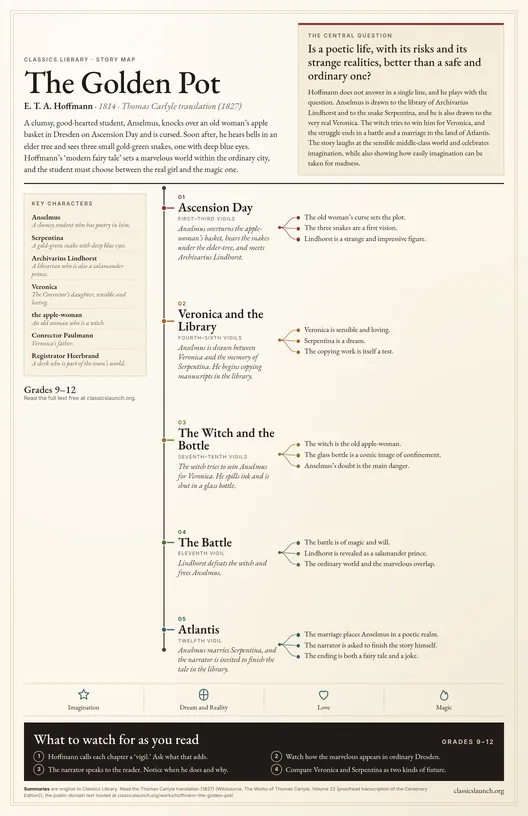 Story mapSee the story mapThe whole book on one page: the story in movements, the characters, and what to watch for. Free to print.
Abstract
Background. Hoffmann wrote this tale in 1813–14 while working as a theatre music director in Dresden and Leipzig. Carlyle's translation of 1827 was among the first to bring German romance to English readers.
Plot. A clumsy student upsets an old woman's basket, hears snakes in an elder-tree, and falls in love with one. He works for a strange archivist who is a prince of spirits, is tempted by a worldly girl and a witch, and at last escapes to Atlantis.
Ideas. The story contrasts the world of poetry with the world of practical comfort. It uses humour and irony to ask what faith in the unseen costs and gives.
Text. Carlyle's translation is in twelve vigils, taken from a proofread transcription of his Works. The language is sometimes archaic and playful. The hosted text is complete as printed here, with its section headings kept as a guide to the reader, and every quotation on this page is drawn directly from that text. Teachers can pair this work with the library's study guide, seminar questions and memory-work selection to prepare a discussion, a short essay or a recitation. The full text is hosted on this site, and each quotation in the guide has been checked against the hosted translation.
Main characters
- Anselmus: A clumsy, poetic student
- Serpentina: A gold-green snake who loves him
- Lindhorst: An archivist who is a salamander prince
- Veronica: A practical young woman
- The witch: An old apple-woman
Summary
The Golden Pot, 'A Modern Fairy Tale', is E. T. A. Hoffmann's best-known story, a comic and strange tale that sets a marvellous world inside the ordinary city of Dresden. It begins, with an Ascension Day, when a clumsy, good-hearted student, Anselmus, runs into the apple-basket of an old woman at the Black Gate. She curses him, and he will soon fall under a spell. That afternoon, sitting under an elder-tree on the Elbe, he hears whispering and the ringing of crystal bells. Three small gold-green snakes slip through the branches, and one of them, with deep blue eyes, looks at him with a longing that turns his heart. He is in love with her, and does not know it. Anselmus is poor and anxious, and is drawn to two women. Veronica, the daughter of the respectable Conrector Paulmann, has a simple, loving nature and dreams of a safe marriage in which her husband is a Court Counsellor. Serpentina, the snake, speaks to him only in the elder-tree. Meanwhile, the eccentric Archivarius Lindhorst offers him a job copying strange manuscripts in his library, which turns out to be a world of palms, birds and spirits. Lindhorst is in fact a prince of the salamanders who was exiled for a fault from the land of Atlantis; Serpentina is his daughter. The old apple-woman is a witch who is Veronica's former nurse, and she works to win Anselmus for Veronica. When Anselmus spills ink, he is imprisoned in a glass bottle on a shelf, among students who are happy there. In a final conflict, the Archivarius defeats the witch and frees him. Veronica gives up, marries Registrator Heerbrand and becomes a Counsellor's wife. Anselmus marries Serpentina and goes to Atlantis, where he is given the golden pot and a farm. The narrator, who has struggled to write the Twelfth Vigil, receives a note from Lindhorst who offers him a room in his library, and tells him that the blessedness of Anselmus is only a living in poetry. The tale is a Romantic story about the poet's choice between the everyday world and the world of the imagination, and about the faith by which the second is perceived. It is funny, sharp about the middle class and strange. Teachers should note that it includes magic, a witch, spirits and a mythical world, all presented as fantasy and not as doctrine, and that readers will want to discuss the difference between imagination and the Christian view of reality.
Virtues in this work
Plot or Argument
- First–Third Vigils: Ascension Day
Anselmus overturns the apple-woman's basket, hears the snakes under the elder-tree, and meets Archivarius Lindhorst.
- Fourth–Sixth Vigils: Veronica and Lindhorst's library
Anselmus is drawn between Veronica and the memory of Serpentina. He begins copying manuscripts in the library.
- Seventh–Tenth Vigils: The witch and the bottle
The witch tries to win Anselmus for Veronica. He spills ink and is shut in a glass bottle.
- Eleventh Vigil: The battle
Lindhorst defeats the witch and frees Anselmus.
- Twelfth Vigil: Atlantis
Anselmus marries Serpentina, and the narrator is invited to finish the tale in the library.
Characters
- Anselmus, student
A clumsy, poetic student who is called to a higher life.
- Serpentina, gold-green snake
Lindhorst's daughter, who loves Anselmus.
- Archivarius Lindhorst, salamander prince
An eccentric archivist who is a magician from Atlantis.
- Veronica, Conrector's daughter
A sensible young woman who hopes to marry Anselmus.
- The old apple-woman, witch
A malign old woman who is Veronica's former nurse.
- Conrector Paulmann, Veronica's father
A solid citizen who thinks Anselmus is deranged.
- Registrator Heerbrand, clerk
A friend of the Paulmanns who becomes Veronica's husband.
Lessons
The marvellous within the ordinary
Hoffmann sets the fantastic in Dresden's everyday streets, so that the reader sees how thin the line between the real and the imagined is.
- What details of Dresden does Hoffmann mention?
- How does the elder-tree scene change the tone?
A choice of loves
Anselmus must choose between Veronica, who offers a safe and respectable life, and Serpentina, who offers the life of poetry. Hoffmann treats both with humour and shows the cost of each.
- What does Veronica want?
- What does Serpentina offer?
Faith and imagination
Anselmus must believe in what he cannot see, and is punished when his belief fails. The story is a parable of the poet's faith, but Christian readers will want to distinguish this from faith in God.
- How does Anselmus's faith waver?
- What is the difference between imagination and revelation?
Context
The tale is set in Dresden in the early nineteenth century, soon after the Napoleonic wars. Hoffmann draws on Romantic nature philosophy, alchemy and the German fairy-tale tradition.
Composition
Hoffmann wrote it in 1813–14, while he was musical director in Dresden and Leipzig during the war. It was published in 1814 in his Fantasy Pieces in Callot's Manner.
Reception
The tale was admired by Heine, Poe and Dostoevsky, and Carlyle's translation of 1827 made it available to English readers.
Comparisons
- Nutcracker and Mouse-King
Hoffmann's Christmas tale is a gentler story of a child's passage into a world of the marvellous.
- Henry of Ofterdingen
Novalis's romance is the serious counterpart to Hoffmann's comic story of a young man called by a vision.
- Household Stories (Grimm's Fairy Tales)
The Grimms' tales are the folk tradition on which Hoffmann's art tale draws.
- Wilhelm Meister's Apprenticeship
Goethe's novel of formation is the model against which the Romantics wrote.
Quotes
Frequently cited
“Were you not even now in Atlantis; and have you not at least a pretty little copyhold Farm there, as the poetical possession of your inward sense? And is the blessedness of Anselmus aught else but a Living in Poesy? Can aught else but Poesy reveal itself as the sacred Harmony of all Beings, as the deepest secret of Nature?”
“On Ascension-day, about three o’clock in the afternoon, there came a young man running through the Schwarzthor, or Black Gate, out of Dresden, and right into a basket of apples and cakes, which an old and very ugly woman was there exposing to sale.”
For Students
A reading companion for classical Christian high school students. See the student guide.
Reading Guide
Watch for
- The moments when the ordinary world gives way to the marvellous.
- What each of the women offers Anselmus.
- How Hoffmann addresses the reader.
Key terms and names
- Vigil
- A night-watch; Hoffmann divides his story into twelve 'vigils' rather than chapters.
- Salamander
- In alchemical lore, a fire spirit; Lindhorst belongs to this race.
- Atlantis
- The legendary island of Plato, here a land of poetry.
- Romanticism
- The literary movement that valued imagination and feeling.
Seminar Questions
- Comprehension What happens to Anselmus on Ascension Day?
- Comprehension Who is Archivarius Lindhorst?
- Interpretation Why does Hoffmann divide the story into vigils?
- Interpretation What does the glass bottle represent?
- Interpretation Why does the narrator appear at the end?
- Big Question Is imagination a form of knowledge?
- Big Question What is the cost of living in a world of poetry?
Faith Connections
- Hebrews 11:1 (Scripture)
'Faith is the assurance of things hoped for, the conviction of things not seen.' Anselmus is tested on his faith in what he cannot see, though not in God.
- Deuteronomy 18:10–12 (Scripture)
Scripture forbids sorcery and divination, which is a caution in reading the story's magic as fiction only.
- C. S. Lewis, An Experiment in Criticism (Great Conversation)
A modern reader can distinguish a delight in fantasy from a creed about reality, as Lewis does.
Logic and Rhetoric
Central argument: A person who can believe in the unseen is made capable of a life that the practical world cannot understand.
Rhetorical device: narrator's direct address. Hoffmann speaks to the reader and confesses his own difficulty in finishing the tale.
Debate: Resolved: That a life of imagination is superior to a life of practical comfort.
Memory Work
On Ascension-day, about three o’clock in the afternoon, there came a young man running through the Schwarzthor, or Black Gate, out of Dresden, and right into a basket of apples and cakes, which an old and very ugly woman was there exposing to sale.
Were you not even now in Atlantis; and have you not at least a pretty little copyhold Farm there, as the poetical possession of your inward sense? And is the blessedness of Anselmus aught else but a Living in Poesy? Can aught else but Poesy reveal itself as the sacred Harmony of all Beings, as the deepest secret of Nature?
Writing Prompts
Essay: How does Hoffmann use humour to prevent the tale from becoming only a hymn to the imagination?
Comparison with Henry of Ofterdingen: Compare the blue flower with the golden pot as images of a poet's calling.
Medical Lens
Anselmus is thought by respectable people to be mad or in a fever, and a night of punch plays a part in the plot. The story treats such questions as comedy.
- Fourth Vigil
The Conrector and the Registrator discuss whether Anselmus is mad or suffering from a fever.
- Tenth Vigil
A night of punch among the Registrator and his friends.
Creative Prompts
- Essay
Why does Hoffmann set a fairy tale in a real city? What does the setting add to the story?
- Fiction
Write a short story in which a magical world appears under a familiar street in your own town.
- Classroom
Debate whether Anselmus makes the right choice between Veronica and Serpentina.
Further Reading
- Nutcracker and Mouse-King, E. T. A. Hoffmann
Hoffmann's Christmas story, hosted in this library.
- Henry of Ofterdingen, Novalis
A Romantic novel of a poet's calling, hosted in this library.
- Household Stories (Grimm's Fairy Tales), Jacob and Wilhelm Grimm
The folk tales on which the Romantics drew.
- German Romance, Thomas Carlyle
Carlyle's collection of German tales, in which this story first appeared in English.
Verification notes
Full text from the Wikisource transcription of Thomas Carlyle's translation, as printed in his Works (Centenary Edition, vol. 22), in public domain. Carlyle first published it in German Romance (Edinburgh, 1827). Quotes were checked against the hosted text.
- Whether Carlyle's 1827 text and the Centenary Edition text differ in any passage.
- The exact order of the vigils' scenes as summarised.