Work record
Lad: A Dog
Albert Payson TerhuneLad: A Dog by Albert Payson Terhune (1919)Lad belongs to a lakeside household that the narrator calls The Place, closely associated with Terhune's Sunnybank in New Jersey.1919 · Early 20th Century · Novel · English
Read this when loyalty needs four paws, a familiar doorway, and a home worth finding again.
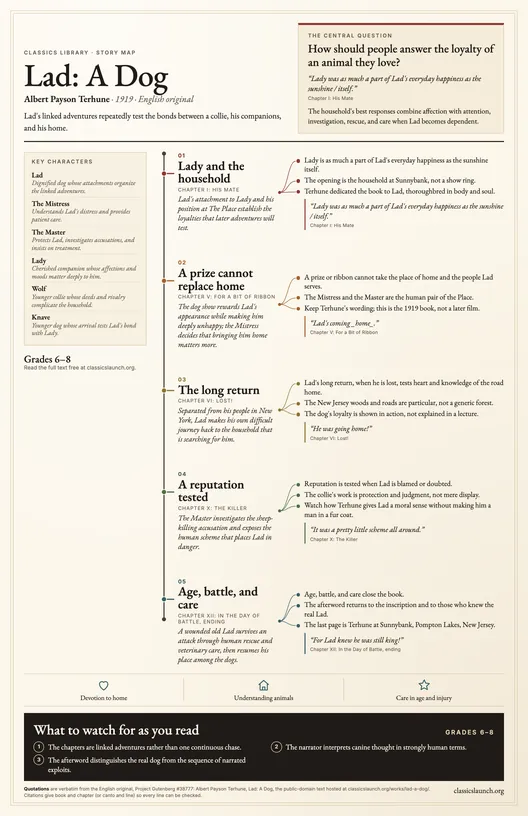 Story mapSee the story mapThe whole book on one page: the story in movements, the characters, and what to watch for. Free to print.
Abstract
Background. Terhune's 1919 volume gathers connected adventures of the real Sunnybank collie celebrated in its afterword. The narrative setting is a northern New Jersey home identified simply as The Place. The book supplies a sustained portrait through separate crises, with recurring people and dogs giving continuity to the episodes and their emotional stakes.
Content. Lad encounters a rival for his mate, defends his household, experiences the ordeal of public exhibition, and finds his way back from the city. A false appearance threatens his reputation in a sheep-killing episode. Age brings a final brutal contest, followed by veterinary treatment and a hard-won return to ordinary authority.
Themes. Loyalty is expressed through recognition of voices, habitual spaces, companionship, and the desire to return. The human duty to understand an animal answers the animal's devotion to its household. Reputation also receives repeated testing: a prize cannot supply happiness, an accusation may mislead, and physical decline need not erase a long-earned place.
Significance. Terhune's emphatic storytelling treats canine feeling with unusual seriousness and often translates it into human concepts of duty and dignity. Readers should distinguish that imaginative method from the afterword's claims about a real animal. The resulting book provides lively material for discussing animal narration, responsible care, and the meaning that repeated shared routines give to a home.
Main characters
- Lad: Dignified dog whose attachments organize the linked adventures.
- The Mistress: Understands Lad's distress and provides patient care.
- The Master: Protects Lad, investigates accusations, and insists on treatment.
- Lady: Cherished companion whose affections and moods matter deeply to him.
- Wolf: Younger collie whose deeds and rivalry complicate the household.
- Knave: Younger dog whose arrival tests Lad's bond with Lady.
Summary
Lad belongs to a lakeside household that the narrator calls The Place, closely associated with Terhune's Sunnybank in New Jersey. Its people are the Mistress and the Master; its most important canine relationships include Lad's mate, Lady, and his son, Wolf. The book follows Lad through separate adventures rather than a single uninterrupted plot. Across them, his dignity, fierce attachment, and understanding of household expectations provide a steady center. The opening episode tests his devotion to Lady when a younger dog, Knave, arrives. Other chapters expose the gap between what people intend and what a dog understands. A command to keep quiet becomes a serious obligation, even when Lad must protect the house from an intruder. Visitors can admire him while failing to notice his distress. Terhune repeatedly invites readers to enter Lad's interpretation of an order, an absence, or a gesture of affection. Public success proves less valuable than belonging. At a dog show, Lad's fine appearance earns recognition, but the unfamiliar surroundings and enforced separation make him miserable. The Mistress chooses his return home over further exhibition. A later adventure strands him in the city, from which he undertakes an exhausting journey back. The household's search and his own determined return meet in a reunion that makes home the clearest measure of reward. The stories also test judgment. An accusation involving sheep puts Lad in danger, and the Master must uncover a scheme rather than accept appearances. Wolf's adventures and the relations among the other dogs enlarge the family portrait. In the last major episode, age has weakened Lad without erasing his authority. An attack by other dogs leaves him terribly wounded, and the people summon veterinary care and nurse him through recovery. His restored passage through a doorway confirms his place in the household hierarchy. An afterword identifies the real dog behind the stories and records his later death. That factual frame should be distinguished from the narrator's dramatic access to canine thought. The book's lasting pleasure lies in its wholehearted attention to an animal's attachments, while its strongest scenes ask people to read those attachments with patience and return loyalty through practical care.
Virtues in this work
- Friendship: The shared routines of Lad and his people give mutual recognition a durable form.
- Fortitude: Lad persists through separation, danger, and the weakness of age.
- Charity: The Mistress and Master answer the wounded dog's dependence with sustained practical care.
Plot or Argument
- Lady and the household
Lad's attachment to Lady and his position at The Place establish the loyalties that later adventures will test.
- A prize cannot replace home
The dog show rewards Lad's appearance while making him deeply unhappy; the Mistress decides that bringing him home matters more.
- The long return
Separated from his people in New York, Lad makes his own difficult journey back to the household that is searching for him.
- A reputation tested
The Master investigates the sheep-killing accusation and exposes the human scheme that places Lad in danger.
- Age, battle, and care
A wounded old Lad survives an attack through human rescue and veterinary care, then resumes his place among the dogs.
Characters
- Lad, Central collie
Dignified dog whose attachments organize the linked adventures.
- The Mistress, Human companion
Understands Lad's distress and provides patient care.
- The Master, Human companion
Protects Lad, investigates accusations, and insists on treatment.
- Lady, Lad's mate
Cherished companion whose affections and moods matter deeply to him.
- Wolf, Lad's son
Younger collie whose deeds and rivalry complicate the household.
- Knave, Early rival
Younger dog whose arrival tests Lad's bond with Lady.
Lessons
Read the animal's response
The show visitors see a prize-winning collie. The Mistress learns to judge the experience through Lad's visible distress.
- What does the show offer the people?
- What signs tell them that Lad wants to leave?
Investigate before judging
A damaging appearance is not a complete explanation. The Master's loyalty includes finding out what actually happened.
- Why is Lad's reputation in danger?
- What distinguishes trust from ignoring evidence?
Return care for loyalty
Lad's devotion is answered most clearly when he cannot help himself. Rescue, treatment, and patient nursing make affection practical.
- How does age change his danger?
- What does the household do during his recovery?
Context
Terhune wrote from a New Jersey household known for its collies, and the book's lakeside setting gives its episodes a recurring physical center. The afterword identifies Lad as a real animal while the stories supply dramatic scenes and imagined thoughts.
Composition
Lad: A Dog appeared in 1919 after stories about Lad had been printed in magazines, as the afterword explains.
Reception
The book became a lasting part of Terhune's animal fiction, linking the name Sunnybank with narratives of collie courage and devotion.
Comparisons
- Black Beauty
Both invite readers to judge human conduct through an animal's experience, though Sewell's horse narrates his own life.
- The Call of the Wild
Compare the pull of household loyalty for Lad with the different demands of ancestry and wilderness in Buck's story.
- White Fang
Both give serious attention to animal learning and human treatment, with very different starting points for trust.
Quotes
“Lady was as much a part of Lad's everyday happiness as the sunshine itself.”
“Lad's coming _home_.”
“He was going home!”
“It was a pretty little scheme all around.”
“For Lad knew he was still king!”
For Students
A reading companion for classical Christian high school students. See the student guide.
Reading Guide
Watch for
- The chapters are linked adventures rather than one continuous chase.
- The narrator interprets canine thought in strongly human terms.
- The afterword distinguishes the real dog from the sequence of narrated exploits.
Key terms and names
- collie
- A herding dog breed central to Terhune's household and stories.
- conformation
- A dog's bodily structure as judged against a breed standard.
- veterinary
- Relating to the medical treatment and care of animals.
- anthropomorphism
- The attribution of human qualities or thought patterns to animals or objects.
Seminar Questions
- Comprehension Why does the Mistress bring Lad home from the show?
- Comprehension How does the final doorway scene establish Lad's position?
- Interpretation What changes when the narrator describes Lad's understanding of a command?
- Interpretation How does the sheep episode test the Master's judgment?
- Big Question What does a household owe an animal that depends on it?
- Big Question Can imagined animal thoughts help people observe real animals more carefully?
Faith Connections
- Proverbs 12:10 (Scripture)
The righteous person's care for animals offers a direct companion to the household's responsibility for Lad.
- Psalm 104:24–30 (Scripture)
The psalm's attention to living creatures can broaden discussion of the value granted to animal life in the novel.
Logic and Rhetoric
Central argument: Lad's devotion makes a claim on the people who keep him: their affection must include understanding, protection, and care when strength fails.
Rhetorical device: focalization. The city and show become frightening when narrated through the collie's expectations of home, familiar voices, and permitted actions.
Debate: Resolved: bringing Lad home matters more than winning another prize.
Memory Work
He was going home!
Writing Prompts
Essay: Compare the dog-show chapter and the final recovery: how do the people learn what loyalty requires of them?
Comparison with Black Beauty: Compare how Terhune and Sewell make an animal's experience available to readers, using one episode from each.
Medical Lens
Lad suffers explicit injuries, including the severe wounds of the final fight, and receives veterinary and household care. These episodes chiefly develop loyalty and dependency.
- Chapter XII: In the Day of Battle
The injured old dog is rescued, examined by a veterinarian, bandaged, and nursed through a prolonged recovery.
Creative Prompts
- Fiction
Describe a familiar room through the routes, smells, and resting places most important to a dog.
- Dialogue
Write a discussion between the Mistress and a show enthusiast about what a ribbon can and cannot measure.
- Classroom
Chart one episode twice, listing what the people know beside what Lad appears to understand.
Further Reading
- Further Adventures of Lad, Albert Payson Terhune
- Bruce, Albert Payson Terhune
Verification notes
Quotations follow the hosted Project Gutenberg #38777 text. The authorial afterword is the source for the real-dog frame and magazine origins; the stories' access to Lad's thoughts is treated as a narrative method rather than independently observable fact.
No verification flags recorded.