Work record
Taras Bulba
Nikolai GogolTaras Bulba (Gogol)Taras Bulba by Nikolai Gogol (1835)Taras Bulba is Gogol's historical romance of the Zaporozhian Cossacks, the free warriors of the Dnieper steppe who fought the Poles and Tatars in the early modern age.Also known as: Taras Bulba (Gogol)
1835 (revised 1842) · 19th Century · Novella · Russian
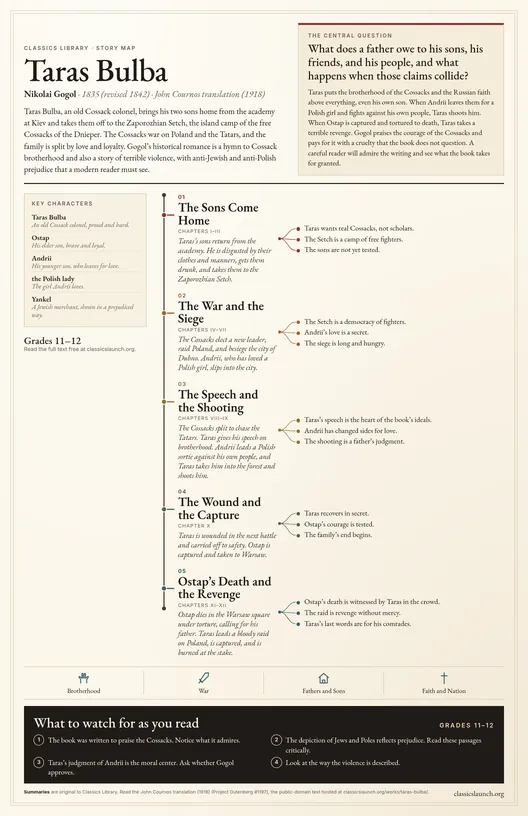 Story mapSee the story mapThe whole book on one page: the story in movements, the characters, and what to watch for. Free to print.
Abstract
Background. Gogol first printed the tale in 1835 in the collection Mirgorod and enlarged it in 1842, adding patriotic and religious passages. It has been read as a national epic in Russia and Ukraine alike, and has also been criticised for its violence and its portrayal of Jews.
Plot. An old Cossack takes his two sons to the Setch and leads them to war against Poland. One son falls in love with a Polish woman and betrays the cause, and his father kills him. The other is tortured to death in Warsaw, and the old man is burned at the stake.
Ideas. The book is about fellowship, courage and the price of loyalty, and about a nation's idea of its own glory. It also contains stereotypes and a hatred that readers should name and judge honestly against the Gospel, which forbids both vengeance and contempt for any people.
Text. The Everyman's Library translation is vigorous, with long sentences that carry the story's energy and its lyrical passages. The text contains cruel scenes and offensive portrayals of Jews, so it should be read with a guide who can set them in their history. Teachers can pair this work with the library's study guide, seminar questions and memory-work selection to prepare a discussion, a short essay or a recitation.
Main characters
- Taras Bulba: An old Cossack colonel
- Ostap: His steadfast elder son
- Andrii: His romantic younger son
- Yankel: A Jewish merchant who helps them

Summary
Taras Bulba is Gogol's historical romance of the Zaporozhian Cossacks, the free warriors of the Dnieper steppe who fought the Poles and Tatars in the early modern age. It opens with the return of two young men, Ostap and Andrii, from the academy at Kiev to their father's farm. Taras Bulba, an old Cossack colonel, a big, hard, loud, proud man, wants his sons to become real Cossacks, and after a day of drinking he takes them off to the Setch, the island camp where the free Cossacks live and train. The long middle of the book is a series of Cossack set pieces: the council of the Setch, the great raid on Poland, the siege of the Polish city of Dubno, the camp, the battle, and the pursuit of the Tatars. The heart of the book is the division of the two brothers. Ostap is steady, hard and loyal, a natural soldier. Andrii is more romantic, and when a young Polish lady he has once seen at Kiev sends a servant to him from the besieged city, he slips through a secret passage, falls in love and goes over to the enemy. In one of the best-known scenes in Russian fiction Taras meets his son in the forest, ordering him to dismount, and says: I gave you life, I will also kill you. He shoots him dead. Ostap is captured in the next battle and sent to Warsaw, where he is tortured to death in public without a cry; at the last he calls for his father, and Taras, hidden in the crowd, answers I hear. The last chapters give an account of Taras's revenge, a series of raids, massacres and burnings across Poland, until he is captured and burned at the stake, calling out a prophecy of a Russian Tsar who will rule the world. Gogol's prose in these chapters is among his most vivid, with lyrical passages on the steppe and the river. The book is a masterpiece of storytelling and a work that Christian readers should handle with serious care. It is a celebration of a violent warrior culture and a nationalist, militantly Orthodox view of Russia and the Ukraine, and it contains vicious stereotypes of Jews, who are mocked and drowned by the Cossacks. Gogol's treatment of fellowship, courage, and the cost of treason is worth studying, but these dark features need to be named in class, and the Gospel judgment on hatred, revenge and the persecution of the Jews set against them.
Virtues in this work
- Fortitude: Ostap's endurance of torture is the book's highest picture of fortitude, though it exists in a morally troubled setting.
- Honor: The Cossack code of honor is the book's central value and the source of its tragedy.
- Justice: The book is a case in which justice and revenge are confused, and the reader should supply the distinction.
- Friendship: Taras's praise of comradeship is the book's best account of friendship, but its limits are shown by the death of Andrii.
Plot or Argument
- Chapters I–III: The sons come home and go to the Setch
Taras's sons return from the academy. He is disgusted by their clothes and manners, gets them drunk, and takes them to the Zaporozhian Setch.
- Chapters IV–VII: The war and the siege
The Cossacks elect a new Koschevoi, raid Poland, and besiege the city of Dubno. Andrii, who has loved a Polish girl, slips into the city.
- Chapters VIII–IX: The speech and the shooting of Andrii
The Cossacks split to chase the Tatars. Taras gives his speech on brotherhood. Andrii leads a Polish sortie against his own people, and Taras takes him into the forest and shoots him.
- Chapter X: The wound and the capture
Taras is wounded in the next battle and carried off to safety. Ostap is captured and taken to Warsaw.
- Chapters XI–XII: Ostap's death and Taras's revenge
Ostap dies in Warsaw's square under torture, calling for his father. Taras leads a bloody raid on Poland, is captured, and is burned at the stake.
Characters
- Taras Bulba, protagonist
An old Cossack colonel, proud, violent and loyal to the Cossack brotherhood and to the Orthodox faith; he kills his own son for treason.
- Ostap, elder son
A steady, strong Cossack who dies under torture without a cry.
- Andrii, younger son
A romantic, more cultivated young man, who betrays his comrades for love and is killed by his father.
- The Polish lady, the beloved
A beautiful young woman from Kiev who calls Andrii into the besieged city.
- Yankel, a Jewish merchant
A merchant who helps Taras, depicted in the caricatured manner of the age.
Lessons
Fellowship and its limits
Taras's speech on comradeship is among the finest passages in the book: a man's true kin are those who share his mind, he says, and the wild beast also loves its young. But the same fellowship demands that he kill his own son. The reader is invited to ask what a brotherhood is worth when it requires such a deed.
- What does Taras mean by saying the bond of fellowship is higher than that of blood?
- Does Gogol approve of the shooting of Andrii?
Courage is not the same as goodness
Ostap's stoical death is magnificent, and the horror of his execution is described plainly. Gogol shows courage and cruelty on both sides, and a thoughtful reader will observe that brave men also kill the innocent.
- What does Ostap's death show about Cossack courage?
- How does Gogol describe the cruelty of the Poles and of the Cossacks?
Hatred is not the Gospel
The book calls the Cossacks defenders of the Orthodox faith, but its heroes burn, kill and mock their enemies. A Christian reader should compare this with the Gospel's command to love one's enemies.
- Where does the book treat Jews and Poles unjustly?
- What would Christ say to Taras at the stake?
Context
The story is set in the Ukraine of the early modern period, when the Cossacks of the lower Dnieper, the Zaporozhian Host, were a self-governing military brotherhood who raided the Ottomans and Crimean Tatars and fought the Polish-Lithuanian Commonwealth, which ruled much of Ukraine. The Commonwealth was Catholic and the Cossacks Orthodox, and religious war was mixed with social revolt. Jews served as tax-farmers and merchants under the Polish nobles, and were often the victims of Cossack uprisings.
Composition
Gogol first published Taras Bulba in 1835 in his collection Mirgorod, and revised and greatly enlarged it in 1842, adding the nationalist passages. The English translation hosted here is the Everyman's Library version of 1918.
Reception
Readers have loved the book for its epic sweep and its descriptions of the steppe, and criticised it for its glorification of violence and its antisemitism. Modern critics read it as a founding text of Russian and Ukrainian national feeling, and its legacy is complicated and politically contested.
Comparisons
- Hadji Murat
Tolstoy's late tale also deals with a warrior people and a conquest, but with a quite different moral view of violence and empire.
- The Captain's Daughter
Pushkin's historical novel treats Cossack rebels and loyal officers with a quieter irony.
- Ivanhoe
Scott's romance of knights and Saxons is another historical romance in which faith, nation and chivalry are in conflict, and in which Jews are shown as victims.
- Dead Souls
Gogol's comic novel gives an unflattering picture of the same Russia that Taras Bulba celebrates in its legends.
- The Cossacks
Tolstoy's account of the later Terek Cossacks, who are less heroic and more human.
Quotes
Frequently cited
“There is no more sacred brotherhood. The father loves his children, the mother loves her children, the children love their father and mother; but this is not like that, brothers. The wild beast also loves its young. But a man can be related only by similarity of mind and not of blood.”
Frequently cited
“I gave you life, I will also kill you!”
Frequently cited
“Father! where are you? do you hear?” “I hear!”
“and he uttered a name; but it was not the name of his native land, nor of his mother, nor his brother; it was the name of the beautiful Pole.”
“Ostap endured the torture like a giant. Not a cry, not a groan, was heard. Even when they began to break the bones in his hands and feet, when, amid the death-like stillness of the crowd, the horrible cracking was audible to the most distant spectators; when even his tormentors turned aside their eyes, nothing like a groan escaped his lips, nor did his face quiver.”
“Wait; the time will come when ye shall learn what the orthodox Russian faith is! Already the people scent it far and near. A czar shall arise from Russian soil, and there shall not be a power in the world which shall not submit to him!”
For Students
A reading companion for classical Christian high school students. See the student guide.
Reading Guide
Watch for
- The passages in which Gogol describes the steppe and the river, and what they add to the war scenes.
- Taras's speeches on brotherhood and the Orthodox faith.
- Every depiction of Jews and Poles, and how the narrator and the Cossacks treat them.
Key terms and names
- Setch
- The island camp of the Zaporozhian Cossacks on the lower Dnieper, which Gogol calls the cradle of their freedom.
- Koschevoi
- The elected chief of the Setch, who commanded the Cossacks in war.
- Zaporozhtzi
- The Cossacks who lived below the rapids of the Dnieper.
- Lyakhs
- The old Russian word for Poles, used by the Cossacks in the text.
Seminar Questions
- Comprehension Who are Taras's two sons, and how are they different?
- Comprehension What happens to Andrii, and why?
- Interpretation Why does Taras kill his own son?
- Interpretation What does Gogol want the reader to feel at Ostap's death?
- Interpretation How do the Cossacks speak of faith, and does their conduct match it?
- Big Question Can a book that celebrates violence and mocks a people be a great book? How should a Christian reader judge it?
- Big Question What would it mean for the Cossack brotherhood to live according to the Gospel?
Faith Connections
- Matthew 5:43–48 (Scripture)
Christ's command to love one's enemies and pray for those who persecute is the plain Gospel judgment on the book's hatreds.
- Genesis 4:8–10 (Scripture)
The first brother killed by his brother's hand is a scriptural comparison for Taras and Andrii; and God's question about Abel is a hard question for Taras.
- Romans 12:19 (Scripture)
'Never avenge yourselves... for it is written, Vengeance is mine, I will repay, says the Lord.' The book's revenge is read against this.
Logic and Rhetoric
Central argument: The book argues that a man's first loyalty is to his comrades and his faith, and that treason is the worst of sins. The reader should test this by asking what it costs, and to whom.
Rhetorical device: epic simile. Gogol compares Andrii's fall to an ear of corn cut by the reaping-hook and to a lamb stabbed in the heart.
Debate: Resolved: That Taras Bulba is a book to admire for its art but not for its morals.
Memory Work
There is no more sacred brotherhood. The father loves his children, the mother loves her children, the children love their father and mother; but this is not like that, brothers. The wild beast also loves its young. But a man can be related only by similarity of mind and not of blood.
Father! where are you? do you hear?” “I hear!
Writing Prompts
Essay: Is Taras Bulba a tragic hero or a fanatic? Use his speech on brotherhood and the shooting of Andrii to support your view.
Comparison with The Captain's Daughter: Compare Gogol's and Pushkin's pictures of the Cossacks. What does each writer admire and what does each fear?
Medical Lens
The book contains battle wounds and a full description of Ostap's public execution by breaking on the wheel. Nothing in the tale is clinical, but its images of wounds, fever after battle, and healing by a Cossack's own herbs show a pre-modern military medicine.
- Chapter X, Taras's wound
Taras is wounded in battle and lies unconscious for days, tended by his men.
- Chapter XI, the execution
The execution of Ostap in Warsaw is described in plain terms.
Creative Prompts
- Essay
Explain how Gogol makes the reader admire Ostap's courage while also seeing the cruelty that surrounds it. Quote two passages.
- Classroom
Read Taras's speech on brotherhood in Chapter IX and then Jesus's words in John 15:13–15. How do they agree and how do they differ?
- Essay
Gogol greatly expanded Taras Bulba in 1842 with nationalist passages. Argue whether they strengthen or weaken the book.
- Dialogue
Write a conversation between Andrii and Taras on the night before the siege, in which neither understands the other.
Further Reading
- Mirgorod, Nikolai Gogol
The collection in which Taras Bulba first appeared.
- Dead Souls, Nikolai Gogol
Gogol's satire of the same Russia; hosted in this library.
- The Captain's Daughter, Alexander Pushkin
A historical novel of Cossack revolt; hosted in this library.
- Ivanhoe, Walter Scott
A historical romance with a similar mix of chivalry and prejudice; hosted in this library.
Verification notes
Full text from Project Gutenberg #1197, the Everyman's Library translation of 1918 (John Cournos, identified from outside records because the Gutenberg text does not name the translator), in public domain. Quotes were checked against the hosted text. The historical notes are the library's summary of standard accounts.
- Direct confirmation of the translator's name from a title page of the 1918 Everyman's edition.
- The date in the early modern period which Gogol intends for the story.