Work record
Hadji Murat
Leo TolstoyHadji Murat (Tolstoy)Hadji Murat by Leo Tolstoy (1904)Hadji Murat is Tolstoy's last major work of fiction, written in secret between 1896 and 1904 and published after his death.Also known as: Hadji Murat (Tolstoy)
1904 (published 1912) · 19th Century · Novella · Russian
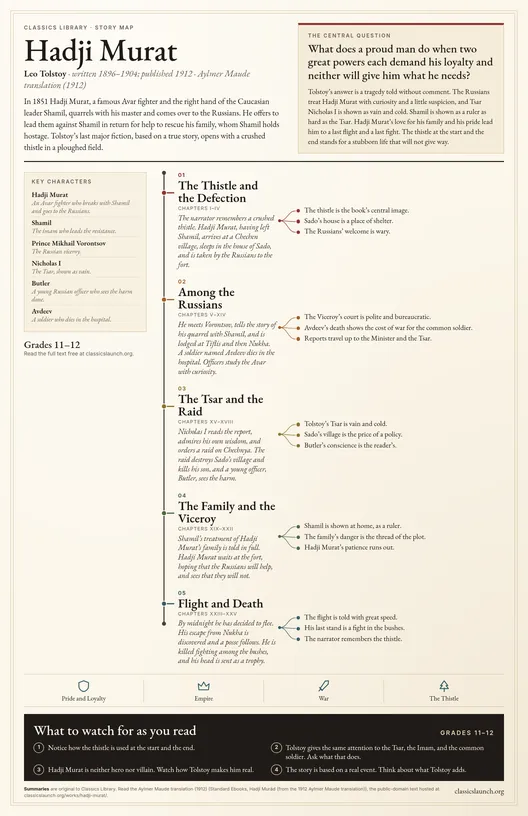 Story mapSee the story mapThe whole book on one page: the story in movements, the characters, and what to watch for. Free to print.
Abstract
Background. Tolstoy wrote this late work in private over eight years and left it unpublished, since it said what he thought of the Tsar and the conquest of the Caucasus. It appeared two years after his death and was at once recognised as a masterpiece of his old age.
Plot. A famous Avar fighter leaves the imam Shamil for the Russians in order to save his captive family. The Russians delay and half-trust him, and at last he decides to flee to the mountains. He is hunted down and killed by militia, and his head is cut off and carried away as a trophy of the frontier.
Ideas. The tale is a judgment on empires, whether Russian or Muslim, and on the glossy talk of rulers who use cruelty as a tool. It gives the highest dignity to a single man's stubborn loyalty, and it grieves for the small victims of the war, whose names the histories do not record and whose deaths no ruler counts.
Text. The Maude translation is clear and lively, and the Standard Ebooks edition adds a short translator's preface and endnotes. The Caucasian terms are kept and explained, and many of the twenty-five chapters can be read separately in class, though the thistle at each end should be read together.
Main characters
- Hadji Murat: An Avar fighter who defects to the Russians
- Shamil: The imam of the mountain peoples
- Vorontsov: The Russian viceroy
- Nicholas I: The Tsar
- Butler: A young Russian officer

Summary
Hadji Murat is Tolstoy's last major work of fiction, written in secret between 1896 and 1904 and published after his death. It tells a true story from the Russian conquest of the Caucasus. In 1851 Hadji Murat, a famous Avar fighter and the naib of the imam Shamil, quarrels with his master, comes over to the Russians, and offers to lead them against Shamil in return for help in rescuing his mother, wives and son, whom Shamil holds hostage. The tale opens with a short frame: the narrator sees a crushed thistle in a ploughed field in the middle of summer and remembers a death. It then turns to the history of the man himself. Tolstoy lays out the story in short, vivid chapters that jump between four worlds. We see the Russian border forts, where a young officer, Butler, falls under the spell of the Caucasus, and the Major's wife, Marya Dmitrievna, befriends the Chechen guest. We see the Viceroy, Prince Vorontsov, a courteous and cultivated man who receives Hadji Murat in Tiflis and cannot bring himself to act. We see the court of Nicholas I, a vain and cruel emperor who gives orders for the destruction of villages and the felling of forests while believing himself a benefactor. And we see the mountain world of Shamil, a ruler as ruthless and as vain as the Tsar himself, who holds Hadji Murat's mother, wives and son at the mercy of his whim. The central scenes are of a man between two empires who belongs to neither. Hadji Murat is a proud, brave, shrewd man, a devout Muslim, tender toward his son and loyal to his comrades, and Tolstoy gives him greater dignity than he gives to either of his masters. When the Russians keep putting off the rescue he has been promised, he decides at midnight to escape, break into the mountains, and either rescue his family or die. He gallops from Nukha, is hunted down by a detachment of militia, and is killed in a short, desperate fight among the bushes. His head is cut off and sent to the Russians as a trophy. The book is as unsparing about the conquest of the Caucasus as any Russian writer had dared to be. The ruined village with its poisoned fountain, the death of the soldier Avdeev in the hospital, and the last stand of the Avar are all rendered without comment. The thistle at the beginning, and again at the end, gives the tale its image of a life that will not yield. Christian readers will see in it a study of the cruelty of empires and the dignity of one man's loyalty to his own.
Virtues in this work
- Fortitude: Hadji Murat's courage and endurance, from the flight from Shamil to the last fight, are the book's centre.
- Honor: His loyalty to his family and his word is set against the false honor of his masters.
- Justice: The tale is a judgment on the injustice of conquest and on the cruelty of hostage-taking.
- Charity: Marya Dmitrievna's hospitality and the soldiers' pity for Avdeev are small signs of kindness among the cruelties.
Plot or Argument
- Chapters I–IV: The thistle and the defection
The narrator remembers a crushed thistle. Hadji Murat, having left Shamil, arrives at a Chechen village, sleeps in the house of Sado, and is taken by the Russian commander to the fort.
- Chapters V–XIV: Among the Russians
He is received by Vorontsov, tells the story of his quarrel with Shamil, and is housed at Tiflis and then Nukha. A soldier named Avdeev dies in the hospital; officers study the Avar with curiosity and unease; Vorontsov reports to the Minister of War and Nicholas I.
- Chapters XV–XVIII: The Tsar and the raid
Nicholas I reads the report, pleases himself with his own wisdom, and orders a raid on Chechnya. The raid destroys Sado's village and kills his son, and Butler, a young officer, sees the harm he has helped to do.
- Chapters XIX–XXII: The family and the Viceroy
Shamil's treatment of Hadji Murat's family is told in full. Hadji Murat waits at the fort, hoping that the Russians will help, and sees that they will not.
- Chapters XXIII–XXV: Flight and death
By midnight he has decided to flee. His escape from Nukha is discovered, a posse follows, and he is killed fighting among the bushes. The head is severed and sent as a trophy; the narrator remembers the thistle.
Characters
- Hadji Murat, protagonist
A famous Avar fighter who leaves Shamil for the Russians in order to rescue his family, a proud man whose loyalty and courage are not changed by betrayal.
- Shamil, the imam
The Muslim leader of the Caucasian resistance, a harsh ruler who takes Hadji Murat's family hostage.
- Prince Mikhail Vorontsov, viceroy
A cultured, courteous Russian governor who receives Hadji Murat but cannot make up his mind to help him.
- Nicholas I, the Tsar
A vain and stern emperor, whose cruelty in the name of order is the book's chief indictment.
- Butler and Marya Dmitrievna, observers
A young officer and the Major's wife, the Russian witnesses who come to like Hadji Murat and see the cost of the war.
- Avdeev, the soldier
A poor soldier who enlisted in his brother's place and dies in the hospital, one of the book's smaller and more affecting figures.
Lessons
Empires lie about their own cruelty
The Tsar thinks himself a wise ruler and orders villages burned; the Viceroy is cultivated and does nothing. Tolstoy shows how decent language can cover indecent acts, and how ordinary men grow used to the damage. The book reminds Christians that a state's claim to order is not a measure of justice.
- How does Tolstoy show the gap between what Nicholas I says and what his orders do?
- What does the polluted fountain tell the reader about the raid?
Loyalty to family is a high thing and a costly one
Hadji Murat risks everything for his mother, wives and son. His loyalty is not made to look simple, and he is as capable of violence as his enemies, but it stands in judgment on the masters who use hostages as tools.
- What does Hadji Murat want, and how does it affect each choice he makes?
- Does Tolstoy admire him for it, or only record it?
Dignity under pressure
The thistle at the opening and end stands for a will that does not bend, however ill-used. The narrator's pity is not for victory but for tenacity.
- Why does the narrator compare Hadji Murat to the thistle?
- What makes a death dignified in this book, and what makes it only brutal?
Context
The Russian conquest of the north Caucasus lasted from the 1810s to the 1860s. Imam Shamil led the Muslim mountain peoples of Chechnya and Dagestan against Russia from 1834 until his surrender in 1859. Hadji Murat, a real Avar naib, defected to the Russians in 1851 and was killed in 1852. Tolstoy served as a young officer in the Caucasus in the 1850s and drew on his own memory and on documents.
Composition
Tolstoy wrote and rewrote the story from 1896 to 1904, set it aside as a work of art not meant for the crowd, and left it unpublished at his death in 1910. It appeared in 1912. The Maude translation hosted here dates from the same year.
Reception
Readers have called it one of the finest short novels in any language, and its judgment on the Caucasian wars has led to its use in discussion of empire, resistance and terror. In Russia it was long read as a protest against Nicholas I; in the Caucasus it is read as a record of a vanished way of life.
Comparisons
- War and Peace
Tolstoy's great earlier war novel shares this book's distrust of those who claim to command history, and sets the mountain war beside the French invasion.
- The Cossacks
Tolstoy's first Caucasian tale, with a young nobleman drawn to the peoples of the mountains and the Cossack line.
- A Hero of Our Time
Lermontov also wrote of Russian officers in the Caucasus and the mountain peoples, with a darker Romantic irony.
- Heart of Darkness
Conrad's novella reads empire's pretensions against its violence in a way close to Tolstoy's thistle and his poisoned fountain.
- Master and Man
Another late Tolstoy story of a death on an ordinary day that tells more about a life than its public history.
Quotes
Frequently cited
““But what energy and tenacity! With what determination it defended itself, and how dearly it sold its life!””
Frequently cited
“By midnight his decision had been formed. He had decided that he must fly to the mountains, and with the Avars still devoted to him must break into Vedenó, and either die or rescue his family.”
Frequently cited
“But suddenly a shudder passed through him; he staggered away from the tree and fell on his face, stretched out at full length, like a thistle that had been mown down, and he moved no more.”
Frequently cited
“It was of this death that I was reminded by the crushed thistle in the midst of the ploughed field.”
“The fountain was polluted, evidently on purpose, so that the water could not be used.”
“So the words stood in the letter; but it was not fated that Peter should receive the news of his wife’s having left home, nor the present of the ruble, nor his mother’s last words.”
For Students
A reading companion for classical Christian high school students. See the student guide.
Reading Guide
Watch for
- The thistle in the first chapter and again in the last.
- What each ruler, Nicholas, Vorontsov and Shamil, says about order and what he does.
- The small Russian figures, the soldier Avdeev and the officer Butler, and how war touches them.
Key terms and names
- Naib
- A governor or deputy of the imam Shamil, as Hadji Murat was; the word is explained in the hosted notes.
- Aoul
- A mountain village in the Caucasus; the hosted text keeps this spelling.
- Murid
- A follower or disciple of Shamil's religious and military movement.
- Viceroy
- The Tsar's governor of the Caucasus, Prince Vorontsov, who rules from Tiflis.
Seminar Questions
- Comprehension Why does Hadji Murat leave Shamil, and what does he ask of the Russians?
- Comprehension What happens to the village of Sado, and why?
- Interpretation Why does Tolstoy begin and end with a thistle?
- Interpretation How are Nicholas I and Shamil alike?
- Interpretation Why does the Viceroy fail Hadji Murat?
- Big Question Can a man be admired for loyalty and courage even when he fights on the wrong side of a war?
- Big Question Is it right to say that every empire poisons its own fountains?
Faith Connections
- Micah 6:8 (Scripture)
The prophet's summary of what God requires, to do justice and love kindness, is a standard against which the Tsar and the imam can both be measured.
- Proverbs 14:34 (Scripture)
'Righteousness exalts a nation, but sin is a reproach to any people.' The book reads the conquest against this.
- Augustine, City of God IV.4 (Great Conversation)
Augustine asked what kingdoms are without justice but great bands of robbers, a question that the raid on Sado's village puts bluntly.
Logic and Rhetoric
Central argument: Empires and their rulers lie about the harm they do, and the truth shows in particular lives and deaths. The book argues by contrast and by omission, letting events and details stand without commentary.
Rhetorical device: recurring image. The crushed thistle at the beginning and end gives a single image for Hadji Murat's last stand and for the whole book's pity.
Debate: Resolved: That Tolstoy's Hadji Murat is more admirable than the rulers who use him.
Memory Work
“But what energy and tenacity! With what determination it defended itself, and how dearly it sold its life!”
By midnight his decision had been formed. He had decided that he must fly to the mountains, and with the Avars still devoted to him must break into Vedenó, and either die or rescue his family.
Writing Prompts
Essay: How does Tolstoy create sympathy for Hadji Murat without hiding his faults? Cite three scenes.
Comparison with The Cossacks: Compare the young Olenin's idea of the Caucasus with the old Tolstoy's picture in Hadji Murat. What has he come to see?
Medical Lens
The hospital chapter, with the wounded soldier Avdeev, shows frontier military medicine in its crudest form: an unremoved bullet in the stomach, an overcrowded ward, a doctor who cannot help. The last chapter is a clear account of a death by wounds and decapitation, and is graphic.
- Chapter VII, the hospital
A soldier wounded in the stomach is carried to a small wooden hospital where the doctor probes for the bullet and cannot remove it.
- Chapter XXV, the last fight
Hadji Murat is shot repeatedly, struggles to rise, and is finished with a dagger; the passage describes his consciousness fading.
Creative Prompts
- Essay
Explain what the thistle means at the beginning and end of the tale. Does Tolstoy offer Hadji Murat as an example, a warning, or a witness?
- Dialogue
Write a conversation between Butler and Hadji Murat on the day before the escape, in which each says less than he feels.
- Classroom
Compare the portraits of Nicholas I, Vorontsov and Shamil. Which is the most dangerous kind of ruler, and why?
- Essay
Read the chapter on the polluted fountain and the chapter on the Tsar. Explain how Tolstoy lets facts, and not comment, convict an empire.
Further Reading
- The Cossacks, Leo Tolstoy
Tolstoy's earlier tale of the Caucasus, hosted in this library.
- A Hero of Our Time, Mikhail Lermontov
The Romantic novel of a Russian officer in the Caucasus.
- Sevastopol Sketches, Leo Tolstoy
Tolstoy's own war reports from the Crimea.
- Tolstoy, Henri Troyat
A life that treats his Caucasian service and his late fiction.
Verification notes
Full text from Standard Ebooks, based on the 1912 Maude translation, which is in the public domain. Quotes were checked against the hosted text. Historical dates of Hadji Murat's defection and death follow standard accounts and the translator's notes in the hosted text.
- Exact dates of Hadji Murat's defection and death, which sources give in different calendars.
- The degree to which Tolstoy's account of Shamil's treatment of the family follows documents.