Work record
The Cossacks
Leo TolstoyThe Cossacks (Tolstoy)The Cossacks by Leo Tolstoy (1863)The Cossacks is Tolstoy's first major work of fiction after his army years, and it draws on his own life in the Caucasus in the early 1850s.Also known as: The Cossacks (Tolstoy)
1863 · 19th Century · Novella · Russian
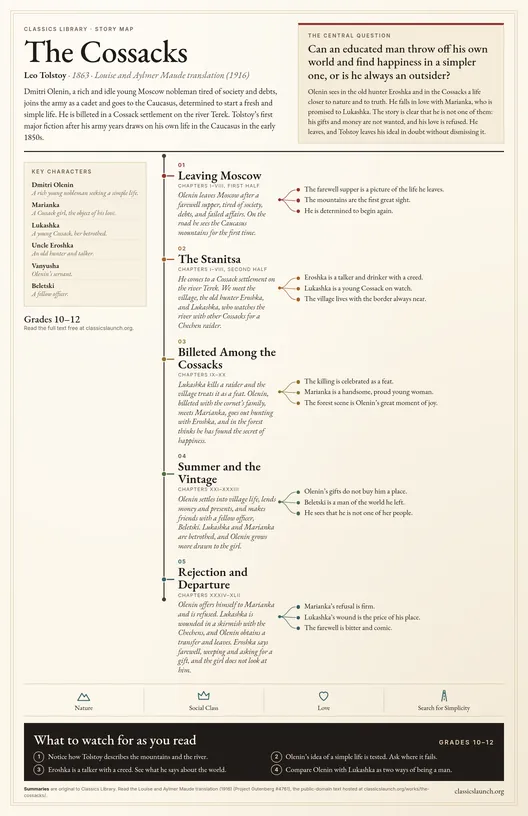 Story mapSee the story mapThe whole book on one page: the story in movements, the characters, and what to watch for. Free to print.
Abstract
Background. Tolstoy drew this story from his own years as a young officer in the Caucasus. He began it in 1852, worked on it for a decade, and published it in 1863, just before War and Peace made him world-famous.
Plot. A rich young Muscovite goes to a Cossack frontier village to begin a new life. He falls in love with a Cossack girl who is promised to another, hunts with an old drinker, and discovers in a forest what he thinks is the secret of happiness. He cannot make himself belong, and when the girl turns from him, he leaves.
Ideas. The book asks whether the longing for a simple life is wisdom or flight. It sets Olenin's thoughts of love and sacrifice against Eroshka's creed that there is no sin, and it shows how little either can do without the habit of real giving, the discipline of duty, and the humility to learn from people who owe him nothing.
Text. The Maude translation is easy and idiomatic, with short chapters and many Russian names in their stressed forms. Some readers find the opening, in Moscow, rather slow before the book reaches the mountains, and a short introduction to the Caucasian frontier helps a class a great deal. Teachers can pair this work with the library's study guide, seminar questions and memory-work selection to prepare a discussion, a short essay or a recitation.
Main characters
- Dmitri Olenin: A rich Moscow cadet who seeks a new life
- Marianka: A Cossack girl he loves
- Lukashka: Her young Cossack suitor
- Uncle Eroshka: The old hunter and philosopher

Summary
The Cossacks is Tolstoy's first major work of fiction after his army years, and it draws on his own life in the Caucasus in the early 1850s. Dmitri Olenin, a rich and idle young Moscow nobleman, tired of society, debts and a string of failed affairs, joins the army as a cadet and goes to the Caucasus, determined to start a fresh and simple life. He is billeted in a Cossack settlement on the Terek, where the Russians have long lived under arms among Chechen raiders. There he meets the old hunter Uncle Eroshka, who drinks, boasts and tells him that God made everything for man's pleasure; the young Cossack Lukashka, bold and reckless, who kills a Chechen abrek on the river bank; and Marianka, the handsome daughter of his landlord, who is promised to Lukashka. Olenin falls in love with Marianka and with the Cossack life she belongs to. He is drawn by the beauty of the mountains and of the land, by the strength of the men and women who live by hunting, vine-growing and war, and above all by what he takes to be their natural happiness. In a famous scene in the forest he thinks that happiness lies in love and self-sacrifice, and that he should live for others. But his goodness is mostly in his head. He lends money, gives gifts, drinks and talks with Eroshka, and offers himself to the girl as one who thinks that he can leap out of his class by affection. When the Cossack community prepares for Lukashka's wedding, and Lukashka is wounded in a skirmish, Marianka turns from Olenin, and he finds that she does not need him and that he is a stranger to her people. He leaves the settlement, and neither the old man nor the girl looks at him as he goes. The story is a young writer's first, clear statement of a theme Tolstoy never gave up: that the educated man's self-regard and reflection cut him off from the simple life that he envies and that the people he idealizes are no more innocent than he is. Eroshka's easy paganism and the Cossacks' readiness to kill are described without flattery, and Olenin's longing is shown to be partly a vanity. Christian readers will find the book a sharp account of how a sentimental love of nature and simplicity can be a refuge from duty, and a reminder that self-giving is not the same as self-deception. The Maude translation hosted here preserves the Russian names with their stress marks.
Virtues in this work
- Humility: Olenin's idealism needs correction by humility, and the end of the book is a lesson in it.
- Charity: His desire for self-sacrifice is a good beginning, unfinished until it is acted on.
- Temperance: Eroshka's easy attitude to drink and appetite sets the question of restraint in a pleasant light and invites a Christian answer.
- Prudence: The book ends in a sober account of the limits of what a man can know about himself.
Plot or Argument
- Chapters I–VIII: Departure and arrival
Olenin leaves Moscow after a farewell supper, sees the Caucasus mountains for the first time, and comes to a Cossack stanitsa on the river Terek. We meet the village, the old hunter Eroshka, and Lukashka, who watches the river with other Cossacks for a Chechen raider.
- Chapters IX–XX: Billeted among the Cossacks
Lukashka kills the abrek and the village treats it as a feat. Olenin, billeted with the cornet's family, meets Marianka, goes out hunting with Eroshka, listens to his creed, and in the forest at last thinks he has found the secret of happiness.
- Chapters XXI–XXXIII: Summer and the vintage
Olenin settles into the life of the village, lends money and presents, and makes friends with a fellow officer, Beletski. Lukashka and Marianka are betrothed, and Olenin grows more drawn to the girl and more aware that he is not one of her people.
- Chapters XXXIV–XLII: Rejection and departure
Olenin offers himself to Marianka and is refused. Lukashka is wounded in a skirmish with the Chechens, and Olenin obtains a transfer and leaves. Eroshka says farewell, weeping and asking for a gift, and the girl does not look at him.
Characters
- Dmitri Olenin, protagonist
A rich Moscow cadet who seeks a new, simpler life in the Caucasus and discovers how little he is prepared for it.
- Marianka, beloved
The handsome, strong-willed daughter of a Cossack household, betrothed to Lukashka and attracted by Olenin without trusting him.
- Lukashka, rival
A bold young Cossack called the Snatcher, who kills an abrek and wins the girl.
- Uncle Eroshka, old hunter
A drinker, storyteller and friend, who tells Olenin that there is no sin and who truly loves him.
- Vanyusha, servant
Olenin's practical manservant, who sees the Cossacks and his master with a plain eye.
Lessons
Self-sacrifice must be done and not only felt
Olenin discovers in the forest that happiness lies in love and self-sacrifice, and runs off to find someone to sacrifice himself for. The comedy and the pathos of the scene are the same: he has seen the truth and has not yet learned to practice it. The point for the student is the gap between insight and action.
- What exactly does Olenin discover in the forest, and what does he do next?
- Why can't he act on it in the village?
The idealised simple life is not innocent
Tolstoy loves the Cossacks and their landscape, but he does not hide their drinking, hunting of men and cruelty. Eroshka's philosophy that there is no sin in any of it is the book's real temptation, since it is attractive and wrong.
- How does Eroshka justify his way of life, and what does the narrator think of it?
- Where does Tolstoy let the reader see the cost of the Cossack code?
Love that takes without belonging is a kind of theft
Olenin's love for Marianka is genuine, but he asks to be made one of a community without sharing its burdens. She sees this sooner than he does. A reader may ask what a love that is willing to give up its own world would have to look like.
- Why does Marianka turn from Olenin at the end?
- What would it have cost him to belong?
Context
The story is set in the early 1850s among the Terek Cossacks, descendants of Russian settlers who had lived on the border with the Chechens since the sixteenth century. They were free, armed, and mixed with the mountain peoples in ways that Russian officers found romantic and disturbing. Tolstoy himself joined the army as a cadet in 1851 and lived in a Cossack village for most of two years.
Composition
He began the book in 1852, worked on it for a decade, and published it in 1863, just before War and Peace. The Maude translation of 1916 is the version hosted here.
Reception
Turgenev and other contemporaries praised its landscapes and its Eroshka, though some thought the end disappointing. Later readers have found in Olenin an early version of the troubled Tolstoyan seeker, and in Eroshka a great figure of Russian fiction.
Comparisons
- Hadji Murat
Tolstoy's late novella returns to the Caucasus, this time through the eyes of an old man who sees the harm of conquest.
- A Hero of Our Time
Lermontov's Pechorin is another Russian officer who seeks meaning in the Caucasus and fails to find it in love.
- War and Peace
Pierre Bezukhov's search for a new life through simplicity and service is an earlier and wider study of the same question.
- A Confession
The older Tolstoy's own account of his search for the meaning of life, which Olenin's forest reflections foreshadow.
- Fathers and Sons
Turgenev's Bazarov is another educated Russian who meets a plain life and learns the limits of his own theories.
Quotes
Frequently cited
“God has made everything for the joy of man. There is no sin in any of it.”
Frequently cited
“What are they? Love, self-sacrifice.” He was so glad and excited when he had discovered this, as it seemed to him, new truth, that he jumped up and began impatiently seeking some one to sacrifice himself for, to do good to and to love. “Since one wants nothing for oneself,” he kept thinking, “why not live for others?”
Frequently cited
“Daddy Eróshka was talking to Maryánka, evidently about his own affairs, and neither the old man nor the girl looked at Olénin.”
“No, to be beloved is a misfortune. It is a misfortune to feel guilty because you do not give something you cannot give.”
“Why injure a beast? You fool, you fool!”
“Why, I love you, and how I pity you! You are so forlorn, always alone, always alone.”
For Students
A reading companion for classical Christian high school students. See the student guide.
Reading Guide
Watch for
- How Olenin sees the mountains in the first chapters, and how the narrator sees them.
- What the Cossacks say about killing, honour and God, and what Eroshka says.
- Every time Olenin tries to be good, and what comes of it.
Key terms and names
- Abrek
- A Chechen or mountain raider, who steals and kills across the Terek.
- Stanitsa
- A Cossack village on the frontier, built as a fortified settlement.
- Cadet
- A young volunteer of good family who serves in the ranks before being commissioned; Olenin's status.
- The Terek
- The river along which the Cossack villages stand, forming the frontier with the Chechens.
Seminar Questions
- Comprehension Why does Olenin go to the Caucasus, and what does he hope to find?
- Comprehension Who is Eroshka, and what does he tell Olenin about sin?
- Interpretation What does Tolstoy think of the Cossack way of life? Cite two passages.
- Interpretation Why does Marianka not accept Olenin?
- Interpretation What does the last line of the book leave the reader with?
- Big Question Is the longing for a simple life a form of wisdom or a form of escape?
- Big Question Can a man leave his class and his habits behind? What does Tolstoy think?
Faith Connections
- Romans 3:23 (Scripture)
Eroshka says that there is no sin; the apostle says that all have sinned. The book gives the reader both the old man's easy creed and the real shadow behind it.
- 1 John 3:18 (Scripture)
'Let us not love in word or talk but in deed and in truth.' Olenin's love is long on word and short on deed, and the verse is the right measure.
- Matthew 7:24–27 (Scripture)
The house on rock and the house on sand are a good way to read the difference between Olenin's resolve and his practice.
Logic and Rhetoric
Central argument: A man cannot escape himself by changing his place; the longing for simplicity may itself be a form of vanity. The novella argues by letting a series of scenes test Olenin's ideas.
Rhetorical device: dramatic irony. Olenin's discovery of self-sacrifice is followed at once by his search for someone to sacrifice himself for, which the reader sees at once is a symptom of the old selfishness.
Debate: Resolved: That Olenin was wiser at the end of The Cossacks than at the beginning.
Memory Work
What are they? Love, self-sacrifice.” He was so glad and excited when he had discovered this, as it seemed to him, new truth, that he jumped up and began impatiently seeking some one to sacrifice himself for, to do good to and to love. “Since one wants nothing for oneself,” he kept thinking, “why not live for others?
God has made everything for the joy of man. There is no sin in any of it.
Writing Prompts
Essay: Is Eroshka a wise man or a dangerous one? Build your answer from his speeches and his farewell.
Comparison with A Hero of Our Time: Compare Olenin and Pechorin as Russians who seek meaning in the Caucasus. How does each treat the people he meets?
Medical Lens
The Cossack settlement drinks freely, with the old man Eroshka as a cheerful example, and fever hangs over the marshes of the Terek. Lukashka's wound and the abrek's death give small pictures of frontier medicine.
- Chapters XX–XXIII, Eroshka's talk
The old hunter's drinking and his praise of wine as a medicine and a joy show the permissive attitude of the settlement.
- Chapter XL, Lukashka's wound
A young Cossack is wounded in a skirmish and treated by his own people.
Creative Prompts
- Essay
Explain what Olenin has discovered by the end of the forest scene and what he has not. Use two later scenes to show the difference.
- Dialogue
Write a conversation between Marianka and her mother after Olenin has gone, in which Marianka explains why she refused him.
- Classroom
Divide the class into Eroshka's party and Olenin's. Argue whether there is sin in any of it, using the text.
- Fiction
Write a brief scene in which Olenin returns ten years later. Keep to Tolstoy's plain style.
Further Reading
- Hadji Murat, Leo Tolstoy
The old Tolstoy's Caucasian tale, hosted in this library.
- A Hero of Our Time, Mikhail Lermontov
The great Romantic novel of the same frontier.
- Sevastopol Sketches, Leo Tolstoy
Tolstoy's war stories from the Crimea.
- Tolstoy, Henri Troyat
A life that treats the Caucasian years at length.
Verification notes
Full text from Project Gutenberg, the 1916 Maude translation, in public domain. Quotes were checked against the hosted text. Summary details of the late chapters were read from the text; some chapter numbers in the plot outline are approximate.
- Exact chapter numbers of the forest scene and the skirmish.
- Dates of Tolstoy's service in the Caucasus.