Work record
The Little Red Hen
Sara Cone BryantThe Little Red Hen by Sara Cone Bryant (1907)The Little Red Hen begins with a discovery small enough to fit in a child's hand: a grain of wheat.1907 · Early 20th Century · Short Stories · English
Read this when a loaf of bread can open a conversation about helping and earning.
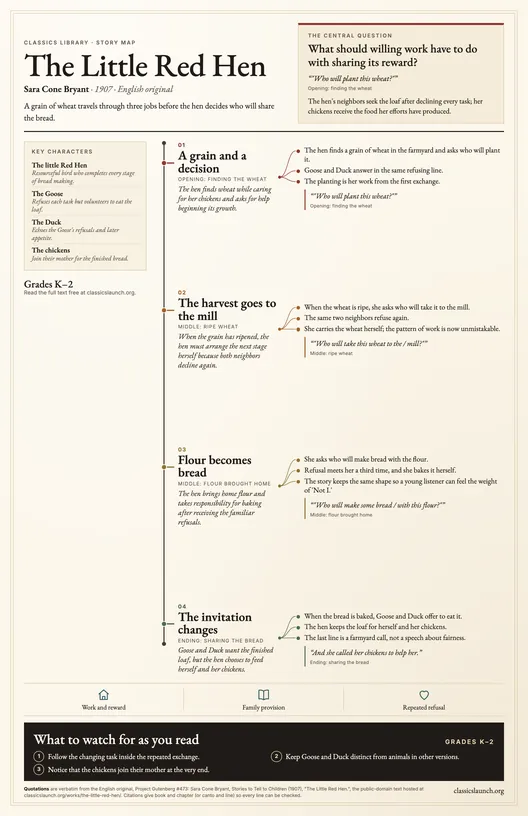 Story mapSee the story mapThe whole book on one page: the story in movements, the characters, and what to watch for. Free to print.
Abstract
Background. Published in Bryant's 1907 storytelling collection, this compact version belongs to a long tradition of animal tales for young listeners. Its small cast and predictable exchanges suit oral delivery. The hosted selection presents the entire tale rather than an expanded picture-book adaptation, with Goose and Duck as the unwilling neighbors.
Content. A mother hen finds wheat, sows it without assistance, carries the crop for grinding, and turns the resulting flour into bread. At each invitation to labor, the other birds decline. When eating becomes the subject, they promptly volunteer. She reserves the finished food for herself and summons her own chicks.
Themes. Industry supplies the narrative's steady movement, while the ending raises questions about fair reward and dependable companionship. The hen's initiative matters as much as her refusal at the feast. She repeatedly makes progress instead of waiting for agreement, and the presence of her young gives her effort an immediate family purpose.
Significance. Repetition turns a chain of practical operations into an easily remembered pattern. Children can distinguish sowing, milling, and baking while following the same pair of responses. The last exchange is effective because the listeners already know the earlier ones. This version provides a clear starting point for comparing different tellings and discussing the relationship between willingness to help and willingness to receive.
Main characters
- The little Red Hen: Resourceful bird who completes every stage of bread making.
- The Goose: Refuses each task but volunteers to eat the loaf.
- The Duck: Echoes the Goose's refusals and later appetite.
- The chickens: Join their mother for the finished bread.
Summary
The Little Red Hen begins with a discovery small enough to fit in a child's hand: a grain of wheat. The hen is in the farmyard with her chickens when she finds it. She sees that the grain can become something useful, but only through a sequence of tasks. Before beginning, she asks her neighbors to help. The Goose refuses, and the Duck gives the same answer. The hen undertakes the planting herself. Bryant's telling then moves directly to the ripened wheat. The hen again seeks assistance, this time with taking the harvest to the mill. Neither neighbor volunteers. She carries the wheat herself and returns with flour. A third request concerns making bread. Again the Goose and Duck decline, and again the hen accepts the work. The repeated exchanges make the whole process easy to follow without a detailed account of farming or baking. Young listeners can anticipate both refusals and the hen's response, while noticing that the task changes at each stage. Once the bread is ready, the hen asks a different question. The Goose and Duck, previously so unwilling, both offer to eat. Their sudden enthusiasm completes the tale's joke. The hen refuses their claim and says that she will eat the bread herself. Her last action gives that decision a domestic warmth: she calls her chickens to join her. The reward belongs to the household whose mother has done the work. This short version uses only four principal speaking roles, counting the hen's neighbors separately and her chickens as a group. It does not introduce the cat, pig, or other helpers found in some retellings. Nor does it interrupt the action with a stated moral. The contrast between repeated refusal and eager appetite does the teaching. A single grain becomes a loaf through patient effort, and a familiar pattern of questions becomes a small test of friendship and responsibility. Read aloud, the story offers children the pleasure of knowing what comes next before the final question changes the terms.
Virtues in this work
Plot or Argument
- A grain and a decision
The hen finds wheat while caring for her chickens and asks for help beginning its growth.
- The harvest goes to the mill
When the grain has ripened, the hen must arrange the next stage herself because both neighbors decline again.
- Flour becomes bread
The hen brings home flour and takes responsibility for baking after receiving the familiar refusals.
- The invitation changes
Goose and Duck want the finished loaf, but the hen chooses to feed herself and her chickens.
Characters
- The little Red Hen, Worker and mother
Resourceful bird who completes every stage of bread making.
- The Goose, Unwilling neighbor
Refuses each task but volunteers to eat the loaf.
- The Duck, Unwilling neighbor
Echoes the Goose's refusals and later appetite.
- The chickens, The hen's young
Join their mother for the finished bread.
Lessons
Begin the work
The hen recognizes a useful possibility in a tiny discovery. She begins even when nobody agrees to assist her.
- What could happen if she waited for everyone?
- Which task must come first?
Notice what changes
The same neighbors answer several different requests. Their eagerness changes only when the work is complete.
- How do the birds answer the first requests?
- Why is the final question funny?
A household's provision
The hen's labor feeds her chickens as well as herself. The ending connects steady work with care for dependents.
- Who shares the bread at the end?
- How might Goose and Duck act differently next time?
Context
Bryant prepared stories for teachers and adults who told them aloud. This tale's farm work, brief speeches, and recurring sequence make it especially suited to that setting.
Composition
The selection comes from Stories to Tell to Children (1907); it is Bryant's telling of a traditional story.
Reception
The hen's story remains familiar in nursery reading, and comparing versions reveals changes in the neighbors and the stages of work.
Comparisons
- Aesop's Fables
Both use speaking animals to make conduct visible, but the hen's lesson emerges through a repeated sequence of tasks.
- The Tale of Peter Rabbit
Compare the hen's careful provision of food with Peter's impulsive visit to a forbidden garden.
Quotes
“"Who will plant this wheat?"”
“"Who will take this wheat to the mill?"”
“"Who will make some bread with this flour?"”
“And she called her chickens to help her.”
For Students
A reading companion for classical Christian high school students. See the student guide.
Reading Guide
Watch for
- Follow the changing task inside the repeated exchange.
- Keep Goose and Duck distinct from animals in other versions.
- Notice that the chickens join their mother at the very end.
Key terms and names
- grain
- A seed that can grow into a cereal plant such as wheat.
- mill
- A place where harvested grain is ground into flour.
- flour
- Ground grain used as an ingredient in bread dough.
- sequence
- The order in which a set of events or tasks happens.
Seminar Questions
- Comprehension What does the hen find in the farmyard?
- Comprehension What happens between planting and baking?
- Interpretation Why does the storyteller repeat the neighbors' answers?
- Interpretation What difference does the presence of the chickens make?
- Big Question Should someone expect a reward after refusing every task?
- Big Question How can friends share work fairly when their abilities differ?
Faith Connections
- Proverbs 6:6–8 (Scripture)
The ant's seasonal preparation offers a useful companion to the hen's steady provision.
- 2 Thessalonians 3:10–12 (Scripture)
Paul addresses refusal to work within a community; compare that specific refusal with the conduct of Goose and Duck.
Logic and Rhetoric
Central argument: Repeated refusals followed by eager appetite support the claim that shared rewards call for willing participation.
Rhetorical device: repetition with reversal. The same two refusals accompany three tasks; the offer of food brings an immediate change in both responses.
Debate: Resolved: Goose and Duck should help with the next loaf before expecting to share it.
Memory Work
And she called her chickens to help her.
Writing Prompts
Essay: Explain how the last question changes the pattern established by the first three requests.
Comparison with Aesop's Fables: Compare the hen with one animal in Aesop: how does each story connect choices with consequences?
Creative Prompts
- Classroom
Arrange picture cards for planting, milling, and baking, then explain why the order matters.
- Dialogue
Write a new conversation in which Goose and Duck offer useful help before the next planting.
- Fiction
Tell a short story about a child who turns one small discovery into something the family can share.
Further Reading
- Stories to Tell to Children, Sara Cone Bryant
- How to Tell Stories to Children, Sara Cone Bryant
Verification notes
Text and quotations follow the complete Bryant selection hosted from Project Gutenberg #473. The year identifies the 1907 collection; no claim is made that Bryant originated the traditional tale.
No verification flags recorded.