Work record
The Tale of Benjamin Bunny
Beatrix PotterThe Tale of Benjamin Bunny by Beatrix Potter (1904)The Tale of Benjamin Bunny continues the trouble that began in Mr. McGregor's garden.1904 · Early 20th Century · Short Stories · English
Read this when a cousin leads you back to a forbidden garden, and a coat must be found.
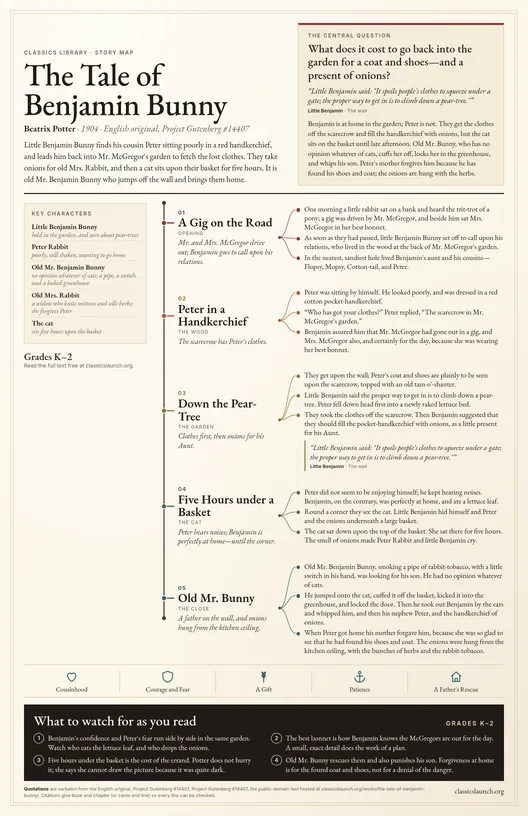 Story mapSee the story mapThe whole book on one page: the story in movements, the characters, and what to watch for. Free to print.
Abstract
The errand. After the McGregors drive out, a young rabbit fetches his cousin and goes back for a lost jacket and shoes. The clothes are on a scarecrow, so the first part of the job looks simple.
The delay. Onions are added to the bundle, and a cat occupies the one way out. The little rabbits spend a long, frightened afternoon under a basket. Nerve and appetite are both on display, and neither is enough to end the trap.
The rescue. An adult rabbit arrives, deals with the cat, and sends the pair home with both the clothes and the vegetables. The household scene at the end is calm rather than triumphant; the recovered jacket matters, and so does the forgiveness waiting in the kitchen. Children can practice sequencing and talk about help, rashness, and what a grown rabbit can do that the little ones cannot. They can also ask whether a confident cousin is always a wise guide. Potter's plates make the scarecrow and the cat on the basket unforgettable, and a text-only reading should be paired with those pictures whenever a printed copy is at hand. The complete English tale is hosted here from a verified public-domain transcription of the 1904 book, so the words can be read freely in the library while the original illustrations are enjoyed alongside them.
Main characters
- Benjamin Bunny: Peter's confident cousin, who leads the return to the garden and cannot resist onions.
- Peter: Still frightened from his first adventure, and anxious to recover his clothes.
- Old Mr. Benjamin Bunny: A grown rabbit who finds the pair and drives the cat from the basket.
- The cat: Sits on the basket for hours and keeps the little rabbits penned.
Summary
The Tale of Benjamin Bunny continues the trouble that began in Mr. McGregor's garden. One morning little Benjamin sits on a bank, hears a pony, and watches Mr. and Mrs. McGregor drive away in a gig. As soon as they have passed, he goes to call on his cousins in the wood behind the garden. Peter is not in good shape. He is wrapped in a red handkerchief because he has lost his jacket and shoes among the cabbages, and he is still frightened. Benjamin, who is more confident and has a little suit of his own, leads his cousin back through the garden gate to look for the clothes. They find the jacket and shoes on a scarecrow, take them down, and then, because Benjamin cannot resist the onions, they fill the handkerchief with booty. The comedy of the book is the difference between a careful errand and a shopping trip that goes on too long. A cat comes into the garden and sits on the basket they need, trapping the two rabbits underneath for hours. Peter is miserable; Benjamin tries to keep his pipe and his nerve. Help arrives in the form of old Mr. Benjamin Bunny, who has been looking for his son. The elder rabbit smokes a pipe, takes in the scene, and then deals with the cat in a way children remember: he switches it off the basket and down the garden. The little rabbits escape with the clothes and the onions. At home old Mrs. Rabbit forgives Peter because he has recovered his things, and the onions are hung from the kitchen ceiling with the herbs and the rabbit-tobacco. The story is useful after Peter Rabbit because it shows courage mixed with folly, and because a grown rabbit, not only a mother, takes a hand in the rescue. It also lets children practice a clear sequence: the empty road, the scarecrow, the onions, the cat, the switch, and the kitchen. Potter does not pretend that going back into the garden was wise, and she does not leave Peter without help. The English text is short, spoken, and complete in the public-domain transcription hosted here; the pictures, especially the cat on the basket and the scarecrow in Peter's clothes, should be seen in an illustrated copy whenever possible.
Virtues in this work
- Friendship: Benjamin sets out to help Peter recover what he lost, even though the garden is still dangerous.
- Prudence: The onion-gathering and the long stay under the basket show how a clear errand can become a new danger.
Plot or Argument
- The empty road
Benjamin sees the McGregors drive away and fetches Peter, still missing his jacket and shoes.
- Clothes and onions
They take Peter's clothes off the scarecrow and fill a handkerchief with onions, then a cat traps them under a basket.
- Old Mr. Bunny
Benjamin's father switches the cat away; the rabbits get home, and the onions are hung in the kitchen.
Characters
- Benjamin Bunny, protagonist
Peter's confident cousin, who leads the return to the garden and cannot resist onions.
- Peter, cousin
Still frightened from his first adventure, and anxious to recover his clothes.
- Old Mr. Benjamin Bunny, father
A grown rabbit who finds the pair and drives the cat from the basket.
- The cat, obstacle
Sits on the basket for hours and keeps the little rabbits penned.
Lessons
A sequel with a job to do
The first aim is to recover lost clothes, not to have another feast. Notice when the errand turns into onion-gathering.
- Why do the rabbits go back into the garden?
- What do they take besides the jacket and shoes?
Help from a grown rabbit
Old Mr. Bunny's arrival changes the ending. Children can talk about asking for help and about a parent's anger mixed with rescue.
- How does the old rabbit get the cat off the basket?
- How does Mrs. Rabbit receive Peter when he comes home?
Tell it in order
The gig, the scarecrow, the cat, and the kitchen make a clear chain for narration.
- Where are Peter's clothes at the start of this book?
- What hangs from the ceiling at the end?
Context
Warne published this 1904 sequel while Peter Rabbit was already widely known, sending the same rabbits back into McGregor's garden with a cousin and a father in the plot.
Composition
First published in 1904; the local text follows Project Gutenberg #14407.
Reception
Benjamin Bunny is often read immediately after Peter Rabbit and is remembered for the scarecrow and the cat on the basket.
Comparisons
- The Tale of Peter Rabbit
The same garden and lost clothes; this sequel adds a cousin's nerve, onions, and a father's rescue.
- The Tale of Squirrel Nutkin
Another early Potter tale in which liveliness leads a young animal into trouble and out again.
Quotes
“One morning a little rabbit sat on a bank.”
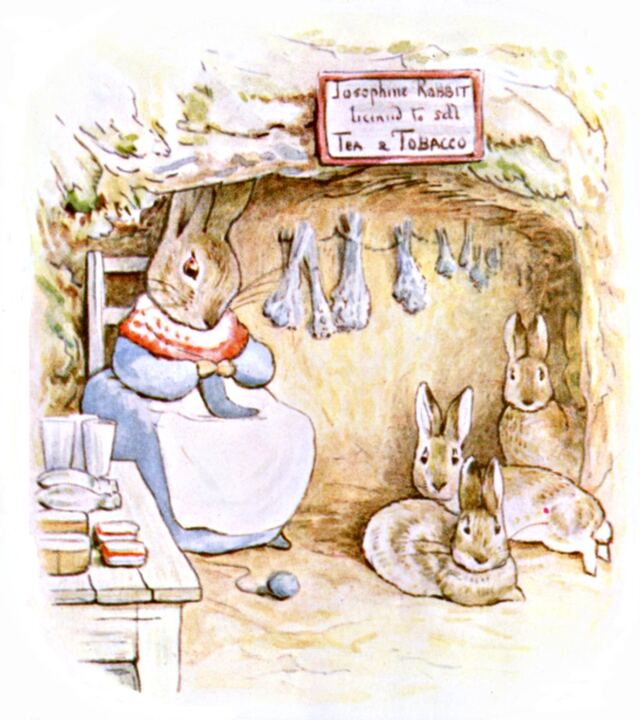
“That wood was full of rabbit holes; and in the neatest, sandiest hole of all lived Benjamin's aunt and his cousins--Flopsy, Mopsy, Cotton-tail, and Peter.”
For Students
A reading companion for classical Christian high school students. See the student guide.
Reading Guide
Watch for
- Why Peter is wearing a handkerchief at the start.
- The moment the errand becomes onion-gathering.
- What old Mr. Bunny does that the little rabbits cannot do.
Key terms and names
- Sequel
- A story that continues characters and unfinished business from an earlier book.
- Scarecrow
- A figure set up to frighten birds; here it wears Peter's lost clothes.
- Rescue
- Help that gets someone out of danger they cannot end alone.
- Scarecrow
- The garden figure on which Peter's lost jacket and shoes have been hung.
Seminar Questions
- Comprehension Where do the rabbits find Peter's jacket and shoes, and what else do they take?
- Comprehension How do they get out from under the basket?
- Interpretation Why is Peter less eager than Benjamin to stay in the garden?
- Interpretation Is old Mr. Bunny only angry, only helpful, or both?
- Big Question When does helping a cousin turn into leading him back into trouble?
- Big Question How might Galatians 6:2 describe what Benjamin intends, and where does he fall short?
Faith Connections
- Galatians 6:2 (Scripture)
Bearing another's burden fits the errand for Peter's clothes; the onions show how a good intention can wander.
- Proverbs 22:3 (Scripture)
The prudent see danger and hide; Peter is afraid, and Benjamin is not afraid enough.
Logic and Rhetoric
Central argument: A rescue can be real even when the errand was unwise, and a sequel can finish a loss from an earlier tale.
Rhetorical device: Sequel. Peter's missing jacket and shoes, already lost in the earlier book, become the reason for this new visit.
Debate: Resolved: It is not kindness to lead a frightened friend back into the same danger without a plan.
Writing Prompts
Essay: Tell, in order, how the rabbits get the clothes, lose time over the onions, and get home again.
Comparison with The Tale of Peter Rabbit: Peter first lost his clothes alone in the garden. In Benjamin Bunny he goes back with a cousin. Compare what each book shows about fear, appetite, and help.
Creative Prompts
- Classroom
Draw four pictures in order: the gig, the scarecrow, the cat on the basket, and the kitchen ceiling.
- Essay
Was Benjamin a good cousin in this story? Use two actions, including one that made the trouble worse.
- Fiction
Tell the afternoon from the cat's point of view, without inventing quotations from the book.
Further Reading
Verification notes
Primary text checked against the edition identified in fullText. No unverified quotations or page numbers supplied. Recommended grades concern teaching suitability, not a mechanical reading score.
No verification flags recorded.