Work record
The Tale of Samuel Whiskers, or The Roly-Poly Pudding
Beatrix PotterThe Tale of Samuel Whiskers, or The Roly-Poly Pudding by Beatrix Potter (1908)The Tale of Samuel Whiskers, first published in 1908 as The Roly-Poly Pudding, returns to Mrs. Tabitha Twitchit and her kittens.1908 · Early 20th Century · Short Stories · English
Read this when a kitten climbs the chimney and meets the rats.
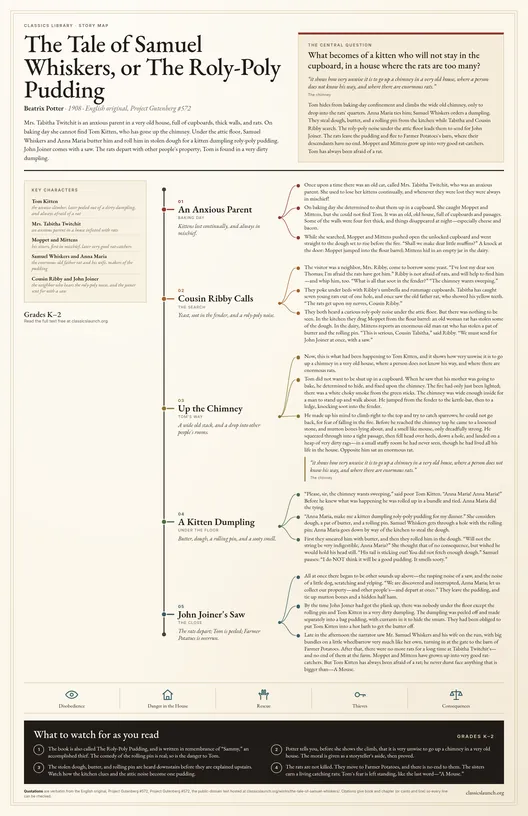 Story mapSee the story mapThe whole book on one page: the story in movements, the characters, and what to watch for. Free to print.
Abstract
The chimney. On baking day a mother cat shuts two kittens up and cannot find the third. Tom has climbed the chimney and come out under the attic floor, in the rooms of a pair of rats.
The pudding. Samuel Whiskers and Anna Maria butter the kitten and roll him in dough for a roly-poly pudding. Downstairs the family hears a strange patting and rolling under the boards.
The joiner. A carpenter opens the floor in time. The rats flee with stolen dough, and Tom is unrolled, shaken, and cured of chimneys. The kitchen talk of pastry makes the danger comic and very clear. Young listeners can retell the events in order and talk about the choices without needing a lecture from the narrator. A text-only reading is well paired with an illustrated copy whenever one is at hand. The complete English text of The Tale of Samuel Whiskers is hosted here from a verified public-domain transcription of the 1908 book, so families can read the words freely. Families can linger over the pictures and retell the events in their own words. The sequence is short enough to narrate after a single sitting. Nothing essential is left to a later sequel.
Main characters
- Tom Kitten: A curious kitten who climbs the chimney and is rolled in dough by rats.
- Samuel Whiskers: A large rat who, with Anna Maria, tries to make Tom into a pudding.
- Mrs. Tabitha Twitchit: Tom's anxious mother, who searches the house and sends for the joiner.
- John Joiner: The carpenter who opens the floorboards in time.

Summary
The Tale of Samuel Whiskers, first published in 1908 as The Roly-Poly Pudding, returns to Mrs. Tabitha Twitchit and her kittens. On baking day she shuts Moppet and Mittens in a cupboard, but she cannot find Tom. He has climbed the chimney, lost his way among the flues, and come out under the attic floor, where an enormous rat named Samuel Whiskers lives with his wife Anna Maria. The rats look at Tom as a piece of luck. They butter him, roll him in dough, and discuss a roly-poly pudding, while Tom can only mew inside the pastry. Downstairs, Tabitha searches and mews; Moppet and Mittens, let out, hear a rolling and patting under the floorboards and try to help. John Joiner is sent for with his tools. The carpenter opens the boards in time; the rats escape with a stolen dough and a rolling-pin, and later are said to have settled in a barn, robbing farmers of meal. Tom is unrolled, washed, and put to bed, and he never looks at a chimney again without a shudder. The book is longer and more frightening than The Tale of Tom Kitten, though it is still comic: the danger is baked into kitchen language, and the rescue is a matter of listening and of calling a man who can lift a plank. Children can follow a clear sequence — lost kitten, hidden rats, dough, and the joiner — and talk about why curiosity in a chimney is different from play in a garden. They can also notice Tabitha's anxiety, which Potter treats with sympathy as well as humor, and the way the kittens' ears do some of the detective work. The library hosts the complete public-domain English text. As always, Potter's plates show the attic, the dough, and the rats more plainly than a text-only reading can, so an illustrated copy is the right companion.
Virtues in this work
Plot or Argument
- Lost on baking day
Tabitha cannot find Tom; he has climbed the chimney into the rats' attic.
- Roly-poly pudding
Samuel Whiskers and Anna Maria roll Tom in dough while the household hears the noise.
- John Joiner
The carpenter opens the boards; the rats escape and Tom is unrolled.
Characters
- Tom Kitten, protagonist
A curious kitten who climbs the chimney and is rolled in dough by rats.
- Samuel Whiskers, antagonist
A large rat who, with Anna Maria, tries to make Tom into a pudding.
- Anna Maria, antagonist
Samuel Whiskers's wife, who helps fetch butter, dough, and a rolling-pin.
- Mrs. Tabitha Twitchit, mother
Tom's anxious mother, who searches the house and sends for the joiner.
- John Joiner, rescuer
The carpenter who opens the floorboards in time.
Lessons
Curiosity in the chimney
Tom's climb is not a garden prank; it leads him into a hidden household of rats.
- Where does Tom go when he is missing?
- What do the rats plan to make?
Listening under the floor
Moppet and Mittens hear the rolling before anyone sees Tom.
- How do the other kittens help?
- Why is John Joiner the right person to call?
A shudder afterward
Tom is saved, and he remembers; the rats go off to rob a barn.
- What does Tom think of chimneys after this?
- Where do Samuel Whiskers and Anna Maria go?
Context
Potter returns to Tabitha's kittens in a longer, more tense farmhouse comedy: a lost climb, rats under the boards, and a pudding that must be undone by a carpenter.
Composition
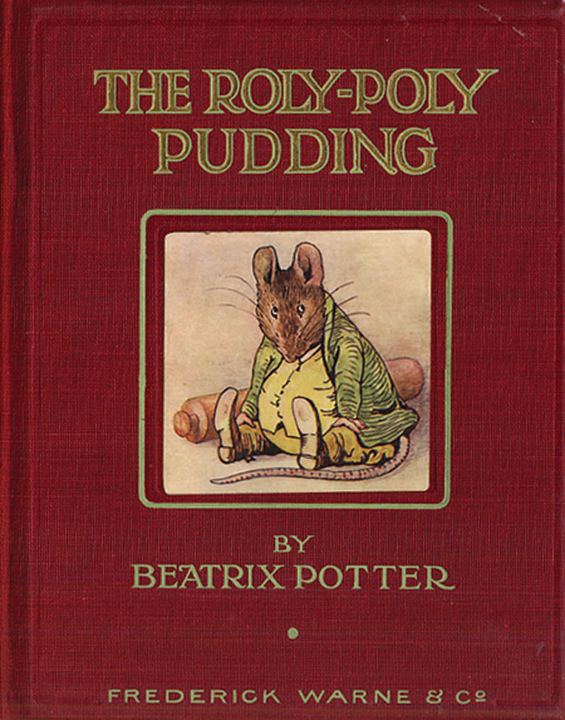
First published by Frederick Warne in 1908 as The Roly-Poly Pudding, later titled The Tale of Samuel Whiskers. The local text follows a Project Gutenberg transcription of the English original.
Reception
It is often read as a companion to The Tale of Tom Kitten and is remembered for the dough and the attic rats.
Comparisons
- The Tale of Tom Kitten
The same kitten who lost his clothes now loses his way in the chimney; this book is darker and longer, with a real rescue.
- The Tailor of Gloucester
Both give mice or rats a secret life behind the walls of a house, but the tailor's mice sew, and these rats cook.
Quotes
“Once upon a time there was an old cat, called Mrs. Tabitha Twitchit, who was an anxious parent.”
“She used to lose her kittens continually, and whenever they were lost they were always in mischief!”
For Students
A reading companion for classical Christian high school students. See the student guide.
Reading Guide
Watch for
- Why Tom is missing on baking day.
- What the rats mean by a roly-poly pudding.
- Who hears the noise, and who can open the floor.
Key terms and names
- Flue
- A passage in a chimney; Tom loses his way among them.
- Roly-poly pudding
- A rolled pudding of dough; here the rats try to make one of a kitten.
- Joiner
- A carpenter who fits boards and can open a floor.
- Attic
- The space under the roof, where the rats have their rooms.
Seminar Questions
- Comprehension Where does Tom go when his mother cannot find him?
- Comprehension What do Samuel Whiskers and Anna Maria do to Tom?
- Interpretation Why is this story more frightening than The Tale of Tom Kitten?
- Interpretation How do the other kittens help even though they cannot lift the boards?
- Big Question When should a family call for help instead of searching alone?
- Big Question How does Psalm 139:7-10 help a talk about being found when you have gone where you should not?
Faith Connections
- Psalm 139:7-10 (Scripture)
There is no hiding place beyond reach; the verses can frame Tom's being found without turning the tale into an allegory.
- Proverbs 27:12 (Scripture)
The prudent see danger and hide themselves; Tom learns, late, to stay out of chimneys.
Logic and Rhetoric
Central argument: Curiosity can lead into hidden danger, and a household is saved when someone listens and calls the person who can help.
Rhetorical device: Irony. Kitchen work — butter, dough, and a rolling-pin — becomes the rats' way of threatening a kitten.
Debate: Resolved: A child who is lost in the house still needs more than a scolding; he needs to be found.
Writing Prompts
Essay: Explain, in order, how Tom goes from the chimney to the dough and then back to his mother. Use two details from the text.
Comparison with The Tale of Tom Kitten: In the earlier book Tom loses his clothes; here he nearly loses his life. Compare the kind of mischief in each tale and how each one ends.
Creative Prompts
- Classroom
Draw a cutaway of the house: kitchen, chimney, attic floor, and the path Tom takes.
- Essay
How is Tom saved? Tell the steps from the first strange noise to the opened boards.
- Fiction
Write a short scene in which Moppet and Mittens try to explain the rolling sound to their mother.
Further Reading
Verification notes
Primary text checked against the edition identified in fullText. No unverified quotations or page numbers supplied. Recommended grades concern teaching suitability, not a mechanical reading score.
No verification flags recorded.