Work record
The Tale of Two Bad Mice
Beatrix PotterThe Tale of Two Bad Mice by Beatrix Potter (1904)The Tale of Two Bad Mice is a nursery comedy about a beautiful doll's-house and two mice who discover that its dinner cannot be eaten.1904 · Early 20th Century · Short Stories · English
Read this when a feast looks perfect, and then will not come off the plate.
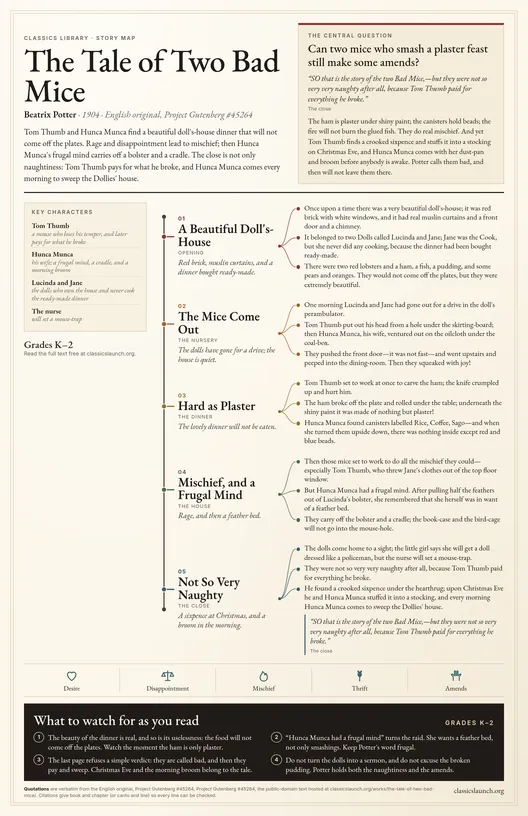 Story mapSee the story mapThe whole book on one page: the story in movements, the characters, and what to watch for. Free to print.
Abstract
A house that cannot feed anyone. A fine doll's-house holds a ready-made dinner of ham, fish, and pudding that will not leave the plates. When the dolls go out, two mice come in from a hole in the skirting, set the table, and sit down as if they had found a feast.
The smash. The food is plaster and lead. In their disappointment the mice break the dinner, pull stuffing from a pillow, and carry a cradle and other useful things back to their hole.
A crooked sixpence. The dolls come home to a wreck. Later the mice leave a crooked coin and a little mop of wool, a comic start at making amends that does not rebuild the house. First published by Frederick Warne in 1904, the English text is public-domain and is hosted here in full. It is a short read-aloud about appetite, toys that only look like dinner, and putting something right after a smash-up. The pictures of the red-brick house and of the cradle being carried off should be seen in an illustrated copy whenever a family can find such a copy. Young listeners can also name what was broken and what was paid back.
Main characters
- Tom Thumb: A mouse who leads the raid on the doll's-house and tries to carve the plaster ham.
- Hunca Munca: His wife, who carries off a cradle and later makes a mop of wool.
- Lucinda and Jane: The dolls who own the house; Jane is called the cook but never cooks.
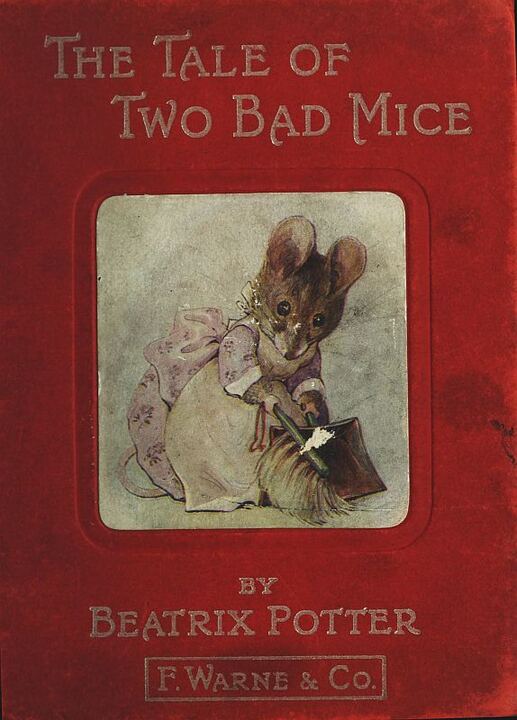
Summary
The Tale of Two Bad Mice is a nursery comedy about a beautiful doll's-house and two mice who discover that its dinner cannot be eaten. The house, red brick with muslin curtains, belongs to the dolls Lucinda and Jane. Jane is called the cook, but the ham, lobsters, fish, and pudding have been bought ready-made and will not come off the plates. One morning the dolls go out in a perambulator, and Tom Thumb and Hunca Munca creep in from a hole under the skirting-board. They set a table, sit down in fine style, and then find that the ham is plaster, the fish is stuck, and the lead food will not be cut. Their disappointment turns to a rampage. They smash the plaster food, pull out the feathers from a pillow, and carry off useful things—a cradle, a bolster, useful chairs—to their own mouse-hole. Tom Thumb also takes a shovel of dolls' coal that proves to be only raisins and bits of paper in a fireplace that will not light. When the dolls return, the house is a wreck. The little girl who owns it, and the book is dedicated to her, later pays a kind of comic justice: a nurse, on the owner's behalf, sets a policeman doll in the house, and the mice, for their part, leave a crooked sixpence and, every morning, a mop made of wool to help tidy the mess. The tale is useful with young children as a story about wanting what looks like a feast, finding it is only a toy, and making amends after a smash-up. It also lets a class talk about the difference between a pretty thing and a useful one. Potter's pictures of the doll's-house and of Hunca Munca with the cradle are half the pleasure, and should be seen in an illustrated copy. The English text is public-domain and complete here, short enough to read in one sitting, and funny without being cruel to the dolls or to the mice.
Virtues in this work
- Temperance: The smash-up follows an appetite that will not stop when the dinner proves false.
- Justice: The crooked sixpence and the mop are a small attempt to pay for what was broken and taken.
Plot or Argument
- The doll's-house
Lucinda and Jane leave a beautiful house whose ready-made dinner cannot be eaten.
- The raid
Tom Thumb and Hunca Munca sit down, find plaster food, smash the dinner, and carry off useful furniture.
- The sixpence
The dolls return to a wreck; the mice later leave a crooked sixpence and a little mop.
Characters
- Tom Thumb, protagonist
A mouse who leads the raid on the doll's-house and tries to carve the plaster ham.
- Hunca Munca, protagonist
His wife, who carries off a cradle and later makes a mop of wool.
- Lucinda and Jane, dolls
The dolls who own the house; Jane is called the cook but never cooks.
Lessons
Looks and use
The dinner is beautiful and useless. Children can sort pretty things from things that do a job.
- What cannot come off the plates?
- What do the mice actually keep?
Anger after disappointment
The smash-up follows a hope that fails. The book lets a child see both the joke and the damage.
- Why do the mice break the food?
- What is lost besides dinner?
A small payment
The sixpence and the mop do not rebuild the house, but they are a start at making amends.
- What do the mice leave behind?
- Is that enough?
Context
Potter turns a real doll's-house, belonging to a child named in the dedication, into a comic raid on plaster food and toy furniture.
Composition
First published by Frederick Warne in 1904; the local text follows a Project Gutenberg transcription of the English original.
Reception
The book is often loved for Hunca Munca and the cradle, and for the joke of a dinner that will not be eaten.
Comparisons
- The Tale of Peter Rabbit
Peter steals real vegetables; these mice are cheated by a toy dinner and then take real (tiny) furniture.
- The Tale of Squirrel Nutkin
Another short Potter tale in which liveliness goes too far and something is lost.
Quotes
“ONCE upon a time there was a very beautiful doll's-house; it was red brick with white windows, and it had real muslin curtains and a front door and a chimney.”
“They would not come off the plates, but they were extremely beautiful.”
For Students
A reading companion for classical Christian high school students. See the student guide.
Reading Guide
Watch for
- What the dinner looks like, and why it cannot be eaten.
- What the mice take because it is useful, not only because they are angry.
- How the story ends after the smash-up.
Key terms and names
- Doll's-house
- The red-brick toy house with muslin curtains, plates, and a fireplace that will not light.
- Plaster food
- The ham, fish, and pudding that look real but cannot be cut or eaten.
- Hunca Munca
- The mouse who helps in the raid and later makes a mop of wool.
- Sixpence
- The crooked coin the mice leave behind as a kind of payment.
Seminar Questions
- Comprehension Why can the mice not eat the ham and the puddings?
- Comprehension What do Tom Thumb and Hunca Munca carry away to their hole?
- Interpretation Are the mice mainly greedy, mainly disappointed, or both?
- Interpretation Does the crooked sixpence put the smash-up right?
- Big Question When have you wanted a toy that looked like the real thing, and found it was not?
- Big Question What does this small book teach about taking care, or failing to, that a speech would not have said as well?
Faith Connections
- Exodus 20:15 (Scripture)
The mice take what is not theirs; the later sixpence and mop are a small attempt to make good.
- Luke 19:8 (Scripture)
Zacchaeus offers to restore what he has taken; the mice's payment is comic and incomplete, but it is a start.
Logic and Rhetoric
Central argument: A feast that is only a toy will not feed you; anger at that fact can make a worse mess, which then asks for some amendment.
Rhetorical device: Irony. The comedy turns on things that look useful—food, coal, a fire—and prove to be paint, lead, and paper.
Debate: Resolved: The two mice are more sinned against by the false dinner than they are at fault for the smash-up.
Writing Prompts
Essay: List what is pretty in the doll's-house and what is useful in the mouse-hole. What does each set of things tell you about the mice?
Comparison with The Tale of Peter Rabbit: Peter takes real lettuces; the mice try to take a dinner that is not food at all. How does Potter treat appetite in each book?
Creative Prompts
- Classroom
Make two lists: things in the doll's-house that only look useful, and things the mice carry off because they can use them.
- Essay
Are Tom Thumb and Hunca Munca bad, unlucky, or both? Use the dinner, the smash, and the sixpence.
- Fiction
Write the scene in which the dolls first come home, without adding speeches Potter does not give them.
Further Reading
Verification notes
Primary text checked against the edition identified in fullText. No unverified quotations or page numbers supplied. Recommended grades concern teaching suitability, not a mechanical reading score.
No verification flags recorded.