Work record
The Tale of Squirrel Nutkin
Beatrix PotterThe Tale of Squirrel Nutkin by Beatrix Potter (1903)Squirrel Nutkin is a tale of autumn harvest, teasing, and a suddenly serious consequence.1903 · Early 20th Century · Short Stories · English
Read this when a lively tease goes too far, and a proud tail is at risk.
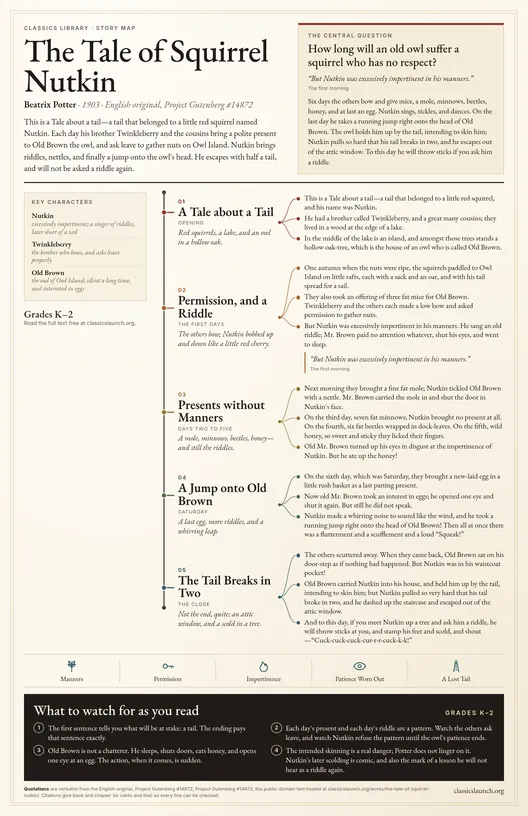 Story mapSee the story mapThe whole book on one page: the story in movements, the characters, and what to watch for. Free to print.
Abstract
The island. Red squirrels cross a lake to gather nuts on land that belongs to an owl. They bring small gifts and ask permission, then fill their sacks in the bushes around his oak.
The teasing. One squirrel will not keep to the pattern of courtesy. He recites rhymes, skips about, and treats the owl as an audience rather than a host. The others work; he performs. The owl's silence lets the mischief continue longer than a scolding would have.
The cost. At last the owl strikes and the tease escapes damaged. The book closes on irritation and a missing tail, not on a spoken moral. Young listeners can sequence the visits, separate work from showing off, and talk about when fun becomes unkind. They can also notice that the other squirrels keep their manners and their tails. Potter's pictures carry much of the island, the rafts, and the scuffle; a text-only reading should be paired with an illustrated copy whenever one is at hand. The complete English tale is hosted here from a verified public-domain transcription of the 1903 book, so families can read the words freely while looking at Potter's own plates in a printed copy.
Main characters
- Squirrel Nutkin: A red squirrel whose riddles and teasing cost him his tail.
- Twinkleberry: Nutkin's more respectful brother, who bows and gathers nuts.
- Old Brown: The owl of the island, silent for a long time and suddenly dangerous.
Summary
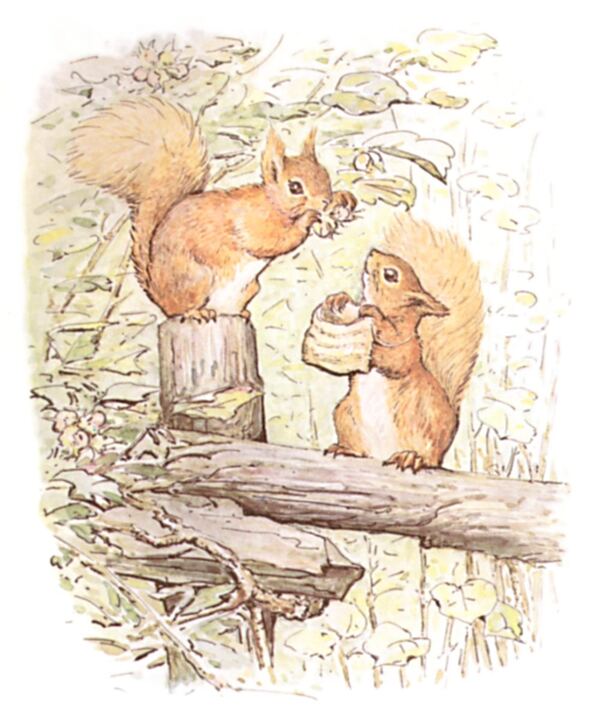
Squirrel Nutkin is a tale of autumn harvest, teasing, and a suddenly serious consequence. Nutkin lives with his brother Twinkleberry and many cousins in a wood at the edge of a lake. In the middle of the water stands Owl Island, thick with nut bushes, and in a hollow oak lives an owl named Old Brown. When the nuts are ripe, the little squirrels paddle over on twig rafts, each with a sack and an oar, and with a tail spread for a sail. They do not simply help themselves. They bring Old Brown a gift of three fat mice, and they ask leave to gather nuts on his island. Twinkleberry and the others bob a respectful curtsy and set to work. Nutkin is different. He dances, sings riddles, and makes a game of the owl's dignity. Day after day the squirrels return with more offerings—a mole, minnows, beetles, and honey—and day after day Nutkin's jokes grow bolder. He skips in front of the owl, recites old rhymes, and will not take a hint from silence. Old Brown says very little. His stillness is part of the comedy and part of the danger. The pictures and the short sentences let a child see that one animal is working and another is showing off. The pinch comes when Nutkin goes too far. He teases Old Brown with a last impertinence, and the owl catches him. There is a scuffle in the oak tree, and when Nutkin escapes he has lost his tail. The ending is not a lecture, but it is not a joke either. The other squirrels still come and go; Nutkin is left irritable and sore, and he does not like to be asked about his tail. Families can use the book to practice retelling a week of repeated visits and to talk about courtesy without crushing the fun of the riddles. Nutkin is appealing because he is lively, and the story is honest enough to show that liveliness without respect can end in hurt. Old Brown is not a sermon in feathers; he is an owl who has had enough. The tale belongs with Potter's other small books about animal manners in a real countryside, and it is complete in a public-domain English text that keeps her tight, spoken rhythm. An illustrated copy will show the rafts, the hollow tree, and the shortening of that famous tail, which the words alone can only suggest.
Virtues in this work
- Prudence: Twinkleberry's respectful asking and Nutkin's refusal to notice the owl's silence show wisdom and its lack.
- Temperance: Nutkin cannot stop performing even when the game has clearly soured.
Plot or Argument
- To Owl Island
The squirrels paddle to Old Brown's island with gifts and ask leave to gather nuts.
- Nutkin's riddles
While the others work, Nutkin dances, sings, and teases the silent owl.
- The lost tail
Old Brown finally seizes Nutkin; the squirrel escapes without his tail.
Characters
- Squirrel Nutkin, protagonist
A red squirrel whose riddles and teasing cost him his tail.
- Twinkleberry, brother
Nutkin's more respectful brother, who bows and gathers nuts.
- Old Brown, owl
The owl of the island, silent for a long time and suddenly dangerous.
Lessons
Riddles and manners
The fun of Nutkin's rhymes sits beside the others' courtesy. Children can enjoy the jokes and still see that Old Brown is being mocked.
- What do the squirrels bring the owl?
- How does Nutkin's behavior differ from Twinkleberry's?
A consequence you can see
The lost tail is a simple, visible result. It does not require a moral paragraph from the narrator.
- What happens when Old Brown has had enough?
- Why might Nutkin dislike questions about his tail?
Repeated days
The week's visits make a clear sequence for narration: gift, work, tease, and a last mistake.
- Name three gifts the squirrels bring.
- What stays the same each day, and what changes?
Context
Potter sets a Lake District harvest and a wise old owl inside a tiny picture book's comic pattern of offering, work, and impertinence.
Composition
First published by Frederick Warne in 1903; the local text follows a Project Gutenberg transcription of the English original.
Reception
Squirrel Nutkin is among Potter's earliest small books and is often remembered for the riddles and the lost tail.
Comparisons
- The Tale of Peter Rabbit
Both follow a lively young animal into someone else's territory; Nutkin's offence is teasing rather than appetite.
- Aesop's Fables
Animal consequence in a short compass; Potter adds riddles, pictures, and a very particular owl.
Quotes
“This is a Tale about a tail--a tail that belonged to a little red squirrel, and his name was Nutkin.”
“In the middle of the lake there is an island covered with trees and nut bushes; and amongst those trees stands a hollow oak-tree, which is the house of an owl who is called Old Brown.”
For Students
A reading companion for classical Christian high school students. See the student guide.
Reading Guide
Watch for
- The difference between a polite offering and a riddle meant to provoke.
- How often Nutkin is warned by silence rather than by a speech.
- What is lost at the end, and how Nutkin behaves afterward.
Key terms and names
- Offering
- A gift brought to ask a favor or show respect.
- Riddle
- A teasing question or rhyme whose answer is hidden in wordplay.
- Consequence
- What follows from a choice; here, the loss of a tail.
- Owl Island
- Old Brown's island in the lake, thick with nut bushes, where the squirrels go to harvest.
Seminar Questions
- Comprehension Why do the squirrels bring gifts to Old Brown before they gather nuts?
- Comprehension What happens to Nutkin's tail, and how does he act after he escapes?
- Interpretation Why does Old Brown stay quiet for so long?
- Interpretation Are Nutkin's riddles clever, unkind, or both?
- Big Question When does a joke stop being play and become an insult?
- Big Question How does Proverbs 15:1 help a family talk about Nutkin's teasing and Old Brown's anger?
Faith Connections
- Proverbs 15:1 (Scripture)
A soft answer and a harsh word offer a way to discuss teasing that stirs anger.
- Ephesians 4:29 (Scripture)
Words can build up or tear down; Nutkin's riddles can be admired and still weighed.
Logic and Rhetoric
Central argument: Repeated teasing is not the same as shared play, and a visible consequence can teach without a lecture.
Rhetorical device: Repetition. The squirrels' daily visits and gifts make Nutkin's growing boldness easy to track.
Debate: Resolved: A joke that ignores another creature's dignity has already gone too far.
Writing Prompts
Essay: Explain, in order, how Nutkin goes from riddles to a lost tail. Use two details from the text.
Comparison with The Tale of Peter Rabbit: Peter is punished after eating in a forbidden garden; Nutkin is hurt after mocking an owl. Compare the choice each little animal makes and what is lost.
Creative Prompts
- Classroom
Retell the week's visits in order, naming one gift and one of Nutkin's jokes for each day you can remember.
- Essay
Is Old Brown cruel, or has Nutkin asked for trouble? Use events from the story, not a guess about owls in general.
- Fiction
Write a short scene in which Twinkleberry tries to stop Nutkin before the last tease.
Further Reading
Verification notes
Primary text checked against the edition identified in fullText. No unverified quotations or page numbers supplied. Recommended grades concern teaching suitability, not a mechanical reading score.
No verification flags recorded.