Work record
The Tale of Jemima Puddle-Duck
Beatrix PotterThe Tale of Jemima Puddle-Duck by Beatrix Potter (1908)The Tale of Jemima Puddle-Duck (1908) follows a farm duck who is annoyed because the farmer's wife will not let her hatch her own eggs.1908 · Early 20th Century · Short Stories · English
Read this when a duck wants to hatch her eggs far from home.
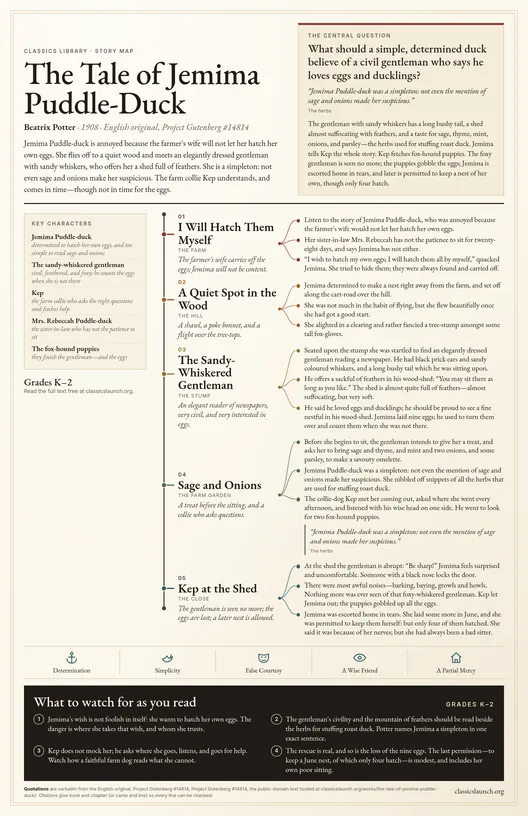 Story mapSee the story mapThe whole book on one page: the story in movements, the characters, and what to watch for. Free to print.
Abstract
The secret nest. A duck is not allowed to sit on her own eggs, so she leaves the farm in a bonnet and shawl to make a hidden nest. In the wood a polite gentleman offers her a quiet shed already full of feathers.
The herbs. She lays many eggs and is pleased with her friend. He asks her to gather sage, thyme, and onions from the farm — the makings of a stuffing — and she agrees, still unsuspecting.
The rescue. A farm dog follows her path and arrives with puppies in time to drive the gentleman off. The nest is lost in the fight, but Jemima later hatches a smaller, safer brood at home. Young listeners can retell the events in order and talk about the choices without needing a lecture from the narrator. A text-only reading is well paired with an illustrated copy whenever one is at hand. The complete English text of The Tale of Jemima Puddle-Duck is hosted here from a verified public-domain transcription of the 1908 book, so families can read the words freely. Families can linger over the pictures and retell the events in their own words. The sequence is short enough to narrate after a single sitting.
Main characters
- Jemima Puddle-duck: A farm duck determined to hatch her own eggs, too ready to trust a polite stranger.
- The foxy gentleman: A well-dressed fox who offers a feathered shed and asks for sage and thyme.
- Kep: The farm collie who traces Jemima's walks and brings help in time.
Summary
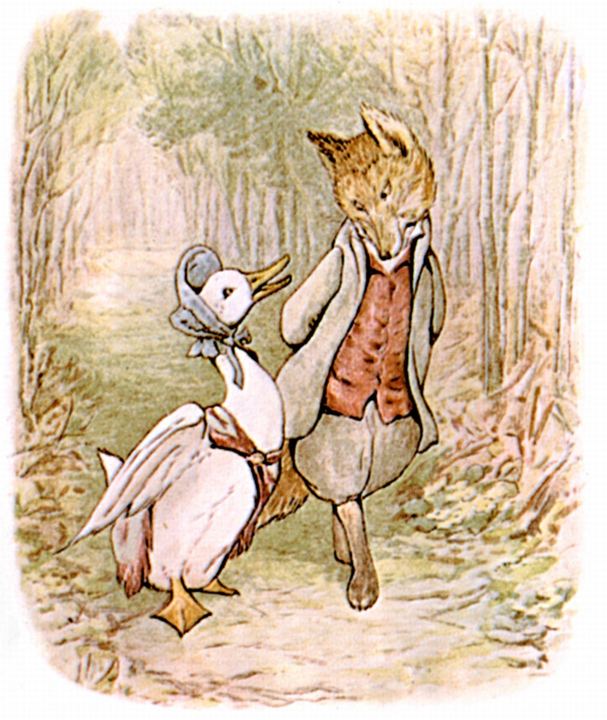
The Tale of Jemima Puddle-Duck (1908) follows a farm duck who is annoyed because the farmer's wife will not let her hatch her own eggs. Other ducks may be content to leave the work to a hen; Jemima is not. She hides eggs and loses them, then sets off over the hill in a shawl and bonnet to make a secret nest. In the wood she meets a well-dressed, foxy gentleman with black prick ears and sandy whiskers. He is politeness itself. He offers a shed full of feathers, listens to her plans, and even agrees to keep an eye on the nest. Jemima, who is not much in the habit of flying, is grateful and rather proud of her new friend. She lays a large clutch and looks forward to sitting. The gentleman then asks her, most helpfully, to collect sage, thyme, and other herbs from the farm kitchen — the makings of a stuffing. A wise dog named Kep notices her coming and going, follows the matter out, and arrives with two fox-hound puppies at the right moment. The gentleman is driven off; the nest is broken up in the scuffle; Jemima is escorted home in tears. Later she hatches four ducklings under proper farm care, which is fewer than she had hoped for, but safer. The book is one of Potter's clearest comic warnings, and also one of her funniest: the danger is never named in a heavy way, because the herbs, the feathers, and the gentleman's smile do the telling. Children can see that courtesy is not the same as kindness, and that a friend who wants you to gather sage may have a dinner in mind. Kep's loyalty and the noisy rescue keep the story from ending in grief, while still letting Jemima's plan fail. The tale belongs with the farmyard books — Tom Kitten, the Puddle-ducks, and the Hill Top neighborhood — and is best read with the plates that show the shawl, the shed, and the foxy smile. The library hosts the complete public-domain English text of the 1908 Warne book.
Virtues in this work
- Prudence: Jemima's wish is understandable, but she ignores every sign of danger until Kep arrives.
- Friendship: Kep follows her, brings help, and sees her home, even though her plan has to fail.
Plot or Argument
- Away from the farm
Jemima, forbidden to hatch her eggs, walks over the hill to make a secret nest.
- The feathered shed
A polite foxy gentleman offers her a soft shed and later asks for sage and thyme.
- Kep arrives
The farm dog and two puppies drive the gentleman off; Jemima later hatches four ducklings at home.
Characters
- Jemima Puddle-duck, protagonist
A farm duck determined to hatch her own eggs, too ready to trust a polite stranger.
- The foxy gentleman, antagonist
A well-dressed fox who offers a feathered shed and asks for sage and thyme.
- Kep, ally
The farm collie who traces Jemima's walks and brings help in time.
Lessons
Politeness is not proof
The gentleman's manners hide his plan; the herbs tell the truth.
- What does the gentleman ask Jemima to fetch?
- Why is a shed full of feathers a strange kindness?
A friend who follows you
Kep does not scold at first; he finds out and comes back with help.
- How does Kep know where Jemima has gone?
- What is lost in the rescue, and what is saved?
A smaller brood
The ending is not a total victory; she hatches fewer ducklings, safely.
- How many ducklings does Jemima hatch at the end?
- Why might fewer and safer be better than a hidden nest?
Context
Potter sets a farm duck's wish to hatch her own eggs against a polite fox and a feathered shed, using kitchen herbs to show the danger without a heavy lecture.
Composition
First published by Frederick Warne in 1908. The local text follows a Project Gutenberg transcription of the English original.
Reception
Jemima is among the best-known of the later farmyard books and is often remembered for the foxy gentleman and the sage.
Comparisons
- The Tale of Peter Rabbit
Both send a young farm animal into danger through a strong wish; Peter is tempted by a garden, Jemima by a private nest.
- The Tale of Tom Kitten
Both belong to the Hill Top farmyard; Tom's trouble is clothes and climbing, Jemima's is a stranger who seems kind.
Quotes
“What a funny sight it is to see a brood of ducklings with a hen!”
“She tried to hide her eggs; but they were always found and carried off.”
For Students
A reading companion for classical Christian high school students. See the student guide.
Reading Guide
Watch for
- The difference between a polite offer and a safe one.
- What sage, thyme, and onions are used for.
- How Kep finds Jemima without being asked.
Key terms and names
- Clutch
- A set of eggs laid to be hatched.
- Sage
- A kitchen herb; here it is also a clue to a fox's dinner.
- Collie
- A farm dog, like Kep, used to watching the yard and the flocks.
- Stuffing
- Herbs and bread used to fill a bird before it is cooked.
Seminar Questions
- Comprehension Why does Jemima leave the farm to make a nest?
- Comprehension What does the gentleman ask her to gather from the kitchen?
- Interpretation Why does Jemima trust the gentleman so quickly?
- Interpretation Is Kep kind to spoil the hidden nest?
- Big Question How can a family tell the difference between courtesy and care?
- Big Question How does Proverbs 22:3 help you talk about seeing danger and turning aside?
Faith Connections
- Proverbs 22:3 (Scripture)
The prudent see danger and hide themselves; Jemima does not, and Kep must come after her.
- Matthew 10:16 (Scripture)
To be wise as serpents and harmless as doves offers a way to discuss trust that is not naive.
Logic and Rhetoric
Central argument: Good manners can hide a bad plan, and a faithful friend may have to spoil a secret in order to save a life.
Rhetorical device: Irony. The soft shed and the helpful request for herbs are the very signs of the fox's dinner.
Debate: Resolved: A secret plan is not wise if it requires you to ignore clear warnings.
Writing Prompts
Essay: Explain, in order, how Jemima goes from a hidden nest to a smaller brood at home. Use two details from the text.
Comparison with The Tale of Peter Rabbit: Peter enters a garden he has been warned about; Jemima trusts a stranger who seems helpful. Compare the wish each one follows and who helps them home.
Creative Prompts
- Classroom
List every kindness the gentleman offers, then write beside each one what it is really for.
- Essay
How do the herbs tell us what the gentleman intends? Use two details from the story.
- Fiction
Write Kep's evening report to the farmer after the rescue.
Further Reading
Verification notes
Primary text checked against the edition identified in fullText. No unverified quotations or page numbers supplied. Recommended grades concern teaching suitability, not a mechanical reading score.
No verification flags recorded.