Work record
The Tale of the Flopsy Bunnies
Beatrix PotterThe Tale of the Flopsy Bunnies by Beatrix Potter (1909)The Tale of the Flopsy Bunnies (1909) continues the family of Peter Rabbit and Benjamin Bunny.1909 · Early 20th Century · Short Stories · English
Read this when lettuce makes a family of rabbits very sleepy.
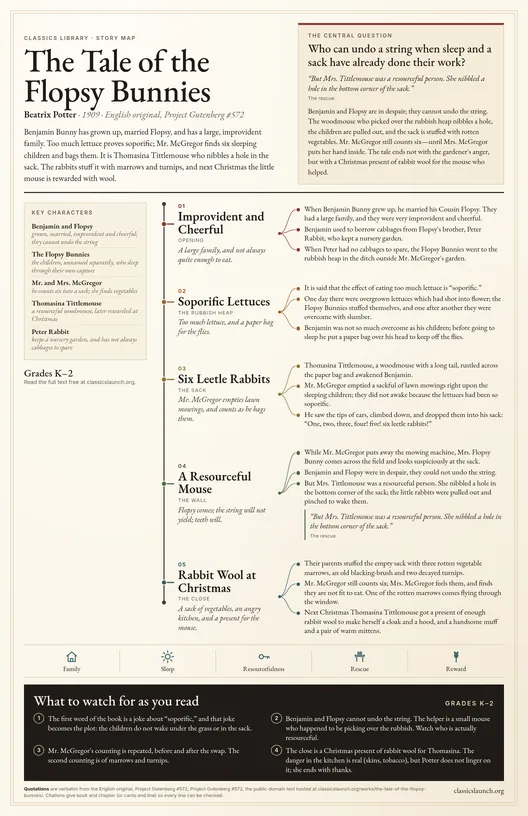 Story mapSee the story mapThe whole book on one page: the story in movements, the characters, and what to watch for. Free to print.
Abstract
The lettuce. A large family of young rabbits, short of cabbages, feast on lettuce at a gardener's rubbish heap and fall asleep. The gardener finds them and ties them in a sack.
The knot. Their parents discover the sack. A little mouse who lives on crumbs gnaws the string, the children slip out, and the adults fill the bag with rubbish and an old boot.
The present. The gardener gives the sack to his wife as rabbits for dinner; she opens it and is not pleased. The bunnies go home, and the mouse is paid in leftover food. Young listeners can retell the events in order and talk about the choices without needing a lecture from the narrator. A text-only reading is well paired with an illustrated copy whenever one is at hand. The complete English text of The Tale of the Flopsy Bunnies is hosted here from a verified public-domain transcription of the 1909 book, so families can read the words freely. Families can linger over the pictures and retell the events in their own words. The sequence is short enough to narrate after a single sitting. Nothing essential is left to a later sequel.
Main characters
- The Flopsy Bunnies: Benjamin and Flopsy's large young family, sleepy after too much lettuce.
- Benjamin Bunny: Their father, who, with Flopsy, finds the sack and helps empty it.
- Mr. McGregor: The gardener who bags the sleeping rabbits and later presents the sack to his wife.
- The little mouse: A crumb-hunting mouse who gnaws the string and sets the bunnies free.
Summary
The Tale of the Flopsy Bunnies (1909) continues the family of Peter Rabbit and Benjamin Bunny. Benjamin has grown up and married his cousin Flopsy. They have a large, cheerful, improvident family, generally called the Flopsy Bunnies, whose names the narrator declines to list. When Peter's spare cabbages run short, the little rabbits go to Mr. McGregor's rubbish heap and eat too much lettuce. Lettuce, the book famously says, is soporific. The bunnies fall asleep in a heap, and Mr. McGregor finds them, ties them in a sack, and leaves it while he cuts more greens. Benjamin and Flopsy discover the empty nest and the sack. A little mouse who has been living on crumbs from the rubbish offers help: he gnaws the string, the children slip out, and Benjamin and Flopsy stuff the sack with moldy vegetables, an old boot, and other rubbish. Mr. McGregor presents the sack to his wife as a present of rabbits for dinner. Mrs. McGregor opens it and is not pleased. The Flopsy Bunnies go home, and the mouse is rewarded with a quantity of leftover rabbit food, which is a joke the children will catch. The book is gentler than Mr. Tod, which will come later, and more family-minded than the first Peter Rabbit: the danger is real, the rescue is cooperative, and the McGregors are still the same garden enemies. Families can talk about appetite and sleepiness, about not leaving a sack unwatched, and about a small neighbor who can chew a knot. The word 'soporific' itself is a gift for young readers, a long word introduced with a smile. The library hosts the complete public-domain English text of the 1909 book; Potter's plates of the rubbish heap, the sack, and Mrs. McGregor's surprise should be close at hand for a first reading.
Virtues in this work
- Prudence: The bunnies sleep in a dangerous place after a greedy meal; their parents and the mouse must repair the mistake.
- Friendship: A mouse who might have stayed hidden chooses to gnaw the knot.
Plot or Argument
- A soporific feast
The Flopsy Bunnies eat too much lettuce on the rubbish heap and fall asleep.
- The sack
Mr. McGregor bags them; a mouse gnaws the string and Benjamin stuffs the sack with rubbish.
- Mrs. McGregor's present
The sack is opened in the kitchen and does not contain rabbits after all.
Characters
- The Flopsy Bunnies, protagonists
Benjamin and Flopsy's large young family, sleepy after too much lettuce.
- Benjamin Bunny, father
Their father, who, with Flopsy, finds the sack and helps empty it.
- Flopsy, mother
Benjamin's wife and Peter's sister, mother of the Flopsy Bunnies.
- Mr. McGregor, antagonist
The gardener who bags the sleeping rabbits and later presents the sack to his wife.
- The little mouse, ally
A crumb-hunting mouse who gnaws the string and sets the bunnies free.
Lessons
A long word for sleepy
Potter teaches 'soporific' by lettuce, not by a glossary.
- What does 'soporific' mean in this book?
- Why do the bunnies fall asleep in a dangerous place?
A small helper
The mouse can do what the parents cannot do quickly: chew the knot.
- How do the bunnies get out of the sack?
- What is put into the sack instead?
A present that is not a present
The joke on Mrs. McGregor ends the book without harming the children.
- What does Mrs. McGregor find in the sack?
- How is the mouse thanked?
Context
Potter continues the McGregor garden story with Benjamin's children, a long funny word for sleepiness, and a sack emptied by a mouse and stuffed with rubbish.
Composition
First published by Frederick Warne in 1909. The local text follows a Project Gutenberg transcription of the English original.
Reception
It is a favorite sequel to Peter Rabbit and Benjamin Bunny, often remembered for the word 'soporific' and for Mrs. McGregor's sack.
Comparisons
- The Tale of Benjamin Bunny
Benjamin, once the young cousin in a hat, is now a father; the garden enemy is still Mr. McGregor.
- The Tale of Peter Rabbit
The same garden world and the same appetite; here a whole litter is caught at once, and the rescue is a family effort.
Quotes
“It is said that the effect of eating too much lettuce is "soporific."”
“When Benjamin Bunny grew up, he married his Cousin Flopsy.”
For Students
A reading companion for classical Christian high school students. See the student guide.
Reading Guide
Watch for
- What 'soporific' means, and why it matters in a garden.
- Who finds the sack, and who can open it.
- What Mrs. McGregor is given, and what she finds.
Key terms and names
- Soporific
- Causing sleep; here, the effect of too much lettuce on rabbits.
- Improvident
- Not planning ahead; the family is cheerful and often short of food.
- Rubbish heap
- The gardener's discard pile, where the bunnies find lettuce and a mouse finds crumbs.
- Sack
- The bag Mr. McGregor ties the sleeping rabbits in.
Seminar Questions
- Comprehension Why do the Flopsy Bunnies fall asleep on the rubbish heap?
- Comprehension How do they get out of Mr. McGregor's sack?
- Interpretation Why does the narrator make a joke of the word 'soporific' at the start?
- Interpretation Is the mouse's reward a fair payment? Why?
- Big Question When is a small helper more useful than a large one?
- Big Question How does Proverbs 6:6-8 help a family talk about planning ahead, as the Flopsy family often does not?
Faith Connections
- Proverbs 6:6-8 (Scripture)
The ant stores in summer; the Flopsy family is cheerful and often unprepared, which leads them to a dangerous feast.
- Philippians 2:4 (Scripture)
Looking to the interests of others frames the mouse's help and the parents' rescue.
Logic and Rhetoric
Central argument: Appetite can make you sleepy in the wrong place, and a family plus a small neighbor can undo a trap together.
Rhetorical device: Humor. A long word, a sack of rubbish, and Mrs. McGregor's disappointment do the teaching without a scolding paragraph.
Debate: Resolved: Help from a small neighbor can matter as much as the strength of parents.
Writing Prompts
Essay: Tell, in order, how the bunnies go from lettuce to the sack and then home again. Use two details from the text.
Comparison with The Tale of Benjamin Bunny: Benjamin once slipped into the garden as a young rabbit; now he is a father pulling his children out of a sack. Compare his role in the two books.
Creative Prompts
- Classroom
Act the sack scene without words: sleep, the knot, the mouse, the rubbish, and the opening of the bag.
- Essay
How do the parents and the mouse work together? Use two details from the story.
- Fiction
Write the mouse's account of why he agreed to gnaw the string.
Further Reading
Verification notes
Primary text checked against the edition identified in fullText. No unverified quotations or page numbers supplied. Recommended grades concern teaching suitability, not a mechanical reading score.
No verification flags recorded.