Work record
Memorabilia
XenophonMemorabilia by Xenophon (c. 370 BC)Memorabilia is Xenophon's defense and portrait of Socrates, written as a series of recollections rather than as a single dramatic trial.c. 370 BC · Ancient · Philosophy · Ancient Greek
Read this when you want Socrates as a teacher of ordinary virtue, not only as a martyr.
Abstract
Background. A former companion, writing in later life far from the city of the trial, undertakes to answer the old public accusations by collecting memories of daily talk rather than by reconstructing the day in court.
Scope. Across four books the conversations turn to honor toward the gods, rule over one's own appetites, the management of a household, the testing of friends, and the preparation of a man who hopes to serve the city.
Method. The method is a series of short recalled scenes, each modest in itself, until the accumulation is offered as a likeness that any doubter may set beside another portrait and then judge. The tone is protective and practical, and the writer rarely leaves the reader in doubt of his own admiration.
Significance. Together with the dramatic dialogues of Plato, this is one of the two principal surviving prose images of Socrates, and it was named in the moral part of a 1785 course of reading planned for a nephew abroad. Teachers often set it beside the trial dialogues so that students can see what a memoir of ordinary conversation adds to a drama of accusation and death, and what it cannot replace.
Key figures
- Socrates: The teacher whose life Xenophon defends by recollection
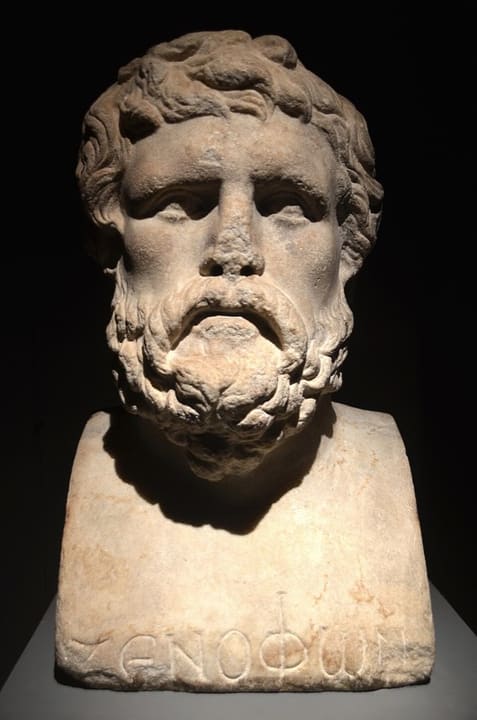
- Xenophon: Former companion and author of the memoirs

Summary
Memorabilia is Xenophon's defense and portrait of Socrates, written as a series of recollections rather than as a single dramatic trial. It opens with Xenophon's surprise that the Athenians could have been persuaded to put Socrates to death, and it answers the formal charges by showing how Socrates actually lived and spoke. Unlike Plato's dialogues, which often press a question until it opens into a larger metaphysics, Xenophon's Socrates is a teacher of ordinary virtue: self-control, piety toward the gods, usefulness to friends and to the city, and the careful management of a household. The four books move through conversations with pupils, politicians, craftsmen and members of Socrates's own family. Socrates examines men who claim to be prepared for public life and finds them unready; he advises a son on how to treat a difficult mother; he talks of friendship, of training, and of the signs by which the gods guide human action. The result is less a system of philosophy than a moral example, written by a soldier and country gentleman who had known Socrates and who wanted later readers to see why that life was not a danger to the city but a help. The book became one of the chief sources, with Plato, for the ancient and early modern picture of Socrates, and it was among the moral works Jefferson named for Peter Carr in 1785, alongside Plato's Socratic dialogues and Cicero's philosophical writings. The hosted text is the public-domain translation by H. G. Dakyns, first published in 1897 in his Works of Xenophon, the same series already used for the Anabasis and now for the Hellenica in this library. Students who know only the Apology and the Phaedo will find here a more practical Socrates, and a useful check on any single portrait of the man.
Virtues in this work
- Temperance: Socrates is repeatedly shown ruling his own appetites as the first condition of teaching or leading anyone else.
- Piety: Xenophon answers the religious charge by recording Socrates's honor for the gods and his attention to divine signs.
- Friendship: Large parts of the book treat how a friend is chosen, tested, and helped, and how Socrates served his companions.
Plot or Argument
- Book I: The charges and the first defense
Xenophon states the accusation that Socrates did not acknowledge the city's gods, introduced new divinities, and corrupted the young. He answers by describing Socrates's piety, his self-control, and the kind of examination he applied to himself and to others.
- Books II–III: Household, friendship, and public life
Conversations treat family duty, friendship, military and civic preparation, and the difference between a man who can talk about ruling and a man who is actually fit to rule.
- Book IV: Teaching and a last estimate
The last book gathers further conversations on education, justice, and the way Socrates led companions toward knowledge they could use. It closes with Xenophon's estimate of his character.
Characters
- Socrates, teacher
The subject of the recollections; presented as pious, self-controlled, and useful to his friends and city.
- Xenophon, author and witness
A former companion who writes to show what Socrates was like in ordinary conversation, not only at his trial.
- Critobulus, young companion
Appears in discussions of household management, friendship, and the education of a gentleman.
- Antiphon, critic
A sophist who taunts Socrates for his poor dress and simple life, giving Xenophon a chance to defend that life.
Lessons
A defense by remembering a life
Xenophon does not answer the court with a single speech. He answers by collecting conversations that show piety, self-command, and usefulness. The book teaches that a charge against a teacher should be tested against the life he actually led.
- Which early conversations do the most work to answer the formal charges?
- What is gained, and what is lost, by defending a man through many short scenes rather than one trial scene?
Virtue in ordinary duties
The Memorabilia keeps returning to household, friendship, military fitness, and speech in the city. Socrates here is a guide for daily responsibilities, not only a martyr of the examined life.
- Where does Socrates treat a family duty as a serious moral test?
- How does this picture of Socrates differ from the one in Plato's trial dialogues?
Self-control as the first training
Again and again Socrates argues that a man unpractised in ruling himself is unfit to rule others or to be a friend. Temperance is not a private decoration but the beginning of public usefulness.
- Which conversation makes the tightest link between self-control and fitness for office?
- Is Xenophon's stress on usefulness a narrowing of Socrates, or a needed correction?
Context
The book was written after the death of Socrates in 399 BC, probably years later, when Xenophon was living away from Athens. It belongs to a group of Socratic writings by his companions and is one of the two principal surviving prose portraits of the man, beside Plato.
Composition
Dakyns's English version follows his 1897 Macmillan text in The Works of Xenophon. The Greek is arranged in four books of recollections and short dialogues, not as a single dramatic day.
Reception
Roman and early modern readers often preferred Xenophon's practical Socrates to a more speculative one. Jefferson listed the Memorabilia among the moral works a young man should read, together with Plato's Socratic dialogues and Cicero's philosophies.
Comparisons
- The Last Days of Socrates
Plato's Euthyphro, Apology, Crito and Phaedo follow the trial and death; Xenophon answers the same charges by remembering years of conversation.
- The Persian Expedition
The Anabasis shows Xenophon as a commander formed, on his own account, by Socratic training; the Memorabilia is the book in which he records that training.
- On Duties (De Officiis)
Jefferson placed the Memorabilia with Cicero's philosophical works in the moral part of a young man's reading, both being practical schools of duty.
Quotes
“I have often wondered by what arguments those who indicted (1) Socrates could have persuaded the Athenians that his life was justly forfeit to the state.”
“Such is our estimate. If the verdict fail to satisfy I would ask those who disagree with it to place the character of any other side by side with this delineation, and then pass sentence.”
For Students
A reading companion for classical Christian high school students. See the student guide.
Reading Guide
Watch for
- The opening statement of the charges, and the first chapters that answer them by describing Socrates's piety and self-control.
- Conversations about household and parents, which test whether philosophy has anything to say about ordinary family duty.
- Scenes in which a man preparing for public life is examined and found unready.
- The last book's closing estimate of Socrates, which the reader should weigh against Plato's better-known ending.
Key terms and names
- Memorabilia
- Recollections or memoirs; Xenophon's title for these remembered conversations with Socrates.
- Self-control
- In this book, the training of appetite and pride without which a man is unfit to rule a house, a friendship, or a city.
- Piety
- Socrates's habit of honoring the gods, attending to signs, and refusing the charge that he introduced a private religion in place of the city's.
- Usefulness
- Xenophon's frequent test of a life or a teaching: whether it makes a companion more able to help friends and serve the city.
Seminar Questions
- Comprehension What are the formal charges Xenophon says were brought against Socrates, and how does Book I begin to answer them?
- Comprehension Name two ordinary settings, outside the marketplace debate, in which Socrates gives advice in this book.
- Interpretation Why does Xenophon keep calling attention to usefulness? What kind of teacher is he trying to defend?
- Interpretation How does the Socrates of these recollections differ from the Socrates of the Apology and the Phaedo?
- Big Question Is a good life better proved by a noble death or by years of useful conversation?
- Big Question Can a city justly fear a teacher who questions everyone, even if his own habits are self-controlled and pious?
Faith Connections
- Proverbs 16:32 (Scripture)
The proverb that the man who rules his own spirit is better than one who takes a city fits Xenophon's repeated claim that self-control is the beginning of any other authority.
- James 1:22-25 (Scripture)
James urges hearers to be doers of the word. Xenophon's Socrates likewise treats talk that does not improve a life as empty, a point students can weigh without treating the two texts as the same gospel.
Logic and Rhetoric
Central argument: Xenophon writes to show that the Socrates he knew was pious, self-controlled, and useful to his companions, and therefore that the city's sentence was unjust. The proof is not a single speech but a series of conversations in which Socrates improves men for household, friendship, and public service.
Rhetorical device: anecdotal defense. Instead of one courtroom oration, the book answers the charges by accumulating short remembered conversations that display the habits the charges had denied.
Debate: Resolved: Xenophon's practical Socrates is a better moral teacher for a young student than Plato's more speculative Socrates.
Writing Prompts
Essay: Choose three conversations in the Memorabilia and explain how each answers, in action rather than in a formal plea, one of the charges named at the opening of Book I.
Comparison with The Last Days of Socrates: Plato's four trial-and-death dialogues and Xenophon's Memorabilia present the same man in different lights. Compare their pictures of Socrates's piety and of his effect on the young, and argue what a student would miss by reading only one of them.
Creative Prompts
- Essay
Explain how Xenophon uses ordinary scenes of family and friendship to answer a public charge, and whether that method still convinces.
- Dialogue
Write a short conversation in Xenophon's manner in which Socrates examines a student who wants office but has not learned to rule himself.
- Classroom
Set two columns on the board, one for Plato's trial dialogues and one for the Memorabilia, and have the class list what each source alone would leave them not knowing.
Further Reading
Verification notes
Primary text checked against the edition identified in fullText. No unverified quotations or page numbers supplied. Recommended grades concern teaching suitability, not a mechanical reading score.
No verification flags recorded.