Work record
Tales Grotesque and Curious
Ryūnosuke AkutagawaRashomon and other stories; Akutagawa, Tales Grotesque and Curious; The Spider's Thread; Rashōmon (Shaw)Tales Grotesque and Curious by Ryūnosuke Akutagawa (1915–1922)Tales Grotesque and Curious is the 1930 English collection of eleven short stories by Ryūnosuke Akutagawa, translated by Glenn W. Shaw and published in Tokyo by the Hokuseido Press.Also known as: Rashomon and other stories · Akutagawa, Tales Grotesque and Curious · The Spider's Thread · Rashōmon (Shaw)
1915–1922 · Early 20th Century · Short Stories · Japanese
Read this when you want to see how cleverly a story can expose pride, hunger and temptation.
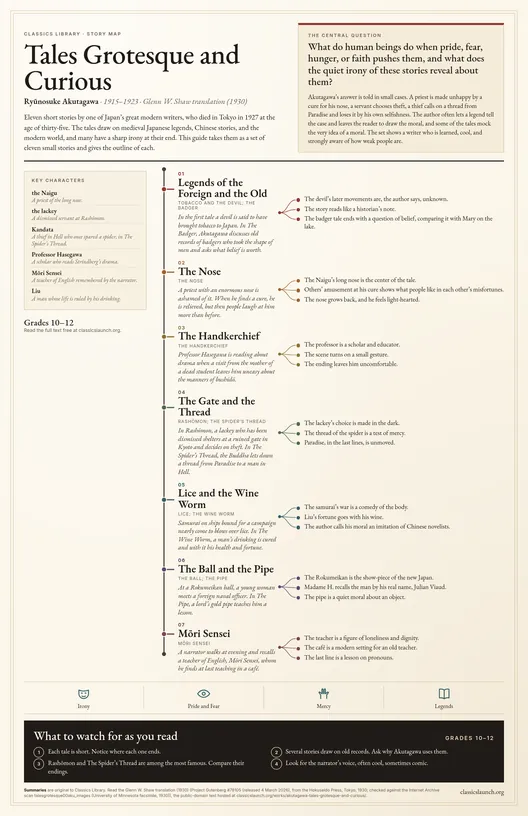 Story mapSee the story mapThe whole book on one page: the story in movements, the characters, and what to watch for. Free to print.
Abstract
Background. A young Japanese writer who studied English literature wrote these stories in the years 1915 to 1922. Many retell older tales from Japan, China and the Christian missions in a modern, ironic voice. The English translation of 1930 appeared three years after his death.
Plot. Each tale has its own plot: a servant at a ruined gate, a priest and his nose, a robber in hell, the Devil and tobacco, and a rich man cured of wine. The others add soldiers on a boat, a professor's puzzle, a clever badger, a ball and a pipe.
Ideas. The stories show how people excuse themselves, how they live by the opinion of others and how mercy can be lost through selfishness. They rarely state their morals, and they leave the reader with questions about conscience, pride and faith.
Text. The full collection and the translator's introduction are hosted. Students should read it with a teacher, because it includes theft from corpses and the torment of hell, and the author's death by his own hand is mentioned. Use it for discussion of conscience and temptation. Teachers can pair this work with the library's study guide, seminar questions and memory-work selection to prepare a discussion, a short essay or a recitation. The full text is hosted on this site, and each quotation in the guide has been checked against the hosted text.
Main characters
- The servant: A dismissed lackey in Rashōmon
- The old woman: A hag who steals hair from corpses
- Zenchi Naigu: A priest with a long nose
- Kandata: A robber in hell
- Liu Tai-cheng: A rich drinker
Summary
Tales Grotesque and Curious is the 1930 English collection of eleven short stories by Ryūnosuke Akutagawa, translated by Glenn W. Shaw and published in Tokyo by the Hokuseido Press. Akutagawa was one of the most admired Japanese short-story writers of the early twentieth century, and these tales, written between 1915 and 1922, are among his best known. Many of them retell older stories from Japanese, Chinese and Christian sources in a dry, modern voice that is full of irony and sometimes of dark humour. The collection opens with a translator's introduction, which gives a brief life of the author and notes on his stories. The tales are very different from one another. Rashōmon follows a poor servant sheltering from the rain at a ruined city gate during a time of famine, where he meets an old woman who is stealing hair from the corpses left there. The Nose tells of a vain Buddhist priest with an absurdly long nose and of the cure that gives him the short one he wanted and then the shame that follows. The Spider's Thread shows the Buddha lowering a thread to a wicked man in hell, and the man's selfishness destroys his chance. Tobacco and the Devil is a comic story of how the Devil is said to have brought tobacco to Japan. The Wine Worm tells of a rich man cured of his craving for wine, and of his decline afterward. Lice, The Handkerchief, The Badger, The Ball, The Pipe, and Mōri Sensei fill out a book that moves between old Japan, the new Japan of the Meiji period and the author's own day. The stories show human pride, hunger and self-deception in sharp small scenes, and they rarely give a plain moral. Many of them turn on the question of what a person will do when he thinks no one is watching. A classical Christian reader will find in them a vivid view of sin, vanity and mercy told from outside the faith, and a good deal of material to discuss in a seminar. The stories are dark. They include theft from the dead, the torment of hell and the mockery of the clergy, and the author took his own life, so a teacher should preview them and choose which tales to assign.
Virtues in this work
- Humility: The Nose shows how the wish to be thought well of makes a person a slave of others' eyes.
- Charity: The Spider's Thread shows that mercy shared is mercy kept, and mercy hoarded is lost.
- Prudence: Rashōmon shows the cost of choosing a wrong for the sake of need.
- Temperance: The Wine Worm asks what a craving is and what its cure costs.
Plot or Argument
- Rashōmon
A servant dismissed in a time of famine and disaster takes shelter in the ruined gate at Kyoto, where unclaimed corpses are left. There he meets an old woman who is pulling out the hair of a dead woman, and the encounter decides his choice between starving and stealing.
- The Nose
A priest of Ike-no-O is ashamed of a nose five or six inches long. A doctor from China gives a cure, and when it works the other priests and the people laugh at him in a new way.
- The Spider's Thread
The Buddha sees a robber in hell who once spared a spider and lowers a silver thread to him. The thread breaks when the man tries to keep it for himself.
- Tobacco and the Devil
A tradition says that the Devil, who came to Japan disguised as a Christian missionary, brought tobacco. The tale tells how he tried to win a cattle dealer and failed.
- The Wine Worm
A rich Chinese landowner who drinks enormous quantities of wine is treated by a mountain priest, and the worm that is said to cause his thirst is drawn out. His health and fortune then decline, and three explanations are offered.
- The other tales
Lice, The Handkerchief, The Badger, The Ball, The Pipe and Mōri Sensei move from a boat full of soldiers and vermin to a professor's puzzle over a visitor, a clever badger, a ball at the Rokumeikan and a teacher's lonely English lessons.
Characters
- The servant (the lackey), hero of Rashōmon
A poor man dismissed from service, waiting under a ruined gate, who must decide between starvation and theft.
- The old woman of the gate, foil
A hag who pulls hair from corpses to make wigs and who defends her act by pointing to the worse deeds of others.
- Zenchi Naigu, priest in The Nose
A priest, past fifty, whose long nose torments his self-respect.
- Kandata, robber in hell
A thief and murderer who is given one chance to climb out of hell by a spider's thread.
- Liu Tai-cheng, rich man in The Wine Worm
A drinker of great appetite whose cure leads to poverty and illness.
Lessons
Pride and the opinion of others
The priest in The Nose is not hurt by his nose so much as by what he thinks others see in it, and when he is rid of it he finds that he is still at the mercy of their eyes. Students can ask what Proverbs and the gospel say about seeking the praise of men.
- What does Zenchi Naigu really want?
- Why do the others laugh at him again after the cure?
Necessity and the conscience
In Rashōmon each character justifies a wrong by pointing to a worse one, and the servant ends by stealing from the one who stole. A classical reader can set this beside Romans 2:14-15 on the conscience, and ask whether necessity ever makes a wrong right.
- What argument does the old woman use for her deed?
- How does the servant use the same argument against her?
Mercy that will not share
In The Spider's Thread the robber is offered a chance to rise and loses it by refusing to share it. Buddhist mercy and Christian grace differ here, and the story invites students to compare the Buddha's thread with the cross.
- Why does the thread break?
- How does the Christian account of grace differ from a reward for one good deed?
The devil and temptation
Tobacco and the Devil closes with a question: when a man thinks he has resisted temptation, has he fallen? Students can read it beside the Screwtape Letters and James 4:7.
- What does the story suggest about pride after a victory over temptation?
- How would a Christian answer the narrator's question?
Context
Akutagawa wrote in the Taishō period (1912 to 1926), when Japan had opened to Western literature and ideas and many writers were struggling with the clash of old and new. Several of his tales take place in old Japan, drawing on twelfth-century story collections, and others are set in the era of the Christian missionaries or the Meiji court. Rashōmon refers to the great gate of Kyoto, which fell into ruin in the late Heian period.
Composition
The stories in this book were written between 1915 and 1922 and first appeared in Japanese magazines. Shaw's English translation was published by the Hokuseido Press in Tokyo in July 1930, three years after the author's death, with Shaw's introduction.
Reception
Akutagawa was recognised in his lifetime as one of Japan's leading short-story writers, and Rashōmon and The Nose were praised by Sōseki. The Kurosawa film Rashomon (1950) took its title from the story and the plot from another of his tales, In a Grove, which is not in this collection.
Comparisons
- The Nose
Gogol's story of a man whose nose leaves his face is a famous grotesque on a related theme, and a good comparison with Akutagawa's priest and his nose.
- The Screwtape Letters
Lewis's devils tempt through pride and self-deception, which gives a Christian reading to Akutagawa's tale of the Devil and the tobacco.
- Botchan
Sōseki, the teacher and patron of the young Akutagawa, wrote Botchan in a lighter vein, and the two give a view of Meiji and Taishō Japan.
- I Am a Cat (excerpt: Preface and Chapters I and II)
Sōseki's satire of a teacher's household shows how a master of an earlier generation handled irony, the style Akutagawa learned from.
- Crime and Punishment
Dostoevsky's novel also asks whether necessity can excuse a crime, and it gives a Christian answer to the question that Rashōmon leaves open.
Quotes
Frequently cited
“It was evening. A solitary lackey sat under Rashōmon waiting for the rain to clear.”
Frequently cited
“Then I guess you won’t blame me for turning highwayman, will you? I, too, must starve else.”
Frequently cited
“Here, you sinners! This spider’s thread is mine. Who on earth gave you permission to come up it? Get down! Get down!”
Frequently cited
“Now nobody will laugh at me surely,” murmured the Naigu in the depths of his heart, the while he dangled his long nose in the wind of the early autumn morning.”
Frequently cited
“May it not be true that when a man thinks he has won out against temptation he finds to his surprise that he has met defeat?”
“The lackey had already braved the rain and hurried away into the streets of Kyōto to rob.”
“Doubtless Kandata’s cold heart that would have saved only himself from Hell and his having received proper punishment and fallen back into Hell, had appeared to the Buddha’s eyes most pitiful.”
“There was nobody at Ike-no-O who did not know about the nose of Zenchi Naigu. It was five or six inches long and hung down from above his upper lip to below his chin.”
“The truth is, he was troubled over his self-respect, which was injured by his nose.”
“Once he tried drinking a decoction of snake-gourd and once applying rat urine to his nose.”
“The effect of the mountain priest’s treatment was immediately evident. From that day, Liu Tai-cheng never drank another drop of wine. Now he hates even the smell of it. But, strange to say, his health has declined little by little ever since.”
“Third. The wine worm was neither Liu’s affliction nor his good fortune. He had always been a heavy drinker. When wine was taken from his life, there was nothing left. So Liu was himself the wine worm, and the wine worm was Liu.”
“Moreover, in the boats there was an abundance of lice. And they were not the simple sort of lice that hide themselves in the seams of garments.”
“He has been more aptly compared to Flaubert for the seriousness with which he took his art and the preciousness of his style.”
“Should we not believe in that which lives within us just as our forefathers believed that the badger bewitched men? And should we not live as bidden by that in which we believe? Herein lies reason why we should not despise the badger.”
For Students
A reading companion for classical Christian high school students. See the student guide.
Reading Guide
Watch for
- Each place where a character justifies himself by pointing to someone else's fault.
- The contrast between how a character looks to others and what he is within.
- The use of Buddhist and Christian images, such as the Buddha, hell, the Devil and the Catholic padre.
- Endings that stop without stating a moral, and what the reader is left to decide.
Key terms and names
- Rashōmon
- The great southern gate of ancient Kyoto, which in the story is a ruin where corpses are left.
- Naigu
- A priest who serves in the palace chapel, as Zenchi does in The Nose.
- Kandata
- The robber in The Spider's Thread who spared a spider.
- Pentagram
- A five-pointed sign used as a charm against evil spirits in Tobacco and the Devil.
- Taishō period
- The years 1912 to 1926 in Japan, in which the author wrote.
Seminar Questions
- Comprehension What does the servant decide at the end of Rashōmon?
- Comprehension Why does Zenchi Naigu want a shorter nose, and what happens after the cure?
- Interpretation What does the Buddha think of Kandata at the end of The Spider's Thread?
- Interpretation Why does the old woman say her wrong is not so bad?
- Interpretation What does The Wine Worm suggest about the cure for a craving?
- Big Question Does necessity ever excuse a wrong?
- Big Question What does the world's mockery do to a person who is anxious about how he looks?
Faith Connections
- Romans 2:14-15 (Scripture)
Gentiles who do not have the law show that its work is written on their hearts, and the servant's unease before the act shows a conscience that a pagan story cannot silence.
- Matthew 18:21-35 (Scripture)
The parable of the unforgiving servant shows a man given mercy who refuses to give it, and it answers Kandata's selfishness.
- James 4:7 (Scripture)
Submit to God and resist the devil; the verse sets beside the closing question of Tobacco and the Devil the Christian call to resist temptation.
- Augustine, Confessions, Book II (Great Conversation)
Augustine's story of stealing pears shows how a wrong may be done for no need, and sets against Rashōmon an honest account of the heart.
Logic and Rhetoric
Central argument: Human pride, hunger and fear lead people to excuse wrongs by pointing to the wrongs of others, and mercy that is held for oneself is lost.
Rhetorical device: ironic ending. The priest's long nose returns on the last page, and the same people who laughed at it are no longer present to laugh, which turns the cure into a joke on the priest.
Debate: Resolved: That a person who steals to avoid starving is not to blame.
Memory Work
Then I guess you won’t blame me for turning highwayman, will you? I, too, must starve else.
May it not be true that when a man thinks he has won out against temptation he finds to his surprise that he has met defeat?
Writing Prompts
Essay: Explain how Rashōmon shows the working of a conscience, and say whether you think the old woman's argument is sound.
Comparison with The Nose: Compare the two stories called The Nose and say what each shows about vanity.
Medical Lens
These stories use medicine for ironic effect, as in The Nose and The Wine Worm, and Lice and Rashōmon show the filth of a time of war and famine. They are not clinical sources. The introduction's mention of the author's death by his own hand calls for a careful classroom discussion.
- The Nose
The priest's folk remedies include a decoction of snake-gourd and rat urine, and a doctor from China advises boiling the nose in hot water and treading on it; afterwards the nose swells and seems feverish.
- The Wine Worm
A rich man's drinking is treated by a mountain priest who draws a small creature from his mouth, after which he gives up wine and declines; three readings of the cure are offered.
- Lice
Soldiers crowd into boats full of lice and pickled radishes, with nausea and filth.
- Rashōmon
A city in famine leaves corpses in the gate, and the servant has a carbuncle on his cheek.
- Introduction
The translator reports that the author died of poison in 1927; teachers should handle this with care.
Creative Prompts
- Essay
Choose one of the stories and explain what its central character wants and what the author seems to think of that desire.
- Classroom
Divide the class into three groups and ask each to retell one of Rashōmon, The Nose and The Spider's Thread in its own words, then compare the moral each one suggests.
- Fiction
Write a short story that retells an old tale with a modern, ironic voice, as Akutagawa does with the Buddha's thread.
- Adaptation
Rewrite the ending of The Spider's Thread so that Kandata shares the thread, and say what the new ending loses or gains.
Further Reading
- Rashōmon and Seventeen Other Stories, Ryūnosuke Akutagawa, trans. Jay Rubin
A modern English collection with an introduction by Haruki Murakami.
- Botchan, Natsume Sōseki
The comic novel by Akutagawa's teacher and patron, in this library.
- The Nose, Nikolai Gogol
A comparable grotesque from nineteenth-century Russia, in this library.
Verification notes
The hosted text is Project Gutenberg eBook #78105, taken from the 1930 Hokuseido Press edition of Glenn W. Shaw's translation and checked against the Internet Archive scan. All eleven stories and the introduction are hosted. The Gutenberg title page also names a 1938 second edition; the hosted text was compared with the 1930 scan. The translation uses the transliteration of its time, and the introduction contains opinions of its date. The collection does not include In a Grove or Hell Screen. Dates of the stories' first publication follow standard reference accounts and should be checked against a modern edition.
- The year of first publication of each story in Japanese.
- The exact date and cause of the author's death, which sources give as an overdose in July 1927.
- Whether to name the Kurosawa film's sources in the guide.