Work record
I Am a Cat (excerpt: Preface and Chapters I and II)
Natsume SōsekiWagahai wa neko de aru; I Am a Cat (Natsume); I Am a Cat (Ando); I am a cat vol. 1I Am a Cat (excerpt: Preface and Chapters I and II) by Natsume Sōseki (1905–1906)I Am a Cat is the first novel of Natsume Sōseki, one of the most important modern Japanese writers.Also known as: Wagahai wa neko de aru · I Am a Cat (Natsume) · I Am a Cat (Ando) · I am a cat vol. 1
1905–1906 · Early 20th Century · Novel · Japanese
Read this when you want a gentle comic satire of vanity, talk and household life.
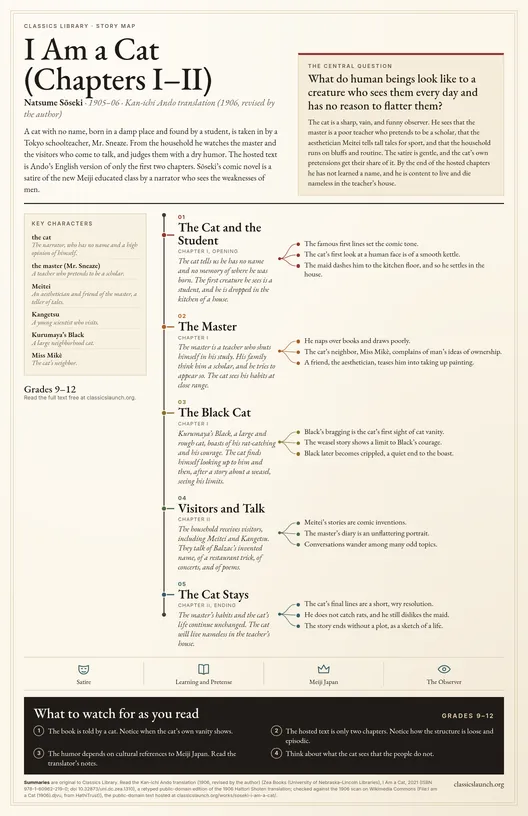 Story mapSee the story mapThe whole book on one page: the story in movements, the characters, and what to watch for. Free to print.
Abstract
Background. A teacher of English who became Japan's best-known novelist wrote this first novel as a magazine sketch in 1905. Its success carried it on for many chapters, and an English translation of the first two chapters appeared the next year, revised by the author himself.
Plot. A kitten thrown out of a house crawls to a schoolmaster's door and settles there. From his place by the fire he watches the household and its visitors and judges them in grand language, while a rival cat boasts of his rats.
Ideas. The comedy shows pretence, vanity and half-learned talk in a Japan that was rushing to be modern. The cat is as vain as the men he mocks, and each scene is driven by the distance between speech and truth.
Text. The hosted text is an excerpt of the preface and the first chapter and a half. Use it for short readings in satire and narration. Teachers may pair it with Botchan and Sanshirō to show how Sōseki's comedy grew darker in Kokoro. Teachers can pair this work with the library's study guide, seminar questions and memory-work selection to prepare a discussion, a short essay or a recitation. The full text is hosted on this site, and each quotation in the guide has been checked against the hosted text.
Main characters
- The cat: A nameless narrator
- The master: A dyspeptic schoolmaster
- Mr. Meitei: An aesthete and joker
- Mr. Kangetsu: A physics student
- Black: A boastful neighbouring cat
Summary
I Am a Cat is the first novel of Natsume Sōseki, one of the most important modern Japanese writers. It was first printed in a Tokyo magazine in 1905 as a short sketch and then went on, to the author's surprise, for eleven chapters. The library hosts an excerpt of the first English translation: the preface, the whole of Chapter I and the first part of Chapter II, translated by Kan-ichi Ando in 1906 and revised by Sōseki himself. The rest of the book is not hosted here. The translation is stiff and very much of its time, with the translator's footnotes explaining Japanese customs. The narrator is a cat, born in a damp place and thrown out by a student into a thicket. He is rescued by a kind of luck and settles in the household of a schoolmaster, whom he calls his master. The master is a sour, dyspeptic teacher who naps over his books, tries to paint in watercolours without talent and complains about his work to every visitor. The cat watches the master, his family and a stream of visitors, and he gives his shrewd, pompous and often mistaken opinions about the follies of the human race. He also makes friends with a boastful neighbouring cat, and in Chapter II the household celebrates the new year, with its rice cakes and its quarrels about a stomach medicine. The cat is a device that allows Sōseki to look at the educated men of the Meiji era, with their half-learned Western ideas, their pretensions and their talk. The satire is gentle. The master is vain but harmless, the visitors are windbags and jokers, and the cat himself is the vainest of all, believing that cats will one day be the lords of creation. The novel shows a Japan in a hurry to be modern, and the comedy is built on the gap between what people say and what they are. Students can read the excerpt as a first taste of Sōseki before Botchan and the later novels. It is a good book for discussing vanity, the habit of pretending to know, and the way that talk can replace thought. It contains little that is offensive, though it has some period remarks about women and servants. A teacher can use a chapter or two as a model of comic narration and of the use of an animal voice for satire.
Virtues in this work
- Humility: The book teases every kind of vanity, and the cat's own pride is made plain.
- Prudence: The master's quarrel about his medicine and his habits shows the lack of patience in a man who wants a cure without effort.
- Temperance: The master gorges at table and then complains of his stomach.
Plot or Argument
- The cat is born and thrown out
A kitten is separated from his mother, taken up by a student and abandoned in a thicket. He crawls toward a house and is driven off several times.
- The master's household
The cat is taken in by a schoolmaster, watches him sleep over books, take a stomach powder and try watercolours, and meets the maid, the mistress and the children.
- Black and the world of cats
A big neighbouring cat, called Black, brags about his rat-catching. The narrator reflects on the vanity of the human race, which he thinks cats will one day outlast.
- The New Year visitors
In Chapter II the master's friends call on him with tall tales and jokes, among them the aesthete Meitei and the physics student Kangetsu, and the family quarrels over the master's medicine.
- The Recitation Society
The excerpt ends when a young man comes to ask the master to join his Recitation Society, and the conversation about their artistic aims begins.
Characters
- The cat, narrator
A nameless cat who observes human beings with great pride and little understanding.
- The master, a schoolmaster
The cat's owner, who is dyspeptic, vain and given to pretending to be busy.
- Mr. Meitei, friend and prankster
An aesthete who tells tall tales to the master for amusement.
- Mr. Kangetsu, a young scientist
A physics student, a visitor to the house.
- Black, a neighbouring cat
A boastful big cat who gives the narrator his idea of cat society.
Lessons
Vanity and pretence
The master pretends to be a scholar and the visitors pretend to know more than they do. Students can ask how Proverbs and Matthew 6 treat the person who wants to be thought wise or holy.
- What does the master pretend about himself?
- What is the cat's own vanity?
A cat's view of man
The cat speaks of men as an alien species, and he expects that cats will one day be the lords of creation. A classical student can compare this with the biblical teaching that man was made to have dominion under God, and notice where the cat's pride repeats the sin he sees in men.
- What does the cat get right about people?
- Where does his own conceit show?
The medicine and the stomach
The master's dyspepsia and his on-and-off use of a patent stomach powder give a comic picture of a man who wants a cure without discipline. Teachers can ask what the family's quarrel reveals about habit, patience and self-knowledge.
- Why will the master not take the powder?
- What do his wife and maid say about patience?
Meiji Japan in a hurry
The characters pick up bits of Western art, science and literature and use them in half-understood talk. Students can discuss the cost of a culture that borrows quickly without digesting.
- Which Western things do the characters mention?
- What does the book suggest about borrowing ideas?
Context
The novel is set in the Meiji period (1868 to 1912), when Japan was changing rapidly. Educated men studied Western science and literature while keeping older customs. Middle-class teachers like the master were paid modestly and lived in rented houses with a maid, as shown in the book.
Composition
Sōseki wrote the first chapter as a sketch for the magazine Hototogisu in 1905. Its success led him to continue until 1906, and it was gathered in volumes. Ando's English version of the first two chapters appeared in Tokyo in 1906, with a preface by the translator, and Sōseki helped revise it.
Reception
I Am a Cat made Sōseki famous in Japan overnight, and it is still one of the most popular Japanese novels. The book has been translated several times since the Ando version, and its voice has been widely imitated.
Comparisons
- Botchan
Botchan, in this library, is Sōseki's next comic novel and is told by an impulsive young teacher; read after the cat to see the author's range.
- Sanshirō
Sanshirō follows a country youth into Tokyo's university world, and its quiet comedy builds on the satire of the Meiji intellectual seen here.
- Kokoro
Kokoro, a guide in this library, shows the same world of teachers and students in a much darker mood.
- Tales Grotesque and Curious
Akutagawa, whom Sōseki encouraged, took up a sharper form of irony in short stories.
- The Screwtape Letters
Lewis's devil also looks at human beings as an outsider, with much wit and much self-deception of his own.
Quotes
Frequently cited
“I am a cat; but as yet I have no name.”
Frequently cited
“I won’t take it,” said my master, “as it is not efficacious.” “But then they say it is marvellously good for starch. You should take it,” urged his wife. “Starch or no starch, it does me no good,” insisted her husband. “You are really very changeable,” murmured the other. “No, I am not. It is because the medicine is poor that I do not take it.” “But you did take it everyday until recently, saying it worked a miracle.” “It did me some good then; it does me no good now,” retorted my master antithetically.”
Frequently cited
“The vanity of man is simply astonishing.”
“Where I was born is entirely unknown to me. But this still dimly lives in my memory. I was mewing in a gloomy damp place, where I got the first sight of a creature called man.”
“He suffers from indigestion, and his sallow complexion tells of the want of elasticity and vitality of his skin. Nevertheless, he is a gormandizer.”
“With all his vanity, my master really wishes to be free from indigestion; for he said he would take a little saké at supper from that very evening. Is it not a farce?”
“Even a cat, if he lives with a teacher, seems to take after his disposition. If I do not take care of myself, I shall probably become a dyspeptic myself.”
“Mighty as man is, he will not always be “lord of creation.”
“It is cleverly written with originality and conviction, and sparks of truth and humor are visible throughout the whole volume.”
For Students
A reading companion for classical Christian high school students. See the student guide.
Reading Guide
Watch for
- The cat's shifts between humility and boasting.
- The things the master pretends and the things the visitors pretend.
- Each mention of food, medicine or health, and how it is used for comedy.
- The translator's footnotes, which explain Japanese customs to readers in 1906.
Key terms and names
- Zoni
- A soup of rice cakes, vegetables and fish eaten at the New Year, mentioned in the footnotes.
- Taka-Diastase
- A patent starch-digesting medicine of the time, taken by the master for indigestion.
- Meiji
- The period from 1868 to 1912, in which the book is set.
- Dyspepsia
- Poor digestion, from which the master suffers and from which the cat fears he too will suffer.
Seminar Questions
- Comprehension How does the cat come to live in the master's house?
- Comprehension What does the master do after dinner each night?
- Interpretation Why does the narrator admire his own intellect so highly?
- Interpretation What does the quarrel about the medicine show about the master and his wife?
- Interpretation How does the cat's view of man make the reader see ordinary habits differently?
- Big Question Is it a mark of wisdom or of pride to look at one's own kind from outside?
- Big Question What does a culture lose when it borrows ideas faster than it can digest them?
Faith Connections
- Proverbs 26:12 (Scripture)
Do you see a man wise in his own eyes? There is more hope for a fool than for him; the verse is a plain summary of the book's targets.
- Genesis 1:26-28 (Scripture)
Man is made with dominion over the animals, which the cat jokingly denies; the passage grounds the book's comic reversal.
- C. S. Lewis, The Screwtape Letters (Great Conversation)
Lewis's devil also looks at human beings from outside and shows how pride and self-deception work.
Logic and Rhetoric
Central argument: Human beings, especially clever ones, are more vain than they know, and an outsider's view shows it, though the outsider is vain too.
Rhetorical device: comic narrator. The cat's solemn praise of his own intellect and his scorn of human vanity makes his own vanity plain.
Debate: Resolved: That an outsider sees a society more truly than its members do.
Memory Work
I am a cat; but as yet I have no name.
The vanity of man is simply astonishing.
Writing Prompts
Essay: Explain how Sōseki uses the cat's voice to make the reader laugh at human vanity and then at the cat himself.
Comparison with Botchan: Compare the narrator of I Am a Cat with the narrator of Botchan, and say how each views the people around him.
Medical Lens
The novel is a small source for the history of everyday medicine: the master's dyspepsia, the patent starch-digesting powder and his half-hearted use of it. It is not a medical text, and Sōseki himself suffered stomach trouble.
- Chapter I
The master suffers from indigestion and takes a stomach powder before bed.
- Chapter II
The master refuses the same medicine, and his wife and maid urge patience; the cat mocks the plan to cure indigestion with saké.
Creative Prompts
- Essay
Explain what the cat sees of human beings that humans fail to see in themselves, and where the cat's own view falls short.
- Fiction
Write a short scene from the point of view of an animal in your own home, in the cat's pompous and comic voice.
- Dialogue
Write a conversation between the master's wife and the master about his medicine, showing how each of them argues.
- Classroom
Divide the class into groups to read the first chapter aloud with different readers for the cat and for the other voices.
Further Reading
- I Am a Cat, Natsume Sōseki, trans. Aiko Ito and Graeme Wilson
A full modern English translation of the whole book.
- Botchan, Natsume Sōseki
The comic novel of a young teacher, in this library.
- Sanshirō, Natsume Sōseki
The novel of a student in Tokyo, in this library.
Verification notes
The hosted text is an excerpt: the preface, Chapter I in full and the first part of Chapter II of the 1906 translation by Kan-ichi Ando, as retyped in the Zea Books edition of 2021, which states that the text is in the public domain, with word breaks repaired by program and paragraph breaks restored by line length. The rest of the 1906 volume is not hosted, and small scanning or repair errors may remain, and the spelling Tō fū for a character's name follows the source. Sōseki's account of the revision appears in the translator's preface. The year of the original serial publication and the number of its chapters follow standard reference accounts.
- The publication dates of the original serial and the three volumes.
- The exact point at which the excerpt breaks off in the original chapter.
- The standard spelling of the characters' names in modern translations.