Work record
Fifty Famous Stories Retold
James BaldwinFifty Famous Stories Retold by James Baldwin (1896)Fifty Famous Stories Retold gathers brief narratives that Baldwin expected children to encounter again in books, conversation, and poetry.1896 · 19th Century · Collection · English
Read this when a familiar name or allusion needs the short, memorable story behind it.
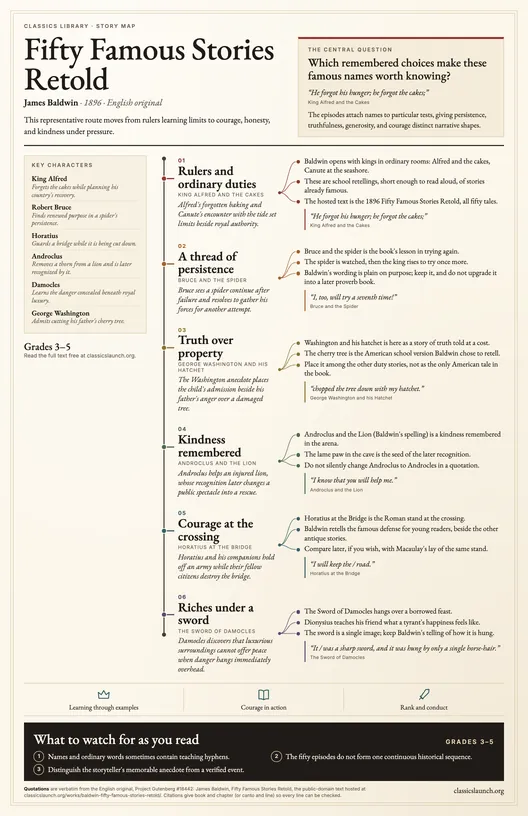 Story mapSee the story mapThe whole book on one page: the story in movements, the characters, and what to watch for. Free to print.
Abstract
Background. Baldwin's 1896 American school reader assembles fifty episodes drawn from inherited anecdote, legend, and literature. The preface explains their value as preparation for later reading, while acknowledging that their relation to history varies. The hosted Gutenberg witness is a later public-domain printing of the work, preserving its distinctive divided spellings.
Content. Royal misadventures introduce Alfred, Canute, and Bruce; classical episodes bring forward Horatius, Damocles, and Androclus. Other chapters follow Whittington, Washington, Sidney, and many less powerful figures. Each selection forms a small independent narrative, usually ending after a decisive action reveals courage, kindness, intelligence, or a mistaken estimate of happiness.
Themes. The collection repeatedly places outward rank beside inward conduct. A sovereign can neglect a small promise, a fugitive can help a dangerous animal, and a child can choose truthful speech. Material objects give those choices memorable form. Readers can compare the lessons without assuming that all fifty tales teach the same virtue.
Significance. Short scenes and accessible conversation make the volume useful for oral narration and recognition of literary references. Its historical names should be introduced with the distinction Baldwin himself makes between records and stories handed down. Read with that care, the book supplies a varied store of narrative examples and a natural bridge from elementary reading to longer works.
Main characters
- King Alfred: Forgets the cakes while planning his country's recovery.
- Robert Bruce: Finds renewed purpose in a spider's persistence.
- Horatius: Guards a bridge while it is being cut down.
- Androclus: Removes a thorn from a lion and is later recognized by it.
- Damocles: Learns the danger concealed beneath royal luxury.
- George Washington: Admits cutting his father's cherry tree.
Summary
Fifty Famous Stories Retold gathers brief narratives that Baldwin expected children to encounter again in books, conversation, and poetry. His introduction distinguishes tales with some historical value from inventions valued for amusement or moral illustration. The collection therefore offers an entrance into a shared store of remembered stories rather than a continuous history. Kings, poor children, soldiers, poets, and animals all receive their turn in its compact scenes. Several early tales bring rulers down to the scale of ordinary obligations. Alfred, hiding after defeat, forgets the cakes he has promised to watch. Canute demonstrates that royal command cannot stop the sea. Bruce, discouraged by repeated military failure, watches a spider try again and takes renewed heart. Each story gathers its lesson around something visible: a hearth, a tide, or a thread stretched between beams. Other selections connect brave action with care for another person. Horatius holds the road while the Romans cut down the bridge behind him. Sir Philip Sidney yields water to a wounded soldier. Androclus removes a thorn from a lion's paw, and the animal's later recognition saves him in the arena. The return of kindness gives that encounter a structure different from the tales of military endurance, though both ask what a person will do under pressure. Baldwin also includes stories about wealth, judgment, and appearances. Damocles learns the anxiety hidden beneath a ruler's pleasures when he sees a sword hanging over his head. Dick Whittington's difficult beginning leads toward prosperity through the extraordinary fortunes of his cat. Washington's damaged cherry tree becomes the setting for a confession that his father values above property. These are the memorable versions Baldwin tells, including familiar legends rather than independently established reports of every event. The reader moves among these episodes without needing to remember a large cast from chapter to chapter. Plain dialogue, strongly marked decisions, and brisk endings make the tales suitable for reading aloud and retelling. Their continuing interest lies in the variety of their tests: persistence is useful in one, generosity in another, and humility or honesty elsewhere. Together they give young readers a lively foundation for recognizing allusions and comparing different kinds of admirable action.
Virtues in this work
Plot or Argument
- Rulers and ordinary duties
Alfred's forgotten baking and Canute's encounter with the tide set limits beside royal authority.
- A thread of persistence
Bruce sees a spider continue after failure and resolves to gather his forces for another attempt.
- Truth over property
The Washington anecdote places the child's admission beside his father's anger over a damaged tree.
- Kindness remembered
Androclus helps an injured lion, whose recognition later changes a public spectacle into a rescue.
- Courage at the crossing
Horatius and his companions hold off an army while their fellow citizens destroy the bridge.
- Riches under a sword
Damocles discovers that luxurious surroundings cannot offer peace when danger hangs immediately overhead.
Characters
- King Alfred, Ruler in hiding
Forgets the cakes while planning his country's recovery.
- Robert Bruce, Discouraged king
Finds renewed purpose in a spider's persistence.
- Horatius, Roman defender
Guards a bridge while it is being cut down.
- Androclus, Fugitive and helper
Removes a thorn from a lion and is later recognized by it.
- Damocles, Envious guest
Learns the danger concealed beneath royal luxury.
- George Washington, Child in an anecdote
Admits cutting his father's cherry tree.
Lessons
Keep the small promise
Alfred's larger concerns do not prevent the cakes from burning. The comic scene makes responsibility tangible without erasing his courage elsewhere.
- Why does Alfred forget his task?
- Can a great purpose excuse every neglected duty?
Let failure teach
Bruce's attention to the spider restores his willingness to act. The tale joins patience with a concrete decision to begin again.
- What does the spider do differently after failure?
- What must Bruce do beyond feeling encouraged?
Recognize a story's kind
Baldwin gathers tales with different degrees of historical grounding. Their memorable choices can be discussed while still naming legend and anecdote accurately.
- What does the introduction say about historical value?
- Why might a story remain useful when it is legendary?
Context
Late nineteenth-century school readers often linked elementary literacy with familiar historical names and moral examples. Baldwin explicitly intended these short retellings to prepare children for allusions in a wider literature.
Composition
The work first appeared in 1896. The hosted Project Gutenberg text comes from a later public-domain printing of the same collection.
Reception
The book's continuing educational appeal rests on its short independent chapters, though its anecdotes should be read as the inherited tales the preface describes.
Comparisons
- Aesop's Fables
Both collections make conduct memorable through short scenes, but Baldwin usually attaches the action to named people or inherited historical anecdotes.
- Paul Revere's Ride
Compare a brief prose account of heroic action with a poem whose rhythm enlarges a single remembered deed.
Quotes
“He forgot his hunger; he forgot the cakes;”
“I, too, will try a seventh time!”
“chopped the tree down with my hatchet.”
“I know that you will help me.”
“I will keep the road.”
“It was a sharp sword, and it was hung by only a single horse-hair.”
For Students
A reading companion for classical Christian high school students. See the student guide.
Reading Guide
Watch for
- Names and ordinary words sometimes contain teaching hyphens.
- The fifty episodes do not form one continuous historical sequence.
- Distinguish the storyteller's memorable anecdote from a verified event.
Key terms and names
- allusion
- A reference that expects the audience to recognize another story or event.
- anecdote
- A brief account focused on a striking incident or action.
- legend
- An inherited story associated with a person or place.
- tyrant
- A ruler who exercises power cruelly or without just restraint.
Seminar Questions
- Comprehension Why does Alfred fail to watch the cakes?
- Comprehension How does the lion recognize Androclus later?
- Interpretation Why are objects so important to these short episodes?
- Interpretation How do Bruce and Horatius show different forms of courage?
- Big Question Can a legendary incident teach without being a historical record?
- Big Question What makes a brief story worth remembering for many years?
Faith Connections
- Luke 16:10 (Scripture)
The teaching about faithfulness in small matters illuminates the contrast between Alfred's plans and his neglected task.
- Galatians 6:9 (Scripture)
The encouragement to continue doing good can be compared with Bruce's renewed effort, while keeping military success distinct from the scriptural promise.
Logic and Rhetoric
Central argument: Concrete incidents make moral choices and familiar literary references easier to retain than abstract instruction alone.
Rhetorical device: exemplum. A ruler's anxiety becomes visible through one banquet place beneath a suspended weapon.
Debate: Resolved: a short legendary example can prepare children for serious reading when its kind is clearly named.
Memory Work
I, too, will try a seventh time!
Writing Prompts
Essay: Compare two tales in which an ordinary object changes a character's judgment or action.
Comparison with Aesop's Fables: Compare the ending of one Baldwin anecdote with one Aesop fable, asking how directly each states its lesson.
Medical Lens
The injured lion's paw gives one selected tale a clear bodily episode; the collection is not otherwise treated as medical writing.
- Androclus and the Lion
Androclus examines the lion's painful paw and removes the thorn, beginning their friendship.
Creative Prompts
- Classroom
Retell one episode without looking, then check which cause-and-effect details you kept or lost.
- Dialogue
Write a conversation between Alfred and the householder after he discovers the burnt cakes.
- Essay
Choose two objects from different tales and explain how each makes an invisible virtue or fear visible.
Further Reading
- Old Greek Stories, James Baldwin
- Fifty Famous People, James Baldwin
Verification notes
Contents and quotations follow the complete hosted Project Gutenberg #18442 text. The source is a later printing of the work first published in 1896. Washington's tree, Bruce's spider, and similar episodes are presented as Baldwin's familiar tales, without asserting documentary certainty.
No verification flags recorded.