Work record
The Lily of the Valley (Le Lys dans la vallée)
Honoré de BalzacLe Lys dans la vallée; The Lily in the Valley; Lily of the Valley; Balzac's Lily of the ValleyThe Lily of the Valley (Le Lys dans la vallée) by Honoré de Balzac (1835)The Lily of the Valley is a novel in the form of a long letter, written by Félix de Vandenesse to the woman he hopes to marry, Natalie de Manerville.Also known as: Le Lys dans la vallée · The Lily in the Valley · Lily of the Valley · Balzac's Lily of the Valley
1835 · 19th Century · Novel · French
Read this when a pure and unspoken love meets the weight of a vow.
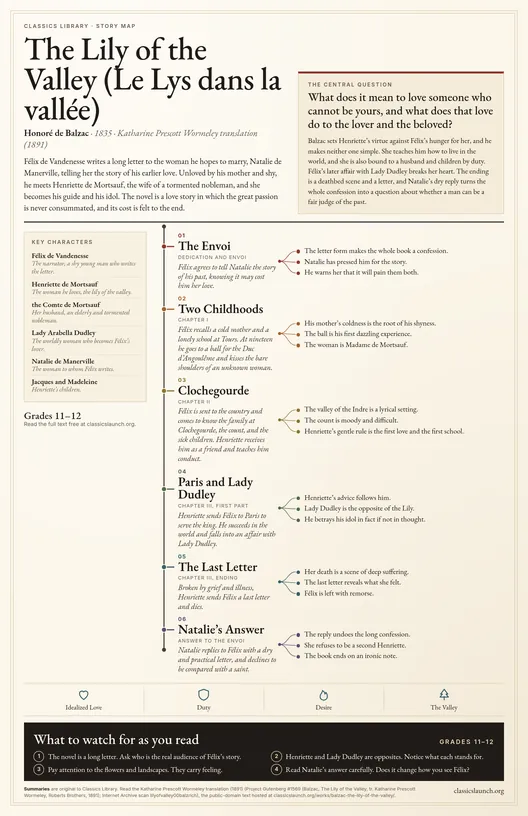 Story mapSee the story mapThe whole book on one page: the story in movements, the characters, and what to watch for. Free to print.
Abstract
Background. Balzac wrote this book in the 1830s, as part of the great series of novels on French life that he called La Comédie humaine. It is set in the country around Tours, where the author had spent time in youth.
Plot. A young man who was never loved writes the story of his first passion for a married countess. He serves her as a friend, goes to Paris to make his career, and then forgets her for another woman while she sickens at home.
Structure. A short envoi opens the book and a short answer closes it, with three long chapters of narrative between them, in which the whole tale is the confession of the narrator. Its manner is slow and full of description, with long speeches and letters, and it moves from the boy's unhappy home to the quiet valley and at last to Paris.
Themes. The book dwells on duty, desire, motherhood and the cost of a restrained love. It asks how a heart should be ruled and what the vow of marriage demands.
Significance. Many readers regard the countess as Balzac's finest portrait of a woman, and the novel is a standard text in the study of the French novel of the nineteenth century.
Main characters
- Félix de Vandenesse: Young narrator who confesses his past
- Henriette de Mortsauf: Devout countess, the lily of the title
- Comte de Mortsauf: Her sick and difficult husband
- Lady Dudley: English rival in Paris
- Natalie de Manerville: The woman who receives the letter
Summary
The Lily of the Valley is a novel in the form of a long letter, written by Félix de Vandenesse to the woman he hopes to marry, Natalie de Manerville. She has pressed him for the story of his past, and he gives it, warning her that it will pain them both. Félix is the unloved younger son of a cold, ambitious mother. He is sent away to school at Tours and grows up starved of affection and shy, and at nineteen he goes to a ball given for the Duc d'Angoulême in 1814, where, overcome, he kisses the bare shoulders of a woman he does not know. She is Henriette de Mortsauf, the young wife of an elderly and tormented nobleman who lives at the château of Clochegourde on the Indre. When Félix is sent to recover his health at a neighbouring estate, he sees her again, is taken into the household, and is received as a friend by the count and as a kind of son and brother by the countess. The count is a Royalist émigré who has been broken by exile, has a sick stomach and a violent temper, and torments his family; the two children, Jacques and Madeleine, are delicate. Henriette bears all this with patience, and she guides Félix in conduct and ambition, sends him to Paris to serve the king, and asks him to love her as a friend and to keep within the bounds of her marriage vow. For years he does. In Paris he rises, but he meets the English Lady Dudley, who draws him into an open affair. Henriette learns of it, is wounded to the heart, and sinks into a decline. She sends for him, writes him a last letter of counsel, and dies, and Félix is left to blame himself. In a short envoi and an answer, Natalie, who has read the story, answers it in her own way. The book is one of Balzac's studies of provincial and Parisian life, and it turns on the struggle between duty and desire, between the quiet love that keeps a vow and the passion that breaks one. It is a book about self-command, the claims of marriage, and the cost of loving without restraint, and it ends with a stern picture of what follows when the lily is neglected for a showier flower.
Virtues in this work
- Temperance: Henriette asks Félix to govern his desire, and her own conduct shows a rule of the heart that holds against strong feeling.
- Fortitude: The countess bears a hard husband and sick children for years without complaint.
- Charity: She shows mercy to the weak, to her husband and to the young man she guides.
- Faith: Her marriage and her sufferings are borne with a steady religion, and her last hours are given to prayer and counsel.
Plot or Argument
- The envoi and the confession (Dedication and Envoi)
Félix agrees to tell Natalie de Manerville the story of his past, knowing that it may cost him her love.
- Two Childhoods (Chapter I)
Félix recalls a lonely childhood under a cold mother and his school years at Tours, and his first meeting with Madame de Mortsauf at the ball for the Duc d'Angoulême.
- First Love (Chapter II)
He is sent to the country, comes to know the family at Clochegourde, the count and the sick children, and is received by Henriette as a friend. She teaches him the conduct of life and sends him to Paris.
- The Two Women (Chapter III)
In Paris, Félix serves the king and falls into an affair with Lady Dudley. Henriette, broken by grief and illness, sends him a last letter and dies.
- Answer to the Envoi
Natalie replies to Félix with a dry and practical letter, and declines to be compared with a saint.
Characters
- Félix de Vandenesse, narrator and young man
A shy and unloved boy who grows into a courtier, writing the story of his first love to the woman he hopes to marry.
- Henriette de Mortsauf, the lily of the valley
A devout and gentle countess, mother of two sick children, who keeps her marriage vow and guides Félix as a friend.
- The Comte de Mortsauf, her husband
A Royalist nobleman broken by exile, who is irritable, sickly, jealous and fond of his wife in his own difficult way.
- Lady Arabella Dudley, the rival
An English noblewoman who draws Félix into an open affair in Paris.
- Natalie de Manerville, addressee
The woman to whom Félix writes and who replies at the end.
- Jacques and Madeleine, the countess's children
Two frail children whose illnesses fill the countess's days.
Lessons
Self-command in love
Henriette asks Félix to love her within the bounds of her vow and he, for a time, does. The book shows how great a thing it is to rule a passion and how heavy the cost when it is not ruled, and invites students to ask what the classical and Christian traditions mean by temperance in love.
- What does Henriette ask of Félix, and why does she ask it?
- What is the difference between loving a person and wishing to possess a person?
Duty and mercy in marriage
The countess keeps faith with a difficult husband from a sense of duty and a religion of mercy. Students can set her example beside the Christian teaching on the marriage vow, and ask whether Balzac thinks duty alone is enough to keep the heart whole.
- Why does Henriette stay with her husband?
- Is the countess's patience a strength or a loss, in the novel's view?
The harm of neglected affection
The boy who is not loved by his mother becomes the man who seeks an idol. A teacher can use Félix's childhood to start a conversation about the duties of parents, and about how an unfed heart looks for the wrong things.
- How does Félix's childhood prepare him for his first love?
- What do parents owe their children beyond food and schooling?
Guilt and the confessor
Henriette goes to a confessor and speaks of her struggle, and Félix, at the end, accuses himself. A Christian reader can compare the novel's idea of guilt with repentance, forgiveness and the amendment of life as taught in Scripture.
- What does the countess ask of her confessor, and what does he give her?
- Does Félix repent, or only regret?
Context
The story begins in 1814, at the fall of Napoleon and the return of the Bourbons, and runs through the Restoration to the reign of Charles X. The countryside of Touraine, with its Royalist noble families and its simple provincial life, is set against the court and society of Paris.
Composition
Balzac wrote the novel in 1835 and published it first in the Revue de Paris, in instalments, and then as a book in 1836. He later placed it in the Scenes of Country Life in La Comédie humaine. The narrator, Félix de Vandenesse, appears in several of Balzac's other novels. The setting owes much to the Loire valley where the author spent part of his youth.
Reception
The book was admired for the portrait of the countess, and later critics have called it one of Balzac's finest novels of the heart. Katharine Prescott Wormeley, a leading American translator of Balzac, published the English version used here with Roberts Brothers of Boston in 1891.
Comparisons
- Father Goriot (Le Père Goriot)
Père Goriot also sets a young man's education against the Paris of the Restoration and ends in a death, but it turns on ambition and money where The Lily turns on the heart.
- Cousin Betty
Balzac's late novel of a household ruined by passion and envy gives a darker study of desire than the countess's patient virtue.
- The Chouans
The earlier novel of Royalist Brittany shows the same circle of Royalist families that shaped the world of Clochegourde.
- Madame Bovary
Flaubert's heroine seeks in romance what Henriette finds in duty, and the contrast shows two very different ends of a married woman's heart.
- Anna Karenina
Tolstoy sets a woman's passion against her vow and her child, and makes the same question of duty and desire a matter of life and death.
- The Sorrows of Young Werther
Werther's love for a married woman is told in his own words, as Félix tells his, but it ends in despair where Félix's ends in guilt.
- The Red and the Black
Julien Sorel also loves a married woman in a provincial town of the Restoration, though Stendhal's hero is driven by ambition where Félix is driven by a hunger for affection.
Quotes
Frequently cited
“all country things were bidding farewell to the loveliest lily of the valley, to her simple, rural life.”
Frequently cited
“the light shining in the darkness like a lily in a wood”
“her religion of mercy to wounded hearts, feeble or suffering, her declared allegiance to her legal yoke.”
“Moreover, women who are naturally mothers live and love far more through sacrifices than through pleasures.”
“I loved her with a double love which shot its arrows of desire, and then lost them in the sky”
“then she died through me!”
“I wish to marry the whole of the man I love, and I really cannot marry Madame de Mortsauf too.”
“Burning with ardent faith, I prayed to God to renew in my behalf the miracles I had read of in martyrology.”
For Students
A reading companion for classical Christian high school students. See the student guide.
Reading Guide
Watch for
- How Félix describes his mother and his childhood, and what he says he lacked.
- The first meeting at the ball, and what the countess says when she next sees him.
- The household at Clochegourde: the count's moods, the children's illnesses, the countess's daily work.
- The countess's counsel to Félix before he goes to Paris.
- How the last chapter changes the picture of Félix.
Key terms and names
- Clochegourde
- The small château on the Indre, near Tours, where the Mortsauf family lives.
- Émigré
- A noble who fled France in the Revolution; the count is one who returned with the Bourbons.
- The Restoration
- The years 1814 to 1830, when the Bourbon kings ruled France again.
- Envoi
- A short opening letter that sends the book on its way, here from Félix to Natalie.
- Lily of the valley
- A white flower of the woods, which the title takes as the picture of a pure and hidden woman, and which recalls the Song of Songs 2:1.
- Confessor
- The priest to whom the countess goes to speak of her struggles.
Seminar Questions
- Comprehension How is Félix treated by his mother, and how does it affect him?
- Comprehension What kind of man is the Comte de Mortsauf, and how does his wife treat him?
- Comprehension What does Henriette ask of Félix before he goes to Paris?
- Interpretation Why does Balzac call the countess a lily, and what does the flower stand for?
- Interpretation Why does Félix write the story as a letter to Natalie, and what does her answer show about him?
- Interpretation How does Balzac set the countess's duty beside Lady Dudley's passion?
- Big Question Is a love that never breaks the marriage vow a good love if it is not honest? Answer from the novel and from Scripture.
- Big Question What does a person owe to the one who has shown him the pattern of a good life?
Faith Connections
- Song of Solomon 2:1-2 (Scripture)
The beloved is called the lily of the valleys, and the lily among thorns; Balzac's title and the picture of Henriette among the household's troubles draw on this verse.
- Matthew 5:27-28 (Scripture)
Christ teaches that the sin of adultery begins in the look and the desire of the heart; the novel's long account of Félix's restrained longing and his later fall invites a comparison with this teaching.
- Ephesians 5:22-33 (Scripture)
Paul's teaching on the marriage vow and the love of husband and wife gives the Christian background for Henriette's faithfulness to a hard husband.
- Augustine, Confessions, Book 2 (Church Fathers)
Augustine's account of the restless heart and of desire that has not yet learned to love rightly gives a Christian counterpart to Félix's confession.
Logic and Rhetoric
Central argument: A love that is held within a vow can make a man better, and love that breaks the vow brings ruin, but the book shows that duty without warmth may be as dangerous as passion without restraint.
Rhetorical device: frame narrative. The whole novel is a confession written to a woman Félix hopes to marry, so that the reader judges the story and the teller at once.
Debate: Resolved: That Henriette de Mortsauf was wise to ask Félix for a love without possession.
Memory Work
the light shining in the darkness like a lily in a wood
Moreover, women who are naturally mothers live and love far more through sacrifices than through pleasures.
Writing Prompts
Essay: Using at least three passages from the novel, explain how Balzac pictures the countess's virtue and say whether he thinks it is enough.
Comparison with Father Goriot (Le Père Goriot): Compare the education of Félix de Vandenesse in this novel with the education of Eugène de Rastignac in Père Goriot, and say what each learns.
Medical Lens
Balzac gives a lively picture of the sickroom in the country. The count is a hypochondriac who complains of his stomach and mind and is also genuinely ill; the physician Origet appears as a sensible country doctor, and the novel shows bleeding by leeches and the care of the sick by family. The countess's own decline is attributed to grief and a wasting disease of the stomach, and the novel treats her death as the consequence of both body and heart, in the manner of the time. It is a useful literary source for ideas about nervous complaint, melancholy and the part of grief in illness, but not a medical text.
- Chapter II: First Love
The count's complaints about his stomach and his nerves, and Dr. Origet's sober treatment in a crisis, with leeches and bleeding.
- Chapter III: The Two Women
The countess declines in health under grief and a stomach disease, and dies surrounded by her family.
Creative Prompts
- Essay
Henriette de Mortsauf asks Félix to love her within the bounds of her marriage. Write an essay on whether the book thinks this request is wise, using at least three passages.
- Dialogue
Write a conversation between Henriette and her confessor in which she speaks of her struggle, and let him answer as a priest of the time would.
- Classroom
Hold a debate on the resolution that Natalie de Manerville's reply is the wisest word in the book, and have both sides cite the text.
- Fiction
Write a letter that Madeleine de Mortsauf might have written to Félix many years after her mother's death.
Further Reading
- Père Goriot (Father Goriot), Honoré de Balzac
Balzac's best known novel, in this library.
- Balzac: A Biography, Graham Robb
A modern life of Balzac, with an account of the writing of The Lily of the Valley.
- Balzac and the Nineteenth Century, Herbert J. Hunt
An older study of La Comédie humaine; needs checking against a library catalogue.
- Song of Songs, Scripture
The Bible's lily of the valleys (2:1) lies behind Balzac's title.
Verification notes
The text is Katharine Prescott Wormeley's English translation (Boston: Roberts Brothers, 1891), taken from the Project Gutenberg transcription and cross-checked against the 1891 scan on the Internet Archive; the Gutenberg license text and the Addendum of characters are removed, and double hyphens are set as dashes. Every quotation in this file was matched to the hosted text. Dates of composition and first publication follow standard reference works. The summary describes the plot in outline and mentions an adulterous affair only in general terms.
- The first publication in the Revue de Paris in 1835 and in book form in 1836 follows standard reference works and was not checked against a first edition.
- The statement that Balzac placed the book in the Scenes of Country Life follows standard reference works.
- Balzac's marriage to Éveline Hańska in 1850 and his death the same year are given from standard reference works.
- The Hunt study is cited from memory and should be checked before it is assigned.