Work record
Inaugural Address
1961 · Postwar Contemporary · Oratory · English
Abstract
Background. After narrowly defeating Nixon, the young senator from Massachusetts came to office with Soviet rockets, a Communist Cuba, newly independent nations, and nuclear testing dominating public anxiety. Snow and frigid wind greeted the noon ceremony.
Content. The new president roots liberty in divine gift rather than government favor and declares that leadership now belongs to Americans shaped by world war. He offers distinct promises to allies, former colonies, impoverished peoples, Latin American neighbors, and the international body in New York. To Moscow and its partners he proposes fresh efforts at peace, mutual weapons inspection, and shared scientific ventures. He then summons citizens to sustained sacrifice and closes with prayer.
Themes. Freedom under God, deterrence joined to diplomacy, service to the common good, and the moral responsibility that accompanies scientific power.
Form. Brief paragraphs, parallel series, reversals of word order, and biblical citation from the prophet and the apostle give the text a cadence suited to the outdoor occasion.
Significance. Admired across party lines, the address inspired the Peace Corps and a generation of public servants, and its central charge remains a standard of American civic rhetoric. Its promises were soon tested in Cuba and Berlin, and its appeal for arms control bore fruit in the 1963 treaty limiting nuclear tests.
Key figures
- John F. Kennedy: Thirty-fifth president, taking office at 43
- Lyndon B. Johnson: Vice president, first named in the salutation
- Earl Warren: Chief Justice who administered the oath
- Dwight D. Eisenhower: Outgoing president seated on the platform
- Theodore Sorensen: Aide who helped draft the address
- Robert Frost: Poet who recited at the ceremony

Summary
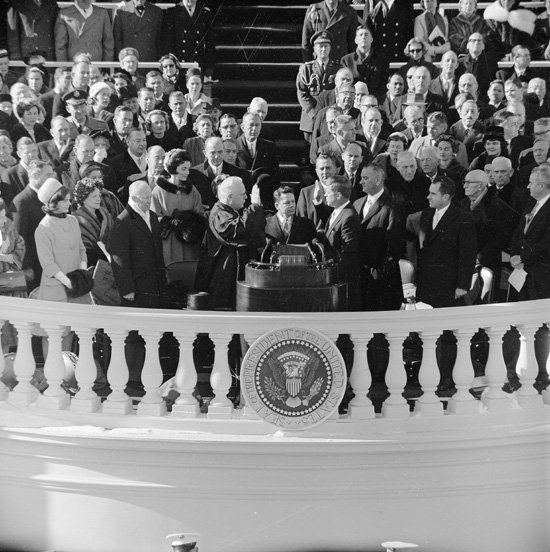
John F. Kennedy took the oath of office from Chief Justice Earl Warren on the east front of the Capitol at noon on 20 January 1961, the morning after a heavy snowfall, in bitter cold. Robert Frost had just recited The Gift Outright from memory when glare kept him from reading the poem he had written for the day. Kennedy's address, prepared with his aide Theodore Sorensen, ran under fifteen minutes, among the shortest of modern inaugurals. He opens by calling the day a celebration of freedom rather than a victory of party and reminds his hearers that the rights of man come not from the state but from the hand of God. Announcing that the torch has passed to a new generation born in this century, he pledges that America will pay any price and bear any burden to assure the survival of liberty. The central section is a series of pledges addressed in turn to old allies, to newly independent states, to the world's poor, to the republics of Latin America in a new alliance for progress, and to the United Nations. To the nation's adversaries he offers not a pledge but a request: that both sides begin anew the quest for peace before the dark powers of science engulf humanity. A run of sentences beginning Let both sides proposes inspection and control of arms, cooperation in exploring the stars and eradicating disease, and obedience to Isaiah's command to undo heavy burdens. Kennedy then admits that none of this will be finished in a hundred days or a lifetime, and calls his generation to a long twilight struggle against tyranny, poverty, disease, and war, rejoicing in hope and patient in tribulation. He welcomes the responsibility of defending freedom in its hour of maximum danger and gives his most famous charge: ask not what your country can do for you, ask what you can do for your country. He closes by asking God's blessing while insisting that on earth God's work must truly be our own. The address was received as a defining statement of Cold War idealism and remains one of the most quoted American speeches.
Virtues in this work
- Magnanimity: Kennedy welcomes the responsibility of defending freedom in its hour of maximum danger and would not exchange places with any other generation.
- Fortitude: He calls the nation to bear the burden of a long twilight struggle, year in and year out, against tyranny, poverty, disease, and war.
- Prudence: He joins sufficient arms to the willingness to negotiate, refusing both weakness and fear.
- Piety: He grounds the rights of man in the hand of God and closes by asking His blessing and His help.
Plot or Argument
- Renewal and inheritance (Paragraphs 1-5)
Kennedy frames the inauguration as a celebration of freedom, grounds human rights in God rather than the state, announces that the torch has passed to a new generation, and pledges to pay any price for liberty.
- Pledges to the world (Paragraphs 6-10)
He addresses in turn old allies, new states emerging from colonial rule, the world's poor, the sister republics of Latin America, and the United Nations, giving each a specific promise.
- A request to adversaries (Paragraphs 11-19)
Turning to the Soviet bloc, he asks both sides to begin anew the quest for peace. Strength must deter war, but civility is not weakness. A sequence of Let both sides sentences proposes arms inspection, scientific cooperation, and a new world of law.
- The long twilight struggle (Paragraphs 20-24)
He says the work will not be finished in a hundred days or a lifetime, places its success in the citizens' hands, and calls the nation, as a trumpet summons, to a long struggle against tyranny, poverty, disease, and war.
- The charge and the benediction (Paragraphs 25-27)
Kennedy asks Americans what they can do for their country and the world what all can do together for freedom, then closes by asking God's help while affirming that God's work on earth must be our own.
Key claims
The main steps of the argument, in order, and how they fit together.
- Human rights come from the hand of God rather than from the generosity of the state, and that belief is still contested worldwide.How it is supported: Appeal to the revolutionary beliefs of the nation's founders.
- Leadership now passes to a new generation of Americans, born in this century and shaped by war and a hard peace.How it is supported: Image of a torch handed from one generation to the next.
- The nation should be willing to bear any cost or hardship to ensure the survival and success of liberty.How it is supported: Parallel series of verbs pledging sacrifice.
- America owes particular commitments to old allies, newly independent states, the world's poor, Latin American neighbors, and the United Nations.How it is supported: A series of distinct pledges addressed to each group in turn.
- Adversaries must be met with military strength beyond doubt, while both sides begin anew the quest for peace.How it is supported: Reasoning that only sufficient arms deter war, and that civility is not a sign of weakness.
- Both sides should pursue arms inspection, shared scientific ventures, and a new world of law rather than letting science destroy humanity.How it is supported: A run of parallel proposals and Isaiah's command to undo heavy burdens.
- The long struggle against tyranny, poverty, disease, and war will not be finished quickly, and its outcome rests with citizens.How it is supported: Image of a trumpet summons and Paul's call to rejoice in hope and be patient in tribulation.
- Citizens should ask what they can give their country rather than what it can give them, seeking God's help in the work.How it is supported: Reversal of word order and a closing prayer affirming that God's work on earth must be our own.
Argument map
Supported by
- 3The nation should be willing to bear any cost or hardship to ensure the survival and success of liberty.
which rests on
- 1Human rights come from the hand of God rather than from the generosity of the state, and that belief is still contested worldwide.
- 2Leadership now passes to a new generation of Americans, born in this century and shaped by war and a hard peace.
- 4America owes particular commitments to old allies, newly independent states, the world's poor, Latin American neighbors, and the United Nations.
- 5Adversaries must be met with military strength beyond doubt, while both sides begin anew the quest for peace.
which rests on
- 6Both sides should pursue arms inspection, shared scientific ventures, and a new world of law rather than letting science destroy humanity.
- 8Citizens should ask what they can give their country rather than what it can give them, seeking God's help in the work.
which rests on
- 7The long struggle against tyranny, poverty, disease, and war will not be finished quickly, and its outcome rests with citizens.
Therefore
Plain-language summaries of the author's argument, not quotations.
Lessons
Rights from the hand of God
Early in the address Kennedy states that the rights of man come not from the generosity of the state but from the hand of God. He presents this as the revolutionary belief of 1776, still at issue around the world, and it grounds every pledge that follows.
- What difference does it make whether rights come from the state or from God?
- How does this claim connect the address to the Declaration of Independence?
- Why might a Cold War president stress this belief in particular?
Strength and civility together
Kennedy refuses to choose between deterrence and diplomacy. Only arms sufficient beyond doubt, he argues, make war unlikely, yet civility is not weakness, and the nation must never negotiate out of fear nor fear to negotiate.
- How does the sentence about negotiation turn on the reversal of its terms?
- Why does Kennedy offer the adversary a request rather than a pledge?
- Is it possible to be firm and generous toward an opponent at the same time?
Citizenship as service
The famous charge reverses the usual expectation of what government owes citizens. Kennedy places the final success or failure of the nation's course in their hands and calls them to bear the burden of a long struggle rather than to wait for benefits.
- What kinds of service might Kennedy have had in mind in 1961?
- How does the second ask not sentence, addressed to the world, change the first?
- What is one concrete thing you could do for your country or community?
Context
Kennedy took office at a tense point in the Cold War. The Soviet launch of Sputnik in 1957 had alarmed Americans, Fidel Castro had taken power in Cuba in 1959, Berlin remained divided and contested, and both superpowers were testing nuclear weapons. Dozens of former colonies in Africa and Asia had just become independent. Kennedy had defeated Vice President Richard Nixon in one of the closest elections in American history.
Composition
Kennedy and Theodore Sorensen drafted the address over several weeks, with suggestions from advisers and writers including John Kenneth Galbraith and Adlai Stevenson. Sorensen studied the Gettysburg Address for its brevity and short words, and Kennedy revised heavily, cutting domestic policy almost entirely. The address quotes Isaiah 58:6 and Romans 12:12, and the hundred days allude to Franklin Roosevelt's first months in office.
Reception
Commentators of both parties praised the address, and the ask not sentence quickly entered common speech. Kennedy launched the Peace Corps and the Alliance for Progress within months. The Bay of Pigs invasion in April 1961 and the Cuban Missile Crisis in October 1962 tested its pledges, and the Limited Test Ban Treaty of 1963 answered its call for arms control. After his assassination the speech became a touchstone of national memory.
Comparisons
- fdr-first-inaugural-address
Roosevelt in 1933 promised action against a domestic emergency, and Kennedy's line about the first hundred days deliberately recalls that precedent while turning to a global one.
- gettysburg-address
Sorensen studied Lincoln's address while drafting, and Kennedy's brevity, plain diction, and appeal to a new birth of freedom follow its model.
- lincoln-second-inaugural-address
Both inaugurals treat the nation's purpose under God; Lincoln reads a war as divine judgment, while Kennedy calls his people to make God's work on earth their own.
- washington-farewell-address-and-selected-letters
Washington warned against permanent foreign alliances; Kennedy, speaking for a superpower, pledges support to allies across the world, a measure of how far American commitments had grown.
Quotes
Frequently cited
“Let the word go forth from this time and place, to friend and foe alike, that the torch has been passed to a new generation of Americans”
Frequently cited
“And so, my fellow Americans: ask not what your country can do for you--ask what you can do for your country.”
“the belief that the rights of man come not from the generosity of the state, but from the hand of God.”
“Let every nation know, whether it wishes us well or ill, that we shall pay any price, bear any burden, meet any hardship, support any friend, oppose any foe, in order to assure the survival and the success of liberty.”
“If a free society cannot help the many who are poor, it cannot save the few who are rich.”
“Let us never negotiate out of fear. But let us never fear to negotiate.”
“With a good conscience our only sure reward, with history the final judge of our deeds, let us go forth to lead the land we love, asking His blessing and His help, but knowing that here on earth God's work must truly be our own.”
For Students
A reading companion for classical Christian high school students. See the student guide.
Reading Guide
Watch for
- The paired phrases of the opening: an end as well as a beginning, renewal as well as change.
- The fivefold series of any price, any burden, any hardship, any friend, any foe in Paragraph 4.
- The sequence of pledges, each opened by To those, and the shift to a request for adversaries.
- The anaphora of Let both sides in Paragraphs 15-19.
- The chiasmus of the ask not sentence and its echo addressed to the world.
Key terms and names
- Inaugural address
- The speech a president gives after taking the oath of office, setting out the purposes of the new administration.
- Cold War
- The rivalry between the United States and the Soviet Union and their allies from the late 1940s to 1991, waged through arms races, alliances, and proxy conflicts.
- Balance of terror
- Kennedy's phrase for nuclear deterrence, in which each side's power to destroy the other keeps both from war.
- Alliance for Progress
- Kennedy's program of economic aid and reform for Latin America, announced in March 1961 and foreshadowed in the address.
- Chiasmus
- A figure in which terms are repeated in reverse order, as in ask not what your country can do for you, ask what you can do for your country.
- Twilight struggle
- Kennedy's image for a long contest neither fully war nor peace, fought year in and year out.
Seminar Questions
- Comprehension List the groups to whom Kennedy makes pledges. What does he promise each?
- Comprehension Name four common enemies of man that Kennedy says his generation must struggle against.
- Interpretation Why does Kennedy describe the power of science as both a wonder and a terror?
- Interpretation What does Kennedy mean by the torch passed to a new generation, and why does he stress that they were tempered by war?
- Interpretation How do the quotations from Isaiah and Romans shape the moral tone of the address?
- Big Question Should a nation pledge to pay any price and bear any burden for liberty abroad? What limits, if any, should such a pledge have?
- Big Question What does it mean that here on earth God's work must truly be our own, and how does that fit with trust in providence?
Faith Connections
- Isaiah 58:6 (Scripture)
The fast God chooses is to loose the bands of wickedness and undo the heavy burdens; Kennedy quotes the verse as a command both superpowers should heed.
- Romans 12:12 (Scripture)
Paul's rejoicing in hope, patient in tribulation becomes Kennedy's description of the spirit of the long twilight struggle.
- Mark 10:43-45 (Scripture)
Whoever would be great must be servant of all, as the Son of Man came not to be served but to serve; the ask not charge echoes this ethic of service.
- Augustine, City of God XIX.12-13 (Church Fathers)
Augustine teaches that peace is the tranquility of order and that even wars aim at peace, a frame for Kennedy's joining of armed strength to the quest for peace.
Logic and Rhetoric
Central argument: Because human rights come from God and are still contested worldwide, a new generation of Americans must defend liberty at any cost; the nation will keep faith with allies, help the poor, and strengthen the United Nations; it will keep its arms sufficient while seeking peace and arms control with its rivals; and success depends finally on citizens who ask what they can do for their country.
Rhetorical device: Antithesis and chiasmus. Let us never negotiate out of fear. But let us never fear to negotiate, in Paragraph 14, reverses the same words to balance firmness with openness.
Debate: Resolved: The pledge to pay any price and bear any burden in Kennedy's Inaugural Address was a sound principle for American foreign policy.
Memory Work
And so, my fellow Americans: ask not what your country can do for you--ask what you can do for your country.
With a good conscience our only sure reward, with history the final judge of our deeds, let us go forth to lead the land we love, asking His blessing and His help, but knowing that here on earth God's work must truly be our own.
Writing Prompts
Essay: Kennedy's address moves from pledges to friends, to a request to adversaries, to a charge to citizens. Analyze how this structure builds his argument, and evaluate whether the speech's idealism is matched by realism about the dangers it names.
Comparison with The Gettysburg Address: Sorensen studied the Gettysburg Address while drafting Kennedy's speech. Compare the two in length, diction, use of the idea of a generation, and the task each assigns to its hearers.
Creative Prompts
- Classroom
Divide the class into the audiences Kennedy addresses in Paragraphs 6-11 (allies, new states, the poor, Latin America, the UN, adversaries) and have each group write a one-paragraph reply from its leaders in January 1961.
- Essay
Find every antithesis in the address (sentences built on balanced opposites) and explain how the device fits a speech about strength and peace.
- Fiction
Write a scene set in a snowbound Washington on 20 January 1961 in which a young listener in the crowd decides, after the speech, to join something larger than themselves.
Further Reading
- Ask Not: The Inauguration of John F. Kennedy and the Speech That Changed America, Thurston Clarke
A detailed account of how the address was drafted and delivered.
- Sounding the Trumpet: The Making of John F. Kennedy's Inaugural Address, Richard J. Tofel
- Kennedy, Theodore C. Sorensen
The memoir of Kennedy's chief speechwriter.
- An Unfinished Life: John F. Kennedy, 1917-1963, Robert Dallek
Verification notes
The text, date, and setting are fully documented, and the address is a public-domain work of the President. The stored Avalon text uses double hyphens for dashes and an ellipsis inside the Isaiah quotation, quoted as stored. The share of drafting between Kennedy and Sorensen has been debated; both contributed and Kennedy revised heavily. The delivered speech ran about fourteen minutes.
No verification flags recorded.