Work record
The Grecian History
Oliver GoldsmithThe Grecian History by Oliver Goldsmith (1774)The Grecian History, from the Earliest State to the Death of Alexander the Great, is Oliver Goldsmith's two-volume survey of Greece, printed in London in 1774, the year of his death.1774 · 18th Century · History · English
Read this when you want a first survey of Greece before opening Herodotus.
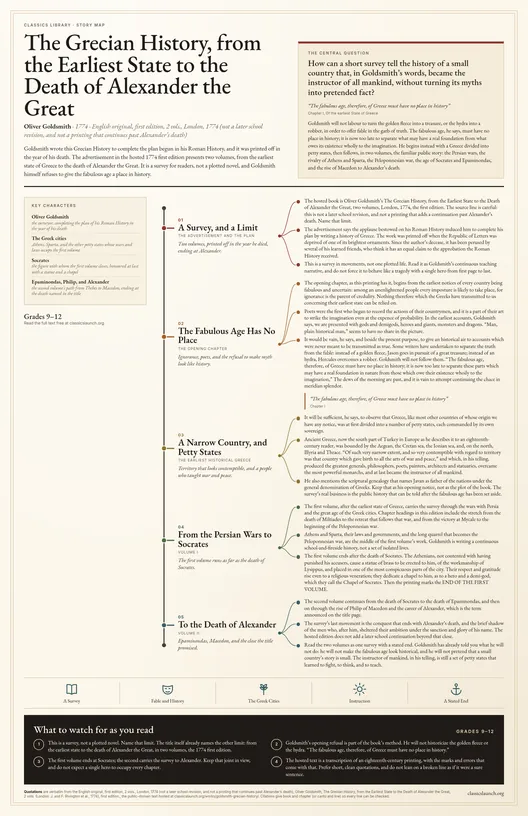 Story mapSee the story mapThe whole book on one page: the story in movements, the characters, and what to watch for. Free to print.
Abstract
Background. In the last year of his life, an Irish-born poet, novelist, and playwright turned to a continuous English narrative of Greece, aimed at general readers who wanted a map of the story before they faced the older historians in full.
Scope. The two volumes move from uncertain early traditions and the growth of the leading cities through the Persian invasions, the long war of Athens and Sparta, the brief lead of Thebes, the coming of Macedon, and the final campaign of Alexander.
Method. The teller favors a straight path and a memorable moral close rather than the patient questioning of ancient inquiry, and this first printing ends at Alexander's death, without the later school additions that sometimes carried the tale into far later centuries. Its fame in the eighteenth century was as a companionable history, not as a work of original research.
Significance. English-speaking students long met Greece first in these pages, and in 1785 the book was named as the starting point of a course that was then to proceed to the Greek and Latin historians themselves. Used that way, it remains a serviceable first map, provided its pointed judgments are later tested against the older sources.
Key figures
- Pericles: Leading statesman of Athens at her height
- Epaminondas: Theban commander at the city's brief lead
- Alexander: The last great subject, judged at his death
Summary
The Grecian History, from the Earliest State to the Death of Alexander the Great, is Oliver Goldsmith's two-volume survey of Greece, printed in London in 1774, the year of his death. It was written for English readers who wanted a clear narrative before they turned to the ancient historians themselves. The first volume moves from the legendary beginnings and the early states through the Persian wars, the age of Pericles, and the long struggle between Athens and Sparta. The second volume follows the later fortunes of those cities, the rise of Thebes, the coming of Macedon under Philip, and the career of Alexander down to his death. Goldsmith writes as a man of letters, not as a scholar of inscriptions. His English is plain and pointed, and he often pauses to judge a law, a battle, or a character in a moral sentence. The book ends with Alexander and a brief look at the successors; it does not continue the story to the later Roman or Byzantine periods. That close matters. Some later printings and school revisions carried the narrative past Alexander, even as far as the taking of Constantinople, or recast the book for the classroom. The text hosted here is the 1774 first edition, a work already in the public domain, and not one of those later recensions. Jefferson recommended Goldsmith's history of Greece as the first book in the course of ancient history he set out for his nephew Peter Carr in 1785, before Herodotus, Thucydides, Xenophon, Curtius, and Justin. A student can still use it in that way: as a first map of names, wars, and cities, to be tested afterward against the older historians, whose voices are slower, fuller, and often less neatly moral. Teachers may assign a first pass for the shape of events, then return to single chapters beside the older historians Jefferson named next.
Virtues in this work
- Prudence: Goldsmith repeatedly treats law, counsel, and self-command as the true strength of a city, not mere success in arms.
- Temperance: The closing estimate of Alexander sets fortune against virtue, and earlier portraits often blame excess in a leader or a people.
- Justice: Laws, the treatment of allies, and the abuse of power in the Greek cities are among the book's standing measures of a public life.
Plot or Argument
- Volume I, early books: Beginnings and the Persian wars
Goldsmith begins with the uncertain early traditions of Greece, then follows the growth of the chief cities and the Persian invasions that first tested them.
- Volume I, later books: The war of Athens and Sparta
The first volume then treats the age of Athenian power and the long war with Sparta that broke that power.
- Volume II: Thebes, Macedon, and the death of Alexander
The second volume treats the rise of Thebes, Philip of Macedon, and Alexander's conquests, and it closes with Alexander's death and a short view of the successors who seized parts of his empire.
Characters
- Lycurgus, Spartan lawgiver
A central figure in Goldsmith's account of Spartan institutions and manners.
- Themistocles, Athenian leader
Prominent in the Persian-war narrative as a type of political shrewdness in a time of danger.
- Pericles, Athenian statesman
The leading name of Athens at the height of her power, before the long war with Sparta.
- Epaminondas, Theban general
The commander under whom Thebes briefly leads Greece; Goldsmith treats his death as the fall of that city's greatness.
- Alexander, King of Macedon
The last great subject of the book, judged at his death for fortune, virtue, and the example he left to his successors.
Lessons
A first map, not a final authority
Goldsmith meant to prepare a reader for the ancient historians, not to replace them. The book is most useful when a student treats it as a clear first narrative, then tests its judgments against Herodotus, Thucydides, and Xenophon.
- Where does Goldsmith's need for a short, clear story most obviously simplify a complicated period?
- How should a student use this book beside a primary historian rather than instead of one?
Moral sentences in a history
Goldsmith often closes a scene with a pointed judgment about ignorance, courage, law, or fortune. Those sentences are part of the book's eighteenth-century manner, and they invite agreement or resistance rather than silent acceptance.
- Find one moral sentence that still seems just, and one that seems too neat for the facts as Goldsmith himself has told them.
- What does the closing judgment on Alexander reveal about the virtues Goldsmith most admires?
Where a history chooses to stop
This first edition ends with Alexander's death and a brief word on the successors. Later revisions sometimes carried the story much farther. The stopping place itself is a lesson in how a history of Greece may be framed for a young reader.
- Why might a writer end a history of Greece at Alexander's death rather than at a later political close?
- What changes in the book's moral shape if the story is continued for many more centuries?
Context
Goldsmith wrote a two-volume narrative of Greece down to Alexander's death, published in London in 1774. It belongs to a line of eighteenth-century English surveys meant to give general readers and students a first, readable account of the ancient world before they met the original historians.
Composition
The work appeared in the last year of Goldsmith's life. The text used here is the 1774 first edition. Later printings and school editions sometimes added a continuation past Alexander or recast the book; those later forms are not the text hosted in this library.
Reception
The book was widely reprinted and was familiar enough that Jefferson could name 'Goldsmith's history of Greece' as the starting point of a young man's ancient-history course in 1785. It remained a common first survey in English-speaking schools well into the nineteenth century.
Comparisons
- The Histories
Herodotus is the ancient starting point Goldsmith is meant to prepare a reader to meet; the survey is shorter and more pointed, the Histories slower and far richer in inquiry.
- The History of the Peloponnesian War
Thucydides treats at full length the war Goldsmith must compress; reading both shows what a survey keeps and what it cannot keep.
- The Vicar of Wakefield
The same author's novel shows his gift for plain English and moral portraiture in fiction; the history shows that manner applied to the public story of Greece.
Quotes
“Among an unenlightened people every imposture is likely to take place, for ignorance is the parent of credulity.”
“he expired, being thirty-two years and eight months old, of which he had reigned twelve, with more fortune than virtue.”
For Students
A reading companion for classical Christian high school students. See the student guide.
Reading Guide
Watch for
- The opening discussion of early traditions, where Goldsmith already warns the reader about uncertain beginnings.
- The Persian-war chapters, which supply the first large test of how a short survey handles a famous story.
- The account of the war between Athens and Sparta, where compression and moral judgment are both most visible.
- The last pages on Alexander, including the closing estimate of his fortune and virtue, and the short view of the successors.
Key terms and names
- Survey history
- A continuous modern narrative written to introduce a period, rather than a translation of an ancient historian.
- Persian wars
- The early-fifth-century BC invasions of Greece, which Goldsmith treats as the first great trial of the Greek cities.
- Peloponnesian War
- The long late-fifth-century war between Athens and Sparta, the central political tragedy of the first volume.
- First edition
- The 1774 London printing used here, which ends with Alexander and does not include later school revisions or a continuation to later ages.
Seminar Questions
- Comprehension To what event does Goldsmith bring his history, and what does he say, in brief, about the successors who followed?
- Comprehension Name three large stages in the survey between the early Greek states and the rise of Macedon.
- Interpretation How does Goldsmith's closing judgment of Alexander use the difference between fortune and virtue?
- Interpretation Where in the earlier books does Goldsmith seem most eager to draw a moral, and how does that habit shape the story of a city such as Athens or Sparta?
- Big Question Should a first history of a people end at the moment of its greatest conquest, or at the moment when its own freedom is already lost?
- Big Question What is gained, and what is lost, when a modern writer tells ancient history in short, pointed English before a student has read the ancient historians themselves?
Faith Connections
- Proverbs 16:32 (Scripture)
The praise of the one who rules his own spirit above the one who takes a city is a just scriptural frame for Goldsmith's last judgment of Alexander, in which fortune is set above, or against, virtue.
- Ecclesiastes 9:11 (Scripture)
The preacher's saying that the race is not always to the swift, nor the battle to the strong, may be set beside Goldsmith's interest in fortune as something other than a sure reward of merit.
Logic and Rhetoric
Central argument: Goldsmith offers a continuous English survey of Greece down to Alexander's death, written so that a new reader may see the shape of the story and form early moral judgments, and then go on to the ancient historians with a map already in mind.
Rhetorical device: sententious close. A chapter or a life is often rounded with a short, memorable judgment that tells the reader how to weigh fortune, courage, law, or vice in what has just been told.
Debate: Resolved: A modern survey is the right first book of Greek history, and the ancient historians should come after it, not before it.
Writing Prompts
Essay: Follow Goldsmith's treatment of one city—Athens, Sparta, or Thebes—from rise to crisis, and show how his moral sentences guide the reader's judgment of that city's fortunes.
Comparison with The Histories: Take one episode that appears in both Goldsmith and Herodotus. How does the modern survey change the pace, the moral, and the place of that episode in a larger story of Greece?
Creative Prompts
- Essay
Compare Goldsmith's last judgment of Alexander with the tone of an earlier portrait in the book, such as that of Epaminondas or Pericles.
- Dialogue
Write a short conversation in which a student who has read only Goldsmith meets a student who has just finished Herodotus, and they argue about one shared episode.
- Classroom
Have the class sketch a timeline from the Persian wars to Alexander, then mark three places where they most want to check Goldsmith against an ancient historian.
Further Reading
Verification notes
Primary text checked against the edition identified in fullText. No unverified quotations or page numbers supplied. Recommended grades concern teaching suitability, not a mechanical reading score.
No verification flags recorded.