Work record
Master and Man
Leo TolstoyMaster and Man (Tolstoy)Master and Man by Leo Tolstoy (1895)Master and Man (1895) is one of the last great short works Tolstoy wrote, and it carries in a single winter night the questions of his whole later life.Also known as: Master and Man (Tolstoy)
1895 · 19th Century · Novella · Russian
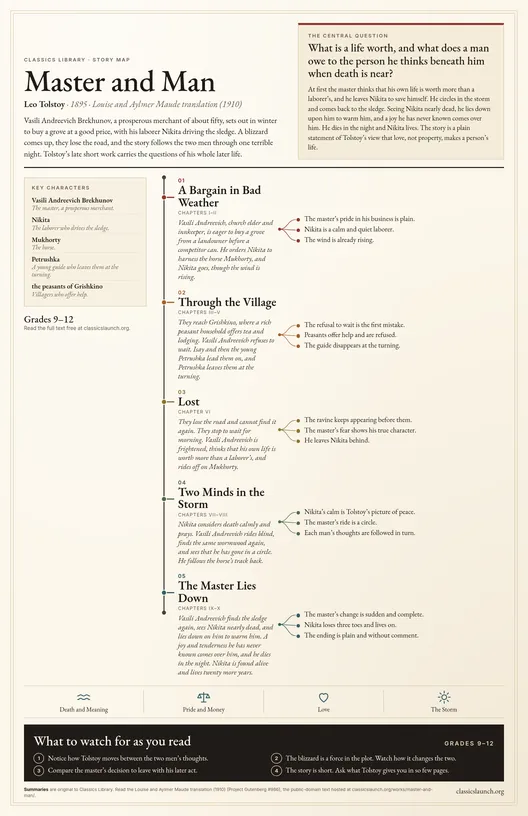 Story mapSee the story mapThe whole book on one page: the story in movements, the characters, and what to watch for. Free to print.
Abstract
Background. Tolstoy wrote this tale in the middle 1890s, many years after his turn to the Gospel and to plain writing for common readers. It sits with the stories in which he asks what a man lives by and what he carries into death, and it was read at once as a companion to his famous story of Ivan Ilyich.
Plot. A rich merchant and his hired labourer drive into a snowstorm for the sake of a business bargain. Lost at night, the master leaves the man to freeze and rides away, circles back to the sledge by accident, and gives his own body's warmth to save him. In the morning the master is found dead and the labourer alive.
Ideas. The tale sets two ways of meeting death side by side. It argues that a life organized around gain dies badly, while one costly act of love can make even a late life true, and it leaves the reader to ask what he himself is living for.
Text. The Maude translation is clear, plain English. Its ten chapters are short, and its images of the white storm, the circling track, and the wormwood by the boundary are easy to follow when read aloud in class. Teachers can pair this work with the library's study guide, seminar questions and memory-work selection to prepare a discussion, a short essay or a recitation.
Main characters
- Vasili Andreevich Brekhunov: A boastful merchant, church elder and innkeeper
- Nikita: His poor, patient peasant labourer
- Mukhorty: The sledge horse
- Petrushka: A young peasant who guides them part of the way

Summary
Master and Man (1895) is one of the last great short works Tolstoy wrote, and it carries in a single winter night the questions of his whole later life. The master is Vasili Andreevich Brekhunov, a prosperous merchant, innkeeper and church elder of about fifty, a man proud of how much he has made and how boldly he does business. On the day after St. Nicholas's Day he sets out by sledge to buy a grove of timber from a landowner before a rival dealer can reach it. With him goes Nikita, his hired labourer, an older peasant, poor, patient, once a drinker, who works for little and does not complain. The landowner's village lies about ten miles off, and a storm is rising, and Vasili Andreevich, who hates to lose a bargain, will not wait for the weather to pass. The journey turns by degrees from a business trip into a fight for life. A boy guides them for a while and leaves them at the turn; the road disappears under snow; the horse Mukhorty balks at ravines; the two men go in circles and finally stop in the open field for the night. There Tolstoy sets side by side two ways of meeting death. Nikita, who has never owned much and has long felt himself in the hands of the Chief Master who sent him into this life, grows quiet and almost willing. Vasili Andreevich, who has everything to live for as he understands it, is gripped by terror, tells himself that Nikita will not grudge his life where he himself has something to lose, and rides off on the horse alone, leaving the labourer to freeze. But the storm gives him back to the sledge. After hours lost in circles he comes upon the same drifted wormwood and his own tracks, jumps down, and follows the horse's trail back to the sledge almost by accident. Then the story that has followed his greed turns on a single action: he opens his fur coat, lies down on top of the freezing labourer, and warms him with his own body. A strange tenderness comes over him, and for the first time he sees that the man called Vasili Brekhunov was troubled by the wrong things. In the morning the peasants dig them out. The master is dead and frozen stiff, and Nikita, who lived because the master died on him, loses three toes, lives another twenty years, and dies at home under the icons. Tolstoy uses a plain tale to say what he believed after his conversion: that wealth and self-protection are a kind of death, and that a man comes alive when he gives himself to another. Christian readers will recognise the shape of the Gospel saying that whoever loses his life will save it, and will also notice that Tolstoy gives the change a sudden, almost mystical character without naming the grace that makes it possible.
Virtues in this work
- Charity: The master's last act is a plain act of mercy, done at the cost of his own life, toward a man who is far beneath him in rank.
- Humility: The story strips the merchant's self-regard and shows Nikita's quiet acceptance of his place and of God's will.
- Fortitude: Nikita's patience in the cold and his lack of panic are a kind of endurance that the story honours.
- Prudence: The master's fatal error is a want of prudence, since his greed for a bargain keeps him from taking the plain advice to wait.
Plot or Argument
- Chapters I–II: A bargain in bad weather
Vasili Andreevich, church elder and innkeeper, is eager to buy a grove from a landowner at a price that suits him, and to be there before a competitor. He orders Nikita to harness the horse Mukhorty. Nikita goes, though the wind is already rising, and the story sets the master's quick pride beside the labourer's long habit of obedience.
- Chapters III–V: Through the village and into the open
They reach the village of Grishkino and stop at a rich peasant household where tea is offered and a night's lodging is urged on them. Vasili Andreevich refuses to wait. Isay, a peasant they meet in Grishkino, and then the young Petrushka lead them on; Petrushka brings them to the turning and disappears, and the two men drive on into the open fields with the storm closing in.
- Chapter VI: Lost, and the master's decision
They lose the road and cannot find it again; the ravine keeps appearing before them. They stop to wait for morning. Vasili Andreevich is frightened, looks at Nikita, thinks that his own life is worth more than a labourer's, and rides away on Mukhorty to look for the forest and the forester's hut.
- Chapters VII–VIII: Two minds in the storm
Nikita, left behind, considers death calmly and prays. Vasili Andreevich rides blind, finds the same wormwood again, and sees at last that he has gone in a circle; he jumps down, is left alone in the storm, and follows the horse's track back. Tolstoy follows each man's thoughts in turn and lets the reader judge between them.
- Chapters IX–X: The master lies down; the morning
Vasili Andreevich finds the sledge again, sees Nikita nearly dead, and lies down on him to warm him. A joy and tenderness he has never known comes over him, and he dies in the night. Nikita is found alive, loses three toes, and lives twenty more years.
Characters
- Vasili Andreevich Brekhunov, protagonist (the master)
A prosperous merchant, innkeeper and church elder, about fifty, boastful about his bargains and his hard work, who learns in a single night what he has not understood about his own life.
- Nikita, protagonist (the man)
A peasant labourer of about fifty, formerly a drinker, who works for little and does not rebel against it, and who meets death with a calm that the master envies and cannot match.
- Mukhorty, the horse
The sorrel stallion who draws the sledge, sees the ravines first, and in the end stands buried to his belly in snow, emaciated and still in harness.
- Petrushka, guide
A cheerful young peasant who leads them to the turning and then shouts a line of verse as he vanishes into the storm.
- The peasants of the village, witnesses
The household where tea is offered and the villagers who dig the two men from the snow at noon; they stand for ordinary shared life against the master's hurry.
Lessons
Gain is a poor measure of a life
Vasili Andreevich counts his life in rubles, groves and standing in the parish, and boasts that he rises early and takes pains. Tolstoy lets him tell the story of his own greatness for most of the book, then strips it away in a night. Scripture's rich fool, who plans larger barns and is told that his soul is required of him that night, is never named, but he stands behind the scene. The lesson is not that work is bad but that a life organized only around getting has no answer when death arrives.
- What does Vasili Andreevich think he has earned, and how does the blizzard test each item?
- Where in the opening chapters do you already see signs that his confidence is fragile?
Self-giving makes a man alive
The master saves Nikita by lying on him and warming him with his own body, and in that moment he feels a joy he has never known. Tolstoy treats the act as a turning, not as a reward for a good life. Readers should notice that the master gives something real and costly, and that the story does not pretend the gift cancels his earlier failure. It does, however, make his last hours the truest of his life.
- Why does Tolstoy have Vasili Andreevich first abandon Nikita, then return?
- What does the master mean when he feels that he is Nikita and Nikita is he?
Two ways of facing death
Nikita, who has lived as a dependent on God and on his masters, thinks of death without much fear and trusts that the Chief Master will not mistreat him. The merchant, who has built a fortress of property against death, is terrified. The story does not make poverty a virtue in itself, and it shows Nikita's flaws, but it does ask which man is better prepared to leave.
- What has Nikita learned from a lifetime of poverty that Vasili Andreevich has not?
- Is Nikita's peace a mere habit of submission or something more? Defend your view from the text.
Context
The story is set in the 1870s in central Russia, among peasants who had been serfs until 1861 and merchants who were rising on the new commerce of the countryside. A merchant of the Second Guild, as Vasili Andreevich is, ranked above the peasants who worked for him but below the gentry; his dealings in groves, shops and church offices show how a trading class grew fat on poor men's labour and on landowners who needed cash.
Composition
Tolstoy wrote the tale in the 1890s, after his religious crisis of the late 1870s, when he had broken with the church and with his own earlier fiction and was writing parables and stories for common readers. He began the story in 1894 and finished it in 1895. The Maude translation hosted here appeared in 1910.
Reception
Contemporaries praised the story as a return of Tolstoy's art after years of preaching, and many saw in it a companion to The Death of Ivan Ilyich. Later critics have disagreed about whether the master's turning is credible or a pious device. Its force in the classroom lies in how simply it sets a rich man's fear of death beside a poor man's calm.
Comparisons
- The Death of Ivan Ilyich
Both stories break a respectable man's pride on the fact of death and let a humble servant, Gerasim there and Nikita here, show the dying what they have missed.
- A Tale of Two Cities
Dickens's Sydney Carton and Tolstoy's merchant both find life by giving it for another, one in a public act and the other in a private blizzard.
- Father Sergius
Tolstoy's later tale also tests holiness against pride, and it asks what a man who has tried to be good by his own effort has still to learn.
- What Men Live By and Other Tales
The title story gives the answer in Tolstoy's own folk register: men live by love, not by their own care for themselves.
- One Day in the Life of Ivan Denisovich
Solzhenitsyn's camp prisoner and Tolstoy's labourer share a plain, enduring peasant resilience in the face of cold and an unjust master.
Quotes
Frequently cited
“It happened in the ‘seventies in winter, on the day after St. Nicholas’s Day.”
Frequently cited
“And it did not seem particularly dreadful, because besides the masters he had served here, like Vasili Andreevich, he always felt himself dependent on the Chief Master, who had sent him into this life, and he knew that when dying he would still be in that Master’s power and would not be ill-used by Him.”
Frequently cited
“undid his girdle, opened out his fur coat, and having pushed Nikita down, lay down on top of him, covering him not only with his fur coat but with the whole of his body, which glowed with warmth.”
Frequently cited
“it seemed to him that he was Nikita and Nikita was he, and that his life was not in himself but in Nikita.”
“‘The horse will move when he has someone on his back. As for him,’ he thought of Nikita--‘it’s all the same to him whether he lives or dies. What is his life worth? He won’t grudge his life, but I have something to live for, thank God.’”
“No, take pains and rack your brains! You get overtaken out of doors at night, like this, or keep awake night after night till the thoughts whirling in your head make the pillow turn,’ he meditated with pride. ‘They think people get on through luck. After all, the Mironovs are now millionaires. And why? Take pains and God gives.”
“Whether he is better or worse off there where he awoke after his death, whether he was disappointed or found there what he expected, we shall all soon learn.”
For Students
A reading companion for classical Christian high school students. See the student guide.
Reading Guide
Watch for
- How the master speaks of work and wealth in the early chapters, and where the narrator quietly disagrees with him.
- Every time Nikita is silent: what he refrains from saying and what he does instead.
- The wormwood on the boundary line, which returns and shows that the master has gone in a circle.
Key terms and names
- Second Guild merchant
- A mid-ranking commercial rank in imperial Russia, above peasants and below the gentry; Vasili Andreevich's status and his pride in it.
- Church elder
- A lay officer of a parish church who managed its funds and candles; it shows how closely the master's piety and business are mixed.
- The Chief Master
- Nikita's name for God, who sent him into this life and will be his Master when he dies.
- Mukhorty
- The horse, whose name means 'dappled' or 'sorrel' and who accompanies the two men through the night.
Seminar Questions
- Comprehension Why does Vasili Andreevich refuse to wait out the storm, and what does he want to buy?
- Comprehension What does Nikita say and do during the night, and how does it differ from the master's behavior?
- Interpretation Why does Tolstoy have the master ride away before he returns? What would be lost if he had stayed in the sledge from the first?
- Interpretation What does it mean that the master feels 'he was Nikita and Nikita was he'?
- Interpretation Why does Nikita survive while the master dies?
- Big Question Is a life well spent only if it ends in self-giving, or can the turning come too late to count? Argue from the text.
- Big Question Does the story need God to be true, or does it work as a purely human parable? What does a Christian reader gain or miss?
Faith Connections
- Luke 12:16–21 (Scripture)
The parable of the rich fool tells of a man who plans bigger barns and is told that his soul will be required that night. Vasili Andreevich's grove and his night in the storm echo it closely, and the comparison shows what Tolstoy keeps and what he alters.
- Mark 8:35 (Scripture)
'Whoever loses his life for my sake will save it.' The master's final act is a lived version of the paradox, though Tolstoy leaves the name of Christ out of the scene.
- John 15:13 (Scripture)
Greater love has no one than this, that he lay down his life for his friends. The master gives his body and his life for a labourer who is neither friend nor equal, and that makes the act more costly.
Logic and Rhetoric
Central argument: A man who lives only for gain has not yet begun to live, and a single act of self-giving can reveal more than a lifetime of getting. The story argues by arranging two men and one night so that their characters appear in action, not in assertion.
Rhetorical device: contrast of two minds. Chapters VII and VIII alternate between Nikita's calm thoughts of death and the master's panicked calculations, so that the reader judges between them by comparison.
Debate: Resolved: That Vasili Andreevich's last night redeems the life that came before it.
Memory Work
And it did not seem particularly dreadful, because besides the masters he had served here, like Vasili Andreevich, he always felt himself dependent on the Chief Master, who had sent him into this life, and he knew that when dying he would still be in that Master’s power and would not be ill-used by Him.
it seemed to him that he was Nikita and Nikita was he, and that his life was not in himself but in Nikita.
Writing Prompts
Essay: Compare Vasili Andreevich's thoughts in Chapter VI with his thoughts in Chapter IX. What has changed, what has remained, and what does Tolstoy think made the difference?
Comparison with The Death of Ivan Ilyich: Compare the deaths of Vasili Andreevich and Ivan Ilyich. What does each man discover too late or just in time, and who serves as the other's teacher?
Medical Lens
The story is a moral parable, but its account of a cold night is exact enough to be useful: slow chill, the numbed hands, the sleepiness, the false warmth, and the loss of three frozen toes show cold injury as an ordinary rural peril. It also shows two men facing probable death with different degrees of fear, which a pastoral or clinical reader can compare.
- Chapters VII and IX, the night in the sledge
Nikita's cold is described without drama: shivering, a sleepy warmth, and then the half-conscious sense of being already in another place.
- Chapter X, the morning
Frozen bodies, a labourer who survives under a dead man, and three amputated toes show both the danger of exposure and the way a living body can be spared by the shelter of another.
Creative Prompts
- Essay
Explain in your own words how Tolstoy lets the reader see Vasili Andreevich's pride before the blizzard begins. Use the opening chapters and the master's thoughts in the storm to show what he must lose.
- Dialogue
Write a short conversation between Nikita and Vasili Andreevich on the morning after, if both had lived. What would each say, and what would remain unsaid?
- Classroom
Stage a two-voice reading of Chapters VII and VIII, alternating Nikita's thoughts with the master's. Then discuss which man is nearer to the truth about death.
- Fiction
Rewrite the night from Mukhorty's point of view, keeping to what a horse could see and feel. What does he make of the two men?
Further Reading
- The Death of Ivan Ilyich, Leo Tolstoy
Tolstoy's other great story of a respectable man's confrontation with death; hosted in this library.
- What Men Live By, Leo Tolstoy
Tolstoy's folk tale on love as the thing by which men live; hosted in this library.
- A Confession, Leo Tolstoy
The author's own account of the crisis behind his later fiction.
- A Tale of Two Cities, Charles Dickens
A novel that closes on a similar act of substitution.
- Tolstoy, Henri Troyat
A readable biography that follows the writer through his conversion.
Verification notes
Full text from Project Gutenberg, the Louise and Aylmer Maude translation of 1910, in public domain. Quotes were checked against that text. Plot and chapter details were checked against the same edition; interpretive claims are the library's own reading.
- Which periodical first printed the story in 1895, and the exact month of first publication.
- Whether the Maude text hosted here is the first-edition wording or a later revision.