Work record
English Fairy Tales
Joseph JacobsEnglish Fairy Tales by Joseph Jacobs (1890)English Fairy Tales gathers a varied company of stories rather than a single kind of fairyland.1890 · 19th Century · Collection · English
Read this when familiar nursery tales need their stranger turns, lively voices, and unexpected neighbors restored.
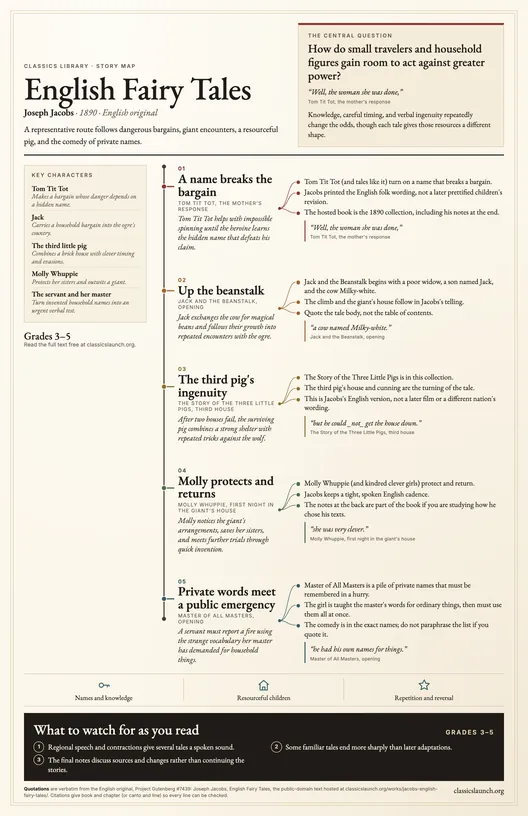 Story mapSee the story mapThe whole book on one page: the story in movements, the characters, and what to watch for. Free to print.
Abstract
Background. Jacobs published English Fairy Tales in 1890 as a collection grounded in earlier printed and oral materials. His preface presents the book as evidence of an English storytelling inheritance. Notes at the end make the collector's work visible by naming sources, related versions, and changes made for this particular presentation.
Content. Domestic boasts lead to a dangerous spinning bargain, magical beans open a road to an ogre's house, and three pigs face a persistent predator. Molly Whuppie's escapes give a young heroine repeated opportunities for quick judgment. Comic and cumulative pieces widen the range beyond quests, while household language itself becomes an adventure in one brief droll.
Themes. Cleverness repeatedly helps the small survive encounters with the powerful, though good fortune and overheard information also matter. Work, appetite, promises, and recognition give the marvels familiar motives. Repetition is both a structural pleasure and a means of increasing risk, making the last encounter different from those that prepare it.
Significance. The volume supports reading aloud and comparative study without requiring those activities to be separated. A child can enjoy the tale first and later discover how another teller arranged its details. Preserving the distinct endings and the scholarly apparatus keeps this collection from dissolving into a general memory of nursery stories, and reveals the art involved in gathering them.
Main characters
- Tom Tit Tot: Makes a bargain whose danger depends on a hidden name.
- Jack: Carries a household bargain into the ogre's country.
- The third little pig: Combines a brick house with clever timing and evasions.
- Molly Whuppie: Protects her sisters and outwits a giant.
- The servant and her master: Turn invented household names into an urgent verbal test.
Summary
English Fairy Tales gathers a varied company of stories rather than a single kind of fairyland. Jacobs's preface answers the claim that English people have no tales of their own, and the collection supplies both familiar adventures and less familiar comic pieces. At the back, scholarly notes identify sources, parallels, and editorial choices. The book can therefore be read first for its voices and events, then again for the questions a collector asks about inherited storytelling. Tom Tit Tot begins with a misunderstanding about pies and spinning. A mother's altered song wins her daughter a royal marriage but also imposes an impossible task. A strange helper offers to spin on terms that place the girl's future at risk unless she discovers his name. An overheard song supplies the knowledge that breaks his claim. Household work, dangerous promises, and the power of naming all meet in a compact suspense story. Jack and the Beanstalk sends a poor widow's son beyond the household on a bargain that looks foolish. Magical beans grow into a route upward, and repeated visits to the ogre's house bring increasingly dangerous encounters. The Three Little Pigs also builds through recurrence, but its third survivor needs more than a strong building. He repeatedly outmaneuvers the wolf before the attempted chimney entrance ends the contest. These versions have sharper consequences than many later nursery adaptations. The collection's resourceful girls are no less active. Molly Whuppie protects her sisters and returns to the giant's territory for further trials. Other tales turn on enchanted forms, faithful help, cumulative requests, or simple foolishness. Master of All Masters compresses an entire comic world into a household whose owner insists on private names for ordinary objects. The servant's urgent announcement turns that verbal display into a practical test. Jacobs preserves a strong impression of stories being spoken: repetitions invite participation, brief dialogues establish character, and regional vocabulary gives different tales their own sound. His notes also reveal deliberate shaping rather than a claim that every printed sentence passed unchanged from a single teller. The result rewards both enjoyment and comparison, making familiar plots newly particular through the wording and endings of this 1890 collection.
Virtues in this work
- Prudence: The surviving pig and Molly Whuppie judge timing and circumstances before acting.
- Fortitude: Young travelers continue through threatening encounters with larger adversaries.
- Friendship: Molly's resourcefulness first serves the safety of her sisters.
Plot or Argument
- A name breaks the bargain
Tom Tit Tot helps with impossible spinning until the heroine learns the hidden name that defeats his claim.
- Up the beanstalk
Jack exchanges the cow for magical beans and follows their growth into repeated encounters with the ogre.
- The third pig's ingenuity
After two houses fail, the surviving pig combines a strong shelter with repeated tricks against the wolf.
- Molly protects and returns
Molly notices the giant's arrangements, saves her sisters, and meets further trials through quick invention.
- Private words meet a public emergency
A servant must report a fire using the strange vocabulary her master has demanded for household things.
Characters
- Tom Tit Tot, Supernatural helper
Makes a bargain whose danger depends on a hidden name.
- Jack, Adventurer
Carries a household bargain into the ogre's country.
- The third little pig, Survivor
Combines a brick house with clever timing and evasions.
- Molly Whuppie, Resourceful sister
Protects her sisters and outwits a giant.
- The servant and her master, Comic household pair
Turn invented household names into an urgent verbal test.
Lessons
Attend to the exact version
Familiar titles can conceal important differences of event and ending. Jacobs's text gives each tale a particular order and voice.
- What does the wolf do after the house resists him?
- Which detail differs from a version you already knew?
Quick judgment begins with noticing
Molly's cleverness depends on seeing small arrangements before danger arrives. Jack and the surviving pig also need timing rather than simple boldness.
- What does Molly notice before sleeping?
- How does waiting help the third pig?
Words can act
A hidden name ends one danger, while invented household terms create another comic difficulty. Speech here changes what people can do.
- Why does the hidden name matter?
- When does the master's vocabulary become inconvenient?
Context
Nineteenth-century folklorists collected tales while comparing their circulation across regions and languages. Jacobs addressed children as a storyteller but also supplied notes for readers interested in that larger investigation.
Composition
English Fairy Tales appeared in 1890. The hosted Gutenberg volume includes its preface and source notes as well as the tale bodies.
Reception
Many selections remain familiar in nursery culture, while the collection preserves variations and lesser-known pieces that reward reading beyond the best-known titles.
Comparisons
- Household Stories (Grimm's Fairy Tales)
Compare hidden names, giant encounters, and repeated trials across distinct collected versions rather than assuming a single universal wording.
- The Blue Fairy Book
Both offer varied traditional tales, but Jacobs's notes foreground the sources and parallels of this particular gathering.
Quotes
“Well, the woman she was done,”
“a cow named Milky-white.”
“but he could _not_ get the house down.”
“she was very clever.”
“he had his own names for things.”
For Students
A reading companion for classical Christian high school students. See the student guide.
Reading Guide
Watch for
- Regional speech and contractions give several tales a spoken sound.
- Some familiar tales end more sharply than later adaptations.
- The final notes discuss sources and changes rather than continuing the stories.
Key terms and names
- folklore
- Stories, customs, and beliefs handed on within communities.
- variant
- A particular version that differs from other tellings of a story.
- cumulative tale
- A story that builds through an expanding chain of repeated actions or requests.
- droll
- A short comic tale centered on foolish or absurd conduct.
- skein
- A loosely coiled length of yarn or thread prepared for use.
Seminar Questions
- Comprehension What claim about spinning brings the girl into danger?
- Comprehension How does the third pig respond after his house survives?
- Interpretation Why does Molly's first observation matter later?
- Interpretation How does the servant's message test her master's instructions?
- Big Question What should a collector preserve when adapting a spoken tale for print?
- Big Question Can cleverness be admired even when its uses differ from tale to tale?
Faith Connections
- Proverbs 22:3 (Scripture)
The prudent person's attention to danger gives a companion to Molly's observation and the pig's preparation.
- Plato, Cratylus (Great Conversation)
The dialogue's inquiry into names offers an older philosophical companion to tales where naming creates power or confusion.
Logic and Rhetoric
Central argument: Repeated encounters and particular voices allow traditional tales to make ingenuity, folly, and danger recognizable without one uniform lesson.
Rhetorical device: rule of three. The pigs' successive shelters establish expectation, then the durable third house forces the predator into a new series of attempts.
Debate: Resolved: knowing several versions deepens enjoyment of a familiar fairy tale.
Memory Work
but he could _not_ get the house down.
Writing Prompts
Essay: Explain how repetition increases suspense in two tales, identifying the action that breaks each pattern.
Comparison with Household Stories (Grimm's Fairy Tales): Compare Tom Tit Tot with a hidden-name tale in Grimm, attending to the bargain, the discovery, and the ending.
Creative Prompts
- Dialogue
Invent a household conversation in which four ordinary things have private names that become awkward in an emergency.
- Classroom
Compare two versions of the pigs' tale and chart the order of the wolf's attempts.
- Fiction
Write a short escape story in which a young traveler succeeds by noticing one small difference at bedtime.
Further Reading
- More English Fairy Tales, Joseph Jacobs
- Celtic Fairy Tales, Joseph Jacobs
Verification notes
All quotations are exact substrings of tale bodies in the hosted Project Gutenberg #7439 text. The collection's notes are acknowledged as part of the book. No quotation is taken merely from its contents list.
No verification flags recorded.