Work record
Father Sergius
Leo TolstoyFather Sergius (Tolstoy)Father Sergius by Leo Tolstoy (1898)Father Sergius is the story of a proud man who tries to make himself a saint and is humbled by the very thing he wanted.Also known as: Father Sergius (Tolstoy)
1898 (published 1911) · 19th Century · Novella · Russian
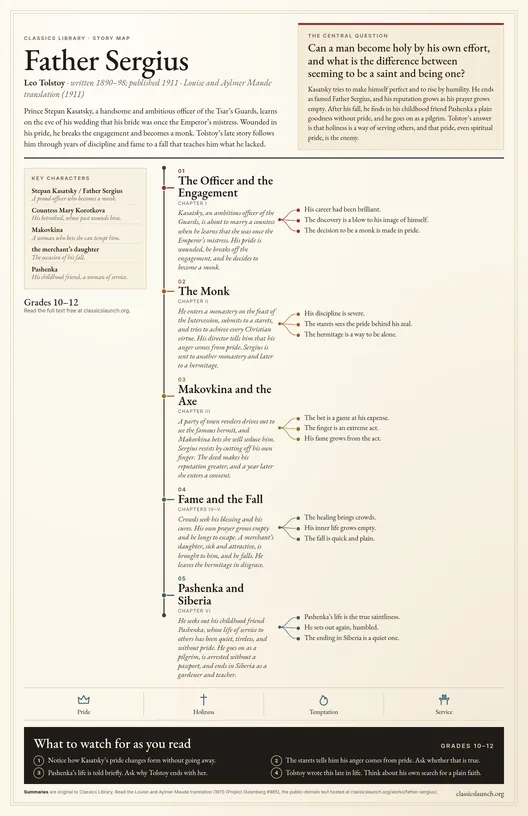 Story mapSee the story mapThe whole book on one page: the story in movements, the characters, and what to watch for. Free to print.
Abstract
Background. Tolstoy worked at this story for years in the 1890s and left it unpublished, perhaps because it touched his own struggles with pride, fame and the church. It appeared only after his death, in 1911, and has been read ever since as one of his most searching late works.
Plot. A prince who wants to be first in the Guards becomes first among monks, resists a woman's temptation by cutting off his finger, and is made famous. When he falls through pride, he wanders in disgrace until a poor woman's quiet service and a Siberian labourer's life teach him what he missed.
Ideas. The tale asks whether holiness can be sought as an achievement, and shows how the desire for admiration can invade the most sincere prayer. It prefers hidden mercy to public sanctity, and it raises questions about the church that readers should weigh against the Gospel.
Text. The Maude translation is plain and exact, with a slight formality. Brief French lines and Russian church terms are made clear by context and by the translator's careful phrasing, so a patient high-school reader can follow the whole story without notes. Teachers can pair this work with the library's study guide, seminar questions and memory-work selection to prepare a discussion, a short essay or a recitation.
Main characters
- Stepan Kasatsky: A proud officer who becomes Father Sergius
- Countess Mary: The fiancée whose past breaks his world
- Makovkina: The woman who tests his chastity
- Pashenka: The poor friend who shows him true service

Summary
Father Sergius is the story of a proud man who tries to make himself a saint and is humbled by the very thing he wanted. Prince Stepan Kasatsky is a handsome officer of the Tsar Nicholas I's Guards, ambitious, disciplined and sure to rise at court. On the eve of his marriage to a beautiful countess he learns that she has been the Emperor's mistress. The discovery wounds his pride beyond bearing, and he leaves the army, gives away his property, and enters a monastery, where he takes the name Sergius. The first half of the story follows his zeal. He submits to every discipline, outdoes the other monks in obedience and fasting, and is at last allowed to live as a recluse in a hermitage, where he prays hour after hour. The temptations that follow are Tolstoy's finest writing about the spiritual life. A party of rich townspeople drives out for a wager, and a divorced woman named Makovkina determines to seduce the holy man. She enters his cell at night, and Sergius, in a fierce struggle, saves himself by laying his finger on a chopping-block and cutting it off with an axe. The deed makes him famous. Crowds of pilgrims come for healing and prayer, his hermitage becomes a place of business, and his own prayer grows dry, because he is now serving the praise of men more than God. He grows more sure of himself in public and more empty in private. The fall comes years later, when a sick merchant's daughter is brought to his cell for a healing. He sins with her in a moment of pride and weakness, and when he sees what he has become he leaves his hermitage by night and goes out into the world as a pilgrim. In the last chapter he visits an old friend of his childhood, Pashenka, now a poor, worn woman who keeps a household of ungrateful relations with no thought of her own goodness. In her he sees a way of living for God that he had mistaken for living for men. Arrested as a vagrant for having no passport, he is sent to Siberia, where he lives as a gardener, teaches children and tends the sick. The story is a warning against the spiritual pride that dresses itself in virtue. It is also, like much of Tolstoy's late work, uneasy with the church and impatient with the cult of holy men, so a Christian teacher will want to read it with care. It has sharp things to say about the show of piety, and they are sharper because the author knew the temptation from within.
Virtues in this work
- Humility: The whole story is a study of the lack of humility and its slow, hard acquisition by Sergius.
- Charity: Pashenka's unnoticed service of her family is the book's picture of real charity.
- Fortitude: His resistance to temptation, though warped by pride, shows an effort that the story honours even as it corrects it.
- Honor: The story is also about honor, which in the Guards means rank and in the cell means a reputation for holiness; both are called into question.
Plot or Argument
- Chapter I: The officer and the engagement
Kasatsky, an ambitious officer of the Guards, is about to marry a countess when he learns that she was once the Emperor's mistress. His pride is wounded, he breaks off the engagement, and he decides to become a monk.
- Chapter II: The monk
He enters a monastery on the feast of the Intercession, submits to a starets, and tries to achieve every Christian virtue. His director tells him that his anger comes from pride; Sergius is sent to another monastery and later to a hermitage.
- Chapter III: Makovkina and the axe
A party of town revelers drives out to see the famous hermit, and Makovkina bets she will seduce him. Sergius resists by cutting off his own finger. The deed makes his reputation greater, and a year later she enters a convent as a novice.
- Chapters IV–V: Fame and the fall
Crowds seek his blessing and his cures. His own prayer grows empty and he longs to escape. A merchant's daughter, sick and attractive, is brought to him, and he falls. He leaves the hermitage in disgrace.
- Chapter VI: Pashenka and Siberia
He seeks out his childhood friend Pashenka, whose life of service to others has been quiet, tireless and entirely without pride. He goes on as a pilgrim, is arrested without a passport, and ends in Siberia as a gardener and teacher.
Characters
- Stepan Kasatsky / Father Sergius, protagonist
A proud and gifted officer who becomes a monk, a recluse and a famed holy man, and who is brought down by his own spiritual vanity before he finds a humbler way.
- Countess Mary Korotkova, betrothed
The beautiful bride-to-be whose past with the Emperor drives Kasatsky from the world.
- Makovkina, the temptress
A bored, clever, divorced woman who bets that she can seduce the hermit and is changed by the result.
- The merchant's daughter, the occasion of his fall
A sick young woman brought to his cell for healing, whose visit marks his collapse.
- Pashenka (Praskovya Mikhaylovna), the true saint
A childhood friend, poor and worn, who lives for her family without noticing it and who shows Sergius what he lacked.
Lessons
Pride can wear the habit of holiness
Kasatsky's whole career, in the Guards and in the cell, is driven by the wish to be first. Tolstoy shows how readily the desire to be pre-eminent can move from a military parade to a monastery. The abbot's rebuke, that his rejection of honours was not for God's sake but for his pride, is the key to the story.
- How does Kasatsky's pride show itself in the army and in the monastery?
- Why does the abbot say his refusal of honours is vanity?
Prayer grows empty when the heart seeks men's praise
As his fame grows, Sergius prays more outwardly and inwardly less. Tolstoy notes that the devil has put an activity for men in the place of an activity for God. The lesson applies to teachers, pastors and students of every kind.
- What are the signs that Sergius's prayer is emptying?
- What would a faithful use of his gift for healing have looked like?
Humble service is the better holiness
Pashenka lives for her relations, takes no credit and expects no reward, and Sergius sees that she is what he failed to be. The point is not that works replace faith but that real faith shows in a hidden, patient love.
- Why does Sergius call Pashenka what he ought to have been?
- Is Tolstoy fair to the monastic life, or does he caricature it?
Context
The story begins in the 1840s, under Nicholas I, when the Guards and the court formed the highest ambition for a young Russian nobleman, and when monasteries and hermitages still drew pilgrims from every class. The starets, an elder who guides souls, was a recognised figure in Russian Orthodoxy, and Tolstoy knew the monasteries of Optina Pustyn well from visits there.
Composition
Tolstoy began the story in 1890 and worked on it intermittently until 1898, but did not publish it. It appeared after his death in 1911, in the Maude translation hosted here.
Reception
Early readers saw in it a portrait of Tolstoy's own struggle with the longing for fame and for spiritual perfection. Orthodox readers have objected to its caricatures of the church, while others have found its account of vanity in the spiritual life among the most searching ever written.
Comparisons
- Master and Man
Another late Tolstoy tale in which a proud man finds the truth of his life only when he gives himself for someone below him.
- The Death of Ivan Ilyich
A second study of a respectable man who has lived by the opinion of others and learns it too late.
- The Brothers Karamazov
Dostoevsky's Elder Zosima is the sort of holy man whom Tolstoy suspects and whom Dostoevsky defends, and the two books can be read as a debate.
- The Pilgrim's Progress
Bunyan's pilgrim also leaves the world, is tempted on the way, and learns that the narrow road runs through his own pride.
- The Imitation of Christ
Thomas à Kempis's counsel on humility and on the dangers of seeking the praise of men is the best companion text to the story's lesson.
Quotes
Frequently cited
“Had you renounced vanity for God’s sake you would have borne it. Worldly pride is not yet dead in you.”
Frequently cited
“In the depth of his soul he felt that the devil had substituted an activity for men in place of his former activity for God.”
Frequently cited
“I lived for men on the pretext of living for God, while she lived for God imagining that she lives for men.”
Frequently cited
“Yes, one good deed--a cup of water given without thought of reward--is worth more than any benefit I imagined I was bestowing on people.”
“He had retained his purity and had chopped off his finger.”
“In Siberia he has settled down as the hired man of a well-to-do peasant, in which capacity he works in the kitchen-garden, teaches children, and attends to the sick.”
For Students
A reading companion for classical Christian high school students. See the student guide.
Reading Guide
Watch for
- Each time Kasatsky is told that he is proud, and how he answers.
- The way a monastery or hermitage becomes a place of business and fame.
- What Pashenka does for her family, and how little notice she takes of it.
Key terms and names
- Starets
- An elder monk who guides others in the spiritual life; a figure of Russian Orthodox tradition.
- Hermitage
- A small cell outside a monastery where a monk lives as a recluse, as Sergius does.
- Archimandrite
- A senior monastic rank, higher than an abbot, who oversees several houses.
- Pilgrim
- A traveller who goes on foot to holy places, living on alms, as Sergius does at last.
Seminar Questions
- Comprehension Why does Kasatsky leave the Guards and become a monk?
- Comprehension What does Sergius do when Makovkina comes to his cell, and why?
- Interpretation Why does Tolstoy show Sergius's reputation growing at the same time as his prayer fades?
- Interpretation What does Pashenka have that Sergius lacks?
- Interpretation What does the last chapter, in Siberia, say about a holy life?
- Big Question Is the story fair to monasticism, or does it attack a caricature?
- Big Question Can a person seek holiness without pride? What would that look like in practice?
Faith Connections
- Matthew 6:1–6 (Scripture)
Christ's warning against doing righteous deeds before men to be seen by them, and his counsel to pray in secret, is the text behind the whole story.
- James 4:6 (Scripture)
'God opposes the proud but gives grace to the humble.' Sergius's fall and his final life as a labourer follow the pattern of the verse.
- Matthew 10:42 (Scripture)
The cup of cold water given in Christ's name is the example Sergius reaches for when he sees his own shortcomings.
- John Cassian, Conferences (Church Fathers)
The monastic tradition counted pride the deadliest vice of the solitary and warned of the demon of vainglory that besets the hermit.
Logic and Rhetoric
Central argument: The pursuit of holiness for its own sake can be a form of pride, and the true saint is one who serves others without thinking of herself. The story argues by a series of episodes, each of which tests the hero's motive.
Rhetorical device: reversal. At the end Sergius, the famed holy man, learns his lesson from a poor woman who never thought herself good.
Debate: Resolved: That Father Sergius ended as a better man than he began.
Memory Work
I lived for men on the pretext of living for God, while she lived for God imagining that she lives for men.
Yes, one good deed--a cup of water given without thought of reward--is worth more than any benefit I imagined I was bestowing on people.
Writing Prompts
Essay: Trace the stages of Sergius's pride from the Guards to the hermitage, and show how the cutting off of the finger belongs to that pattern. What would humility have looked like at each stage?
Comparison with The Brothers Karamazov: Compare Father Sergius with the Elder Zosima. How do Tolstoy and Dostoevsky differ about the holy man and the church?
Medical Lens
The story is a moral study, but the axe scene is a vivid case of self-mutilation as an attempt to master temptation, which a pastoral reader will want to discuss with care. The sick girl brought for healing, and the crowds who seek cures, show how a religious reputation draws the ill.
- Chapter III, the finger
Sergius chops off his own finger to resist temptation, an act of self-injury presented here as a heroic act but that the story later recasts as proud.
- Chapter V, the sick girl
A merchant's daughter, described as unwell, is brought for healing and becomes the occasion of his fall.
Creative Prompts
- Essay
Explain how Tolstoy makes Sergius's pride visible in each stage of the story: the Guards, the monastery, the hermitage, and the road. Which moment is the clearest?
- Dialogue
Write a conversation between Sergius and Pashenka in her kitchen, in which she says nothing about her own goodness and he says too much about his.
- Classroom
Hold a short trial of Father Sergius. One side argues that he was a hypocrite from the start, and the other that he was a sinner who found grace late. Cite the text.
- Essay
Compare the abbot's teaching on pride with a passage from the Imitation of Christ or from the Sermon on the Mount. What does each add?
Further Reading
- The Death of Ivan Ilyich, Leo Tolstoy
Tolstoy's other study of a respectable life undone by pride; hosted in this library.
- A Confession, Leo Tolstoy
The author's account of his own crisis and the search for faith.
- The Imitation of Christ, Thomas à Kempis
A classic on humility and the danger of spiritual vanity.
- Tolstoy, Henri Troyat
A readable life that treats his struggle with fame and faith.
Verification notes
Full text from Project Gutenberg, in the 1911 Louise and Aylmer Maude translation, in public domain. Quotes were checked against the text. The dating of composition (1890–1898) and first publication (1911) follow standard accounts and should be confirmed in a critical edition.
- Exact dates of Tolstoy's drafting between 1890 and 1898.
- The identity of the model for the hermit, which some biographers connect with a monk of Optina.