Work record
The Tales of Belkin
Alexander PushkinTales of Belkin; The Late Ivan Petrovich Belkin's Tales; Belkin TalesThe Tales of Belkin by Alexander Pushkin (1831)The Tales of Belkin are five short stories which Pushkin wrote in the autumn of 1830 and published in 1831 as the work of a fictitious late country gentleman, Ivan Petrovich Belkin, who had heard them from other people.Also known as: Tales of Belkin · The Late Ivan Petrovich Belkin's Tales · Belkin Tales
1831 · 19th Century · Short Stories · Russian
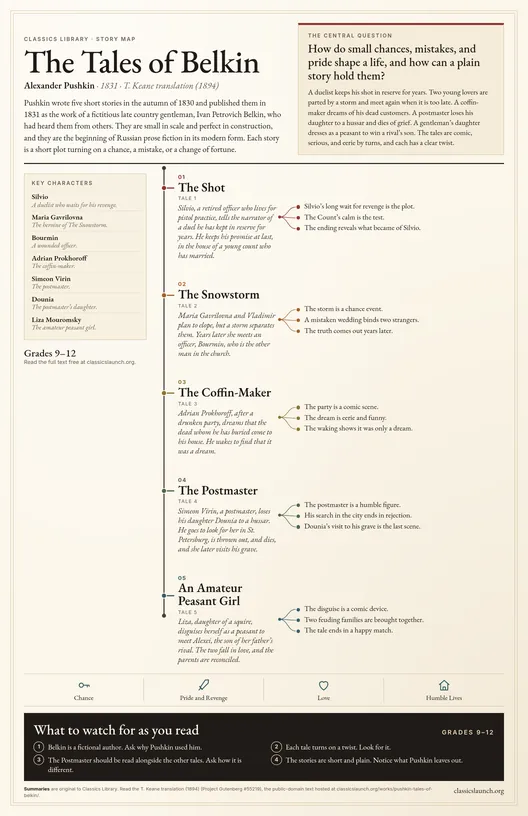 Story mapSee the story mapThe whole book on one page: the story in movements, the characters, and what to watch for. Free to print.
Abstract
Background. Pushkin wrote the tales in the autumn of 1830 and published them in 1831 under the name of an imaginary author, a country gentleman who had merely collected stories from his neighbours. They are generally counted among the first masterpieces of Russian realist prose, and they set a standard of economy for the writers who followed.
Plot. Five short stories: a duellist's patience and a duel never finished, an elopement lost in a snowstorm and a marriage by mistake, a coffin-maker's drunken dream of the dead, a father's search for a lost daughter, and a squire's daughter who plays at being a peasant. Each is told with quiet irony and ends on a small surprise.
Ideas. The tales ask about honour, mercy, providence, love and class, and they treat the poor with respect. The Postmaster is the finest and the saddest of the five, and the one most often taught.
Text. The Keane translation is plain and clear. The tales are short and can be read separately, in any order; The Postmaster and The Shot are the best to start with, and the whole cycle can be read in a few evenings. Teachers can pair this work with the library's study guide, seminar questions and memory-work selection to prepare a discussion, a short essay or a recitation.
Main characters
- Silvio: A duellist
- Maria Gavrilovna: An eloper
- Adrian Prokhoroff: A coffin-maker
- Simeon Virin: A postmaster
- Liza: A squire's daughter
Summary
The Tales of Belkin are five short stories which Pushkin wrote in the autumn of 1830 and published in 1831 as the work of a fictitious late country gentleman, Ivan Petrovich Belkin, who had heard them from other people. They are small in scale and perfect in construction, and they are the beginning of Russian prose fiction in its modern form. The five tales hosted here, in T. Keane's translation of 1894, are arranged in Pushkin's own order: The Shot, The Snowstorm, The Coffin-Maker, The Postmaster, and An Amateur Peasant Girl, which Keane's volume prints in a different sequence and which some editions call The Lady Rustic. Pushkin's short fictional preface by the 'publisher' is not part of the Keane text. In The Shot, a young officer tells of Silvio, a mysterious duellist who, years before, was insulted by a fellow officer, faced him at twelve paces while the man ate cherries from his cap, and lowered his pistol, keeping his shot for another day. When the narrator meets Silvio again, he learns the end. The Snowstorm tells of Maria Gavrilovna, who sets out to elope with an officer in a storm, and of another man who loses his way in the same storm and finds himself, by a mistake, married to a girl he cannot see. The Coffin-Maker, a comic-grotesque tale, follows Adrian Prokhoroff, who goes to a neighbour's silver wedding feast, jokes about his trade, and dreams that the dead come to dine with him. The Postmaster is the saddest and most celebrated. A narrator who travels the post roads stops at the house of Simeon Virin, the postmaster, and his daughter Dounia, whom a passing hussar, Captain Minsky, carries off to St. Petersburg. The old man follows and is turned away; years later the narrator returns to find him dead, and learns that the daughter, now a fine lady with three children, has already come to weep at his grave. The Postmaster is a tale of a father's love for a child and of the cheap pity of the world, written with a humane sympathy for a man of the lowest official rank. In An Amateur Peasant Girl, the daughter of a landowner, Liza, dresses as a peasant girl to meet the son of a rival neighbour, who has fallen in love with her in her disguise; the story ends with a reconciliation that the author declines to describe. Pushkin's cycle is about the way stories are told: through Belkin, through the officers and clerks and ladies who tell them to him, through the writer who edits them. Each tale turns on a surprise in its last pages, and each has a moral shape. Mercy and revenge, honour and pride, providence and chance, love and class are among the questions the tales raise. The cycle was a main influence on the later Russian short story, and Dostoevsky and Chekhov knew it well.
Virtues in this work
- Charity: The narrator's pity for the postmaster, and Dounia's late return, are the cycle's picture of charity.
- Humility: Silvio's last choice is a form of humility, though proud in manner.
- Honor: The Shot is a study of the honour that cannot be wiped out by revenge.
- Hope: The postmaster's picture of the prodigal son is a sign of his hope.
Plot or Argument
- The Shot
Silvio, a retired officer who lives for pistol practice, tells the narrator of a duel he has kept in reserve for years. He keeps his promise at last, in the house of a young count who has married.
- The Snowstorm
Maria Gavrilovna and Vladimir plan to elope but a storm separates them, and years later she meets an officer, Bourmin, who is the other man in the church.
- The Coffin-Maker
Adrian Prokhoroff, after a drunken party, dreams that the dead whom he has buried come to his house. He wakes to find that it was a dream.
- The Postmaster
Simeon Virin, a postmaster, loses his daughter Dounia to a hussar. He goes to look for her in St. Petersburg, is thrown out and dies, and she later visits his grave.
- An Amateur Peasant Girl
Liza, daughter of a squire, disguises herself as a peasant to meet Alexei, the son of her father's rival. The two fall in love and the parents are reconciled.
Characters
- Silvio, the duellist
A strange, silent, brave man who lives by his pistol and by an unsettled debt of honour.
- Maria Gavrilovna, the heroine of The Snowstorm
A well-read, romantic young woman who is the heiress of a good country house.
- Bourmin, the wounded officer
A young Colonel, serious and melancholy, who has a secret.
- Adrian Prokhoroff, the coffin-maker
A gloomy tradesman, dour and thrifty, who is mocked at a party for his trade.
- Simeon Virin, the postmaster
A kind, simple old man whose whole life is his daughter.
- Dounia, the postmaster's daughter
A lovely, lively girl who is carried off by a passing officer.
- Liza Mouromsky, the amateur peasant girl
A clever, playful young lady who assumes a disguise to meet the man she is supposed to dislike.
Lessons
Mercy and pride
In The Shot, Silvio's long-planned revenge ends with a spared life; the story asks what honour is and what remains when the shot is fired. Pride and mercy are both present, and the reader must weigh them.
- What does Silvio want from the count?
- Why does Silvio not shoot him in the end?
Providence and chance
In The Snowstorm, a storm and a mistake decide the lives of two people, and the narrator treats it as a joke and as a mercy. The tale asks whether it is chance or Providence that brings the characters together again.
- How does the storm change the course of the story?
- How does the ending answer the question of fate?
A father's love
The Postmaster is the great story of the cycle. Virin's love for Dounia is shown by his humble, stubborn effort to get her back, and the world's response is a kind of cheerful indifference. The narrator's pity at the end is the tale's moral.
- What does Virin do to find Dounia?
- What does the picture of the prodigal son in his house tell us about his hopes?
Context
The tales are set in the early nineteenth century, in provincial Russia, in the age of the Napoleonic wars, among officers, landowners, tradesmen and post-house keepers. The post-road, the station-house and the ranks of the civil service are the background of the Postmaster; the world of the Guards and their duels is the background of The Shot.
Composition
Pushkin wrote the five tales in the autumn of 1830 while he was kept at his estate of Boldino by a cholera quarantine, and published them in 1831 under the name of the fictitious I. P. Belkin. The hosted Keane translation was published in 1894 in Bohn's Standard Library; the ordering of the five tales used here follows Pushkin.
Reception
The cycle was received quietly at first and has been recognised since as the first great work of Russian prose in the realistic tradition. The Postmaster, in particular, was a model for Gogol's Overcoat and Dostoevsky's Poor Folk.
Comparisons
- The Queen of Spades
Pushkin's other short prose masterpiece, with the same economy and the same fondness for a surprise at the end.
- The Overcoat
Gogol's story of a poor clerk is a descendant of The Postmaster.
- The Captain's Daughter
Pushkin's historical novel, which shares the theme of honour and mercy.
- The Schoolmistress and Other Stories
Chekhov's short stories show the same fine economy and sympathy for ordinary lives.
- The Death of Ivan Ilyich
Tolstoy's novella, which is far longer and heavier, shares with The Coffin-Maker an interest in the meaning of death.
Quotes
Frequently cited
“Who has not cursed postmasters, who has not quarrelled with them?”
Frequently cited
“I am satisfied. I have seen your confusion, your alarm. I forced you to fire at me. That is sufficient. You will remember me. I leave you to your conscience.”
Frequently cited
“She lay down here, and remained lying down for a long time. Then she went back to the village, sent for the pope, gave him some money and drove off, after giving me a five-copeck piece.... such an excellent lady!”
“only protected by his rank from blows, and that not always”
“What is the use,’ thought I, ‘of depriving him of life, when he attaches no value whatever to it?”
“that such was evidently Maria Gavrilovna’s fate, that a woman cannot ride away from the man who is destined to be her husband, that poverty is not a crime, that one does not marry wealth, but a man, etc., etc.”
“My wares are not like yours: the living can do without shoes, but the dead cannot do without coffins.”
“You have not had any quarrel with young Berestoff; let the old ones quarrel and fight, if it gives them any pleasure.”
For Students
A reading companion for classical Christian high school students. See the student guide.
Reading Guide
Watch for
- How each tale is told by someone other than Pushkin.
- The surprise that ends each tale.
- How rank and class shape what happens.
Key terms and names
- Postmaster
- The keeper of a post-station, who looked after the changing of horses for travellers; the lowest official rank in the story.
- Hussar
- A cavalry officer, here Captain Minsky.
- Duel
- A fight of honour with pistols, a regular part of Russian military life.
- Belkin
- The fictitious author of the tales.
Seminar Questions
- Comprehension Who is Silvio, and why does he leave his shot unfired?
- Comprehension What happens to Dounia?
- Interpretation How does The Shot show the difference between courage and indifference?
- Interpretation Why does Pushkin end An Amateur Peasant Girl without describing the wedding?
- Interpretation What does the comic dream of The Coffin-Maker say about death?
- Big Question Is the cycle best read as a set of five tales or as a single work?
- Big Question What is the place of pity in the cycle?
Faith Connections
- Luke 15:11–24 (Scripture)
The picture of the prodigal son on the postmaster's wall shows his hope that Dounia will return, and the parable explains his longing.
- Romans 12:19 (Scripture)
'Never avenge yourselves... vengeance is mine.' Silvio's final choice not to kill is a rough form of this.
- Proverbs 16:18 (Scripture)
'Pride goes before destruction.' The Shot and The Coffin-Maker both turn on wounded pride.
Logic and Rhetoric
Central argument: Small lives in provincial Russia are as full of honour, love and pity as the lives of the great, and the way they are told is an art.
Rhetorical device: frame narrative. Each tale is told by one speaker to another and then passed to Belkin, so that the author stands several steps behind the story.
Debate: Resolved: That the narrator of a story should be a character.
Memory Work
Who has not cursed postmasters, who has not quarrelled with them?
She lay down here, and remained lying down for a long time. Then she went back to the village, sent for the pope, gave him some money and drove off, after giving me a five-copeck piece.... such an excellent lady!
Writing Prompts
Essay: Show how Pushkin builds the end of one of the tales from a detail he has placed earlier.
Comparison with The Overcoat: Compare the pity of The Postmaster with the pity of The Overcoat.
Medical Lens
In The Snowstorm, Maria Gavrilovna lies delirious for two weeks of fever after her night flight. In The Postmaster, the narrator gives the old man punch to loosen his tongue; the story is a plain account of a father's grief. The Coffin-Maker is a comic treatment of death.
- The Snowstorm
Maria Gavrilovna is taken ill and sent for a doctor; the doctor finds her delirious and she hovers on the brink for two weeks.
- The Postmaster
The postmaster drinks with the narrator and tells his sorrow; he is later dead.
Creative Prompts
- Essay
Choose one of the five tales and show how its last page changes the meaning of what came before.
- Fiction
Retell The Postmaster from Dounia's point of view, in the first person.
- Classroom
Debate: Is Silvio's refusal to shoot an act of mercy or of pride?
- Essay
The tales are said to be told by Belkin, who has heard them from others. What does this device do?
Further Reading
- The Queen of Spades, Alexander Pushkin
Pushkin's best-known story; hosted in this library.
- The Captain's Daughter, Alexander Pushkin
Pushkin's historical novel; hosted in this library.
- The Overcoat, Nikolai Gogol
A story that grew from the Postmaster; hosted in this library.
- Pushkin: A Biography, T. J. Binyon
A thorough modern life of the poet.
Verification notes
Full text from Project Gutenberg #55219, T. Keane's translation (1894, the 1916 Bell printing), public domain. The five tales are arranged in Pushkin's order; the hosted Keane volume prints them in a different order, and Pushkin's short fictional preface is not in the Keane text. Quotes were checked against the hosted text. The statements on the Boldino quarantine and on the later influence on Gogol and Dostoevsky are standard reports and are not verified here.
- Composition at Boldino in the autumn of 1830 and publication in 1831.
- The influence of The Postmaster on Gogol and Dostoevsky.