Work record
The Story of Miss Moppet
Beatrix PotterThe Story of Miss Moppet by Beatrix Potter (1906)The Story of Miss Moppet is one of Beatrix Potter's shortest picture books, first issued in 1906 as a small folded panorama and later as a tiny bound volume.1906 · Early 20th Century · Short Stories · English
Read this when a kitten is sure she can catch a mouse.
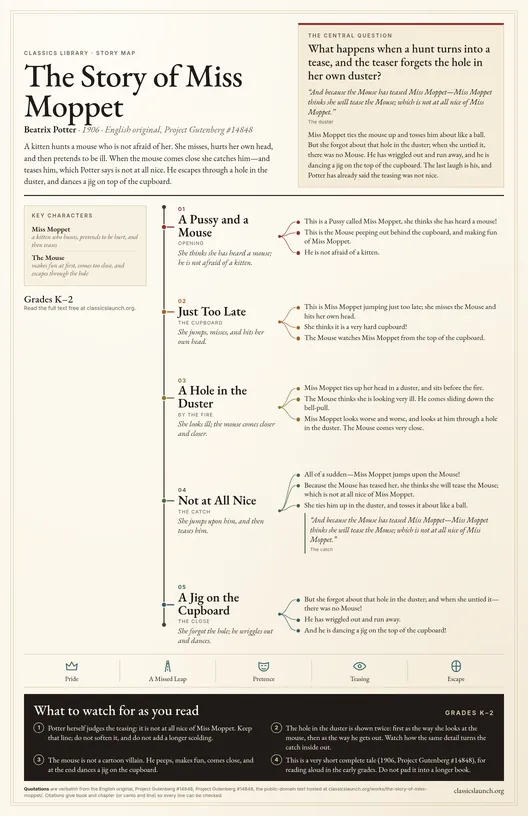 Story mapSee the story mapThe whole book on one page: the story in movements, the characters, and what to watch for. Free to print.
Abstract
The jump. A kitten hears a mouse and leaps too late, hitting her own head on the cupboard. She ties a duster around the bump and sits by the fire as if she were a patient.
The bundle. The mouse comes near to look. She has been watching through a hole in the cloth, catches him, and ties him up. Then she dances and tosses the bundle, sure the hunt is finished.
The escape. While she plays, the mouse works free and runs off, leaving her with an empty duster. The book ends in comedy, not in a scolding. The joke is small and complete: a kitten, a mouse, a cloth, and a victory that did not last. Young listeners can retell the events in order and talk about the choices without needing a lecture from the narrator. A text-only reading is well paired with an illustrated copy whenever one is at hand. The complete English text of The Story of Miss Moppet is hosted here from a verified public-domain transcription of the 1906 book, so families can read the words freely. Families can linger over the pictures and retell the events in their own words.
Main characters
- Miss Moppet: A kitten who jumps too soon, binds her head, and thinks she has caught a mouse.
- The Mouse: A bold mouse who teases her, is tied in a duster, and slips away.
Summary
The Story of Miss Moppet is one of Beatrix Potter's shortest picture books, first issued in 1906 as a small folded panorama and later as a tiny bound volume. A kitten named Miss Moppet thinks she has heard a mouse. The mouse peeps from behind a cupboard and is not afraid of her. Miss Moppet jumps too late, misses him, and strikes her own head on the hard wood. She binds the hurt with a duster and sits before the fire, looking invalid and interesting. The mouse, curious, comes closer. Miss Moppet, who has been watching through a hole in the duster, pounces and ties him up in that same cloth. She tosses the bundle and dances as if the hunt were over. While she plays, the mouse loosens the duster and runs away. The last image leaves her holding an empty cloth and the mouse free once more, having made fun of her from first to last. The book is almost a comic strip in prose: short caption-like sentences, repeated 'This is' openings, and a handful of clear pictures do the work of a longer plot. Nothing is explained beyond what a child can see. Moppet is not wicked, only hasty and pleased with herself; the mouse is not a villain, only quicker and less easily fooled. The joke turns on patience and on mistaking a performance for a victory. Families can talk about what happens when someone stops watching the thing she has just caught, and about how a sore head can become a trick. Because the text is so brief, it is well suited to the youngest listeners, who can point to the cupboard, the duster, and the escape. Older children can notice the mock-solemn tone, the way Potter lets the pictures carry the timing, and the kinship with her other very short 1906 book, The Story of a Fierce Bad Rabbit. The present library text follows a public-domain English transcription of the original Warne book. It should be read, if possible, with Potter's own plates, which show the duster, the fire, and the mouse's retreat more plainly than words alone can do. No later sequel is required; the little chase is complete in a few pages, and the ending is a laugh rather than a punishment.
Virtues in this work
- Prudence: Moppet jumps before she is ready and later plays instead of watching her catch.
- Temperance: She cannot resist dancing with the bundle, and the mouse uses that moment to leave.
Plot or Argument
- A missed jump
Miss Moppet leaps at a teasing mouse, hits her head, and binds it in a duster.
- A captured mouse
She watches through a hole in the cloth, pounces, and ties the mouse up.
- An empty duster
While she dances, the mouse slips free and the hunt ends in a laugh.
Characters
- Miss Moppet, protagonist
A kitten who jumps too soon, binds her head, and thinks she has caught a mouse.
- The Mouse, antagonist
A bold mouse who teases her, is tied in a duster, and slips away.
Lessons
Watch what you have caught
Moppet loses the mouse when she starts to show off.
- What does Miss Moppet do after she ties the mouse?
- Why is the duster empty at the end?
A sore head and a trick
The bandage is both a comfort and a way to hide her eyes.
- How does Miss Moppet watch the mouse while her head is tied?
- Is the mouse cruel, or only careful?
A short comic pattern
The repeated 'This is' lines work like captions under pictures.
- How does the book tell you what you are looking at?
- How is this tale like The Story of a Fierce Bad Rabbit?
Context
Potter issued this tiny 1906 book as a short comic chase: a kitten, a mouse, a duster, and a missed victory, told in caption-like sentences for the youngest listeners.
Composition
First published by Frederick Warne in 1906, at first as a panorama format and then as a small bound book. The local text follows a Project Gutenberg transcription of the English original.
Reception
It is often paired with The Story of a Fierce Bad Rabbit as one of Potter's briefest picture tales.
Comparisons
- The Story of a Fierce Bad Rabbit
Both are very short 1906 picture chases that end in a visible comeuppance or escape, with little commentary.
- The Tale of Tom Kitten
Tom and Moppet belong to the same household of kittens; this book is slighter, a single joke rather than a day of mischief.
Quotes
“This is a Pussy called Miss Moppet, she thinks she has heard a mouse!”
“Miss Moppet ties up her head in a duster, and sits before the fire.”
For Students
A reading companion for classical Christian high school students. See the student guide.
Reading Guide
Watch for
- How the duster is first a bandage and later a bag.
- When Miss Moppet stops watching the mouse.
- Whether the ending is a punishment or a joke.
Key terms and names
- Duster
- A cloth Miss Moppet ties around her head and later around the mouse.
- Cupboard
- The hard place the kitten hits when she jumps too late.
- Panorama
- An early format of this book, a long folded strip of pictures and words.
- Caption
- A short line that tells you what a picture is showing.
Seminar Questions
- Comprehension What happens when Miss Moppet jumps at the mouse the first time?
- Comprehension How does the mouse get out of the duster?
- Interpretation Why does Miss Moppet sit by the fire with her head tied up?
- Interpretation Is the mouse brave, rude, or both when he peeps and teases?
- Big Question When does celebrating a victory come too soon?
- Big Question How does Proverbs 16:18 help a family talk about being sure of yourself too quickly?
Faith Connections
- Proverbs 16:18 (Scripture)
Pride goes before a fall: Moppet is sure of the catch before it is secure.
- Proverbs 12:27 (Scripture)
A catch not carefully kept is easily lost; the verse can frame a talk about finishing what you start.
Logic and Rhetoric
Central argument: A victory celebrated too early can slip away, and a short picture book can teach that without a sermon.
Rhetorical device: Irony. The duster that hides a bump becomes the bag that cannot hold the mouse.
Debate: Resolved: A hunt is not over until the thing you caught is still in hand.
Writing Prompts
Essay: Tell the story in order, from the missed jump to the empty duster, using two details from the text.
Comparison with The Story of a Fierce Bad Rabbit: Both short 1906 books show a creature who acts too quickly. Compare what each one loses, and how the ending feels.
Creative Prompts
- Classroom
Act the story in three scenes: the missed jump, the duster, and the escape. Use a cloth as the only prop.
- Essay
How does Miss Moppet lose the mouse after she has caught him? Use two details from the book.
- Fiction
Write a short scene from the mouse's point of view as he loosens the duster.
Further Reading
Verification notes
Primary text checked against the edition identified in fullText. No unverified quotations or page numbers supplied. Recommended grades concern teaching suitability, not a mechanical reading score.
No verification flags recorded.