Work record
The Story of Burnt Njal (Njal's Saga)
Anonymous (Old Norse)The Story of Burnt Njal (Njal's Saga) by Anonymous (Old Norse) (13th century)Njal's Saga, which George Webbe Dasent called The Story of Burnt Njal, is the longest and greatest of the Icelandic family sagas.13th century · Medieval · Epic · Old Norse
Read this when you wonder whether law, counsel and mercy can stop a cycle of vengeance.
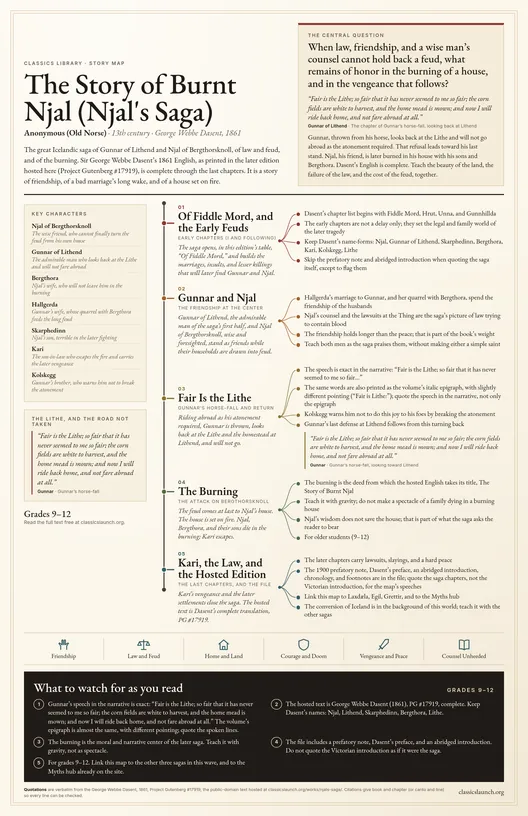 Story mapSee the story mapThe whole book on one page: the story in movements, the characters, and what to watch for. Free to print.
Abstract
Background. Three centuries after the events, a southern Icelander who knew the old law intimately composed this long account of two households. Dasent's English version of 1861 made it the most famous saga among Victorian readers.
Gunnar. Gunnar, a matchless fighter who dislikes killing, weds the dangerous Hallgerda. Her quarrels with Bergthora cost many servants' lives, yet the two husbands remain friends. Pulled into one fight after another, Gunnar is exiled, cannot bear to leave, and falls at his own door.
Conversion. At the midpoint a missionary priest tours the island, and the assembly of 1000 adopts Christianity by law after a heathen lawspeaker's long silence. Njal is among the first to praise the change.
The burning. Njal's sons, stirred by slander, murder the foster-brother their father loved. His widow forces her uncle Flosi to act, a peace at the assembly collapses, and Flosi sets fire to Njal's hall. The old couple die in prayer. Kari survives to pursue the burners until both he and Flosi seek pardon in Rome and are finally reconciled.
Themes. Law, honour, counsel and mercy are weighed against one another. The saga ends with peace freely chosen, not with a final act of revenge, and its most admired figure is the counsellor rather than the swordsman.
Main characters
- Njal: beardless lawyer and counsellor, burned in his house
- Gunnar: peerless warrior of Lithend, Njal's friend
- Hallgerda: Gunnar's proud and vengeful wife
- Skarphedinn: Njal's fierce eldest son
- Hauskuld: Njal's innocent foster-son, murdered in his field
- Flosi: leader of the burners, later a pilgrim
- Kari: Njal's son-in-law and avenger
Summary
Njal's Saga, which George Webbe Dasent called The Story of Burnt Njal, is the longest and greatest of the Icelandic family sagas. Written down about 1280, it tells of two friends, the warrior Gunnar of Lithend and the wise lawyer Njal of Bergthorsknoll, and of the feuds that destroy them both in the decades around the year 1000. The library text is Dasent's translation of 1861, in the one-volume edition of 1900. The saga opens with Hrut's unhappy marriage to Unna and with his niece Hallgerda, beautiful and dangerous, whose first two husbands are killed by her foster-father. Gunnar, the finest fighter in Iceland, marries Hallgerda against Njal's advice. Njal and Gunnar stay friends while their wives, Bergthora and Hallgerda, kill each other's servants in a long quarrel, and each killing is settled with silver. When Hallgerda sends a thrall to steal food, Gunnar slaps her, and she remembers. Gunnar is drawn into fight after fight, is outlawed for three years, and turns back at the moment of leaving because his home looks so fair. His enemies surround him at Lithend; when his bowstring breaks, Hallgerda refuses him two locks of her hair, and he dies. The second half turns to Njal's sons. They kill Thrain, and Njal takes Thrain's son Hauskuld into his own house as a foster-son, loves him, and wins him a chieftaincy. Through the slanders of Mord Valgard's son, Njal's sons and Kari kill the innocent Hauskuld in his cornfield. Hauskuld's widow Hildigunna throws his bloody cloak over her uncle Flosi to force him to vengeance. A great settlement at the Althing fails over an insult, and Flosi and his men burn Njal's house with the family inside. Njal and Bergthora lie down with their grandson under an ox-hide, sign themselves with the cross and commend their souls to God. Kari escapes and hunts the burners until both he and Flosi go on pilgrimage to Rome, are absolved, and are at last reconciled. Between the two halves stands the conversion of Iceland. Njal welcomes the news of the new faith; the missionary Thangbrand preaches through the land; and at the Althing of the year 1000 the lawspeaker Thorgeir decides that all Icelanders shall be Christian and believe in one God. For a classical Christian reader the saga is a study in law and grace: it honours the patient wisdom that tries to bind vengeance with law, and it shows how the faith of Njal and the penitence of Flosi and Kari opened a way out of the cycle of blood.
Virtues in this work
- Prudence: Njal gives far-seeing counsel to friends and enemies alike, and works for atonement by law instead of vengeance.
- Friendship: Gunnar and Njal remain friends through years of killings between their households, settling each one in peace.
- Faith: Njal and Bergthora sign themselves with the cross and commit their souls to God as their house burns.
- Charity: Hauskuld prays God to forgive his killers as he dies, and Flosi and Kari are reconciled after their pilgrimages.
- Justice: Thorgeir of Lightwater gives Iceland one law for Christians and heathens to keep the peace of the whole land.
Plot or Argument
- Introduction and prefatory matter
The 1900 edition opens with a prefatory note, Dasent's preface and his abridged introduction on the Northmen in Iceland, their beliefs, law and daily life, followed by a chronology and a table of contents.
- Chapters I-XVIII: Hrut, Unna and Hallgerda
Hrut returns from the court of Queen Gunnhillda under her curse, his marriage to Unna fails, and Hallgerda's first two husbands, Thorwald and Glum, are killed by her foster-father Thiostolf.
- Chapters XIX-XLV: Gunnar, Njal and the wives' feud
Gunnar wins fame abroad and marries Hallgerda; she and Bergthora have each other's servants killed in turn, while Gunnar and Njal settle every killing in friendship.
- Chapters XLVI-LXXIV: Gunnar's quarrels and outlawry
Hallgerda's theft from Otkell, a horse-fight and a series of ambushes draw Gunnar into many killings; Njal advises him never to slay twice in the same stock, Gunnar breaks the warning, is sentenced to three years abroad, and turns back at the sight of his home.
- Chapters LXXV-LXXXI: The death of Gunnar
Gunnar's enemies attack Lithend; when his bowstring is cut, Hallgerda refuses him two locks of her hair, he dies fighting and is heard singing in his burial mound, and his brother Kolskegg is baptized abroad.
- Chapters LXXXII-XCV: Njal's sons, Kari and Thrain
Njal's sons go abroad and win the friendship of Kari Solmund's son; back in Iceland Skarphedinn kills Thrain on the ice, and Njal fosters Thrain's son Hauskuld.
- Chapters XCVI-CV: The change of faith
Njal welcomes news of the new faith, Thangbrand preaches and fights his way through Iceland, Gizur and Hjallti return from King Olaf, and at the Althing Thorgeir of Lightwater lies under his cloak a day and a night before declaring that all men shall be Christian.
- Chapters CVI-CXXIII: The slaying of Hauskuld and the failed atonement
Mord's slanders set Njal's sons against Hauskuld, whom they kill in his field; Hildigunna goads Flosi with the bloody cloak; at the Althing a great atonement is agreed but breaks when Skarphedinn insults Flosi.
- Chapters CXXIV-CXXXI: The burning
Flosi and a hundred men burn Bergthorsknoll; Njal and Bergthora refuse to leave, lie down under an ox-hide with their grandson and commend their souls to God; Skarphedinn dies in the fire with two crosses branded on him, and Kari escapes.
- Chapters CXXXII-CLVIII: The suits, the vengeance and the reconciliation
The burning suit ends in battle at the Althing; Kari pursues the burners to Orkney and Brian's battle in Ireland; Flosi and Kari each go on pilgrimage to Rome, and at last Flosi receives Kari at Swinefell and gives him his niece Hildigunna in marriage.
Characters
- Njal Thorgeirsson, lawyer and counsellor of Bergthorsknoll
Wise, peaceable and far-seeing, he cannot grow a beard and gives counsel to all; he welcomes the new faith and dies in the burning of his house.
- Bergthora, Njal's wife
Strong-willed and loyal, she quarrels bitterly with Hallgerda but refuses to leave her husband in the fire.
- Gunnar Hamondsson, warrior of Lithend
The finest fighter in Iceland, generous and unwilling to kill, who is drawn into feud after feud and dies defending his home.
- Hallgerda, Gunnar's wife
Beautiful, proud and vengeful; three husbands die through her, and she refuses Gunnar the hair for his bowstring.
- Hrut Herjolfsson, Hallgerda's uncle
A shrewd and honourable man, cursed by Queen Gunnhillda so that his marriage to Unna fails.
- Kolskegg, Gunnar's brother
Keeps his sentence of exile, is baptized in Denmark and becomes a knight of God in Constantinople.
- Skarphedinn, Njal's eldest son
Grim, mocking and fearless; he kills Thrain and Hauskuld and dies in the fire with crosses branded on his body.
- Helgi and Grim, Njal's younger sons
Skarphedinn's brothers, who share his voyages, his killings and his death in the burning.
- Kari Solmund's son, Njal's son-in-law
A brave and steady warrior who escapes the burning, hunts the burners and is finally reconciled with Flosi.
- Thrain Sigfus' son, Gunnar's kinsman
Shelters the troublemaker Hrapp and is killed by Skarphedinn in a leap across the ice.
- Hauskuld, the Priest of Whiteness, Thrain's son, Njal's foster-son
Gentle and upright; murdered by Njal's sons and Kari, he dies praying God to forgive them.
- Hildigunna, Hauskuld's widow, Flosi's niece
Throws Hauskuld's bloody cloak over Flosi to compel him to vengeance; marries Kari at the end.
- Flosi Thord's son, chieftain of Swinefell
Leader of the burning, who knows it to be a great evil, later seeks absolution in Rome and makes peace with Kari.
- Mord Valgard's son, schemer
Envious and cunning; he plots Gunnar's fall and slanders Hauskuld to Njal's sons.
- Thangbrand, missionary priest
Sent by King Olaf Tryggvason to preach Christianity in Iceland; he baptizes Hall of the Side and fights off those who oppose him.
- Hall of the Side, chieftain
An early convert and peacemaker who leads the Christians at the Althing and later gives up his claim for his son's death to secure peace.
- Thorgeir of Lightwater, lawspeaker
A heathen who, after a day and a night under his cloak, declares that all Iceland shall have one law and one faith.
- Snorri the Priest, chieftain
Shrewd ally of Njal's kin at the Althing, whose men bar the burners' retreat in the battle at the Althing.
Lessons
Law as the foundation of a people
Njal believes that with law the land will be built up and with lawlessness laid waste, and he spends his life settling killings by atonement instead of more blood. The saga shows both the power and the limits of law: settlements hold for years, but they fail when pride and slander poison men's hearts.
- Why does Njal advise Gunnar never to slay twice in the same stock, and what happens when the advice is broken?
- Why does the great atonement at the Althing collapse in Chapter CXXIII?
- Can law alone keep peace among people who prize honour above life?
One law and one faith
At the Althing of the year 1000 Thorgeir warns that a sundering of the laws will be a sundering of the peace, and Iceland accepts Christianity by law. The saga treats the conversion as a public act of peace-making as well as a matter of belief, and it shows Njal welcoming the new faith before it is preached.
- What reasons does Thorgeir give for making all Icelanders Christian?
- Why does Njal say the new faith must be much better than the old?
- Was a conversion by law a true conversion? What does the rest of the saga suggest?
Forgiveness in the fire
Hauskuld dies praying God to help him and forgive his killers, and Njal and Bergthora meet death with the sign of the cross. In the end Flosi and Kari, the burner and the avenger, both go to Rome for absolution and are reconciled at Swinefell. The saga closes not with a final killing but with a peace that vengeance could never bring.
- How does Hauskuld's death prayer differ from the words of other men who die in the saga?
- Why does Njal refuse Flosi's offer to leave the burning house?
- What makes the reconciliation of Flosi and Kari possible at the end?
Context
The saga is set in southern Iceland between about 960 and 1016. It portrays the Icelandic Commonwealth, a land without a king, governed by chieftains, local Things and the annual Althing at Thingvellir, where the lawspeaker recited the law. Its central events include the conversion of Iceland at the Althing in 1000, the founding of the Fifth Court soon after, and the Battle of Clontarf near Dublin in 1014, which the saga calls Brian's battle.
Composition
An unknown author wrote the saga down about 1280, after Iceland had submitted to the Norwegian crown, perhaps looking back on the Commonwealth's law and its failures. It survives in many medieval manuscripts. George Webbe Dasent's translation of 1861, in two volumes with maps and a long introduction, was the first English version; the 1900 one-volume edition abridged the introduction but kept the full saga text.
Reception
Njal's Saga has been the best known of the Icelandic sagas since the Middle Ages and is often called the greatest prose work of medieval Scandinavia. Dasent's version introduced it to Victorian readers, and the poem The Woof of War embedded in Chapter CLVI inspired Thomas Gray's ode The Fatal Sisters (1768). Modern translators and historians of law continue to read it as a study of feud and settlement.
Comparisons
- Laxdæla Saga
Both sagas centre on the conversion of Iceland about the year 1000 and on a feud that runs through generations; Laxdæla tells it through love and jealousy, Njal's Saga through law and counsel.
- The Story of Egil Skallagrimsson (Egil's Saga)
Egil's Saga shows the earlier, heathen generation of the settlement; Njal's Saga shows its grandchildren living under the law of the Althing and receiving the new faith.
- The Story of Grettir the Strong (Grettis Saga)
Both sagas follow men whom the law makes outlaws; Gunnar refuses exile and dies at home, while Grettir lives nearly twenty years as an outlaw on the fells and Drangey.
- The Poetic Edda
The Woof of War in Chapter CLVI, sung by valkyries at a loom of men's entrails before Brian's battle, is a poem in the Eddic manner, and Gunnar's song from his mound recalls the heroic lays.
- The Prose Edda
Snorri's handbook preserves the pagan myths and poetic diction that the saga's heathen characters, and Thangbrand's opponents, still lived by.
- The Story of the Volsungs (Volsunga Saga)
Hallgerda refusing Gunnar her hair, and the burning of a hall with a family inside, echo the heroic legend of the Volsungs and Niflungs, where women drive men to their deaths and halls are burned in vengeance.
- The Oresteia
Aeschylus shows a chain of family killings ended by a court of law in Athens; Njal's Saga shows the same hope in the Althing and its courts, and how often the hope failed.
- Ecclesiastical History of the English People
Bede tells how English kings and councils accepted the faith; the saga's account of the Althing of 1000 is the Icelandic counterpart.
Quotes
Frequently cited
“for with law shall our land be built up and settled, and with lawlessness wasted and spoiled”
Frequently cited
“Fair is the Lithe; so fair that it has never seemed to me so fair; the corn fields are white to harvest, and the home mead is mown; and now I will ride back home, and not fare abroad at all”
Frequently cited
“Give me two locks of thy hair, and ye two, my mother and thou, twist them together into a bowstring for me”
Frequently cited
“that all men shall be Christian here in the land, and believe in one God, the Father, the Son, and the Holy Ghost, but leave off all idol-worship, not expose children to perish, and not eat horseflesh”
“It seems to me as though this new faith must be much better, and he will be happy who follows this rather than the other; and if those men come out hither who preach this faith, then I will back them well”
“for if there be a sundering of the laws, then there will be a sundering of the peace, and we shall never be able to live in the land”
“God help me, and forgive you”
“put your faith in God, and believe that He is so merciful that He will not let us burn both in this world and the next”
“I have promised him this, that we would both share the same fate”
“Then they signed themselves and the boy with the cross, and gave over their souls into God's hand”
“but Njal's body and visage seem to me so bright that I have never seen any dead man's body so bright as this”
For Students
A reading companion for classical Christian high school students. See the student guide.
Reading Guide
Watch for
- Each time Njal gives advice, and whether it is followed.
- The killings between Bergthora's and Hallgerda's households in Chapters XXXV-XLV, and the price set on each.
- Hallgerda's slap in Chapter XLVIII and her answer at Gunnar's last fight.
- The conversion chapters XCVI-CV, especially Njal's words and Thorgeir's law.
- Signs of Christian faith during and after the burning: prayers, the cross, the bright body.
Key terms and names
- Althing
- The annual national assembly at Thingvellir, where laws were recited, suits pleaded and the conversion decided.
- Lawspeaker
- The elected officer who recited the law at the Althing; Thorgeir of Lightwater held the office in 1000.
- Atonement
- A settlement in which a killer's side paid compensation to the dead man's kin instead of suffering vengeance.
- Outlawry
- A legal sentence placing a man outside the protection of the law; lesser outlawry meant three years abroad.
- Godi (priest)
- A chieftain holding a priesthood and seat at the Things; Hauskuld becomes the Priest of Whiteness.
- Fifth Court
- A court of appeal created at the Althing after the conversion, on Njal's advice in the saga.
- Prime-signing
- Being marked with the cross as a first step toward baptism, as Flosi is in Chapter XCVII.
Seminar Questions
- Comprehension Why does Gunnar turn back instead of leaving Iceland, and what follows?
- Comprehension How does Iceland come to accept Christianity at the Althing in Chapter CI?
- Interpretation Why does Njal foster Hauskuld, the son of the man his sons killed, and what does this reveal about him?
- Interpretation Is Flosi a villain, or a good man forced into evil by Hildigunna and the law of honour?
- Interpretation What does the saga mean by showing Njal's body bright and Skarphedinn branded with crosses?
- Big Question Can a society be held together by law if its people do not share a faith that teaches forgiveness?
- Big Question When is it right to accept death rather than flee it, as Njal and Bergthora do?
Faith Connections
- Romans 13:1-4 (Scripture)
Paul calls the civil authority God's servant for good. Njal's trust in law and atonement reflects this view of law as a gift that restrains evil.
- Luke 23:34; Acts 7:60 (Scripture)
Hauskuld's dying prayer, God help me, and forgive you, echoes Christ on the cross and Stephen under the stones, a sign of how the new faith had reached him.
- Matthew 10:28 (Scripture)
Jesus tells his disciples not to fear those who kill the body but cannot kill the soul; Njal comforts his household that God will not let them burn in this world and the next.
- Aeschylus, The Eumenides (Great Conversation)
Athena ends the Furies' cycle of blood by founding a court; Njal and Thorgeir hope for the same from the Althing, and the saga shows what more was needed.
Logic and Rhetoric
Central argument: The saga argues that law, counsel and atonement can restrain vengeance only as long as men keep faith with them; slander, pride and the demands of honour repeatedly break settlements, and the cycle ends only when the chief men of both sides seek absolution and forgive.
Rhetorical device: Foreshadowing by prophecy and portent. Njal repeatedly foresees what will come, telling Gunnar the cost of slaying twice in the same stock and warning that his own death is near, and before the burning Njal sees the table and the food turned to blood.
Debate: Resolved: Njal was right to refuse Flosi's offer to leave the burning house.
Memory Work
for with law shall our land be built up and settled, and with lawlessness wasted and spoiled
put your faith in God, and believe that He is so merciful that He will not let us burn both in this world and the next
Writing Prompts
Essay: Trace the conversion of Iceland in Njal's Saga from Njal's first words about the new faith to the burning and the pilgrimages, and argue whether the faith changes how the feud ends.
Comparison with The Oresteia: Compare how The Oresteia and Njal's Saga try to end a cycle of family vengeance through courts of law, and explain why the saga's settlement fails where Athena's succeeds.
Medical Lens
The saga is not a medical text, but its fights are described with exact attention to wounds, and it records portents and prophetic dreams, a beardless body as a mark of mockery, and deaths faced with remarkable calm.
- Chapter LXXVII
Gunnar fights on with two wounds and is said never to have winced at wounds or death.
- Chapter CXXXII
Flosi dreams of a giant in goatskins calling out the names of the burners who will die.
- Chapter CXXVIII
Njal and Bergthora meet death by fire calmly, with the boy Thord between them.
Creative Prompts
- Dialogue
Write the conversation in which Njal advises Gunnar never to slay twice in the same stock, then a second scene years later when Gunnar remembers it.
- Essay
Njal says that with law the land shall be built up and with lawlessness laid waste. Write an essay on whether the saga proves him right, using the atonement at the Althing and the burning.
- Poetry
Write the song Gunnar sings from his burial mound in Chapter LXXVII in your own words, in four short stanzas.
- Classroom
Hold a mock Althing on the slaying of Hauskuld: one team prosecutes for Flosi, one defends Njal's sons, and a panel of judges proposes an atonement.
Further Reading
- Njal's Saga, trans. Magnus Magnusson and Hermann Pálsson
A widely read modern translation (1960).
- Why Is Your Axe Bloody? A Reading of Njáls Saga, William Ian Miller
A legal historian's close reading of the saga.
- Bloodtaking and Peacemaking: Feud, Law, and Society in Saga Iceland, William Ian Miller
How feud and settlement worked in saga Iceland.
- Viking Age Iceland, Jesse L. Byock
The Commonwealth, its Things and its chieftains.
- The Fatal Sisters, Thomas Gray
Gray's 1768 ode based on the valkyries' song in Chapter CLVI.
Verification notes
All quotations were checked by exact search against the stored Project Gutenberg text (#17919) of Dasent's translation in the 1900 one-volume edition, with line breaks collapsed to single spaces. Chapter numbers and titles are Dasent's. The edition abridges Dasent's introduction but prints the full saga, his chronology and footnotes; two illustration captions were removed from the reading text.
- The date of composition (c. 1280) is a scholarly estimate.
- The author of the 1900 prefatory note (signed E. V. Lucas in the stored text) should be confirmed before citing.