Work record
The Castle
Franz KafkaDas Schloss; Das SchloßThe Castle by Franz Kafka (1926)The Castle is Kafka's last novel, left unfinished at his death in 1924 and published in 1926 by his friend Max Brod.Also known as: Das Schloss · Das Schloß
1926 · Early 20th Century · Novel · German
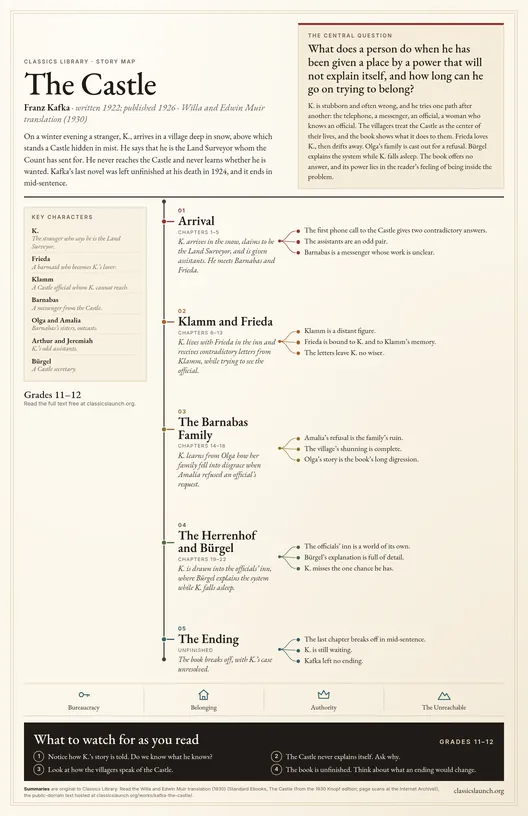 Story mapSee the story mapThe whole book on one page: the story in movements, the characters, and what to watch for. Free to print.
Abstract
Background. Kafka wrote this novel in 1922, when he was already ill with tuberculosis, and left it unfinished at his death in 1924. Max Brod published it in 1926; the Muirs' translation appeared in 1930.
Plot. A stranger arrives in a village and claims to be summoned as Land Surveyor by the Castle. He tries to make contact with the officials who rule it and to settle in the village, but receives only contradictory messages. The book breaks off before its end.
Ideas. The novel studies authority, exclusion and the search for a home. It has been read as an allegory of bureaucracy and, by Brod, of grace, and it resists any single reading.
Text. The Muirs' translation follows Brod's edition and adds an introductory note and a postscript. It is a long text with a plain and exact style. The hosted text is complete as printed here, with its section headings kept as a guide to the reader, and every quotation on this page is drawn directly from that text. Teachers can pair this work with the library's study guide, seminar questions and memory-work selection to prepare a discussion, a short essay or a recitation. The full text is hosted on this site, and each quotation in the guide has been checked against the hosted translation.
Main characters
- K.: A stranger claiming to be a Land Surveyor
- Frieda: A barmaid who becomes his fiancée
- Klamm: A Castle official
- Barnabas: A messenger
- Olga: Barnabas's sister
- Bürgel: A Castle secretary
Summary
The Castle is Kafka's last novel, left unfinished at his death in 1924 and published in 1926 by his friend Max Brod. It opens on a winter evening, with a stranger, K., arriving in a village deep in snow, above which stands a Castle that is hidden in mist and darkness. K. announces to the innkeeper that he is the Land Surveyor whom the Count is expecting. A telephone call to the Castle first denies that any such appointment exists, and then, after a second call, confirms it. From the first page, nothing is simply true or false: K. is hired and not hired, welcome and not welcome. The rest of the book is K.'s attempt to reach the Castle, to enter into proper relations with the authorities who rule the village from it, and to settle in the village as a citizen. He is given two assistants, Arthur and Jeremiah, who are at once servants and spies. He takes up with Frieda, a barmaid who is the mistress of Klamm, an official, and thus gets a foothold. He receives letters from Klamm that are contradictory and unreadable. He learns from the family of Barnabas, a messenger, how the whole village was once ostracised after Barnabas's sister, Amalia, refused the indecent request of an official. He listens to long speeches by innkeepers and landladies, who have a sacred awe of the Castle, and he meets a Castle secretary, Bürgel, who explains the workings of the system in the middle of the night, while K. falls asleep. The novel breaks off in the middle of a sentence, although Kafka is reported to have said that K. would die, exhausted, with the Castle's reluctant word that his residence in the village is permitted. The hosted edition is Brod's text, with the Muirs' translation, which leaves out a few passages that Brod omitted, and it includes Brod's postscript. The book is a masterpiece of strange comedy and of dread. It has been read as an allegory of bureaucracy, of the isolation of modern man, and, in Brod's reading, of divine grace which cannot be commanded but must be waited for. Edwin Muir's introduction, which is part of the hosted edition, contrasts Bunyan's pilgrim, who knows his goal and has a road, with K., who has almost nothing. Teachers should note that the book contains suggestive scenes, a few lewd approaches, and a sense of persistent unease, and that it makes no explicit appeal to the Christian faith.
Virtues in this work
Plot or Argument
- Chapters 1–5: Arrival
K. arrives in the snow, claims to be the Land Surveyor, and is given assistants. He meets Barnabas and Frieda.
- Chapters 6–13: Klamm and Frieda
K. lives with Frieda in the inn and receives contradictory letters from Klamm, while trying to see the official.
- Chapters 14–18: The Barnabas family
K. learns from Olga how her family fell into disgrace when Amalia refused an official's request.
- Chapters 19–22: The Herrenhof and Bürgel
K. is drawn into the officials' inn, where Bürgel explains the system while K. falls asleep.
- The ending
The book breaks off, with K.'s case unresolved.
Characters
- K., protagonist
A stranger who claims to be a Land Surveyor and tries to enter the village and the Castle.
- Frieda, barmaid
A young woman, once the mistress of Klamm, who becomes K.'s fiancée.
- Klamm, official
A high Castle official whom K. never speaks to.
- Barnabas, messenger
A young messenger whose family has been ostracised.
- Olga and Amalia, Barnabas's sisters
Two sisters whose family history shows how the village fears the Castle.
- Arthur and Jeremiah, assistants
Two assistants who seem to spy on K.
- Bürgel, secretary
An official who explains the system to a sleeping K.
Lessons
Authority can be unreachable and total
The Castle controls every part of the village's life, but is never seen to act. Kafka shows how an apparently rational system can be a source of dread.
- What do the villagers believe about the Castle?
- How do the officials communicate with K.?
Seeking and belonging
K. wants to belong, but each step toward belonging seems to put him further away. The book is a study of what it is to be a stranger.
- Why does K. want to be accepted?
- What does he give up in the attempt?
Waiting and grace
Max Brod read the Castle as divine grace, which cannot be demanded. The novel does not say so, but readers may ask whether the story fits that reading.
- What does the book say about merit and favour?
- Does the Castle resemble God or a bureaucracy?
Context
Kafka wrote the book in Prague and a village in Bohemia in 1922, in the last years of his life, when he was already ill with tuberculosis. The world of Habsburg bureaucracy and a Jewish German-speaking minority informs it.
Composition
Kafka worked on it between January and September 1922, and left it incomplete. He told Brod to burn his papers, but Brod published the novel in 1926, after The Trial in 1925. The Muirs translated it in 1930.
Reception
The English translation of 1930 introduced Kafka to English readers and made 'Kafkaesque' a word. Critics have read the book as a religious, political and psychological allegory.
Comparisons
- The Trial
Kafka's other unfinished novel, also about a man caught in an incomprehensible system.
- The Metamorphosis
Kafka's best-known story is a shorter study of alienation.
- The Pilgrim's Progress
Edwin Muir's introduction compares Bunyan's pilgrim, who has a clear goal, with K., who has almost nothing.
- Notes from Underground
Dostoevsky's narrator shares K.'s sense of isolation and his argumentative persistence.
- Michael Kohlhaas
Kleist's story of a man against a corrupt system was admired by Kafka.
Quotes
Frequently cited
“It was late in the evening when K. arrived. The village was deep in snow. The Castle hill was hidden, veiled in mist and darkness, nor was there even a glimmer of light to show that a castle was there. On the wooden bridge leading from the main road to the village K. stood for a long time gazing into the illusory emptiness above him.”
“Let me tell you that I am the Land Surveyor whom the Count is expecting. My assistants are coming on tomorrow in a carriage with the apparatus.”
“If you have the strength to look at things steadily, without, as it were, blinking your eyes, you can see much; but if you relax only once and shut your eyes, everything fades immediately into obscurity.”
For Students
A reading companion for classical Christian high school students. See the student guide.
Reading Guide
Watch for
- Every contradictory message K. receives from the Castle.
- What the villagers say about the officials.
- The moments in which K. seems to gain ground, and how they dissolve.
Key terms and names
- Land Surveyor
- A person who measures and maps land; K.'s claimed profession.
- Bureaucracy
- Government by offices and officials, rather than by persons.
- Kafkaesque
- Marked by a nightmarish, incomprehensible administration.
- Allegory
- A story in which characters and events stand for ideas.
Seminar Questions
- Comprehension Why does K. say that he is a Land Surveyor?
- Comprehension What is the village's attitude to the Castle?
- Interpretation Why does Kafka leave K.'s case unresolved?
- Interpretation What does the story of Amalia tell us about the Castle?
- Interpretation What does Bürgel's speech add?
- Big Question Is the Castle like God, or like a government?
- Big Question Can a person be right and yet not be heard?
Faith Connections
- Luke 18:1–8 (Scripture)
Jesus tells of a persistent widow before an unjust judge. K.'s persistence resembles hers, but with no promise of an answer.
- Ephesians 2:8 (Scripture)
'By grace you have been saved.' Max Brod read the novel as a picture of grace, which cannot be earned.
- John Bunyan, The Pilgrim's Progress (Great Conversation)
Muir's introduction sets Bunyan's clear road against K.'s lack of one.
Logic and Rhetoric
Central argument: A man seeking acceptance by an unreachable authority is caught in a system that grants no clear answer and no clear refusal.
Rhetorical device: deadpan realism. Kafka describes absurd circumstances in a plain and exact style, so that the reader is drawn into K.'s logic.
Debate: Resolved: That The Castle is better read as a religious allegory than as a political one.
Memory Work
It was late in the evening when K. arrived. The village was deep in snow. The Castle hill was hidden, veiled in mist and darkness, nor was there even a glimmer of light to show that a castle was there. On the wooden bridge leading from the main road to the village K. stood for a long time gazing into the illusory emptiness above him.
If you have the strength to look at things steadily, without, as it were, blinking your eyes, you can see much; but if you relax only once and shut your eyes, everything fades immediately into obscurity.
Writing Prompts
Essay: How does Kafka create the sense of an authority that is both everywhere and nowhere?
Comparison with The Trial: Compare K.'s relation to the Castle with Joseph K.'s relation to the Court.
Creative Prompts
- Essay
What does the Castle stand for? Support a reading with details from the first chapters.
- Dialogue
Write a conversation between K. and a villager who has lived all her life under the Castle.
- Classroom
Compare the introduction by Edwin Muir with the novel itself. Does Muir's contrast with Bunyan hold?
Further Reading
- The Trial, Franz Kafka
Kafka's other novel of a man and a legal system, hosted in this library.
- The Metamorphosis, Franz Kafka
Kafka's story of alienation, hosted in this library.
- The Pilgrim's Progress, John Bunyan
The Christian allegory with which Muir contrasts The Castle.
- Franz Kafka: A Biography, Max Brod
The biography by Kafka's friend and editor.
Verification notes
Full text from Standard Ebooks, set from the 1930 Knopf edition of Willa and Edwin Muir's translation (CC0 edition). Published in 1930, the translation entered the US public domain on 1 January 2026. Quotes were checked against the hosted text. The hosted edition follows Max Brod's 1926 text, which omits a few passages. The interpretation as allegory of grace is Brod's, not Kafka's.
- The exact author of the introductory note at the head of the hosted edition.
- Kafka's reported plan for the ending of the novel.