Work record
The Sealed Angel
Nikolai LeskovThe Sealed Angel (Leskov); Zapechatlyonny angel; The Sealed Angel and Other StoriesThe Sealed Angel by Nikolai Leskov (1873)The Sealed Angel is a short novella by Nikolai Leskov, first printed in 1873, and one of the most admired of all Russian tales about religion.Also known as: The Sealed Angel (Leskov) · Zapechatlyonny angel · The Sealed Angel and Other Stories
1873 · 19th Century · Novella · Russian
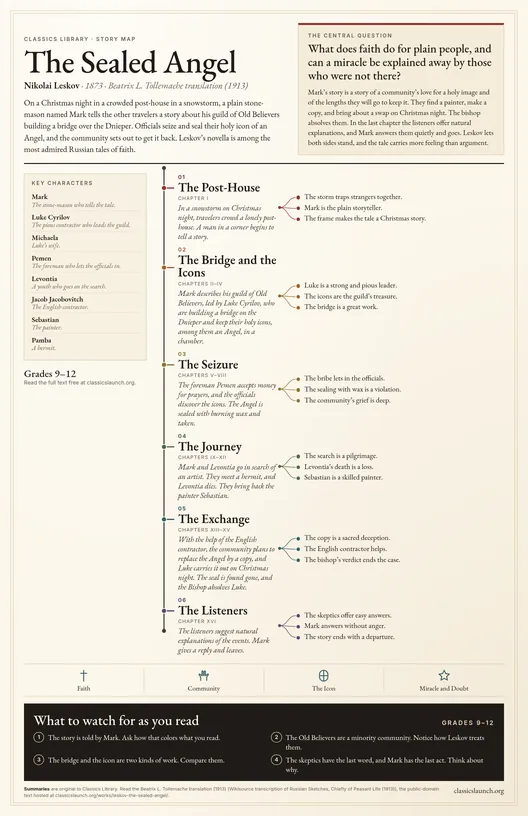 Story mapSee the story mapThe whole book on one page: the story in movements, the characters, and what to watch for. Free to print.
Abstract
Background. Leskov's tale of 1873 is one of the most admired Russian stories about religion, and one of the best known of his shorter works. He wrote it from close knowledge of church life in Russia, and with sympathy for both the Old Believers and the State Church.
Plot. A mason tells how his guild of Old Believers, working on a bridge over the Dnieper, had its holy Angel icon sealed with burning wax by officials, how a painter made a copy and the community took the original back from the Bishop's chapel, and how the seal vanished on Christmas night.
Ideas. The tale is about a religious divide and the love that can heal it. It treats icons seriously, shows the dignity of craftsmen and the warmth of a guild, notices the faults of a rogue foreman, and leaves the miracle open to the reader's judgement.
Text. The Tollemache translation is plain and readable. The frame is short and the tale reads well aloud. Teachers can pair this work with the library's study guide, seminar questions and memory-work selection to prepare a discussion, a short essay or a recitation. The full text is hosted on this site, and each quotation in the guide has been checked against the hosted translation.
Main characters
- Mark: A stone-mason narrator
- Luke Cyrilov: The guild's master
- Pemen: A rogue foreman
- Sebastian: An icon painter
- The Bishop: A merciful churchman
Summary
The Sealed Angel is a short novella by Nikolai Leskov, first printed in 1873, and one of the most admired of all Russian tales about religion. It begins in a crowded post-house on a Christmas night, in a snowstorm, when a company of travellers who cannot sleep listen to a plain man in the corner tell a story. The speaker, Mark, a stone-mason and a former Old Believer, tells how he and his fellow workers, who followed the old rites of the Russian church and refused the authority of its priests, went to build a great bridge over the Dnieper under a contractor named Luke Cyrilov. They carried with them in a chamber a treasury of ancient icons, and the dearest of these was an icon of a Guardian Angel. The quiet of the guild is broken by a scandal. The foreman Pemen takes money from the wife of a government official in return for prayers that her husband may be given a lucrative commission, and she asks to visit the holy icons. The result is that the authorities discover the Old Believers' chamber, tear down the icons and seal them, and drip hot wax on the face of the Angel. The community, in grief, cannot bear to see its beloved Angel blinded in a cellar of the State Church. Mark and a young companion, Levontia, set out on a journey to find a painter who can make a copy, and meet a hermit who is a follower of the State Church and whose gentle words leave Mark shaken. With the help of the English contractor, Jacob Jacobovitch, and his wife, the community plans to take back the Angel from the Bishop's chapel on Christmas night and to leave the copy in its place. The plot succeeds, and then fails in a way that no one has planned: when Luke looks at the icon he has taken, he finds that the seal is gone. In terror, he runs into the church where the Bishop is disrobing, confesses his theft, and is forgiven. The community comes into the Church. Mark ends his story with the remark that the learned may explain the facts by natural causes, but that it makes no difference to him by what path God seeks a man. Leskov's tale is, among other things, a loving portrait of Russian craftsmen, of their skill, humour and obstinacy, and of the way in which sacred objects shape a community. It shows the cost of religious division in Russia and the possibility of reconciliation. The tale also contains hostile stereotypes of Jewish merchants and some polemic against the sectarians, which a teacher should discuss with students. The hosted translation is Beatrix L. Tollemache's of 1913, from the book Russian Sketches, Chiefly of Peasant Life.
Virtues in this work
Plot or Argument
- Chapter I: The post-house
In a snowstorm on a Christmas night, travellers crowd a lonely post-house. A man in a corner begins to tell a story.
- Chapters II–IV: The bridge and the icons
Mark describes his guild of Old Believers, led by Luke Cyrilov, who are building a bridge on the Dnieper and keep their holy icons, among them an Angel, in a chamber.
- Chapters V–VIII: The seizure
The foreman Pemen accepts money for prayers, and the officials discover the icons. The Angel is sealed with burning wax and taken.
- Chapters IX–XII: The journey
Mark and Levontia go in search of an artist. They meet a hermit, and Levontia dies. They bring back the painter Sebastian.
- Chapters XIII–XV: The exchange
With the Englishman's help, the community plans to replace the Angel by a copy, and Luke carries it out on Christmas night. The seal is found gone, and the Bishop absolves Luke.
- Chapter XVI: The listeners
The listeners suggest natural explanations of the events. Mark gives a reply and leaves.
Characters
- Mark, the narrator
A stone-mason, once an Old Believer, who tells his tale in a post-house.
- Luke Cyrilov, the contractor
The master of the guild, a grave, pious, orderly man who is the keeper of the icons.
- Michaela, Luke's wife
A shrewd, tender-hearted woman who has brought Mark up as her son.
- Pemen, the foreman
A rogue who sells prayers for money and brings disaster on his community.
- Maroe, the old man
An aged Old Believer who is bound by the officials and dies on the day he foretells.
- Levontia, the youth
A young companion who goes with Mark on the journey and dies after they shelter with the hermit.
- Jacob Jacobovitch, the English contractor
A sympathetic, practical employer who helps the community.
- Sebastian, the artist
An icon painter with huge black hands, who copies the Angel.
- Pamba, the hermit
An old man of the State Church, who says that love breaks the seal.
Lessons
Icons and devotion
The Sealed Angel asks what an icon is to the people who pray before it. The community's grief at the sealing of the Angel is more than superstition: it is the pain of people who have only one thing that links them to their God and to their fathers.
- Why is the Angel so dear to the community?
- How do the officials treat the icons, and why does it hurt?
Division and reconciliation
The tale is about the division of Russian Christians into the State Church and the Old Believers. Leskov imagines a moment in which the wall falls and love breaks a seal. Students should see this as the author's own hope and ask whether the story is fair to both sides.
- What does Pamba say that moves Mark?
- What does the Bishop do when Luke confesses?
Craft and community
Leskov's picture of the masons, their guild, their work on the bridge and their shared meals is as much a part of the tale as the miracle. It shows the Christian dignity of labour and of skill.
- How does Leskov describe the work on the bridge?
- What does Sebastian's copy show about the artist's craft?
Context
The Old Believers (raskolniki) were Russian Christians who refused the church reforms of Patriarch Nikon in the 1650s, and who were persecuted for two centuries. Some groups, like the one in this tale, had no priests. The State Church, supported by the tsar, saw them as schismatics, and their icons and chapels could be seized.
Composition
Leskov wrote the tale in the 1870s and it was first printed in 1873. The hosted version is a Wikisource transcription of the translation by Beatrix L. Tollemache, in Russian Sketches, Chiefly of Peasant Life (Smith, Elder & Co., London, 1913).
Reception
Leskov was often passed over in his lifetime, but later critics, among them Walter Benjamin, treated him as one of the great Russian storytellers. The Sealed Angel is among his best-known works.
Comparisons
- What Men Live By and Other Tales
Tolstoy's folk tales, with their plain peasant speech and religious point, are Leskov's nearest companions.
- The Brothers Karamazov
Dostoevsky's novel also treats the Russian Church, its hermits and its divisions.
- A Sportsman's Sketches
Turgenev's peasants, wanderers and holy men, in Kassyan of Fair Springs, are a neighbour to Leskov's.
- The Pilgrim's Progress
Another plain story of the journey of believers, told in a simple voice.
- Dead Souls
Gogol's Russia is full of rogues like Pemen, but Leskov's is a story of grace.
Quotes
Frequently cited
“I only remember that the beautiful face of the Angel was red, and melted olive oil ran down in two streams from underneath the seal, like tears and blood.”
Frequently cited
“The Angel is meek, the Angel is humble; what the Lord will tell him he will do. This is what an Angel means: he lives in the soul of man, he is sealed up by the vanity of knowledge, but love breaks the seal.”
Frequently cited
“As everyone believes, so let him judge; but for us it is all the same by what paths God seeks out a man and out of what vessel God gives him to drink, only let him quench his thirst together with those of his own country.”
“You know we are but simple people, and yet we can feel the beauty of natural scenery which God has given to us,”
“I never lead anyone anywhere; it is the Lord who leadeth every man.”
“Now it has been made clear to you where the true Faith really is; you,’ said he, ‘by a deceitful trick took the seal off your Angel, but our Angel took the seal off himself, and brought you hither.”
For Students
A reading companion for classical Christian high school students. See the student guide.
Reading Guide
Watch for
- How the community treats its icons.
- How Leskov shows Mark's own change of heart on the journey.
- How the Bishop, the Englishman and the hermit each act with kindness.
Key terms and names
- Old Believers
- Russian Christians who kept the old rites after the church reforms of the 1650s and were persecuted for it.
- Icon
- A painted holy image used in Orthodox worship and prayer.
- State Church
- The official Russian Orthodox Church, as the Old Believers called it.
- Seal
- A mark of wax or lead used to close a thing under authority; here it blinds the Angel's face.
Seminar Questions
- Comprehension Who tells the story, and where?
- Comprehension What happens to the Angel in Chapter VIII?
- Interpretation Why does the Bishop forgive Luke?
- Interpretation What does Pamba mean when he says love breaks the seal?
- Interpretation How do the natural explanations in Chapter XVI answer the story?
- Big Question Can sacred images be harmed by those who seal them?
- Big Question Is the unity of the Church more important than its customs?
Faith Connections
- John 17:20–23 (Scripture)
'That they may all be one.' The tale is a long picture of a division healed by mercy.
- Exodus 20:4 (Scripture)
Reformed readers will bring to the tale the commandment on images, and the library invites them to see how Leskov's people understand an icon as a window and not an idol.
- Matthew 5:23–24 (Scripture)
'First be reconciled to your brother.' The Bishop's forgiveness and Luke's confession are a picture of this.
Logic and Rhetoric
Central argument: Religious division can be healed by love, and the plain faith of simple people sometimes sees what the learned cannot.
Rhetorical device: frame narrative. The story is told in a snowbound post-house to a company of strangers, and its last chapter returns to them with their objections.
Debate: Resolved: That a miracle that can be explained by natural causes is no less a miracle.
Memory Work
The Angel is meek, the Angel is humble; what the Lord will tell him he will do. This is what an Angel means: he lives in the soul of man, he is sealed up by the vanity of knowledge, but love breaks the seal.
As everyone believes, so let him judge; but for us it is all the same by what paths God seeks out a man and out of what vessel God gives him to drink, only let him quench his thirst together with those of his own country.
Writing Prompts
Essay: Show how Mark's attitude to the State Church changes from the beginning of the journey to the end.
Comparison with What Men Live By and Other Tales: Compare Leskov's and Tolstoy's use of a plain speaker to tell a religious story.
Medical Lens
Maroe, an old man of eighty, is bound by the officials, and is said to die on the day he has foretold. A disease of the eyes spreads among the workmen, who believe it to be a sign of the Angel's blinding, and refuse the doctors sent by the English contractor. The tale is an example of how religious explanations and medical ones are set side by side by the people.
- Chapter XI, Levontia's death
Levontia dies after the two travellers shelter in the hermit's hut, and Mark mourns him.
- Chapter IX, the eye disease
Workmen suffer from an eye disease and ask for the Angel rather than the doctors.
Creative Prompts
- Essay
Why does Leskov make the miracle ambiguous at the end? What does Mark's answer to the listeners mean?
- Fiction
Tell the story of the sealing of the Angel from the point of view of the officer who drips the wax.
- Classroom
Discuss with a teacher the passages about Jewish merchants and the Old Believers' view of the State Church. How does the story treat them?
- Essay
What does Pamba mean when he says that the Angel is sealed up by the vanity of knowledge, but love breaks the seal?
Further Reading
- What Men Live By and Other Tales, Leo Tolstoy
Folk tales with a similar voice; hosted in this library.
- The Brothers Karamazov, Fyodor Dostoevsky
A novel with monks, elders and the Russian Church; hosted in this library.
- The Storyteller: Reflections on the Works of Nikolai Leskov, Walter Benjamin
A famous essay on Leskov; not hosted here.
- The Old Believers and the World of Antichrist, Robert O. Crummey
A history of the Old Believers of the seventeenth and early eighteenth centuries.
Verification notes
Full text from the Wikisource transcription of Beatrix L. Tollemache's 1913 translation, public domain. Quotes were checked against the hosted text. The plot is summarised from the text and the interpretation of the Old Believers follows the text; the date of first publication (1873) and the Benjamin essay are standard reports not verified here. The tale contains hostile stereotypes of Jewish merchants (Chapters V and VII) and sectarian polemic, which are Leskov's characters' and not the library's view.
- Date of first publication (1873).
- The details of the Old Believers' history.