Work record
Lorna Doone: A Romance of Exmoor
R. D. BlackmoreR. D. Blackmore; RD Blackmore; R.D. Blackmore; R D Blackmore; RDBlackmore; Richard Doddridge Blackmore; Lorna Doone; Lorna Doone: A Romance of Exmoor; John Ridd; The Doones of ExmoorLorna Doone: A Romance of Exmoor by R. D. Blackmore (1869)Lorna Doone is the story of John Ridd, a farmer’s son of the parish of Oare on Exmoor, who tells it in old age.Also known as: Lorna Doone · Lorna Doone: A Romance of Exmoor · John Ridd · The Doones of Exmoor
1869 · 19th Century · Novel · English
Read this when you want a long, warm tale of a strong farmer, an outlaw clan and love.
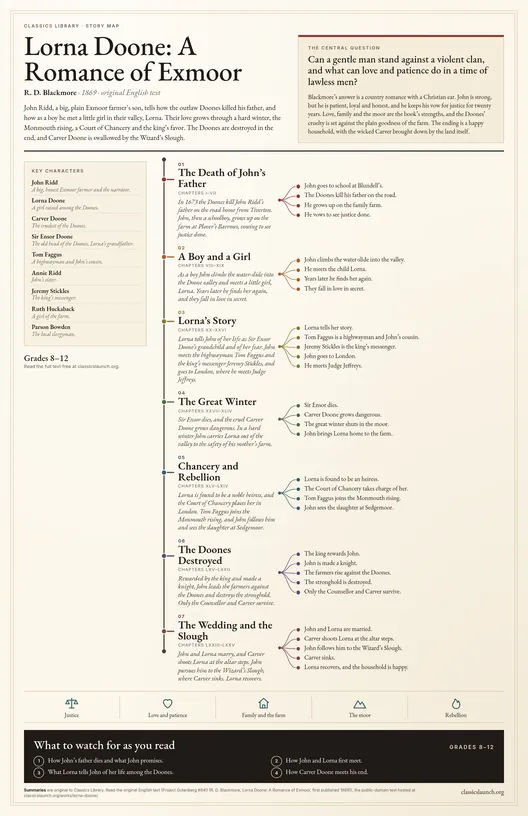 Story mapSee the story mapThe whole book on one page: the story in movements, the characters, and what to watch for. Free to print.
Abstract
The boy and the girl. John Ridd’s father is killed by the outlaw Doones, who hold a hidden valley on Exmoor. As a boy John climbs into the valley and meets Lorna, a little girl who tends him. Years later they meet again and fall in love, in spite of the feud between their houses.
The feud. Lorna is raised by the Doones as the grandchild of their chief, Sir Ensor, and she knows little of her noble birth. After Sir Ensor dies, the cruel Carver Doone threatens her. John carries her through a great winter to safety, and she is claimed by the Court of Chancery. John is drawn into the Monmouth rising, and into dealings with Judge Jeffreys.
The end. The farmers rise under John’s lead, break into the Doone valley and put an end to the clan. John and Lorna marry, but Carver shoots Lorna at the altar. John follows Carver to the Wizard’s Slough, where he sinks. Lorna recovers, and John, now a knight, closes his tale with praise of mercy, having taken in Carver’s orphaned son. It is a story of strength made gentle, and of the long road from grief to peace.
Main characters
- John Ridd: giant farmer and narrator
- Lorna Doone: heiress raised by outlaws
- Carver Doone: the cruelest of the outlaws
- Tom Faggus: highwayman cousin
Summary
Lorna Doone is the story of John Ridd, a farmer’s son of the parish of Oare on Exmoor, who tells it in old age. In 1673, when John is twelve and at school at Blundell’s in Tiverton, the Doones, a clan of outlaw nobles who have made their stronghold in a hidden valley on the moor and terrorize the neighborhood, kill his father on the road. John grows up to be a man of enormous strength, and as a boy he climbs the water-slide into the Doone valley, where a little girl, Lorna, tends him and sends him home. Years later he finds her again, a young woman who has been brought up by the Doones as the grandchild of their old chief, Sir Ensor Doone, and who knows little of her birth. They fall in love, in secret, against the hatred between their houses. John’s cousin, the highwayman Tom Faggus, and the king’s messenger Jeremy Stickles bring him into matters of state, and John travels to London and meets the Lord Chief Justice, Jeffreys. When Sir Ensor dies, the cruel Carver Doone, who wants Lorna for himself, becomes the chief threat to her. John carries her to safety in the snows of a great winter, and brings her to the Ridd farm at Plover’s Barrows. Lorna is found to be the Lady Lorna Dugal, an heiress, and the Court of Chancery places her with her kinsman Earl Brandir in London. John, who has been drawn into the Monmouth rising, witnesses the slaughter of the rebels in the marshes of Sedgemoor and returns to find the countryside in the hands of the King’s officers. After many troubles, he is rewarded by the king and rises from yeoman to knight, and the farmers of the district, led by John, storm the Doone valley and destroy the clan, leaving only the Counsellor and Carver alive. John and Lorna marry in Oare church, but Carver shoots Lorna at the altar steps. John pursues him across the moor to the Wizard’s Slough, where Carver sinks into the bog before his eyes, and he takes in Carver’s young son. Lorna, who has hung between life and death, recovers. The book closes with John as Sir John Ridd, a husband, a father and a farmer. It is a long, warm and strongly told romance, with a hero whose strength is matched by his tenderness, and whose last word on the matter is that God is merciful.
Virtues in this work
- Fortitude: John bears the loss of his father, long hardship and great danger without losing heart.
- Charity: John spares Carver’s child and cares for those who suffer.
- Justice: He asks for justice for his father’s death and for his neighbors, and doubts his own severity.
- Hope: Lorna and John keep faith through long separation.
Plot or Argument
- The death of John’s father
In 1673 the outlaw Doones kill John Ridd’s father on the road home from Tiverton. John, then a schoolboy, grows up on the farm at Plover’s Barrows, vowing to see justice done.
- A boy and a girl
As a boy John climbs the water-slide into the Doone valley and meets a little girl, Lorna. Years later he finds her again, and they fall in love in secret.
- Lorna’s story
Lorna tells John of her life with the Doones as the grandchild of Sir Ensor Doone and of the fear in which she lives. John meets the highwayman Tom Faggus and the king’s messenger Jeremy Stickles, and goes to London, where he meets Judge Jeffreys.
- The great winter
Sir Ensor dies, and the cruel Carver Doone grows dangerous. In a hard winter John carries Lorna out of the valley to the safety of his mother’s farm.
- Chancery and rebellion
Lorna is found to be a noble heiress, and the Court of Chancery places her in London. John’s cousin Tom Faggus joins the Monmouth rising, and John follows him and sees the slaughter at Sedgemoor.
- The Doones destroyed
Rewarded by the king and made a knight, John leads the farmers against the Doones and destroys the stronghold. Only the Counsellor and Carver survive.
- The wedding and the slough
John and Lorna marry, and Carver shoots Lorna at the altar steps. John pursues him to the Wizard’s Slough, where Carver sinks. Lorna recovers, and the book closes with a happy household.
Characters
- John Ridd, narrator
The narrator, a giant and gentle farmer of Exmoor who becomes a knight.
- Lorna Doone, girl raised by the outlaw Doones
A girl raised by the outlaw Doones who proves to be a noble heiress.
- Carver Doone, strongest and cruelest of the Doones
The strongest and cruelest of the Doones, who wants Lorna.
- Sir Ensor Doone, aged chief of the Doones
The aged chief of the Doones, a courteous gentleman and a bad man.
- Tom Faggus, John’s cousin
John’s cousin, a highwayman with a famous mare, who marries John’s sister Annie.
- Annie Ridd, John’s younger sister
John’s younger sister, a sweet and spirited girl.
- Jeremy Stickles, king’s messenger and officer
A king’s messenger and officer who befriends John.
- Ruth Huckaback, John’s cousin
John’s cousin, who nurses Lorna.
- Parson Bowden, old parson of Oare
The old parson of Oare, a man of faith and courage.
Lessons
Strength under restraint
John Ridd is as strong as a giant and as gentle as a child. He seeks justice for his father’s death without sinking into hatred, and he fights only when he must. Students can ask what Blackmore means us to admire in a strong man, and where John’s strength fails him.
- How does John’s strength show in the first part of the book?
- What does John do when he has Carver at his mercy, and what does he not do?
- Is John’s gentleness a weakness?
Law, lawlessness and the king’s justice
The Doones are nobles who have become robbers, and the neighbors are too afraid to resist them. The King, the Chancery, Judge Jeffreys and the farmers each stand for a kind of justice, and the book shows the limits of each.
- Why are the Doones allowed to rule Exmoor?
- What does John find in London in the courts?
- When may a community take the law into its own hands?
Love across a feud
John and Lorna belong to two houses in enmity, and their love is tested by the feud, the Doones and the claims of rank. The book offers a long courtship of patience and fidelity, with comparisons to Romeo and Juliet in its start and to its opposite in its end.
- What parts of the feud divide John and Lorna?
- How does John court Lorna, and how does she respond?
- What makes this love last?
Vengeance and mercy
At the climax John destroys the Doones and, years afterward, doubts how he shall be judged for it, saying that God’s forehead is mercy. The question of the ethics of revenge is left open at the end and may be taken up with Christian teaching.
- Why does John doubt his own deed?
- What does the book say about revenge and judgment?
- Why does John spare Carver’s son?
Context
Lorna Doone was published in 1869 and is set in Exmoor in the West of England, in the years from 1673 to the time of the Monmouth rising and its harsh aftermath in 1685. It draws on a local legend of the Doones, a family of outlaws said to have lived on the moor in the seventeenth century, and on the author’s own boyhood in the country.
Composition
Blackmore was a gardener and a scholar, and his novel mixes a romance of love and feud with a picture of the farming year. He calls the book a romance, in a preface, because its incidents, characters, time and scenery are alike romantic, and he does not claim for it the dignity of a historic novel.
Reception
The book was slow to find readers at first and then became one of the most loved novels of the Victorian period. It has been often filmed and staged, and the places named in it are a draw for visitors to Exmoor to this day.
Comparisons
- Ivanhoe
Scott’s romance of an outlaw age, with a hero who is strong, loyal and wronged and a noble heroine.
- Kidnapped
Stevenson’s novel of a boy carried through a country torn by feud and rebellion.
- The Black Arrow
Stevenson’s tale of the Wars of the Roses, with outlaws, a young hero and a sweetheart he must save.
- The Merry Adventures of Robin Hood
A tale of an outlaw band and the question of when a robber is a hero.
- Far from the Madding Crowd
Hardy’s West Country novel of farm life and love, with a harsher view than Blackmore’s.
- Micah Clarke
Conan Doyle’s novel of the Monmouth rising, which is the background of the later part of Lorna Doone.
- Captain Blood: His Odyssey
Sabatini’s romance of the Monmouth rising’s aftermath and of Jeffreys’ justice.
- Romeo and Juliet
The classic tale of lovers from houses at war, with a very different end.
Quotes
Frequently cited
“If anybody cares to read a simple tale told simply, I, John Ridd, of the parish of Oare, in the county of Somerset, yeoman and churchwarden, have seen and had a share in some doings of this neighborhood”
Frequently cited
“the front of whose forehead is mercy”
Frequently cited
“by the two words 'Lorna Doone.'”
“This work is called a 'romance,' because the incidents, characters, time, and scenery, are alike romantic.”
“Of Lorna, of my lifelong darling, of my more and more loved wife, I will not talk”
For Students
A reading companion for classical Christian high school students. See the student guide.
Reading Guide
Watch for
- How John’s strength and his gentleness are shown in the same scene.
- How the book describes the weather, the moor and the farm year.
- What the book makes of the Doones as nobles who have become outlaws.
- How John’s opinion of his own revenge changes at the end.
Key terms and names
- Yeoman
- A farmer who owns his own land, as the Ridds do.
- Exmoor
- The wild upland of Somerset and Devon where the book is set.
- Doones
- The outlaw clan of noble birth who hold Glen Doone in the book.
- Chancery
- A court of equity which, in the book, takes control of Lorna as a ward.
- Romance
- A tale of wonders, adventure and love, as Blackmore calls his book.
- Sedgemoor
- The battlefield where the Monmouth rebels were defeated in 1685.
Seminar Questions
- Comprehension How does John Ridd’s father die?
- Comprehension Who is Lorna, and how does she come to live among the Doones?
- Interpretation Why does Blackmore tell the story in the voice of John Ridd?
- Interpretation How does Blackmore make the Doones both frightening and human?
- Big Question When may a community take up arms against lawless neighbors?
- Big Question What does John mean by saying that the front of God’s forehead is mercy?
Faith Connections
- Romans 12:19–21 (Scripture)
Do not repay evil for evil; overcome evil with good. John’s years of grief for his father and his destruction of the Doones give a test of this word, and he doubts his own deed afterward.
- Psalm 103:8–10 (Scripture)
The Lord is merciful and gracious, slow to anger. John’s reference to the forehead of God as mercy echoes this psalm and gives the book its last word on judgment.
- Augustine, City of God XIX.6 (Great Conversation)
Augustine speaks of the sadness of the judge who must sometimes punish and may err. It frames John’s doubt about the severity of his own act.
Logic and Rhetoric
Central argument: Strength should serve mercy, and a man who has vengeance in his power must answer for how he uses it.
Rhetorical device: understatement. John calls his tale a simple one told simply, and tells in plain words matters of great horror and tenderness.
Debate: Resolved: That John Ridd was right to destroy the Doones.
Memory Work
the front of whose forehead is mercy
If anybody cares to read a simple tale told simply, I, John Ridd, of the parish of Oare, in the county of Somerset, yeoman and churchwarden, have seen and had a share in some doings of this neighborhood
Writing Prompts
Essay: How does Blackmore use the setting of Exmoor and the farm year to show what John Ridd values? Answer with three scenes.
Comparison with Ivanhoe: Compare the way Scott and Blackmore draw an outlaw age and a hero of strength and good faith.
Medical Lens
Wounds, a sickroom for Lorna, a bride shot at the altar and a battle after the Monmouth rising give the book a few brief passages of bodily suffering. The tone is a Victorian romance, and the detail is slight.
- Chapter LXXV: Life and Lorna Come Again
Lorna lies between life and death after the shot, nursed by Ruth.
Creative Prompts
- Essay
Write an essay on what John Ridd’s strength means, and on where Blackmore shows its limits.
- Fiction
Retell the first meeting of John and Lorna from Lorna’s side, in her own voice.
- Dialogue
Write a conversation between John and Parson Bowden after the destruction of the Doone valley.
- Classroom
Draw a map of Exmoor with Oare, the Doone valley, Plover’s Barrows, the Wizard’s Slough and the road to Tiverton.
Further Reading
- Micah Clarke, Arthur Conan Doyle
A novel of the Monmouth rising, in this library.
- Far from the Madding Crowd, Thomas Hardy
A West Country novel of love and farm life, in this library.
- Ivanhoe, Sir Walter Scott
A classic romance of outlaws and a loyal hero, in this library.
Verification notes
The text is as given in Project Gutenberg eBook #840, the 1869 romance, complete with the preface and seventy-five chapters. The plot was read against the chapter titles and the key chapters. The legend of the Doones and the author’s dates follow standard references.
- The text follows Project Gutenberg eBook #840 and has not been compared with a scan of the first edition. The first edition appeared in three volumes; some editions differ in the preface and chapter divisions.
- Details of Blackmore’s life, such as his schooling, bar call and market garden, follow standard biographical references and should be checked in a biography.
- The tradition of the real Doones on Exmoor is a local legend and its date is uncertain.