Work record
The Story of a Fierce Bad Rabbit
Beatrix PotterThe Story of a Fierce Bad Rabbit by Beatrix Potter (1906)The Story of a Fierce Bad Rabbit is one of Potter's shortest books, almost a series of captioned pictures, about a carrot, a scratch, and a sudden bang.1906 · Early 20th Century · Short Stories · English
Read this when a carrot is taken by force, and a sudden bang follows.
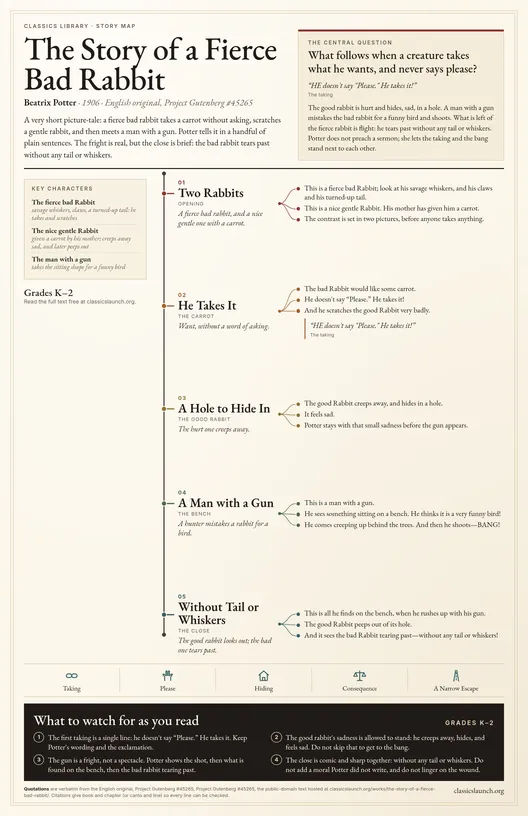 Story mapSee the story mapThe whole book on one page: the story in movements, the characters, and what to watch for. Free to print.
Abstract
A carrot taken. A fierce rabbit with savage whiskers sees a gentle rabbit who has been given a carrot. He does not ask. He seizes the carrot and scratches the other badly. The gentle rabbit creeps into a hole, sad and hurt, and hides.
A man with a gun. A man comes along, sees a figure on a bench, and takes it for a strange bird. He creeps up and fires. What he finds is not a bird, but a dropped tail and whiskers. The hidden rabbit looks out and sees the thief running past, stripped of his proud look, and the carrot is there again.
A very short book. The story is one of Potter's briefest, almost a strip of captioned pictures, issued by Frederick Warne in 1906. The English text is public-domain and is hosted here in full, but the plates do much of the telling, so a printed copy should be used with the words. It suits the youngest listeners who can follow a gift, a theft, a bang, and a visible consequence, provided a grown reader is ready for the gun and does not flatten the fright into a mere joke or a lecture.
Main characters
- The fierce bad Rabbit: A rabbit with savage whiskers who takes a carrot by force and loses his tail.
- The nice gentle Rabbit: A rabbit given a carrot by his mother, scratched, and later left with the carrot again.
- The man with a gun: A man who sees something on a bench, takes it for a bird, and shoots.
Summary
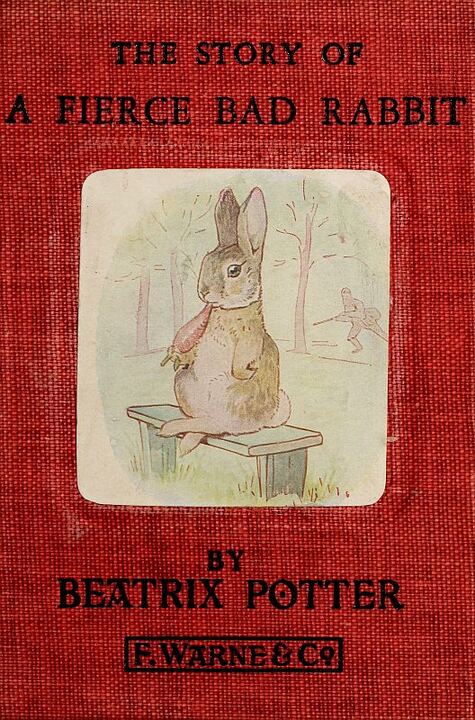
The Story of a Fierce Bad Rabbit is one of Potter's shortest books, almost a series of captioned pictures, about a carrot, a scratch, and a sudden bang. A fierce bad rabbit, with savage whiskers, claws, and a turned-up tail, sees a nice gentle rabbit whose mother has given him a carrot. The bad rabbit would like some carrot. He does not say please. He takes it, and he scratches the good rabbit very badly. The good rabbit creeps away and hides in a hole, feeling sad. Then a man with a gun appears. He sees something sitting on a bench and takes it for a very funny bird. He creeps up behind the trees and shoots—BANG. When he rushes up, he finds on the bench not a bird but a leftover tail and whiskers. The good rabbit peeps out of the hole and sees the bad rabbit tearing past, without any tail or whiskers, and he also finds the carrot. The tale is useful with the very youngest listeners because the plot is a handful of clear pictures: a gift, a theft, a hiding place, a shot, and a rabbit who has lost his pride. It is sharper than some of the longer books, and a grown reader should be ready for the gun, without turning the page into a lecture on hunting or into a joke that ignores the fright. Families can talk about saying please, about taking what was given to someone else, and about a consequence that is visible and a little shocking. The English text is public-domain and complete here; because so much is carried by the plates, an illustrated copy is especially needed, and the words alone should be read with the pictures whenever possible. The book was issued by Frederick Warne in 1906, in the same season as Miss Moppet and Jeremy Fisher.
Virtues in this work
- Justice: The theft and the scratch are followed by a visible loss of the thief's proud look, and the carrot returns.
- Temperance: The bad rabbit will not ask, and will not wait; he takes and injures at once.
Plot or Argument
- The carrot
A fierce rabbit takes a gentle rabbit's carrot without asking and scratches him.
- The shot
A man with a gun mistakes the thief for a bird and fires.
- What is left
A tail and whiskers remain on the bench; the good rabbit peeps out and finds the carrot.
Characters
- The fierce bad Rabbit, antagonist
A rabbit with savage whiskers who takes a carrot by force and loses his tail.
- The nice gentle Rabbit, protagonist
A rabbit given a carrot by his mother, scratched, and later left with the carrot again.
- The man with a gun, hunter
A man who sees something on a bench, takes it for a bird, and shoots.
Lessons
Please, and taking
The book states the theft in the plainest words: he does not say please; he takes it.
- What does the bad rabbit want?
- How does he get it?
A bang in a small book
The gun is sudden. A grown reader should not skip the fright or make it comic only.
- What does the man think he sees?
- What is actually left on the bench?
A visible ending
The lost tail and whiskers, and the carrot found again, close the story without a lecture.
- Who is sad at first?
- What has changed at the end?
Context
Potter made one of her briefest picture stories from a theft, a hiding hole, and a hunter's mistake.
Composition
First published by Frederick Warne in 1906; the local text follows a Project Gutenberg transcription of the English original.
Reception
The book is often grouped with Miss Moppet as a very short tale for the youngest children, and it is sharper than its length suggests.
Comparisons
- The Tale of Squirrel Nutkin
Another Potter tale in which a proud tail is lost after a fault; this one is much shorter and ends with a gunshot.
- The Tale of Mr. Jeremy Fisher
A companion 1906 miniature in which a sudden danger changes a small animal's day.
Quotes
“THIS is a fierce bad Rabbit; look at his savage whiskers, and his claws and his turned-up tail.”
“HE doesn't say "Please." He takes it!”
For Students
A reading companion for classical Christian high school students. See the student guide.
Reading Guide
Watch for
- What the good rabbit has, and how the bad rabbit takes it.
- What the man thinks he sees on the bench.
- What is left after the shot, and who gets the carrot.
Key terms and names
- Carrot
- The gift from the gentle rabbit's mother, taken and later found again.
- Whiskers
- Part of the bad rabbit's fierce look, left behind after the shot.
- Bench
- The seat where the man sees something he takes for a bird.
- Hole
- The hiding place of the gentle rabbit during the bang.
Seminar Questions
- Comprehension What does the bad rabbit take, and how does he take it?
- Comprehension What does the man find on the bench after he shoots?
- Interpretation Why might Potter show the theft and the scratch so plainly in a book for little children?
- Interpretation Is the ending a punishment, a joke, or both?
- Big Question When has taking something without asking changed a quiet moment into trouble?
- Big Question What does this small book teach about taking care, or failing to, that a speech would not have said as well?
Faith Connections
- Exodus 20:15 (Scripture)
The carrot was given to someone else; the bad rabbit takes it by force.
- Galatians 6:7 (Scripture)
The visible loss of tail and whiskers is a consequence the child can see, not a long speech.
Logic and Rhetoric
Central argument: A gift taken without asking, and a scratch, are followed by a sudden shot that leaves the thief without his fierce look.
Rhetorical device: Caption. Short, picture-like sentences and a single bang carry a complete plot in a few pages.
Debate: Resolved: This book is too sharp for the youngest children and should wait until after Peter Rabbit.
Writing Prompts
Essay: Tell the story in five pictures. What does each picture show that the last one did not?
Comparison with The Tale of Squirrel Nutkin: Nutkin loses a tail after teasing; this rabbit loses tail and whiskers after a theft. How does Potter treat the consequence in each book?
Creative Prompts
- Classroom
Arrange the story as five spoken captions, like Potter's pages, without adding a long moral at the end.
- Essay
Is the man important as a character, or only as the cause of the bang? Use what the book actually shows.
- Fiction
Write the good rabbit's moment in the hole, hearing the shot, in a few sentences.
Further Reading
Verification notes
Primary text checked against the edition identified in fullText. No unverified quotations or page numbers supplied. Recommended grades concern teaching suitability, not a mechanical reading score.
No verification flags recorded.