Work record
The Tale of Mr. Jeremy Fisher
Beatrix PotterThe Tale of Mr. Jeremy Fisher by Beatrix Potter (1906)The Tale of Mr. Jeremy Fisher is a short fishing story about a frog, a lily-leaf boat, a shower, and a trout that almost ends the day.1906 · Early 20th Century · Short Stories · English
Read this when a frog goes fishing, and a trout almost ends the day.
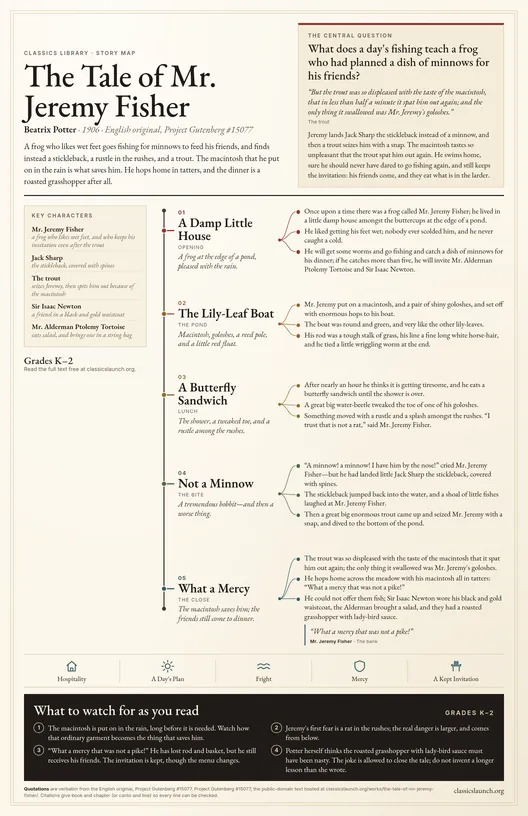 Story mapSee the story mapThe whole book on one page: the story in movements, the characters, and what to watch for. Free to print.
Abstract
A damp house and a boat. Mr. Jeremy Fisher, a frog, lives among the buttercups at the edge of a pond. He puts on a macintosh and goloshes, takes a rod and a basket, and sets off with great hops to a little round boat, where he sits on a lily leaf and fishes in the rain.
Lunch and a bite. When he is hungry he eats a butterfly sandwich and waits for the shower to end. A beetle tweaks his toe. At last something very large takes the line, and then takes Jeremy too: a trout seizes him and dives to the bottom of the pond.
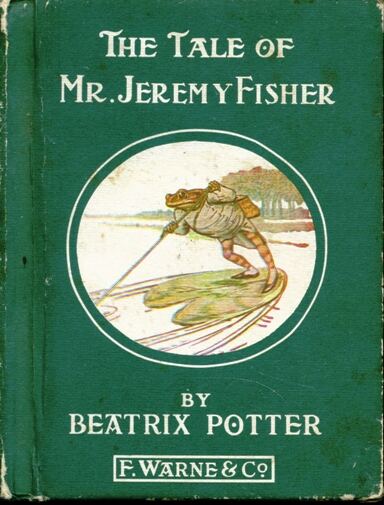
Home to dinner. The trout does not like the macintosh or the goloshes and spits the frog out. Jeremy loses some of his clothes but gets home, and later serves roasted grasshopper to friends. First published by Frederick Warne in 1906, the English text is public-domain and is hosted here in full. It is a short, comic read-aloud with a real fright in the middle, and an illustrated copy will show the lily boat and the trout, which the words only flash before the child. They can also name what he wore out and what he served at home.
Main characters
- Mr. Jeremy Fisher: A frog who lives by a pond, goes fishing, and is nearly swallowed by a trout.
- The trout: A large fish that seizes Jeremy and then rejects the taste of his clothes.
Summary
The Tale of Mr. Jeremy Fisher is a short fishing story about a frog, a lily-leaf boat, a shower, and a trout that almost ends the day. Jeremy lives in a damp house among the buttercups at the edge of a pond. One rainy day he puts on a macintosh and goloshes, takes his rod and basket, and hops to his little round boat. He sits on a lily leaf and fishes, and when he is hungry he eats a butterfly sandwich under the leaf while the rain passes. A water-beetle tweaks his toe; the fishing is slow; at last he feels a bite that is far too strong. An enormous trout seizes Jeremy himself, snaps him up, and dives. The trout finds the macintosh and the goloshes not to its taste and spits the frog out again. Jeremy has lost his shoes and his macintosh, but he is alive, and he makes his way home in a sorry state. That evening he has friends to dinner and serves roasted grasshopper with lady-bird sauce, which frogs think a treat, though the narrator is not so sure. The tale is useful with young children as a comic adventure with a real fright in the middle, and as a chance to retell a clear sequence: the house, the boat, the shower, the bite, the trout, and the dinner. It also lets a class talk about what almost happens, and about a narrator who smiles at frog tastes without spoiling the story. The English text is public-domain and complete here; the pictures of the macintosh, the lily boat, and the trout should be seen in an illustrated copy whenever possible. Families can also talk about a day that was meant to be quiet, and about a narrator who tells the fright without lingering on it. The book is short enough for one sitting, and it rewards a second look at the clothes that seem only comic until the trout finds them unappetizing.
Virtues in this work
- Fortitude: Jeremy endures a sudden fright and still gets home to give a dinner for friends.
- Temperance: The book smiles at appetite—sandwich, trout, grasshopper—without letting hunger be the whole lesson.
Plot or Argument
- To the pond
Jeremy puts on a macintosh and goloshes, takes his rod, and fishes from a lily-leaf boat.
- The trout
After a sandwich in the rain, a trout seizes him and dives, then spits him out.
- Dinner at home
Jeremy gets home without all of his clothes and serves roasted grasshopper to friends.
Characters
- Mr. Jeremy Fisher, protagonist
A frog who lives by a pond, goes fishing, and is nearly swallowed by a trout.
- The trout, antagonist
A large fish that seizes Jeremy and then rejects the taste of his clothes.
Lessons
A clear sequence
The day is easy to retell: house, boat, shower, bite, trout, home, dinner.
- What does Jeremy take with him?
- What does he lose?
A fright in a comic book
The trout is a real danger, then a joke. Children can hold both without flattening the story.
- What does the trout do?
- Why is Jeremy spat out?
A narrator's taste
The last line about grasshopper sauce lets children hear a grown voice smiling at frog habits.
- What is served at dinner?
- What does the narrator think of it?
Context
Potter puts a frog angler, a lily boat, and a trout into one of her smallest comic adventures. Potter wrote it as one of her small English picture books, and the hosted text follows a public-domain transcription of the first Warne edition.
Composition
First published by Frederick Warne in 1906; the local text follows a Project Gutenberg transcription of the English original.
Reception
Jeremy Fisher is often remembered for the macintosh, the butterfly sandwich, and the trout.
Comparisons
- The Tale of Peter Rabbit
Both heroes are almost eaten; Peter's danger is a gardener, Jeremy's is a fish.
- The Story of a Fierce Bad Rabbit
Another very short 1906 Potter book in which a sudden bang changes a small animal's day.
Quotes
“Once upon a time there was a frog called Mr. Jeremy Fisher; he lived in a little damp house amongst the buttercups at the edge of a pond.”
“Jeremy put on a macintosh, and a pair of shiny goloshes; he took his rod and basket, and set off with enormous hops to the place where he kept his boat.”
For Students
A reading companion for classical Christian high school students. See the student guide.
Reading Guide
Watch for
- What Jeremy wears and where he fishes.
- What he eats in the rain.
- How he escapes the trout, and what he serves at home.
Key terms and names
- Macintosh
- Jeremy's raincoat, which later makes him a poor mouthful for the trout.
- Goloshes
- His waterproof overshoes, lost or spat out with the macintosh.
- Lily leaf
- The seat and shelter of his little fishing boat on the pond.
- Trout
- The large fish that seizes Jeremy and then rejects him.
Seminar Questions
- Comprehension Where does Jeremy live, and how does he go fishing?
- Comprehension What happens when the trout comes up?
- Interpretation What saves Jeremy, his skill or his clothes?
- Interpretation Why does the narrator comment on the roasted grasshopper at the end?
- Big Question When has a plan for a quiet day turned into a fright, and then into a story you could tell later?
- Big Question What does this small book teach about taking care, or failing to, that a speech would not have said as well?
Faith Connections
- Psalm 124:7 (Scripture)
The frog is caught and then delivered; the escape is sudden, not earned by a long fight.
- Matthew 6:31 (Scripture)
Jeremy's day of food and danger ends at a table with friends, a small picture of daily bread after trouble.
Logic and Rhetoric
Central argument: A quiet day's fishing can turn in a moment; what looks like dinner to a trout may be a frog in a macintosh, and the frog may yet get home.
Rhetorical device: Sudden reversal. A snap and a dive, then a comic spit, turn a fishing trip into an escape.
Debate: Resolved: Jeremy is saved by luck and by his raincoat, not by any wisdom of his own.
Writing Prompts
Essay: Retell the day in order, and then say what the last dinner adds to the adventure that the trout scene did not already say.
Comparison with The Tale of Peter Rabbit: Both heroes nearly become someone else's dinner. How is Jeremy's escape different from Peter's flight from Mr. McGregor?
Creative Prompts
- Classroom
Retell Jeremy's day in six steps, from the macintosh to the dinner.
- Essay
What almost happens, and what actually happens? Why does Potter let the trout spit Jeremy out?
- Fiction
Write the trout's moment underwater, without making the fish talk at length.
Further Reading
Verification notes
Primary text checked against the edition identified in fullText. No unverified quotations or page numbers supplied. Recommended grades concern teaching suitability, not a mechanical reading score.
No verification flags recorded.