Work record
The Tale of Little Pig Robinson
Beatrix PotterThe Tale of Little Pig Robinson by Beatrix Potter (1930)The Tale of Little Pig Robinson (1930) is Beatrix Potter's longest small book, closer to a short chapter story than to a thirty-page picture tale.1930 · Early 20th Century · Short Stories · English
Read this when a seaside pig is carried off and must find his way.
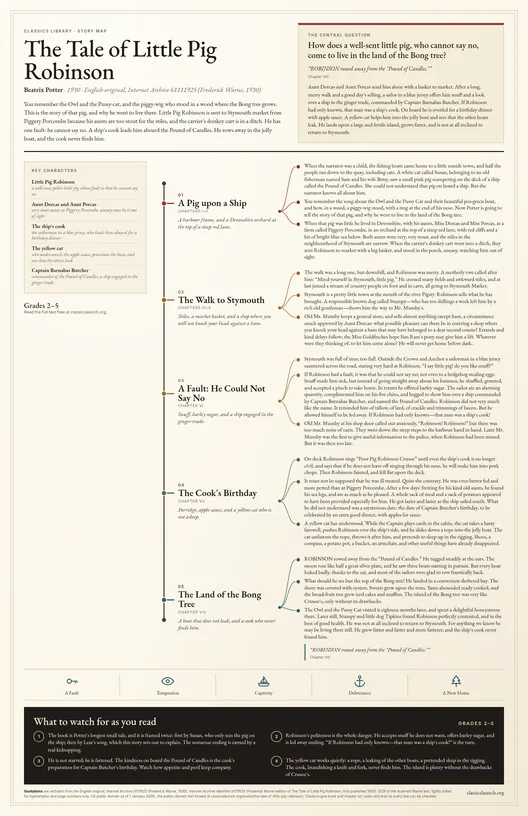 Story mapSee the story mapThe whole book on one page: the story in movements, the characters, and what to watch for. Free to print.
Abstract
The harbour and the farm. The book opens on a seaside town of herring boats and then on a farm called Piggery Porcombe, where a young pig lives with two aunts. They send him to market at Stymouth with a basket and a list.
The ship. In town he falls in with a sailor who is not a safe friend and is taken aboard a ship, far from his market basket and from the meal others had planned.
The island. He comes at last to a warm island and is later seen living in comfort. The tale is longer than the earlier farm books and is told in chapters, still in Potter's voice, from a public-domain Warne edition. Young listeners can retell the events in order and talk about the choices without needing a lecture from the narrator. A text-only reading is well paired with an illustrated copy whenever one is at hand. The complete English text of The Tale of Little Pig Robinson is hosted here from a verified public-domain transcription of the 1930 book, so families can read the words freely. Families can linger over the pictures and retell the events in their own words.
Main characters
- Little Pig Robinson: A pink-and-white pig sent to market, carried off, and later settled on an island.
- Aunt Dorcas: A stout speckled pig who keeps hens at Piggery Porcombe.
- Aunt Porcas: A large smiling black pig who takes in washing.
Summary
The Tale of Little Pig Robinson (1930) is Beatrix Potter's longest small book, closer to a short chapter story than to a thirty-page picture tale. The narrator begins in a seaside town she knew in childhood, with a harbour, herring boats, and a white cat named Susan who never misses the catch. The story then turns to Piggery Porcombe and to Little Pig Robinson, a charming pink-and-white pig with a silver ring in his nose, who lives with his two aunts, Dorcas and Porcas. One aunt keeps hens; the other takes in washing. They send Robinson to market in Stymouth with a basket and a list, and the town — shops, smells, and crowds — is described at a leisurely pace. There he falls into the company of a sailor who is not a safe friend. Robinson is taken aboard a ship, and the voyage carries him far from the Devonshire farm and from the dinner that had been intended for him. In time he comes to a warm island, where he makes a life of his own, later seen again in comfort, 'eighteen months later,' by visitors who can tell the end of the story. The book has more weather, more street, and more voyage than the earlier farmyard tales, and it asks a slightly older listener to follow chapters rather than a single afternoon. Families can talk about errands, about a stranger's kindness that is not kindness, and about a home made far from the aunts' farm. It is the last of the Peter Rabbit books in date, still in Potter's voice, and still public domain in the United States as a 1930 publication. The library hosts a complete English text from a Frederick Warne edition in the Internet Archive. Because the tale is long and full of pictures, an illustrated copy should sit beside the hosted words, especially for the harbour, the ship, and the island at the end.
Virtues in this work
Plot or Argument
- Sent to Stymouth
Robinson's aunts send him to market with a basket; the harbour town is described at length.
- Aboard ship
A sailor takes him to sea, away from the farm and from an intended dinner.
- A life on an island
Robinson comes to a warm island and is later seen living in comfort.
Characters
- Little Pig Robinson, protagonist
A pink-and-white pig sent to market, carried off, and later settled on an island.
- Aunt Dorcas, aunt
A stout speckled pig who keeps hens at Piggery Porcombe.
- Aunt Porcas, aunt
A large smiling black pig who takes in washing.
Lessons
A longer Potter book
This tale is told in chapters, with a harbour, a voyage, and an island, not in one short afternoon.
- Where do Robinson's aunts send him?
- How does this book feel different from The Tale of Peter Rabbit?
An unsafe friend
The sailor's company is the turning point of the errand.
- What happens to Robinson in Stymouth?
- Why is a pleasant stranger not always a safe one?
A home far from the farm
The ending is not a return to the aunts but a life made elsewhere.
- Where does Robinson end up?
- Is that ending sad, or is it a kind of freedom?
Context
Potter's last small book is a longer, chaptered seaside story: a Devonshire farm, a market town, a ship, and an island, still in her comic animal voice.
Composition
First published by Frederick Warne in 1930. The local text follows a Frederick Warne edition in the Internet Archive (identifier b1111925).
Reception
It is often read as the last of the Peter Rabbit books and as a tale for slightly older listeners than the shortest farmyard volumes.
Comparisons
- The Tale of Pigling Bland
Both send a young pig out on the road and toward the danger of being eaten; Pigling escapes over a boundary, Robinson over the sea.
- The Tale of Jemima Puddle-Duck
Both involve a farm animal who may become a dinner; Jemima is brought home, Robinson makes a life far away.
Quotes
“WHEN I was a child I used to go to the seaside for the holidays.”
“Aunt Dorcas was a stout speckled pig who kept hens. Aunt Porcas was a large smiling black pig who took in washing.”
For Students
A reading companion for classical Christian high school students. See the student guide.
Reading Guide
Watch for
- How the book opens on a seaside town before the pig's errand.
- What the aunts send Robinson to do, and what happens in Stymouth.
- Where he lives at the end, and how we learn it.
Key terms and names
- Stymouth
- The seaside market town where Robinson is sent on his errand.
- Piggery Porcombe
- The oddly named farm where Robinson lives with his aunts.
- Harbour
- The sheltered water where fishing boats come in with the catch.
- Chapter
- A numbered part of a longer story; this book uses chapters, unlike most of the earlier small tales.
Seminar Questions
- Comprehension Why do the aunts send Robinson to Stymouth?
- Comprehension Where does Robinson live at the end of the book?
- Interpretation Why does Potter begin with her own childhood at the seaside?
- Interpretation Is the island ending a loss, a rescue, or both?
- Big Question What makes a stranger in a town trustworthy, and what should make us cautious?
- Big Question How does Proverbs 22:3 help a family talk about seeing danger on an errand?
Faith Connections
- Proverbs 22:3 (Scripture)
The prudent see danger and hide themselves; Robinson's errand is a chance to talk about caution without spoiling the adventure.
- Psalm 107:23-24 (Scripture)
Those who go down to the sea in ships: a frame for the voyage, used as wonder, not as a forced allegory.
Logic and Rhetoric
Central argument: A longer children's book can still be comic and clear, and a life made far from home may be a rescue rather than only a loss.
Rhetorical device: Frame. The narrator's childhood memory of a harbour opens a door into a pig's longer adventure.
Debate: Resolved: A happy ending need not be a return to the same farm.
Writing Prompts
Essay: Tell, in order, how Robinson goes from the farm to the island. Use two details from the text.
Comparison with The Tale of Pigling Bland: Both books send a young pig toward the danger of being eaten. Compare the road and the sea, and the kind of escape each story gives.
Creative Prompts
- Classroom
Draw a three-part map: the farm, the harbour town, and the island, with one object in each place from the book.
- Essay
How does this book differ in length and shape from an earlier Potter tale? Use two details from the voyage or the town.
- Fiction
Write Susan the cat's account of a morning when the herring boats come in.
Further Reading
Verification notes
Primary text checked against the edition identified in fullText. No unverified quotations or page numbers supplied. Recommended grades concern teaching suitability, not a mechanical reading score.
No verification flags recorded.