Work record
The Tale of Pigling Bland
Beatrix PotterThe Tale of Pigling Bland by Beatrix Potter (1913)The Tale of Pigling Bland (1913) begins with Aunt Pettitoes and eight little pigs who eat too much.1913 · Early 20th Century · Short Stories · English
Read this when a well-mannered pig is sent to market and meets a friend.
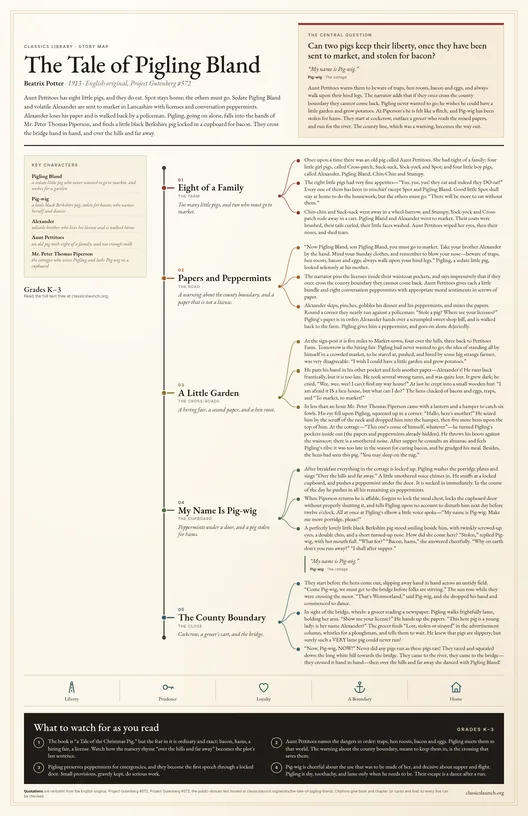 Story mapSee the story mapThe whole book on one page: the story in movements, the characters, and what to watch for. Free to print.
Abstract
To market. A large pig family eats too much, and two brothers are sent to market with papers and advice. The livelier one loses his license and is taken home; the quieter one goes on alone.
Pig-wig. Pigling misses the road and stays in a strange farmer's house, where a little black pig is shut up for a meal. They share food, dance, and resolve to leave.
The boundary. In the morning they nearly fail a check of papers, then bolt over a county line and make a home of their own, far from sale and stew-pot. The ending is an escape and a small holiday. Young listeners can retell the events in order and talk about the choices without needing a lecture from the narrator. A text-only reading is well paired with an illustrated copy whenever one is at hand. The complete English text of The Tale of Pigling Bland is hosted here from a verified public-domain transcription of the 1913 book, so families can read the words freely. Families can linger over the pictures and retell the events in their own words. The sequence is short enough to narrate after a single sitting.
Main characters
- Pigling Bland: A quiet, musical pig sent to market who loses his brother and meets Pig-wig.
- Alexander: Pigling's lively brother, who loses his papers and is taken back.
- Pig-wig: A little black Berkshire pig kept to be eaten, who runs away with Pigling.
- Aunt Pettitoes: The old pig who sends the boys to market after they eat too much.

Summary
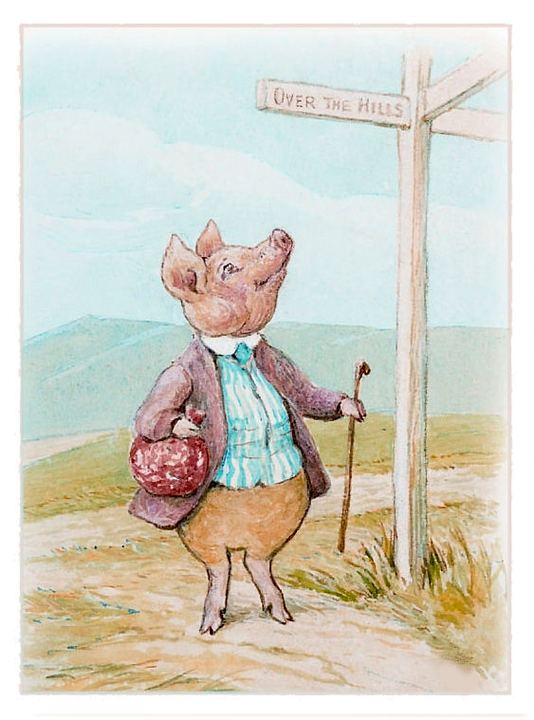
The Tale of Pigling Bland (1913) begins with Aunt Pettitoes and eight little pigs who eat too much. After a series of kitchen disasters she keeps some of the daughters at home and sends two sons, Alexander and Pigling Bland, to market, with licenses, a peppermint apiece, and strict advice about the road. Alexander is lively and soon loses his papers; a policeman takes him back. Pigling, who is quieter and more musical, goes on alone, misses his way, and spends a night in a strange house belonging to a farmer named Mr. Peter Thomas Piperson. There he meets Pig-wig, a pretty little black Berkshire pig kept in a closet, intended for a meal. The two share biscuits, dance a minuet, and decide to run. In the morning Pigling tries to pass them off with his remaining papers; they are nearly caught, then they bolt across a county boundary and toward a new life together, away from the market and the pot. The book has the shape of a small idyll after a hard start: hunger, official papers, a lonely road, and then a companion. Children can talk about obeying on the road, about what a 'license' is, about a pig who is meant for dinner and does not consent, and about kindness between two runaways. The tone is lighter than Mr. Tod and more romantic than Jemima, with a tune in it. The library hosts the complete public-domain English text of the 1913 Warne book. Potter's plates of the road, the little black pig, and the dance are part of why the ending feels like a holiday, and they should be close at hand when the tale is read aloud for the first time to a child who is just old enough for a longer road story. The road and the dance stay in the memory.
Virtues in this work
- Prudence: Pigling keeps his papers and his head on the road when Alexander does not.
- Friendship: He will not leave Pig-wig in the closet, and they cross the boundary together.
Plot or Argument
- Sent to market
Aunt Pettitoes sends Alexander and Pigling off with licenses; Alexander is soon taken back.
- A pig in a closet
Pigling meets Pig-wig, kept to be eaten, and they become allies.
- Over the boundary
They nearly fail a papers check, then run for a new life together.
Characters
- Pigling Bland, protagonist
A quiet, musical pig sent to market who loses his brother and meets Pig-wig.
- Alexander, brother
Pigling's lively brother, who loses his papers and is taken back.
- Pig-wig, companion
A little black Berkshire pig kept to be eaten, who runs away with Pigling.
- Aunt Pettitoes, aunt
The old pig who sends the boys to market after they eat too much.
Lessons
Papers on the road
The licenses are a joke and a real plot device; Alexander loses his.
- What does Aunt Pettitoes give the boys for the road?
- What happens to Alexander?
A pig who will not be dinner
Pig-wig is kept for a meal and chooses to run.
- Where does Pigling meet Pig-wig?
- What do they do before they leave?
A county line
The ending is an escape, not a market sale.
- How do they get away in the morning?
- Why does the book feel like a holiday at the end?
Context
Potter sends two young pigs to market with official papers, then turns the road into a small romance and an escape across a county line.
Composition
First published by Frederick Warne in 1913. The local text follows a Project Gutenberg transcription of the English original.
Reception
It is often remembered for Pig-wig, the minuet, and a gentler ending than the darker farm books.
Comparisons
- The Tale of Jemima Puddle-Duck
Both involve a farm animal who may be eaten and a last-minute escape; Jemima is rescued, Pigling and Pig-wig rescue themselves.
- The Tale of Peter Rabbit
A journey off the home ground, papers or warnings in hand, and a tight escape.
Quotes
“Once upon a time there was an old pig called Aunt Pettitoes.”
“She had eight of a family: four little girl pigs, called Cross-patch, Suck-suck, Yock-yock and Spot; and four little boy pigs, called Alexander, Pigling Bland, Chin-Chin and Stumpy.”
For Students
A reading companion for classical Christian high school students. See the student guide.
Reading Guide
Watch for
- Why the pigs are sent to market.
- What the papers are for, and who loses them.
- How Pig-wig and Pigling get away together.
Key terms and names
- License
- A paper allowing a pig to travel to market; Alexander loses his.
- Berkshire
- A breed of pig; Pig-wig is a little black Berkshire.
- Minuet
- A formal dance; Pigling and Pig-wig dance one before they run.
- County boundary
- The line between counties; crossing it is their escape.
Seminar Questions
- Comprehension Why does Aunt Pettitoes send Alexander and Pigling to market?
- Comprehension Who is Pig-wig, and why is she shut up?
- Interpretation Why is Pigling able to go on when Alexander is not?
- Interpretation Is the ending only a joke, or is it also a kind of justice?
- Big Question What does it mean to help someone who is being kept for harm?
- Big Question How does Proverbs 31:8-9 help a family talk about speaking up for someone who cannot get out alone?
Faith Connections
- Proverbs 31:8-9 (Scripture)
Open your mouth for the mute and for the rights of the poor; a way to discuss Pig-wig without heavy preaching.
- Ruth 1:16 (Scripture)
A pledge to go together can frame the two pigs' flight, carefully and without forcing the verse.
Logic and Rhetoric
Central argument: A quiet traveler may finish a harder road than a lively one, and two runaways can make a just escape together.
Rhetorical device: Irony. Papers meant to get a pig to market become part of a plan to get two pigs away from the pot.
Debate: Resolved: Obedience on the road does not mean consenting to be eaten.
Writing Prompts
Essay: Explain, in order, how Pigling goes from the farm to the boundary. Use two details from the text.
Comparison with The Tale of Jemima Puddle-Duck: Jemima is saved by a farm dog; Pigling and Pig-wig save themselves. Compare the danger of being eaten and the kind of help each story gives.
Creative Prompts
- Classroom
Make two paper 'licenses' and retell the road, the lost papers, and the escape.
- Essay
How do Pigling and Pig-wig help one another? Use two details from the story.
- Fiction
Write Pig-wig's first night after they have crossed the boundary.
Further Reading
Verification notes
Primary text checked against the edition identified in fullText. No unverified quotations or page numbers supplied. Recommended grades concern teaching suitability, not a mechanical reading score.
No verification flags recorded.