Work record
The House by the Medlar-Tree (I Malavoglia)
Giovanni VergaI Malavoglia; The Malavoglia; The House by the Medlar Tree; Verga's Malavoglia; The House of the Medlar TreeThe House by the Medlar-Tree (I Malavoglia) by Giovanni Verga (1881)The House by the Medlar-Tree (I Malavoglia, 1881) tells of a family of fishermen in the Sicilian village of Aci Trezza, nicknamed the Malavoglia, the Ill-wills, though they are honest and hard-working.Also known as: I Malavoglia · The Malavoglia · The House by the Medlar Tree · Verga's Malavoglia · The House of the Medlar Tree
1881 · 19th Century · Novel · Italian
Read this when a family's honest labour and loyalty are tested by debt, death and temptation.
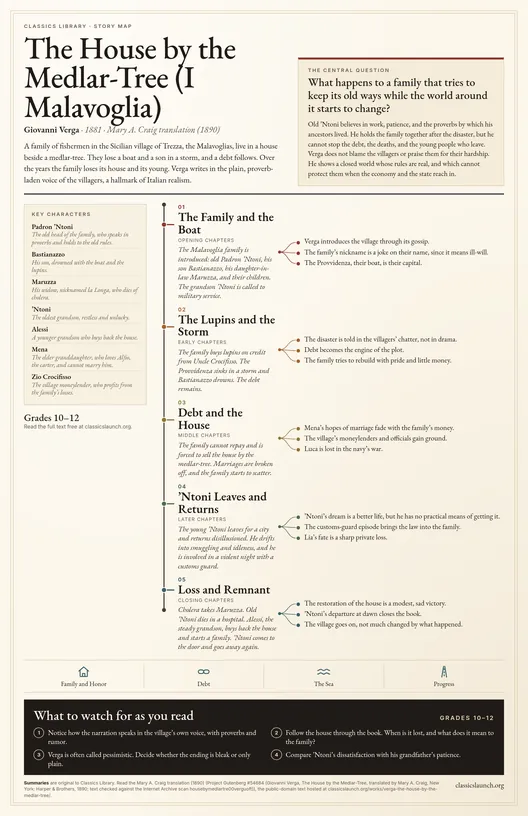 Story mapSee the story mapThe whole book on one page: the story in movements, the characters, and what to watch for. Free to print.
Abstract
Background. Verga wrote this novel in 1881 as the first of a planned cycle on the struggle for life. He set it in the fishing village where he had seen the poor at their work.
Plot. A family of fishermen risks its savings on a cargo of lupins bought on credit. The boat sinks and the father drowns, and the debt follows the family through death, war, cholera and the loss of the house. The eldest grandson drifts into idleness and smuggling, a sister leaves in shame, and the old grandfather dies in a hospital. The youngest grandson works on, marries a good neighbour and buys the house back.
Method. Verga tells it in the voice of the village, with its proverbs and gossip, so that the reader sees the people as their neighbours see them and must judge them for himself.
Why it matters. The book is a plain account of loyalty, labour and loss among the poor, and it asks what a family owes to its house and its name. It stands near the head of the Italian novel after Manzoni, and it has lasted because its people are shown with such patience and respect.
Main characters
- Padron ’Ntoni: Old head of the Malavoglia family
- ’Ntoni: His eldest grandson, who leaves
- Alessio: The youngest grandson, who stays and works
- Mena: The eldest granddaughter
- Uncle Crucifix: The moneylender who holds the family's debt
Summary
The House by the Medlar-Tree (I Malavoglia, 1881) tells of a family of fishermen in the Sicilian village of Aci Trezza, nicknamed the Malavoglia, the Ill-wills, though they are honest and hard-working. Their head is old Padron ’Ntoni, who owns a small boat, the Provvidenza, and the house by the medlar-tree, and who rules his household by proverbs: as the five fingers of a hand must help one another to pull an oar, so each member must bear his share. His son Bastianazzo, his daughter-in-law Maruzza (La Longa) and the grandchildren ’Ntoni, Luca, Mena, Alessio and Lia live under his roof. When the government calls the eldest grandson ’Ntoni to the navy, the household loses a pair of hands, and Padron ’Ntoni tries to make up the loss with a bold venture. He buys a cargo of lupins on credit from the moneylender Uncle Crucifix, and the Provvidenza sails with Bastianazzo aboard. A September storm sinks the boat, Bastianazzo is drowned and the lupins are lost, and the debt remains. From this stroke the family's ruin follows step by step. Luca is called up and dies at the sea battle of Lissa; the debt ends in the loss of the house to the moneylender; the cholera takes Maruzza. Mena, the eldest girl, loses her chance of marriage with Alfio Mosca, whom she loves, because the family has no dowry and the neighbours' talk has touched her name. ’Ntoni comes home from the navy with a taste for town life and idleness, drinks, falls in with smugglers and is jailed after a night fight with the coast-guard brigadier. His sister Lia, shamed by gossip, leaves the village and is lost. Through all this Alessio, the youngest grandson, goes on working and saving, and Padron ’Ntoni is carried to the hospital to die. In the end Alessio marries Nunziata, a poor and good neighbour, and buys back the house by the medlar-tree; ’Ntoni, who has learned too late what the old man meant, comes home to the dark village at night and then goes away for good. Verga writes in the plain voice of the village, so that proverbs and gossip tell the story, and he does not comment on his people. Readers can judge them by the standard of the old man's rule: honour, work and loyalty to the family.
Virtues in this work
- Fortitude: Padron ’Ntoni and Alessio bear the loss of the boat, the death of their kin and the loss of the house without giving up the work.
- Honor: The old man keeps an honest name through debt and ruin, and Alessio keeps it after him.
- Industry: The household's strength is its daily labour at sea, and Alessio's patient saving buys the house back.
- Charity: Nunziata and Cousin Anna keep their doors open to the family when others shut theirs.
Plot or Argument
- Chapters I–II: The Malavoglia and the lupins
The family is introduced under Padron ’Ntoni, with his proverbs about the fingers of the hand. ’Ntoni goes to the navy, and the old man buys lupins on credit from Uncle Crucifix to be sold at Riposto, and sends his son Bastianazzo and the boy Menico on the Provvidenza.
- Chapters III–IV: The storm and the debt
A storm in September wrecks the boat; Bastianazzo and Menico are lost. The family mourns while Uncle Crucifix, with the notary's clerk Don Silvestro, presses for payment, and the village talks.
- Chapters V–IX: Hard years
The Malavoglia patch their losses with a small borrowed boat. ’Ntoni returns from service, Mena is courted by Brasi Cipolla and loves Alfio Mosca, and Luca draws a low number in the conscription. In Chapter IX the news comes that Luca is dead at the battle of Lissa.
- Chapter X: The house is lost
The unpaid debt ends in the loss of the house by the medlar-tree, and the family must leave it. Padron ’Ntoni is hurt at sea and nearly dies.
- Chapters XI–XII: Restlessness and cholera
’Ntoni, who has heard tales of fortune abroad, leaves the village; the cholera comes, and Maruzza dies.
- Chapters XIII–XIV: The brawl and Lia's flight
’Ntoni returns penniless, drinks, and takes to smuggling. In a night fight he stabs Don Michele, the coast-guard brigadier, and is jailed. Lia, spoken of in the village, leaves home.
- Chapter XV: What remains
Padron ’Ntoni dies in the hospital. Alessio buys back the house and marries Nunziata, Mena stays unmarried, and ’Ntoni, released from prison, visits at night and goes away at dawn.
Characters
- Padron ’Ntoni, old head of the family
The old head of the family, a fisherman who lives by proverbs and by a strict sense of duty.
- Maruzza (La Longa), his daughter-in-law
His daughter-in-law, a patient, praying widow who bears her losses in silence.
- ’Ntoni, eldest grandson
The eldest grandson, who comes home from the navy discontented with the labour of the village.
- Alessio, youngest grandson
The youngest grandson, steady and industrious, who restores the family's house.
- Mena, eldest granddaughter
The eldest granddaughter, a good and careful girl, who loves Alfio Mosca but does not marry.
- Lia, younger granddaughter
The younger granddaughter, who leaves the village in disgrace.
- Uncle Crucifix (Zio Crocifisso), moneylender
The moneylender, called Dumb-bell and Goosefoot by the village, who holds the family's debt.
- Alfio Mosca, carter
A carter, kind and poor, who loves Mena.
- Nunziata, poor orphan girl
A poor orphan girl who cares for her little brothers and later marries Alessio.
- Don Michele, brigadier of the coast-guard
The brigadier of the coast-guard, who hunts the smugglers and courts Lia.
Lessons
The household as a body
Padron ’Ntoni teaches that a family is like the fingers of a hand, in which every member has a place and a work and none can be spared. The book shows what happens when one finger breaks away, and it asks the reader to weigh loyalty against the wish to better oneself.
- What does Padron ’Ntoni mean when he says each finger must be itself?
- Why does ’Ntoni's departure hurt the family more than the loss of the boat?
Debt and the borrower
The family's ruin begins with one loan taken to make a profit, and it falls into the hands of a lender who has no mercy. Students can read the story beside Proverbs 22:7 and discuss prudence, the real cost of borrowing and the duty of the lender.
- What risk did Padron ’Ntoni take when he bought the lupins on credit?
- What does Uncle Crucifix owe the Malavoglia, if anything, as a neighbour and a Christian?
Honour and work
The old man's pride is not in wealth but in an honest name and in duty done without complaint, and Alessio keeps that rule. The book lets the reader see that a good name can be lost by a family's loss of work, a girl's reputation or a single quarrel.
- How does the village judge Mena and Lia, and is its judgment just?
- In what ways does Alessio restore the family's honour?
Fortune and Providence
The boat is called the Provvidenza, and the family loses it in a storm. Verga does not preach, yet his readers must ask whether the old man's patience and prayer are foolish or wise, and how a Christian should bear a sorrow he cannot prevent.
- Why do you think Verga named the boat Providence?
- What do Maruzza's silence and Santuzza's words about sinners show about faith in the village?
Context
The novel is set in Aci Trezza, a fishing village near Catania, in the years after Italian unification (1861), when Sicily was joined to the new kingdom. Conscription, new taxes and the cholera of 1867 reached the villages, and Luca's death at Lissa in 1866 recalls the war of that year in which the Italian fleet was beaten by the Austrians. Verga wrote at the time when Italian and French writers were turning to the observation of poor people's lives.
Composition
Verga planned a cycle of five novels on the struggle for life at every level of society, called I vinti (The Vanquished). He completed only two, I Malavoglia (1881) and Mastro-don Gesualdo (1889). He wrote I Malavoglia after visiting Aci Trezza, using the speech and proverbs of the fishermen. Mary A. Craig's English translation appeared in New York in 1890, with an introduction by W. D. Howells.
Reception
The book sold badly at first, and Italian readers found it slow, but it came to be regarded as one of the great Italian novels of the nineteenth century. It shaped the verismo school and later the film makers of the Italian neo-realist movement; Luchino Visconti's film La terra trema (1948) was drawn from it. Howells praised it in 1890 as a tale of the simple heart.
Comparisons
- The Vicar of Wakefield
Goldsmith's vicar loses his fortune and keeps his faith and family, as Padron ’Ntoni does; but Goldsmith rescues his family by a happy turn, and Verga does not.
- Silas Marner
Eliot, too, writes of a small community in which a debt, a theft and a child test the characters, and her narrator is more ready to comment than Verga's.
- Tess of the d'Urbervilles
Hardy's Tess is ruined by gossip and by the weight of a family's fortunes, as Lia is; both novels show a village's judgment on a girl.
- The Count of Monte Cristo
Dumas's novel also turns on a ruined seafaring family and a moneylender's world, but it follows revenge and Verga follows endurance.
- The Adventures of Pinocchio
Collodi's Italian tale shows a child who leaves home and is ruined by idle companions, a lesson ’Ntoni learns too late.
- The Pearl
Steinbeck's novella also shows a poor fishing family broken by a hope of gain, and it should be read beside Padron ’Ntoni's venture.
- Money (L'Argent)
Zola shows the world of speculators and debt from the top, as Verga shows it from the bottom of the village.
- The Leopard (Il Gattopardo)
Lampedusa's novel shows Sicily after unification from the other end of society, among the princes.
Quotes
Frequently cited
“To pull a good oar the five fingers must help one another.”
Frequently cited
“When my father, rest his soul, left me the Provvidenza and five mouths to feed, I was younger than you are now, and I was not afraid; and I have done my duty without grumbling; and I do it still, and I pray God to help me to do it as long as I live, as your father did, and your brother Luca, blessed be their souls!”
Frequently cited
“for the sea has no country, either, and belongs to whoever will pause to listen to it, here or there, wherever the sun dies or is born”
“Men are like the fingers of the hand—the thumb must be the thumb, and the little finger the little finger.”
“He did his duty abroad, as he had done it at home, and was content.”
“One must pray also for sinners,” said Santuzza; “that is what good people are for.”
“The girl as she is trained, and the flax as it is spun”
For Students
A reading companion for classical Christian high school students. See the student guide.
Reading Guide
Watch for
- How the family's proverbs are used, and who repeats them.
- What each of the Malavoglia does after the loss of the boat.
- How the villagers talk about the family and what the talk does to Mena and Lia.
- How the sea and the house appear at the end of each chapter.
Key terms and names
- Verismo
- The Italian movement of the late nineteenth century that tried to show life as it is, without the author's comment.
- Padron
- A title for a man who owns a boat, here used of the master of a fishing family.
- Provvidenza
- The name of the family's boat; the word means Providence.
- Lupins
- Beans sold as a cheap food, bought here on credit as the cargo that sinks with the Provvidenza.
- Conscription
- The call-up of young men for the navy or army, which took the eldest sons of poor houses.
- Coast-guard (dazio)
- The officers who hunted smugglers and collected the duty on goods that came by sea.
Seminar Questions
- Comprehension Why do the villagers call the family the Malavoglia, and why is the name unfair?
- Comprehension How does Padron ’Ntoni come to lose the Provvidenza and then the house?
- Interpretation Why does Verga tell the story through the voices and sayings of the village rather than through his own comment?
- Interpretation What is the difference between ’Ntoni's discontent and Alessio's contentment?
- Interpretation What does the novel say about the part that gossip plays in the fall of Lia and Mena?
- Big Question Is there justice in a world where the honest family loses and the moneylender thrives, and what does the Christian hope add?
- Big Question What do we owe to the household in which we are born, and when may we leave it?
Faith Connections
- Proverbs 22:7 (Scripture)
The rich rule over the poor, and the borrower is the slave of the lender; the Malavoglia's ruin begins with a debt to Uncle Crucifix.
- Psalm 107:23–30 (Scripture)
Those who go down to the sea in ships see the works of the Lord, and he brings them to their haven when they cry to him; the psalm sets the fishermen's dangers beside the family's loss and patience.
- Exodus 20:12 (Scripture)
The commandment to honour father and mother lies behind Padron ’Ntoni's rule of the house and ’Ntoni's late sorrow for what he has done.
Logic and Rhetoric
Central argument: A family's honour and a house's welfare depend on every member's steady labour and loyalty; the pull of ambition and idleness breaks it, and only patient work can rebuild it.
Rhetorical device: dramatic irony through proverb. The old man's sayings, such as the five fingers of the hand, are shown to be true in the very stories of the grandsons who ignore them.
Debate: Resolved: That a family's duty to its household outweighs a young man's right to seek his fortune elsewhere.
Memory Work
To pull a good oar the five fingers must help one another.
When my father, rest his soul, left me the Provvidenza and five mouths to feed, I was younger than you are now, and I was not afraid; and I have done my duty without grumbling; and I do it still, and I pray God to help me to do it as long as I live, as your father did, and your brother Luca, blessed be their souls!
Writing Prompts
Essay: Using at least three passages, explain what Padron ’Ntoni means by duty and show how Alessio and ’Ntoni each answer it.
Comparison with The Vicar of Wakefield: Compare how Goldsmith's vicar and Padron ’Ntoni bear the loss of fortune, and say what each book teaches about patience and the family.
Medical Lens
The book is a plain record of how a poor village met death. It shows the cholera of 1867 reaching a household, the fear of the neighbours who bar their doors, the apothecary whom the people suspect of spreading the disease, and the long grief of a family that loses a father, a son and a mother in turn. It is a useful source on popular ideas of contagion and on the care of the sick at home in southern Italy in the nineteenth century.
- Chapter XII
Maruzza falls ill with the cholera after nursing a stranger; the neighbours bar their doors and blame the apothecary, and she dies at home.
- Chapters IV and VIII
The family's grief for Bastianazzo and then for Luca, and the way the mother is struck dumb after the news from Lissa.
Creative Prompts
- Essay
Write an essay on Padron ’Ntoni's proverbs: choose three and explain how each guides his choices and whether the story proves it right or wrong.
- Dialogue
Write the conversation on the wall of the vineyard in which ’Ntoni tells Alessio why he is leaving, and Alessio answers him as the old man would have.
- Classroom
Hold a classroom debate on the resolution that Padron ’Ntoni was wrong to buy the lupins on credit, with one side using Proverbs 22:7 and the other the duty to provide for a family.
- Fiction
Write a short scene from the point of view of Uncle Crucifix on the day he sells the house back to Alessio, showing what he thinks of the family.
Further Reading
- The Last Day of a Condemned Man, Victor Hugo
A shorter work of the nineteenth century that also gives a voice to a man at the mercy of the law, in this library.
- Mastro-don Gesualdo, Giovanni Verga
Verga's second novel of the Vanquished cycle, on a Sicilian builder's rise; read in a modern translation.
- Cavalleria rusticana and Other Stories, Giovanni Verga
Short stories of Sicilian life, among them the tale that became the opera.
- Giovanni Verga, Gregory Lucente
A study of Verga's verismo and its Sicilian setting; check the exact title before citing.
- The Italian Novel: Manzoni to Moravia, Peter Bondanella and Andrea Ciccarelli, eds.
A collected volume on the Italian novel since The Betrothed; check the exact title before citing.
Verification notes
The text is Mary A. Craig's 1890 English translation, published by Harper & Brothers, New York, with W. D. Howells's introduction, as found in Project Gutenberg #54684 and checked against the Internet Archive scan. The translation abbreviates and softens some of Verga's dialect and proverbs, and a few place names and proverbs follow Craig's spelling; the Italian original is not hosted here. The plot summary was checked against the hosted text.
- The planned five-novel cycle I vinti and the dates 1881 and 1889 follow standard reference works and were not checked against a source in this library.
- The description of Luchino Visconti's La terra trema (1948) as drawn from the novel follows standard film histories.
- The two critical titles under further reading should be checked for exact titles and authors before citing.
- That the book sold badly at first follows standard accounts of Verga.
- The chapter ranges in the plot outline are approximate and were set from the hosted text.
- The identification of Lissa with the naval battle of 20 July 1866 is standard history; the text only says that Luca died at Lissa.