Work record
Orlando Furioso
Ludovico AriostoOrlando Furioso (Rose); Mad Orlando; The Frenzy of Orlando; Roland Furious; Ariosto's Orlando; Orlando Furioso (Ariosto)Orlando Furioso by Ludovico Ariosto (1516–1532)Orlando Furioso, Mad Orlando, is a romantic epic in forty-six cantos in which Ludovico Ariosto continues the story of Roland (Orlando) and the paladins of Charlemagne.Also known as: Orlando Furioso (Rose) · Mad Orlando · The Frenzy of Orlando · Roland Furious · Ariosto's Orlando · Orlando Furioso (Ariosto)
1516–1532 · Renaissance Early Modern · Epic · Italian
Read this when love has made a wise man foolish and you wish to laugh and learn.
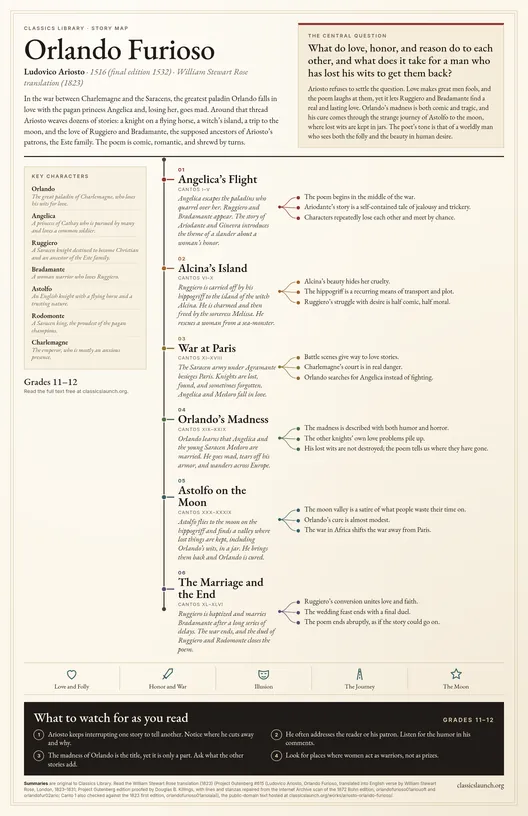 Story mapSee the story mapThe whole book on one page: the story in movements, the characters, and what to watch for. Free to print.
Abstract
Background. Ariosto wrote this poem for the court of Ferrara in the early sixteenth century. It takes up the legends of Charlemagne's war with the Saracens and tells them with humour and wonder.
Plot. The princess Angelica flees her suitors and marries the soldier Medoro. Orlando, the greatest of the knights, goes mad when he finds their names on the trees, and wanders naked and violent. Astolfo flies to the moon on the hippogriff and brings back Orlando's lost wits in a flask. Ruggiero and Bradamante, through many trials, are married, and the war with the Saracens ends in a great battle on an island, in which Ruggiero, who has become a Christian, kills the proud Rodomonte.
Method. The poem moves among many stories, breaking off each at a high point, and the narrator addresses the reader with a smile.
Why it matters. It is the great comic epic of the Renaissance, and shaped Tasso, Spenser and many later writers. It shows how a wise man may be made a fool by desire, and what is needed to bring him back. Readers should know that some episodes are frank about love, and a teacher should preview the cantos before they are assigned to the class.
Main characters
- Orlando: The paladin driven mad by love
- Angelica: The princess who chooses Medoro
- Ruggiero: The knight who founds the house of Este
- Bradamante: The warrior-maiden who loves him
- Astolfo: The knight who flies to the moon
Summary
Orlando Furioso, Mad Orlando, is a romantic epic in forty-six cantos in which Ludovico Ariosto continues the story of Roland (Orlando) and the paladins of Charlemagne. The poem takes place in the war between the Christian emperor Charlemagne and the Saracen king Agramante, who has invaded France; its action is spread over a great many knights, ladies, magicians and monsters, whose stories break off and begin again as in a tapestry. The central thread is love and the folly it breeds. The beautiful princess Angelica of Cathay flees from all her suitors, among them Orlando and his cousin Rinaldo, and she falls in love with a young Saracen soldier, Medoro, whom she nurses and marries. When Orlando finds their names carved on the trees, he goes mad, tears off his armour and roams the land naked, killing all in his way. A second thread follows Ruggiero, a Saracen knight, and Bradamante, a Christian warrior-maiden, who love each other and are destined to found the house of Este, Ariosto's own patrons. Ruggiero is held in the enchanted garden of the sorceress Alcina, is freed, and is carried by the winged horse called the hippogriff through many adventures. The English knight Astolfo flies to the moon on the hippogriff with St John as his guide, and there he finds the valley in which all that men have lost is kept: lost time, wasted gifts, lovers' vows and the wits of Orlando, which he brings back in a flask. Orlando is cured and returns to the war; the Christians win in a great battle on an island near Africa, Ruggiero is baptised and marries Bradamante, and the poem ends with the death of the pagan Rodomonte. Ariosto tells the story with a smile. He shows the grandeur of the knights and the folly that brings them down, he turns from one tale to another just at their most exciting moment, and he keeps a calm humour with the follies of human desire. Some episodes are frank about love and are not for young readers. William Stewart Rose's English verse translation was published in 1823–1831 and is the version given here.
Virtues in this work
- Temperance: The poem shows the ruin of those who cannot govern desire, in Orlando and in the captives of Alcina, and shows the better way in Ruggiero's recovery.
- Fortitude: Bradamante and the paladins face wounds and monsters with courage.
- Humility: The moon's valley of lost things humbles all human ambition and invites the reader to laugh at his own folly.
- Faith: Ruggiero is brought to baptism and the aid of St John in the poem shows heavenly help for the lost.
Plot or Argument
- Cantos I–V: The flight of Angelica
Angelica flees through the forest, pursued by Rinaldo, Ferrau and Sacripante. Bradamante and Ruggiero, the destined pair, are introduced. In Canto V the story of Ginevra and Ariodante tells of a false accusation, a deceit by night and a jealous lover.
- Cantos VI–X: Alcina's island
Ruggiero is carried by the hippogriff to the island of the sorceress Alcina and is bewitched by her. Melissa, a good enchantress, frees him with a magic ring. He then rescues Angelica from a sea-monster.
- Cantos XI–XXII: Wanderings and wars
Orlando, Rinaldo, Bradamante and many others pursue love and fight in a maze of adventures, while Agramante's army besieges Paris.
- Cantos XXIII–XXIX: Orlando's madness
Orlando finds the names of Angelica and Medoro carved on the trees, falls into a frenzy, tears off his armour and runs mad over France and Spain, doing great harm.
- Cantos XXX–XXXIV: Astolfo on the moon
Astolfo travels on the hippogriff to the earthly paradise, where St John guides him to the moon and its valley of lost things, in which he finds Orlando's wits stored in a flask.
- Cantos XXXV–XLI: Orlando restored
Astolfo restores Orlando's reason. The Christians rally against the Saracens, and Ruggiero, converted, is baptised.
- Cantos XLII–XLVI: The wedding of Ruggiero and Bradamante
Orlando and his companions defeat Agramante's host in a battle on an island. Ruggiero kills Rodomonte and marries Bradamante in a feast at which the poem ends.
Characters
- Orlando (Roland), great paladin of Charlemagne
The great paladin of Charlemagne, a hero of strength who is undone by love and madness.
- Angelica, beautiful princess of Cathay
The beautiful princess of Cathay whom every knight desires, and who chooses a poor soldier.
- Rinaldo, Orlando's cousin and rival for Angelica
Orlando's cousin and rival for Angelica, a fierce and quick-tempered knight.
- Ruggiero, saracen knight
A Saracen knight, destined to become a Christian and to found the house of Este.
- Bradamante, christian warrior-maiden
A Christian warrior-maiden who loves Ruggiero and is the match of any man in arms.
- Astolfo, english paladin
The English paladin, boastful and good-natured, who flies to the moon on the hippogriff.
- Alcina, sorceress
A sorceress whose island of delights turns her lovers into plants and beasts.
- Medoro, young Saracen foot soldier
The young Saracen foot soldier whom Angelica nurses and marries.
- Charlemagne, christian emperor
The Christian emperor, besieged in Paris by the Saracens.
- Agramante, saracen king
The Saracen king who invades France to avenge his father.
Lessons
Passion that turns to folly
Orlando's madness shows what happens when a good man puts a created thing above all else. Ariosto treats it with humour, but the lesson is serious: desire that is not governed by reason ends in loss of the very self that desired.
- Why does Orlando go mad, and what does he lose besides Angelica?
- Why does Ariosto tell the story with a smile?
What is lost and what remains
On the moon, Astolfo finds lost time, wasted gifts and broken vows, but Ariosto says that folly stays on earth. The lesson is humility, and a Christian reader may think of the Preacher's words about vanity.
- Which things on the moon are of most value, and why does the poet say that folly is not there?
- What would you hope to find in such a valley?
Illusion and the true good
Alcina's island and the castle of Atlante offer delights that vanish when the knight sees them as they are. The poem shows the temptation of false goods, and the help of Melissa's ring shows that truth is a grace.
- How does Ruggiero come to see Alcina as she really is?
- How does Melissa's ring work as an image of truth?
Women's courage and constancy
Bradamante is as brave and faithful as any knight, and the poem's women are not simply objects of desire. A reader should note both how Ariosto praises their virtue and how he sometimes treats their charms as a joke.
- How does Bradamante keep faith with Ruggiero over many trials?
- What does the story of Ginevra and Ariodante teach about trust and false accusation?
Context
Ariosto wrote in Ferrara at the time of the Italian Wars, when French, Spanish and imperial armies fought over Italy and the courts of the Este, the Medici and the popes struggled to survive. The Renaissance court loved romances of chivalry, and Ferrara's poets, Boiardo before Ariosto, had made the Charlemagne legends into a fashionable entertainment. The poem looks back with affection on the world of knights while it is aware that the age of cannon and treachery had arrived; in one passage Ariosto curses the gun.
Composition
Ariosto took up the story where Matteo Maria Boiardo's unfinished Orlando Innamorato left off. He published the first edition in forty cantos in 1516, a revised edition in 1521, and the final edition in forty-six cantos in 1532. William Stewart Rose published his English verse translation in 1823–1831, and the 1872 Bohn edition used to check this text reprints it.
Reception
The poem was the most widely read Italian poem of the sixteenth century and was translated into many languages. It was a model for Spenser, who borrowed from it in the Faerie Queene, and for Tasso, who wrote the Jerusalem Delivered as a more serious answer. Cervantes mocked the romances of chivalry but admired Ariosto, and Milton took from him the idea of the Paradise of Fools on the moon.
Comparisons
- The Song of Roland
The medieval French epic on which Ariosto draws gives a stern and heroic Roland, who dies a Christian martyr, in contrast with the mad and ridiculous Orlando.
- Jerusalem Delivered (Gerusalemme liberata)
Tasso's poem is the serious reply to Ariosto, with a single hero and a religious aim in place of Ariosto's wandering stories and humour.
- The Faerie Queene, Book I
Spenser's allegory takes many episodes, the enchantress and the garden of delights, from the Furioso and gives them a moral and Protestant meaning.
- Don Quixote
Cervantes's hero is mad from reading the romances of chivalry, and Ariosto's Orlando is the model of the knight who loses his wits.
- The Aeneid
Ariosto's Ruggiero is a founder of a great house like Aeneas, and the poem often imitates Virgil's lines.
- Legends of Charlemagne
Bulfinch retells the legends of Charlemagne and his paladins in prose, and gives the background of the stories that Ariosto plays with.
- Paradise Lost
Milton's Limbo of Vanity is drawn from Ariosto's moon, where everything lost by human folly is stored.
- The Odyssey
Astolfo's journeys on the hippogriff to the moon and the earthly paradise echo Odysseus's journeys, but are told as a comedy.
Quotes
Frequently cited
“OF LOVES and LADIES, KNIGHTS and ARMS, I sing, Of COURTESIES, and many a DARING FEAT;”
Frequently cited
“On whom strange madness and rank fury fell, A man esteemed so wise in former time;”
Frequently cited
“At length, impelled by phrensy, the fourth day, He from his limbs tore plate and mail away.”
Frequently cited
“There wilt thou find, if thou wilt thither post, Whatever thou on earth beneath hast lost.”
“’Tis here that all infirmities are stored, Save only Madness, seen not here at all, Which dwells below, nor leaves this earthly ball.”
“That largest was which of the paladin, Anglantes’ lord, the mighty sense contained;”
For Students
A reading companion for classical Christian high school students. See the student guide.
Reading Guide
Watch for
- How each story breaks off and is resumed in another canto, and why Ariosto does it.
- How Orlando changes between the first cantos and the madness of Canto 23.
- What the poet says about love and about women in the openings of the cantos.
- What is found on the moon, and what Ariosto says is not there.
Key terms and names
- Paladin
- One of the twelve peers of Charlemagne, the knights who fought for the Christian emperor.
- Hippogriff
- The winged horse with the head of a griffin, which carries Ruggiero and Astolfo through the air.
- Ottava rima
- The eight-line stanza rhymed abababcc in which Ariosto and Rose write.
- Enchantment
- A magic spell, such as Alcina's, that holds a knight from his duty.
- Saracen
- The medieval name used in the poem for the Muslim armies of Agramante.
- Este
- The ruling family of Ferrara, whom Ariosto served and whose ancestors Ruggiero and Bradamante are said to be.
Seminar Questions
- Comprehension Who are Angelica, Orlando and Medoro, and what do the names carved on the trees tell Orlando?
- Comprehension What does Astolfo find on the moon, and how does he use it?
- Interpretation Why does Ariosto tell the story of Orlando's madness with such good humour?
- Interpretation How does the story of Ruggiero and Alcina compare with the story of Orlando and Angelica?
- Interpretation What does the poem say about women through Bradamante, Angelica and Ginevra?
- Big Question Is reason something we can lose, and how is it restored?
- Big Question What should a Christian reader do with a poem that is amusing about the follies of love?
Faith Connections
- Ecclesiastes 1:2 (Scripture)
The Preacher's cry that all is vanity is the thought behind the moon's valley of lost things, in which crowns, vows and wits lie among the heaps of what men have wasted.
- Proverbs 4:23 (Scripture)
The counsel to keep the heart with all diligence, for out of it are the issues of life, is the lesson Orlando learns too late.
- Augustine, Confessions (Great Conversation)
Augustine's account of restless desires that find no rest apart from God underlies Ariosto's picture of knights who chase what flees them.
Logic and Rhetoric
Central argument: Desire that is not ruled by reason leads a man to folly, and the folly is cured only when what has been lost is found again and put to better use.
Rhetorical device: comic irony and digression. Ariosto breaks off each tale at its height and picks up another, so that the reader feels how quickly human wishes are turned aside.
Debate: Resolved: That folly, not wickedness, is the chief danger of the lover.
Memory Work
On whom strange madness and rank fury fell, A man esteemed so wise in former time;
There wilt thou find, if thou wilt thither post, Whatever thou on earth beneath hast lost.
Writing Prompts
Essay: Using at least three passages, explain what Ariosto shows about the folly of desire in Orlando and what he proposes as its cure.
Comparison with Jerusalem Delivered (Gerusalemme liberata): Compare how Ariosto and Tasso treat the madness of passion in Orlando and in Rinaldo, and say which poem teaches the more useful lesson.
Medical Lens
Orlando's madness is one of the great literary accounts of a mind broken by love. Ariosto shows the course of it with exactness: the proof that cannot be denied, the sleeplessness and refusal of food, grief that turns to rage, the loss of memory of who he is, the stripping of his clothes and his wandering in the wild with enormous strength. The cure, by which his wits are returned to him in a flask and breathed in through the nose, is the poet's own fantasy, but it shows the Renaissance idea that reason is a substance that can be lost and restored. It is useful to readers of the history of melancholy and psychiatry.
- Canto 23
Orlando reads the carved names of Angelica and Medoro, denies the proof, loses sleep and appetite, and then falls into frenzy, tearing off his armour and clothes.
- Canto 34
On the moon, St John shows Astolfo the lost wits of men in flasks, and the largest is Orlando's.
- Canto 39
Orlando is restored by inhaling his wits from the flask and regains his reason and his shame at his folly.
Creative Prompts
- Essay
Write an essay on Orlando's madness: what the poem says caused it, what it cost him, and what restored him, using at least three passages.
- Poetry
Write three stanzas in ottava rima on an item that you would hope to find in Astolfo's valley of lost things, and say why it was lost.
- Classroom
Hold a debate on the resolution that Ariosto's treatment of Orlando's madness is more instructive than Tasso's treatment of Tancred's grief, using both poems.
- Fiction
Write a short scene in which Astolfo returns from the moon and tries to persuade Orlando to take back his wits.
Further Reading
- Orlando Innamorato, Matteo Maria Boiardo
The earlier poem whose story Ariosto continues; read in a modern translation.
- Jerusalem Delivered, Torquato Tasso
The serious reply to Ariosto in this library.
- Ariosto, Tasso, and Guarini in Elizabethan England, Jason Lawrence
A study of the poets' reception in England; check the exact title before citing.
- Orlando Furioso: A New Verse Translation, David R. Slavitt, tr.
A modern verse translation; check the edition before use.
- The Faerie Queene, Edmund Spenser
Spenser's response, in this library.
Verification notes
The text is William Stewart Rose's English verse translation of 1823–1831, from Project Gutenberg #615, with about twenty-five defects (missing stanzas and lines, misprinted stanza numerals and garbled lines) repaired from the 1872 Bohn edition scans. Rose omitted a few stanzas, which are marked in bracketed notes, and other small differences from the printed page may remain. The Italian is not hosted here. Some episodes are frank about love and war, and teachers should preview them before assigning the whole. The plot outline follows the standard cantos.
- The dates of the editions (1516, 1521, 1532) and Ariosto's career in the service of the Este family follow standard reference works and are not in the hosted text.
- The canto ranges in the plot outline follow standard summaries of the poem and were not checked against every stanza of the hosted text.
- The detail that Milton's Limbo of Vanity draws on the moon of Ariosto is a standard critical observation and was not checked in this library.
- The titles in further reading by Lawrence and Slavitt should be checked for exact title and edition before citing.
- The detail that Ariosto speaks against the gun in Canto 11 and the battle on an island near Africa follow standard summaries.
- The text still may contain small line-level errors from the Gutenberg file that were not found in the comparison with the 1872 scan.