Work record
Jerusalem Delivered (Gerusalemme liberata)
Torquato TassoGerusalemme liberata; Godfrey of Bulloigne; Godfrey of Bouillon (Fairfax); Jerusalem Delivered (Tasso); The Liberation of Jerusalem; Gerusalemme liberata (Fairfax)Jerusalem Delivered (Gerusalemme liberata) by Torquato Tasso (1581)Jerusalem Delivered is a Christian epic in twenty books of eight-line stanzas, written by Torquato Tasso and first printed in 1581.Also known as: Gerusalemme liberata · Godfrey of Bulloigne · Godfrey of Bouillon (Fairfax) · Jerusalem Delivered (Tasso) · The Liberation of Jerusalem · Gerusalemme liberata (Fairfax)
1581 (Fairfax translation 1600) · Renaissance Early Modern · Epic · Italian
Read this when a leader must keep a holy cause from being spoiled by passion and pride.
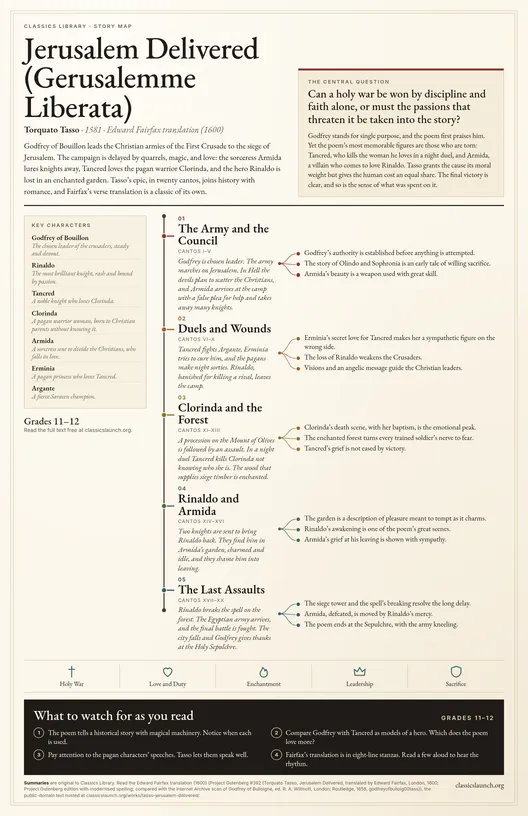 Story mapSee the story mapThe whole book on one page: the story in movements, the characters, and what to watch for. Free to print.
Abstract
Background. Tasso wrote this epic in the late sixteenth century, and he set it in the last year of the First Crusade, when the Christians besiege Jerusalem. He modelled it on Virgil and Homer but made its hero a Christian leader, and he gave it a purpose of piety as well as of glory.
Plot. God chooses Godfrey to lead the army to Jerusalem. The devils send the enchantress Armida, who lures Rinaldo and others from the camp, and the enchanted forest keeps the army from its timber. Tancred kills Clorinda by mistake, and she dies baptised. Rinaldo is freed from Armida, breaks the spell, and the city is taken. Godfrey spares a captive and prays in the temple at the end, with his arms hung up before the altar.
Method. The poem uses the epic's devices of the council of gods, the single combat and the catalogue, and it mixes them with romance and with a pious purpose.
Why it matters. The poem was one of the great Christian epics of the Renaissance and shaped Spenser and Milton. It pictures how a leader and a host are tried by desire and brought to duty, and it joins the beauty of romance to the purpose of devotion.
Main characters
- Godfrey: The chosen captain of the crusade
- Rinaldo: The best knight, led astray by Armida
- Tancred: The knight who loves and kills Clorinda
- Clorinda: The warrior maiden who dies baptised
- Armida: The enchantress sent to ruin the Christians
Summary
Jerusalem Delivered is a Christian epic in twenty books of eight-line stanzas, written by Torquato Tasso and first printed in 1581. It tells of the last year of the First Crusade, in 1099, when the Christian army besieges Jerusalem. In the first book God sends the angel Gabriel to Godfrey of Bouillon, and the princes choose him captain of the host. The army marches on the holy city, which is held by the king Aladine with his pagan champions Argantes and Solyman, the warrior-maiden Clorinda, and Ismeno the sorcerer. The poem is built on the struggle between obedience and desire. The devils, in council, send the enchantress Armida to the Christian camp, where she lures many knights away, among them Rinaldo, the best of the army. Rinaldo kills Gernando in a quarrel and is exiled, and the siege stalls: the army needs his sword and also a forest, enchanted by Ismeno, from which the timber for the siege towers must be cut. In a tragic duel, the Christian hero Tancred, who loves Clorinda, kills her in the dark without knowing her, and she begs for baptism as she dies. Meanwhile Rinaldo is held in Armida's island garden, where birds sing a song urging him to gather the rose of pleasure, and two knights, Charles and Ubaldo, are sent by Godfrey to free him; they hold up a diamond shield in which he sees himself, ashamed. Rinaldo returns, breaks the enchantment of the forest, and the towers are built. The city is stormed, and Godfrey kills the Egyptian general Emiren in the final battle and spares the captive Altamoro. Armida, who has come to take revenge, is overcome by Rinaldo's pleas and submits to him. The poem ends with Godfrey in the temple, praying and hanging up his arms. Tasso wrote under the influence of the Counter-Reformation, and he aims to teach that the work of God is accomplished through discipline, obedience and humility, while the pleasures of the world, however sweet, can ruin it. He also loved romance, so that the most vivid passages are those of Armida and of Tancred and Clorinda. Edward Fairfax's English version of 1600 is a classic of its own and praised by Dryden.
Virtues in this work
- Faith: The poem's captain is chosen by God and ends in prayer, and Clorinda comes to baptism at her death.
- Temperance: Rinaldo's recovery from Armida's garden teaches mastery of desire, and Godfrey is the pattern of self-command.
- Magnanimity: Godfrey refuses ransom and spares his captive, and he leads without ambition for himself.
- Fortitude: The knights and the poem's pagan champions alike face wounds and death with courage.
Plot or Argument
- Books I–II: The council and Sophronia
God sends the angel Gabriel to Godfrey, who is chosen leader of the crusade, and the army musters. In Jerusalem the sorcerer Ismeno steals an image of the Virgin, and the Christian girl Sophronia and her lover Olindo offer to die for it; Clorinda saves them.
- Books III–V: The march and Armida
The Christians reach Jerusalem, and Tancred sees Clorinda. In hell the devils send Armida to the camp, where she lures away many of the knights. Rinaldo kills the arrogant Gernando and leaves the camp.
- Books VI–IX: The duels and the night attack
Tancred fights Argantes in a duel that is broken off at night. Erminia, a pagan princess who loves Tancred, goes out to him in Clorinda's armour and is driven away. Solyman and the pagans attack the camp by night.
- Books X–XII: Prayer and the death of Clorinda
The procession on Mount Olivet, and the assault on the walls. Clorinda sets fire to the Christian tower and in the night fights Tancred, who kills her without knowing who she is; she dies baptised.
- Books XIII–XIV: The enchanted wood
Ismeno enchants the forest so that the army cannot take timber for its siege engines. Godfrey, in a dream, is told to recall Rinaldo, and he sends two knights to find him.
- Books XV–XVI: Armida's island
The two knights, Charles and Ubaldo, come to Armida's garden, where Rinaldo lies in her power. They show him a shield of diamond and he sees his own shame; he breaks away and Armida, in despair, destroys her palace.
- Books XVII–XIX: Rinaldo's return
The Egyptian host arrives. Rinaldo returns, breaks the spell of the forest, and the towers are raised. The city is stormed, and Tancred kills Argantes in a duel.
- Book XX: The final battle
Godfrey kills the Egyptian general Emiren, spares Altamoro, and takes the city. Rinaldo meets Armida again, and she submits to him. Godfrey goes to the temple to give thanks.
Characters
- Godfrey of Bouillon, chosen captain of the crusade
The chosen captain of the crusade, pious, steady and without ambition for himself.
- Rinaldo, youngest and best knight of the army
The youngest and best knight of the army, who is lured away and then returns.
- Tancred, christian prince
A Christian prince who loves Clorinda and kills her by mistake.
- Clorinda, warrior maiden of the pagan side
A warrior maiden of the pagan side, born of a Christian queen, who dies baptised.
- Armida, beautiful enchantress sent to ruin the Christian leaders
A beautiful enchantress sent to ruin the Christian leaders, who falls in love with Rinaldo.
- Argantes, fierce pagan champion
A fierce pagan champion who despises death and gives battle to the end.
- Erminia, pagan princess
A pagan princess who loves Tancred and wanders in a shepherd's country.
- Ismeno, sorcerer of Jerusalem
The sorcerer of Jerusalem who raises the enchanted wood.
- Solyman, sultan
The sultan whose kingdom was lost, a leader of the pagan defenders.
- Peter, holy man
A holy man who prays for the army and guides the procession.
Lessons
Obedience and the common good
Godfrey is chosen captain by God and the princes, and the army prospers when it obeys him and falters when its best knights follow their own wills. A student can discuss what Tasso teaches about authority, and ask when a good soldier should speak against his captain.
- Why is Rinaldo's anger so costly to the army?
- What qualities of Godfrey does the poem commend, and how are they shown in the last book?
Temptation and temperance
Armida's garden gives the reader one of the finest pictures of temptation in epic poetry, with its sweet song urging the knights to gather the rose while they can. The poem shows the loss of will and the shame that follow, and the rescue by a shield in which Rinaldo sees himself truly.
- What does the song of the rose argue, and how would a Christian answer it?
- How does the diamond shield help Rinaldo?
Mercy in war
Godfrey spares and honours his prisoner, and Clorinda's dying words show that mercy and baptism can come at the last. Tasso does not hide the cruelty of war, and he sets the clemency of a just captain against it.
- Why does Godfrey refuse the ransom Altamoro offers?
- What does Tancred's grief for Clorinda show about the cost of battle?
Poetry and truth
In his opening, Tasso asks pardon for mixing fiction with divine truth. Students can ask why a Christian poet should use romance and magic to teach, and whether the fiction helps or harms the lesson.
- What does Tasso mean when he says he mixes light fictions with truth divine?
- Which scenes of the poem are the most moving, and are they the most Christian?
Context
The poem is set in the First Crusade, which took Jerusalem in July 1099, and Tasso wrote in the late sixteenth century, when the Ottoman Turks threatened the Christian states of the Mediterranean and the Catholic Church was renewing itself after the Council of Trent. The poem turns on that background: the holy war is shown as a work of piety and discipline, in the fashion of the Counter-Reformation, and the enemies are treated with a respect that is rare in epics of the period. Modern readers will see how its picture of the Crusade is shaped by the poet's own age.
Composition
Tasso began a version of the poem as a young man and finished it at Ferrara about 1575. He submitted it to friends in Rome for criticism, and its more romantic passages were questioned. In 1579 he was confined to the hospital of Sant'Anna, and the poem was printed without his leave in 1580–1581 under the title Goffredo. He revised it as the Gerusalemme conquistata (1593). Edward Fairfax translated it as Godfrey of Bulloigne, and it was printed in London in 1600 and dedicated to Queen Elizabeth.
Reception
The poem was read throughout Europe and was seen by many as the equal of Virgil's, and it shaped Spenser's Faerie Queene, whose Bower of Bliss is drawn from Armida's garden. Milton praised Tasso, and Handel and Monteverdi set parts of it. Fairfax's translation was praised by Dryden and has been read as a classic of English verse.
Comparisons
- The Aeneid
Tasso takes from Virgil the ideas of a chosen leader, a divinely ordered war and the hero's struggle between duty and love, and Godfrey is like Aeneas as Armida is like Dido.
- The Faerie Queene, Book I
Spenser's Bower of Bliss and Acrasia are modelled on Armida's garden, and the two poems share the idea of Christian virtues tested by enchantment.
- Paradise Lost
Milton, who admired Tasso, takes from him the council of devils and the Christian epic of the great struggle between God and his adversaries.
- The Iliad
Tasso draws on Homer for single combats and the catalogue of the host, but he replaces Achilles' wrath with the discipline of Godfrey.
- The Song of Roland
This medieval French epic of Christian knights fighting the Saracens is a forerunner of the crusade theme, and Roland's end can be compared with Clorinda's.
- Chronicle of the Fourth Crusade and the Conquest of Constantinople
Villehardouin's chronicle of the Fourth Crusade is an eyewitness account of how such a crusade was in fact conducted, and it provides a historical counterpoint to Tasso's idealised campaign.
- Orlando Furioso
Ariosto's Orlando Furioso is the comic and romantic epic of the generation before, and Tasso answers it with a more serious and unified poem.
- The Lusiads
Camões's Portuguese epic of exploration is of the same age and shares Tasso's wish to join the classical epic with Christian purpose.
Quotes
Frequently cited
“The sacred armies, and the godly knight, That the great sepulchre of Christ did free, I sing;”
Frequently cited
“I set no rent on life, no price on blood, I fight, and sell not war for gold or good.”
Frequently cited
“So, in the passing of a day, doth pass The bud and blossom of the life of man,”
Frequently cited
“Friend, thou hast won, I pardon thee, nor save This body, that all torments can endure, But save my soul, baptism I dying crave,”
Frequently cited
“And there hung up his arms, and there he bows His knees, there prayed, and there performed his vows.”
“If fictions light I mix with truth divine, And fill these lines with other praise than thine.”
“This spotless lamb thus offered up her blood, To save the rest of Christ’s selected fold,”
For Students
A reading companion for classical Christian high school students. See the student guide.
Reading Guide
Watch for
- How Godfrey is shown as leader, and what he does when his knights quarrel.
- How the pagan characters are drawn, and which are treated with respect.
- How Armida's garden is described and what the song of the rose argues.
- How the poem joins prayer and battle at the end.
Key terms and names
- Ottava rima
- The eight-line stanza rhymed abababcc in which Tasso and Fairfax write.
- Crusade
- A war of Christian knights, blessed by the church, to recover the holy places of Jerusalem.
- Enchantment
- A magical spell, here used by pagan sorcerers and by Armida to hold knights back from their duty.
- Paynim
- An old English word for a pagan or Muslim, used by Fairfax.
- Epic
- A long narrative poem on the deeds of heroes and the fate of a people; Tasso's is modelled on Homer and Virgil.
- Counter-Reformation
- The renewal of the Catholic Church after the Council of Trent, which shaped Tasso's moral purpose.
Seminar Questions
- Comprehension Why does God send Gabriel to Godfrey, and how is Godfrey chosen captain of the host?
- Comprehension How does Armida lure the knights from the camp, and how is Rinaldo brought back?
- Interpretation Why does Tasso give the pagan characters Argantes, Clorinda and Erminia such sympathy?
- Interpretation What does the song of the rose argue, and how does the poem answer it?
- Interpretation Why does Tasso have Godfrey end the poem by hanging up his arms in the temple?
- Big Question Can a war be holy, and what must a just captain do to keep it just?
- Big Question What should a Christian poet do with beauty that tempts, as Armida's garden does?
Faith Connections
- Romans 13:1–4 (Scripture)
Paul's teaching that the ruler bears the sword for the good is a base of Tasso's view of Godfrey's authority, though the poem pushes it to the point of holy war and needs a careful reading.
- James 1:14–15 (Scripture)
James's account of how desire conceives and brings forth sin and death is the pattern of Rinaldo's fall into Armida's snares.
- Augustine, City of God (Great Conversation)
Augustine's treatment of just war and of the two cities lies behind Tasso's idea of a war that serves a heavenly end.
Logic and Rhetoric
Central argument: A holy cause is won by obedience to lawful authority and by the mastery of passion; the soldier who follows his desire or his pride endangers the whole host.
Rhetorical device: allegory and epic simile. The enchantress Armida and her garden stand for the pleasures that lure the will from duty, and the diamond shield shows the knight himself as he is.
Debate: Resolved: That a just war requires a leader who rules his own passions before he rules his army.
Memory Work
I set no rent on life, no price on blood, I fight, and sell not war for gold or good.
And there hung up his arms, and there he bows His knees, there prayed, and there performed his vows.
Writing Prompts
Essay: Using at least three passages, explain how Tasso shows the relation of duty and desire in the characters of Godfrey, Rinaldo and Tancred.
Comparison with The Aeneid: Compare Tasso's Godfrey with Virgil's Aeneas as a leader who puts duty before love, and say what changes when the cause is Christian.
Medical Lens
The poem is useful for the history of medicine and of the mind. Erminia treats the wounds of Tancred with herbs and charms, and a warrior's wounds are healed by an angel's balm; Tancred's despair after he has killed Clorinda is a study of grief and of the mind close to madness. Tasso himself spent seven years in a hospital for the insane, and later writers have read the poem through his illness, though that reading is disputed.
- Book XIX
Erminia finds the wounded Tancred and binds his wounds, and the poem gives a detailed picture of the care of wounds in the field.
- Book XII
Tancred's grief and remorse after the death of Clorinda, which brings him close to despair.
- Book XIII
The enchanted wood, in which Tancred is struck with a delusion that Clorinda's voice speaks from a tree.
Creative Prompts
- Essay
Write an essay on the song of the rose in Armida's garden: state its argument fairly, then answer it with a passage from Scripture on how to use the days of life.
- Poetry
Write a stanza of eight lines, in rhymed ottava rima of ababab cc, on a battle that you have read about, in the plain style of Fairfax.
- Classroom
Hold a debate on the resolution that Godfrey is right to refuse the ransom for Altamoro, using Book XX and the principles of just conduct in war.
- Dialogue
Write the conversation between Tancred and Clorinda at the moment before the last duel, in which each speaks from the heart.
Further Reading
- The Aeneid, Virgil
The model for Tasso's epic, in this library.
- The Faerie Queene, Edmund Spenser
Spenser's epic, shaped by Tasso, in this library.
- Chronicle of the Fourth Crusade, Geoffrey de Villehardouin
An eyewitness account of a crusade, in this library.
- Torquato Tasso: Jerusalem Delivered, Max Wickert, tr.
A modern verse translation in the Oxford World's Classics series; check the edition before citing.
- The Crusades: A History, Jonathan Riley-Smith
A standard history of the crusading movement; check the exact title before citing.
Verification notes
The text is Edward Fairfax's translation of 1600, Godfrey of Bulloigne, in the Project Gutenberg edition with modernised spelling (#392). It was compared with the Internet Archive scan of the 1858 Routledge edition edited by R. A. Willmott. Fairfax paraphrases freely, and his English stanzas are not line-for-line renderings of the Italian. The Italian original is not hosted here. The book and stanza summaries were checked against the hosted text; the names follow Fairfax's spelling.
- Tasso's dates, the printing of the poem in 1580–1581, and the later Conquistata (1593) follow standard reference works and are not in the hosted text.
- The statement that the poem was dedicated to Queen Elizabeth follows standard accounts of Fairfax's translation.
- Dryden's praise of Fairfax and Milton's admiration of Tasso follow standard literary histories.
- The setting of parts of the poem by Monteverdi and Handel follows standard music histories.
- The claim that Tasso's illness shaped the poem is disputed and is stated here only as an opinion of later readers.
- The further reading titles by Wickert and Riley-Smith should be checked for exact title and edition before citing.