Work record
The Pie and the Patty-Pan
Beatrix PotterThe Pie and the Patty-Pan by Beatrix Potter (1905)The Pie and the Patty-Pan is a longer comic tale about a tea invitation, two pies, and a tin that a guest is sure she has swallowed.1905 · Early 20th Century · Short Stories · English
Read this when a tea invitation, two pies, and a missing tin get tangled.
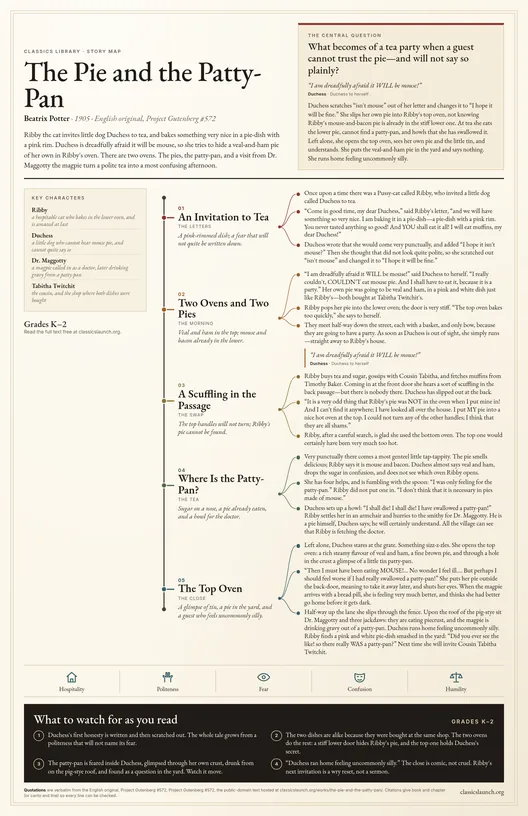 Story mapSee the story mapThe whole book on one page: the story in movements, the characters, and what to watch for. Free to print.
Abstract
An invitation. A cat named Ribby asks her friend Duchess, a small dog, to come for tea. She offers a pie from a pink-rimmed dish and says that she will stick to muffins. Duchess answers courteously, then frets that the filling will be mouse, a dish she cannot face among company.
A pie of her own. So she cooks a veal-and-ham pie in a matching dish, with a small tin under the crust, and tries to exchange it for Ribby's baking. Doors, errands, and two dishes that look alike undo the plan. Duchess eats a pie, then cannot find the tin, and is sure she has swallowed it.
The doctor and the tin. Ribby fetches Dr. Maggotty the magpie, who sings while Duchess sits in misery. The missing patty-pan turns up, and the joke is on a fear and on a scheme that was never quite open. First published by Frederick Warne in 1905, the English text is public-domain and is hosted here in full. It is a longer read-aloud for children who can follow two kitchens and a mix-up of dishes. An illustrated copy will show the pink rims, the oven, and the doctor, which carry much of the comedy.
Main characters
- Ribby: A cat who invites Duchess to tea and bakes a pie in a pink-rimmed dish.
- Duchess: A little dog who fears mouse pie, bakes a pie of her own, and later thinks she has swallowed a tin.
- Dr. Maggotty: A magpie fetched when Duchess is sure the patty-pan is lost inside her.
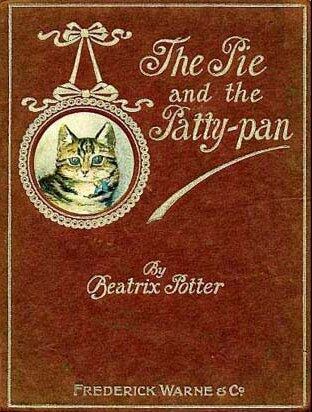

Summary
The Pie and the Patty-Pan is a longer comic tale about a tea invitation, two pies, and a tin that a guest is sure she has swallowed. Ribby the cat invites a little dog named Duchess to tea and writes that she is baking something very nice in a pink-rimmed pie-dish. She herself will eat muffins; Duchess is to eat the pie. Duchess is polite in her reply, but she is sure the pie will be mouse, and she cannot bear the thought of eating it at a party. She bakes a veal-and-ham pie of her own in a dish just like Ribby's, with a patty-pan under the crust to hold it up, and she plans to slip her pie into Ribby's oven in place of the mouse pie. The plan goes wrong in a tangle of locked doors, a walk, a cousin at the post office, and two dishes that look alike. Duchess does get a pie, but not the one she meant, and later she can find no patty-pan on her plate. She is sure she has swallowed it. Ribby, alarmed, fetches Dr. Maggotty, a magpie who is 'a Pie himself' and who sings nonsense while Duchess sits wretchedly in a chair. The missing tin is found in the end, as it should be in a book for small children, and the joke is on fear and on a plan that was never quite honest. The tale is useful after the shorter books because it asks a child to follow two kitchens, two letters, and a mix-up of dishes without losing the thread. It is also a story about hospitality: Ribby wants to give her friend a feast, and Duchess cannot say plainly what she does not like. The English text is public-domain and complete here; the pictures of the pink-rimmed dishes, the oven, and the doctor should be seen in an illustrated copy whenever possible.
Virtues in this work
- Friendship: Ribby's invitation is generous; the comedy shows how hard it can be to be a truthful guest.
- Prudence: A plain word about the menu would have spared a secret switch and a panic about a tin.
Plot or Argument
- The invitation
Ribby invites Duchess to tea and bakes a pie; Duchess fears it will be mouse.
- The switch
Duchess bakes a veal-and-ham pie with a patty-pan and tries to exchange the dishes; the plan fails.
- The tin
Duchess cannot find the patty-pan and thinks she has swallowed it; Ribby fetches a doctor, and the tin is found.
Characters
- Ribby, host
A cat who invites Duchess to tea and bakes a pie in a pink-rimmed dish.
- Duchess, guest
A little dog who fears mouse pie, bakes a pie of her own, and later thinks she has swallowed a tin.
- Dr. Maggotty, doctor
A magpie fetched when Duchess is sure the patty-pan is lost inside her.
Lessons
Saying what you cannot eat
Duchess's polite letter hides a real dislike, and the hidden plan makes more trouble than a plain word would have.
- What is Duchess afraid of?
- What could she have written instead?
Two dishes alike
The plot is a puzzle of matching pie-dishes. Children can practice keeping both kitchens in mind.
- Why do the dishes match?
- Where is the patty-pan supposed to be?
Fear and a tin
The swallowed patty-pan is a fear, not a fact, and the book lets the joke be funny without mocking the guest cruelly.
- What does Duchess think has happened?
- How is the tin found?
Context
Potter makes a village tea, two ovens, and a tin under a crust into a comic puzzle for young listeners.
Composition
First published by Frederick Warne in 1905; the local text follows a Project Gutenberg transcription of the English original (from the collected volume #572).
Reception
The book is longer than the earliest little volumes and is remembered for the pink-rimmed dishes and the missing patty-pan.
Comparisons
- The Tale of Two Bad Mice
Both make comedy from food that is not what a guest or a mouse hoped; here the food is real, and the fear is of a tin.
- The Tale of Mrs. Tiggy-Winkle
Another 1905 Potter book; this one is a social comedy of letters and ovens rather than a hillside mystery.
Quotes
“Once upon a time there was a Pussy-cat called Ribby, who invited a little dog called Duchess to tea.”
“I am dreadfully afraid it WILL be mouse!”
For Students
A reading companion for classical Christian high school students. See the student guide.
Reading Guide
Watch for
- What Ribby promises, and what Duchess is afraid of.
- Why Duchess bakes a second pie, and how the switch goes wrong.
- What she thinks she has swallowed, and how the tin is found.
Key terms and names
- Patty-pan
- A small tin placed under a pie-crust to hold it up while it bakes.
- Pink-rimmed dish
- The matching pie-dishes that make the two pies easy to confuse.
- Ribby
- The cat who invites Duchess to tea and bakes a mouse pie.
- Dr. Maggotty
- The magpie doctor Ribby fetches when Duchess fears she has swallowed the tin.
Seminar Questions
- Comprehension What does Ribby bake, and what does she plan to eat herself?
- Comprehension Why does Duchess bake a veal-and-ham pie?
- Interpretation Why does Duchess not tell Ribby, plainly, that she does not like mouse pie?
- Interpretation Is the lost patty-pan a real danger, or only a fear?
- Big Question When has a plan to avoid hurting someone's feelings made a larger mess?
- Big Question What does this small book teach about taking care, or failing to, that a speech would not have said as well?
Faith Connections
- Ephesians 4:25 (Scripture)
Duchess's trouble grows from a polite letter that is not quite true, and from a secret switch of pies.
- Romans 12:13 (Scripture)
Ribby's invitation is a picture of hospitality; the comedy starts when the guest cannot receive it simply.
Logic and Rhetoric
Central argument: A kind invitation and an unspoken dislike, plus two dishes that look alike, are enough to make a guest sure she has swallowed a tin.
Rhetorical device: Matched objects. The two pink-rimmed dishes and a hidden patty-pan keep the mix-up in front of the child's eye.
Debate: Resolved: Duchess should have told Ribby at once that she did not want mouse pie.
Writing Prompts
Essay: Follow the two pies from the two ovens to the table. Where does Duchess's plan first go wrong?
Comparison with The Tale of Two Bad Mice: Both books make comedy out of food that is not what it seems. How is Duchess's fear different from the mice's plaster ham?
Creative Prompts
- Classroom
Draw or list the path of each pie, and mark where Duchess's plan goes wrong.
- Essay
Was Duchess unkind, or only shy and particular? Use the letter, the second pie, and the scene with the doctor.
- Fiction
Write Ribby's letter again, as she might have written it if she had known what Duchess really liked.
Further Reading
Verification notes
Primary text checked against the edition identified in fullText. No unverified quotations or page numbers supplied. Recommended grades concern teaching suitability, not a mechanical reading score.
No verification flags recorded.