Work record
The Tale of Mrs. Tiggy-Winkle
Beatrix PotterThe Tale of Mrs. Tiggy-Winkle by Beatrix Potter (1905)The Tale of Mrs. Tiggy-Winkle is a hillside story about lost handkerchiefs, a door in a slope, and a washerwoman who proves to be a hedgehog.1905 · Early 20th Century · Short Stories · English
Read this when lost handkerchiefs lead up a hill, to a door in the slope.
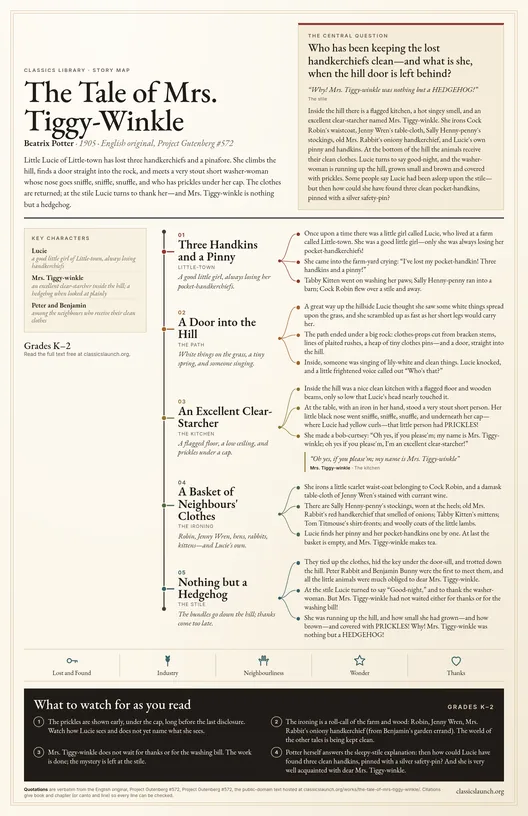 Story mapSee the story mapThe whole book on one page: the story in movements, the characters, and what to watch for. Free to print.
Abstract
Lost handkerchiefs. Little Lucie, who lives at a farm called Little-town, cannot find her pocket-handkerchiefs or her pinny. She asks the animals in the yard, then climbs a long hill and finds a small door in the slope, with a tiny person ironing a great heap of wash inside.
The washerwoman. Mrs. Tiggy-Winkle, in cap and print gown, has been cleaning the clothes of birds, animals, and Lucie herself. They sort the laundry together, take tea, and start down the path with baskets. Lucie begins to notice short arms, a prickly shape, and a voice that is not quite like a neighbor's.
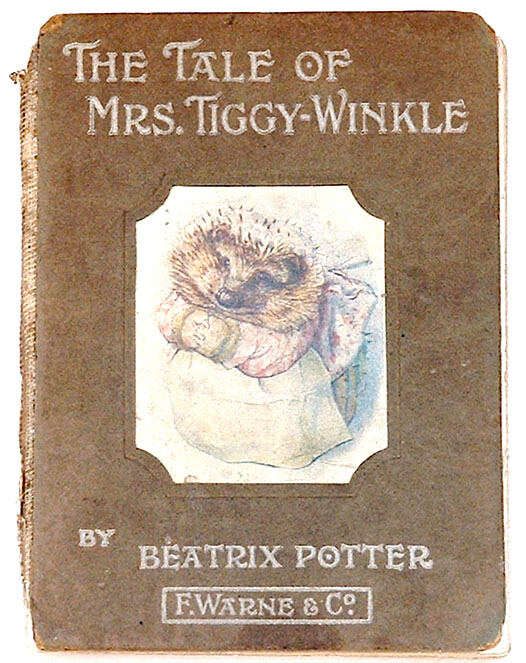
At the gate. At the bottom of the hill the little washerwoman slips away under a gate, and Lucie is left holding her own clean things, no longer sure whether the visit was a dream. A hedgehog runs off in the distance. First published by Frederick Warne in 1905, the English text is public-domain and is hosted here in full. It is a gentle read-aloud about lost things carefully kept, and about work done in a small kitchen on a hill. An illustrated copy will show the iron, the cap, and the prickles that the words only hint at until the last page.
Main characters
- Lucie: A little girl from Little-town who loses her handkerchiefs and climbs the hill to find them.
- Mrs. Tiggy-Winkle: A hedgehog in a cap and print gown, who washes and irons for her neighbors.

Summary
The Tale of Mrs. Tiggy-Winkle is a hillside story about lost handkerchiefs, a door in a slope, and a washerwoman who proves to be a hedgehog. Little Lucie lives at a farm called Little-town and is always losing her pocket-handkerchiefs and her pinny. One day she comes into the yard in tears, asks a kitten and a hen and Cock Robin, and then climbs a stile toward a hill that seems to have no top. High on the slope she finds a little door and a tiny person in a print gown, with a cap, an apron, and an odd prickly shape under her clothes, who is ironing a great heap of laundry. This is Mrs. Tiggy-Winkle. Together they sort the wash: a tablecloth, stockings, a vest of Cock Robin's, and at last Lucie's own handkerchiefs and pinafore, all beautifully clean. Lucie stays to tea, helps to carry the baskets down the path, and begins to wonder about her companion's short arms, her prickles, and her way of speaking. At the bottom of the hill Mrs. Tiggy-Winkle seems to run under a gate, and Lucie is left with her clean clothes, no longer quite sure whether she has been visiting a neighbor or dreaming. When she looks back she sees a hedgehog running away. The tale is useful with young children as a gentle mystery that is also a lesson in careful work: someone has been washing and ironing all along, and Lucie gets back what she lost because it was kept and cleaned, not because it was scolded into appearing. Families can practice retelling the climb, the sorting of the laundry, and the moment of doubt at the gate. The English text is public-domain and complete here; Potter's pictures of the kitchen and of the little person at the iron should be seen in an illustrated copy whenever possible, because the prickles under the cap are half the joke and half the tenderness of the book.
Virtues in this work
Plot or Argument
- The climb
Lucie, missing her handkerchiefs and pinny, climbs the hill behind Little-town and finds a little door.
- The laundry
Mrs. Tiggy-Winkle irons the wash of birds, beasts, and Lucie; they sort it and take tea.
- The gate
On the way down, the washerwoman slips away; Lucie keeps her clean clothes and sees a hedgehog run off.
Characters
- Lucie, protagonist
A little girl from Little-town who loses her handkerchiefs and climbs the hill to find them.
- Mrs. Tiggy-Winkle, washerwoman
A hedgehog in a cap and print gown, who washes and irons for her neighbors.
Lessons
Lost and kept
The handkerchiefs were not thrown away; they were being cleaned. Children can talk about care as well as about magic.
- What does Lucie get back?
- Who has been doing the work?
Clues on the way down
Potter does not announce the hedgehog at once. The clues are in arms, prickles, and a last glance.
- What seems odd about the little person?
- What does Lucie see at the end?
Ordinary work
The kitchen, the iron, and the baskets matter as much as the surprise.
- What jobs do they do together?
- Why might a child remember the ironing as clearly as the hedgehog?
Context
Potter sets a Lake District hill, a child's lost clothes, and a hedgehog washerwoman inside a tiny picture book.
Composition
First published by Frederick Warne in 1905; the local text follows a Project Gutenberg transcription of the English original (from the collected volume #572, not a later reprint).
Reception
Mrs. Tiggy-Winkle is among Potter's best-loved figures, remembered for the cap, the iron, and the prickles.
Comparisons
- The Tale of Peter Rabbit
Another short Potter tale of a child who leaves home; Lucie's adventure is a visit and a return of lost things, not a chase.
- The Tailor of Gloucester
Both books honor small, careful work done out of sight—sewing by mice, washing by a hedgehog.
Quotes
“Once upon a time there was a little girl called Lucie, who lived at a farm called Little-town.”
“She was a good little girl--only she was always losing her pocket-handkerchiefs!”
For Students
A reading companion for classical Christian high school students. See the student guide.
Reading Guide
Watch for
- What Lucie has lost, and whom she asks first.
- What is being ironed in the little kitchen.
- What Lucie sees when she looks back from the gate.
Key terms and names
- Pinny
- Lucie's pinafore, one of the lost garments that later comes back clean.
- Little-town
- The farm where Lucie lives, at the foot of the long hill.
- Washerwoman
- Mrs. Tiggy-Winkle's work: washing and ironing for her neighbors.
- Prickles
- The spines hidden under the print gown, which tell Lucie what she has been visiting.
Seminar Questions
- Comprehension What has Lucie lost, and where does she go to look?
- Comprehension Whose clothes does Mrs. Tiggy-Winkle have in the wash?
- Interpretation When does Lucie first suspect that her host is not an ordinary neighbor?
- Interpretation Does the ending say the visit was only a dream, or does it leave the question open?
- Big Question When have you found a lost thing because someone else had taken care of it?
- Big Question What does this small book teach about taking care, or failing to, that a speech would not have said as well?
Faith Connections
- Luke 15:8–9 (Scripture)
A lost thing is sought with care and found with joy; Lucie's handkerchiefs have been kept and cleaned.
- Colossians 3:23 (Scripture)
The little kitchen is a picture of ordinary work done carefully, not for show.
Logic and Rhetoric
Central argument: What was lost was not gone; it was being cleaned by a neighbor whose true shape is only clear at the end.
Rhetorical device: Gradual revelation. Short arms, a prickly back, and a last glimpse of a hedgehog tell the reader what Lucie has been visiting.
Debate: Resolved: The visit is a dream, and the clean clothes are all that can be trusted.
Writing Prompts
Essay: Track the clues Potter gives about Mrs. Tiggy-Winkle's nature, from the first sight of the cap to the hedgehog at the gate.
Comparison with The Tale of Peter Rabbit: Both children leave home and meet a surprising grown figure. How is Lucie's hillside visit different from Peter's morning in the garden?
Creative Prompts
- Classroom
Retell the climb, the sorting of the wash, and the moment at the gate, in that order.
- Essay
Is Mrs. Tiggy-Winkle a neighbor, a dream, or both? Use only what Lucie sees and what she carries home.
- Fiction
Write a short scene in which Lucie later tells her mother about the hillside door, without deciding the mystery for her.
Further Reading
Verification notes
Primary text checked against the edition identified in fullText. No unverified quotations or page numbers supplied. Recommended grades concern teaching suitability, not a mechanical reading score.
No verification flags recorded.