Work record
The Tale of Mrs. Tittlemouse
Beatrix PotterThe Tale of Mrs. Tittlemouse by Beatrix Potter (1910)The Tale of Mrs. Tittlemouse (1910) is a comedy of housekeeping.1910 · Early 20th Century · Short Stories · English
Read this when a tidy mouse finds her house full of visitors.
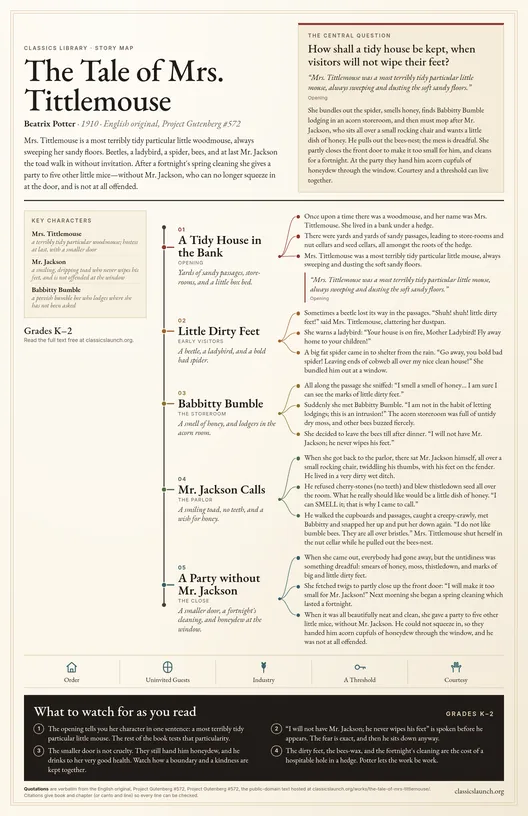 Story mapSee the story mapThe whole book on one page: the story in movements, the characters, and what to watch for. Free to print.
Abstract
The tidy house. A woodmouse lives in a bank under a hedge, in rooms and cellars she keeps very clean. She spends her days sweeping, and she does not look for company.
The visitors. Uninvited insects arrive, and then a large damp toad called Mr. Jackson fills the doorway. He asks for honey, leaves puddles, and cannot squeeze through the little doors.
The party. After a fierce cleaning she closes the short-cut holes and later entertains mouse guests only. The book is a comedy about hospitality and its limits, not a tale of real danger. Young listeners can retell the events in order and talk about the choices without needing a lecture from the narrator. A text-only reading is well paired with an illustrated copy whenever one is at hand. The complete English text of The Tale of Mrs. Tittlemouse is hosted here from a verified public-domain transcription of the 1910 book, so families can read the words freely. Families can linger over the pictures and retell the events in their own words. The sequence is short enough to narrate after a single sitting. Nothing essential is left to a later sequel. Families can linger over the pictures and retell the events in their own words.
Main characters
- Mrs. Tittlemouse: A terribly tidy woodmouse whose house is invaded by uninvited creatures.
- Mr. Jackson: A large wet toad who wants honey and does not fit through her doors.
Summary
The Tale of Mrs. Tittlemouse (1910) is a comedy of housekeeping. Mrs. Tittlemouse is a woodmouse who lives in a bank under a hedge, in a house of sandy passages, store-rooms, a parlor, and a little box bed. She is terribly tidy. Her days are spent sweeping and dusting, and her peace is spent receiving visitors she did not invite. A beetle, a ladybird, a spider, and, most of all, a large wet toad named Mr. Jackson come through her rooms, leaving muddy marks and unwelcome conversation. Mr. Jackson cannot get through the doors properly, sits in a puddle of his own making, and asks for honey, which she does not keep. She is polite, flustered, and determined to get her house back. When at last the visitors leave, she begins a ferocious spring-cleaning, shuts up the short-cut doors that let toads in, and later gives a party for more suitable mouse guests, with cherry-stones and a little seed cake, and no Mr. Jackson. The book is slight in plot and rich in texture: passages, cellars, and a puddle on the parlor floor. Children who like order will recognize the feeling at once, and children who do not can still enjoy the toad who will not fit. Families can talk about hospitality and its limits, about saying no without being cruel, and about the difference between a guest and a trespasser. There is no villain worse than mud and a large sitting toad. The library hosts the complete public-domain English text of the 1910 Warne book. Potter's plates of the tiny rooms and of Mr. Jackson filling a doorway are the right companion to the words, and they make the scale of the house clear in a way prose alone cannot do for a first-time listener. It is a small book to read slowly and enjoy.
Virtues in this work
- Temperance: She wants order, not luxury; she also has to limit a visitor who will not be moderate.
- Prudence: After the mess she closes the short-cut holes that let a toad in.
Plot or Argument
- A house in the bank
Mrs. Tittlemouse keeps sandy passages, store-rooms, and a box bed in perfect order.
- Mr. Jackson
Uninvited insects and a large wet toad disturb the rooms and ask for honey.
- Spring-cleaning
She scrubs, shuts the toad-sized openings, and later gives a party for mice only.
Characters
- Mrs. Tittlemouse, protagonist
A terribly tidy woodmouse whose house is invaded by uninvited creatures.
- Mr. Jackson, visitor
A large wet toad who wants honey and does not fit through her doors.
Lessons
A house of passages
The setting is half the story: cellars, a parlor, and doors that let in a toad.
- Where does Mrs. Tittlemouse live?
- What kind of visitor is Mr. Jackson?
Politeness under strain
She is courteous, and she still wants her floor dry.
- How does she treat Mr. Jackson while he is there?
- What does she do after the visitors leave?
Guests of her own
The closing party is for mice, with food she actually keeps.
- Whom does she invite at the end?
- Is it unkind to close a door that is too large?
Context
Potter writes a tiny housekeeping comedy: a woodmouse's rooms under a hedge, uninvited insects, and a toad who will not fit the doors.
Composition
First published by Frederick Warne in 1910. The local text follows a Project Gutenberg transcription of the English original.
Reception
It is remembered for Mr. Jackson and for the pleasure of a small, orderly house restored.
Comparisons
- The Pie and the Patty-Pan
Both are village or household comedies of invitation and discomfort, without a real villain.
- The Tale of Two Bad Mice
Both take a close interest in rooms, food, and what does not belong on a tidy floor.
Quotes
“Once upon a time there was a woodmouse, and her name was Mrs. Tittlemouse.”
“She lived in a bank under a hedge. Such a funny house!”
For Students
A reading companion for classical Christian high school students. See the student guide.
Reading Guide
Watch for
- How the house is built, and who does not fit it.
- The difference between a visitor and a mess.
- What changes after the spring-cleaning.
Key terms and names
- Woodmouse
- A small mouse of banks and hedges; Mrs. Tittlemouse is one.
- Parlor
- The sitting room of her tiny house, soon wet with toad-prints.
- Spring-cleaning
- A thorough cleaning after the uninvited visitors leave.
- Hospitality
- The welcome given to a guest; here it is tested by mud and a large toad.
Seminar Questions
- Comprehension What kind of house does Mrs. Tittlemouse keep?
- Comprehension Who is Mr. Jackson, and what does he want?
- Interpretation Why does she close some of the openings after she cleans?
- Interpretation Is Mrs. Tittlemouse inhospitable, or is she setting a fair limit?
- Big Question When may a household say no to a visitor and still be kind?
- Big Question How does Proverbs 25:17 help a family talk about visits that last too long?
Faith Connections
- Proverbs 25:17 (Scripture)
Let your foot be seldom in your neighbor's house, lest he have his fill of you: a frame for Mr. Jackson's stay.
- 1 Peter 4:9 (Scripture)
Show hospitality without grumbling; the verse can be set beside her politeness and her later limits.
Logic and Rhetoric
Central argument: A tidy house can be offered in courtesy and still needs doors that fit, and a comedy can teach that without scorn.
Rhetorical device: Irony. The most careful housekeeper in the bank is the one whose parlor is filled by a toad.
Debate: Resolved: Kindness to a visitor does not require leaving the doors wide enough for a toad.
Writing Prompts
Essay: Tell, in order, how Mrs. Tittlemouse's house is disturbed and then restored. Use two details from the text.
Comparison with The Pie and the Patty-Pan: Both books make comedy out of a visit that does not go as planned. Compare what each hostess fears and how each gathering ends.
Creative Prompts
- Classroom
Draw Mrs. Tittlemouse's house as a plan: parlor, pantry, bed, and the holes you would close.
- Essay
How does Mrs. Tittlemouse get her house back? Use two details from the story.
- Fiction
Write Mr. Jackson's account of why he wanted honey and why he left.
Further Reading
Verification notes
Primary text checked against the edition identified in fullText. No unverified quotations or page numbers supplied. Recommended grades concern teaching suitability, not a mechanical reading score.
No verification flags recorded.