Work record
The White Company
Arthur Conan DoyleThe White Company (Doyle); Alleyne Edricson and Sir Nigel; Hordle John and the bowmenThe White Company by Arthur Conan Doyle (1891)The White Company is Arthur Conan Doyle's historical novel of the fourteenth century, set at the time when English bowmen fought in France and Spain.Also known as: The White Company (Doyle) · Alleyne Edricson and Sir Nigel · Hordle John and the bowmen
1891 · 19th Century · Novel · English
Read this when you want a tale of English archers, a boy leaving the cloister, and honor.
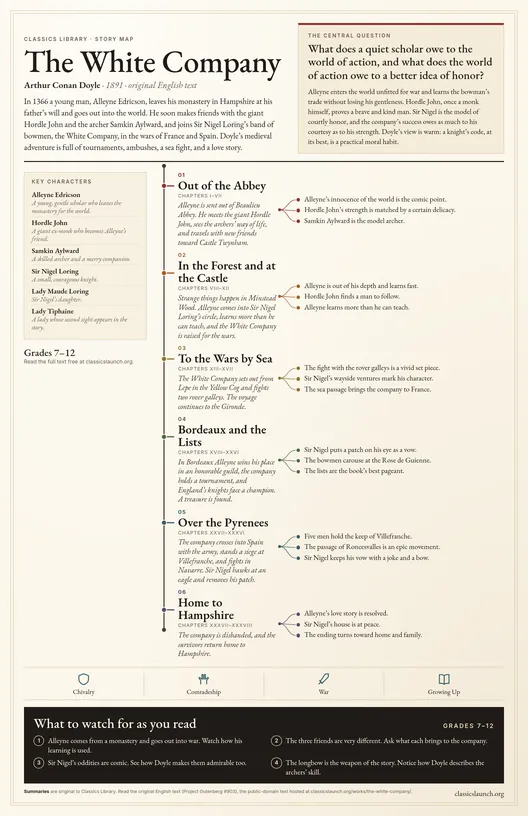 Story mapSee the story mapThe whole book on one page: the story in movements, the characters, and what to watch for. Free to print.
Abstract
Background. Conan Doyle wrote this novel in 1891 while still at the start of his writing career. He worked from the chronicles of the Hundred Years' War and gave the story the manner of Scott.
Plot. A young man raised in an abbey is sent out at twenty to see the world. He becomes squire to a small and brave knight, goes with the archers to France and Spain, and marries the knight's daughter after the company is broken up in the mountains.
Ideas. The book weighs the cloister against the world and finds a place for both. It sets honor, loyalty and friendship against cruelty and greed, and ends with thanks that the age's vices have been outgrown. Young readers meet the English archer, the knight's vow and the Black Prince's court in one long journey.
Text. The hosted text is the complete novel from Project Gutenberg. Use it for reading aloud, for studying a historical adventure and for comparing the English archer with the knight of romance. Teachers can pair this work with the library's study guide, seminar questions and memory-work selection to prepare a discussion, a short essay or a recitation. Every quotation in the guide has been checked against the hosted text.
Main characters
- Alleyne Edricson: A scholar from the abbey who becomes a squire
- Sir Nigel Loring: A near-sighted, gallant knight
- Samkin Aylward: A Hampshire archer and captain of bowmen
- John of Hordle: A giant ex-novice and friend
- Lady Maude: Sir Nigel's daughter
Summary
The White Company is Arthur Conan Doyle's historical novel of the fourteenth century, set at the time when English bowmen fought in France and Spain. It opens in the Cistercian abbey of Beaulieu in Hampshire. A huge, rebellious novice, John of Hordle, is turned out by Abbot Berghersh. At the same time the Abbot sends Alleyne Edricson into the world. Alleyne is a gentle young scholar who has lived in the abbey all his life and has taken no vows, and he has to go because his dying father, Edric the Franklin of Minstead, made the Abbot promise that at twenty the boy should see for himself how he liked the savor of the world. Alleyne leaves with Hordle John as a companion, who finds a master worth following in the small, near-sighted and fearless knight Sir Nigel Loring. They meet the archer Samkin Aylward, who is recruiting for the company that Sir Nigel is to lead. Alleyne becomes Sir Nigel's squire and falls in love with his daughter, the Lady Maude. The White Company sets out to the wars from Hampshire with Aylward, Hordle John and Alleyne beside Sir Nigel. They sail from Lepe in the Yellow Cog, fight off two rover galleys, and cross the bar of the Gironde to Bordeaux, where the Black Prince holds his court. There Sir Nigel puts a patch upon his eye to keep a vow, and he does not take it off until the vow is done. Much of the book is a series of adventures on the road. There is a mighty tournament at Bordeaux, the wassail of the bowmen, the sight of the seer Lady Tiphaine, a treasure, the siege of the Chateau of Villefranche, and the passage of the army over Roncesvalles into Spain, where the Prince has come to restore Don Pedro. In the end the White Company is trapped on a hill in the Cantabrian mountains, fights a long last stand against Spaniards and Bretons, and is disbanded. Sir Nigel and Aylward are carried off and come home after captivity among the Moors. Alleyne is knighted, Hordle John is rewarded for a capture, and Alleyne comes home to marry Maude. The story is a young man's education in courage, love and loyalty. It is also a view of the Middle Ages as a time of rough living and hard fighting that Doyle admired for its virtues and did not wish to restore.
Virtues in this work
- Honor: Sir Nigel keeps his vow of the eye patch and holds his post to the end because a promise is a promise.
- Fortitude: The Company's last stand on the Cantabrian hill is the picture of steady courage in a losing fight.
- Friendship: Alleyne, Aylward and Hordle John bind themselves to each other through hard marches, the siege at Villefranche and the stand in the mountains.
- Piety: Alleyne carries the habit of prayer and the learning of Beaulieu into the camp, and the Abbot keeps his promise to the boy's dying father.
Plot or Argument
- Chapters I-IV: Beaulieu and the road
Hordle John is expelled from the abbey. Alleyne leaves Beaulieu at twenty because of his father's wish and goes out into Hampshire.
- Chapters V-XII: Aylward and Sir Nigel
At the Pied Merlin inn Aylward wagers his feather-bed on his skill with the bow. Hordle John meets Sir Nigel Loring, and Alleyne enters his service and falls in love with Lady Maude.
- Chapters XIII-XVII: To the wars
The White Company sets out and sails from Lepe in the Yellow Cog. The ship fights two rover galleys and crosses the bar of the Gironde to Bordeaux.
- Chapters XVIII-XXVII: Bordeaux
Sir Nigel puts a patch upon his eye to keep a vow. The Company joins the Black Prince's court, the lists are held, and a champion appears from the east. Alleyne, Aylward and Hordle John win a treasure.
- Chapters XXVIII-XXXVI: France and Spain
The comrades cross into France, defend the keep at Villefranche, and cross the Pyrenees at Roncesvalles with the Prince's army. Sir Nigel takes the patch from his eye.
- Chapters XXXVII-XXXVIII: The last stand and home
The Company makes a last stand on a Cantabrian hill and is disbanded. Alleyne is knighted, Sir Nigel and Aylward come home from captivity, and Alleyne marries Maude.
Characters
- Alleyne Edricson, hero
A learned, gentle young man raised at Beaulieu, who goes out at twenty and becomes squire to Sir Nigel and, in the end, a knight.
- Sir Nigel Loring, knight
A small, near-sighted and perfectly brave knight whose gentle manners and vows make him the book's picture of chivalry.
- Samkin Aylward, archer
A Hampshire bowman, loyal, humorous and skilled, who raises the White Company's archers.
- John of Hordle, giant companion
A huge former novice expelled from the abbey, who becomes Alleyne's friend and a famous fighter.
- Lady Maude Loring, Sir Nigel's daughter
A spirited young woman whom Alleyne loves and marries.
- Abbot Berghersh, abbot
The Abbot of Beaulieu, who has kept his promise to Alleyne's father.
- Sir Oliver Buttesthorn, knight
A stout, hearty friend of Sir Nigel who fights with the Company.
- Lady Tiphaine, seer
A lady of the Chateau who is said to have the gift of sight.
Lessons
The scholar and the world
Alleyne has been raised among books and prayers and has to learn what the world is like. Doyle does not mock the cloister, and the Abbot keeps a promise given to a dying man. The book asks how a faith that has been learned in the abbey is lived in the market, the camp and the home. John 17:15 can be read alongside it.
- Why must Alleyne leave Beaulieu, and what does the Abbot say about it?
- What does Alleyne bring to the Company that the soldiers lack?
- What does Alleyne's argument about tilling God's earth say about the active and the contemplative life?
Chivalry and its limits
Sir Nigel is courteous, humble and fearless, and he keeps his vows. Around him are rough soldiers and cruel allies, so the book shows both the ideal and the world it had to live in. Doyle admires the one and does not hide the other.
- How does Sir Nigel's vow of the eye patch show his idea of honor?
- How do the men of the Company differ from Sir Nigel, and what do they have in common?
- How does Doyle's last paragraph judge the fourteenth century?
Loyal friendship and service
Hordle John, Aylward and Alleyne are very different men who serve one master and one another. Their loyalty is tested in the siege at Villefranche and in the last stand. The book makes friendship a school of the other virtues.
- How does each of the three comrades show loyalty?
- Why does Hordle John choose Sir Nigel as the man he will follow?
- What does the Company's last stand show about the cost of loyalty?
Love and marriage
Alleyne and Maude come together at the end of the book, when Maude is on the point of entering a nunnery and chooses Alleyne instead. The book treats marriage as a serious oath and not as a way of escape, which fits Doyle's picture of honor.
- Why is Maude at the door of the nunnery, and what changes her mind?
- What does the choice of Maude and Alleyne say about vows and about love?
- How does the last chapter treat their choice?
Context
The story is set in the later fourteenth century, in the years after the Hundred Years' War had been renewed. English archers who had won Crecy and Poitiers served as soldiers for hire in France and Spain, and the Black Prince governed Aquitaine from Bordeaux. Free companies of professional soldiers roamed the country when truces were made. Doyle's story has the Prince's expedition over the Pyrenees to restore Don Pedro of Castile as the background to its later chapters.
Composition
Doyle wrote the book after his early success with A Study in Scarlet, steeped in the chronicles of Froissart and other sources, and published it in The Cornhill Magazine in 1891 before it came out as a book. It is often reported that Doyle counted it among his best works. Its chivalry offered readers a change from the books of the day about modern life.
Reception
The White Company was admired by readers and critics, and it made Doyle's name as a writer of historical fiction as well as of detective stories. Sir Nigel (1906) was written as its prequel. The two books are often paired as Doyle's picture of the later Middle Ages.
Comparisons
- Sir Nigel
The prequel, written fifteen years later, which tells how the young Nigel Loring won his lady and his knighthood.
- Ivanhoe
Scott's novel gave the nineteenth century its picture of knights and archers, and Doyle's book is a descendant with more attention to the common soldier.
- The Black Arrow
Stevenson's novel of the Wars of the Roses also makes English archers the heroes of a coming-of-age story.
- The Canterbury Tales
Chaucer's Knight and Squire belong to the same fourteenth-century world of French wars, and Sir Nigel and Alleyne can be read beside them.
- The Rule of St Benedict
The Rule shaped the abbey life that Alleyne leaves, and Doyle's picture of the Cistercian community owes something to it.
- The Hound of the Baskervilles
Doyle's most famous novel was written ten years later, and it shares the White Company's love of the English landscape and its sense of duty.
- Micah Clarke
Doyle's earlier historical novel is about a Puritan lad and a soldier of fortune in the rising of 1685.
Quotes
Frequently cited
“Here I am, and here I bide, while God gives me strength to lift a sword.”
Frequently cited
“Now, which is better, to till God's earth, to have happy faces round one's knee, and to love and be loved, or to sit forever moaning over one's own soul, like a mother over a sick babe?”
Frequently cited
“Let us thank God if we have outgrown their vices. Let us pray to God that we may ever hold their virtues.”
“I had given my foreword and sacred promise to your father, Edric the Franklin, that at the age of twenty you should be sent out into the world to see for yourself how you liked the savor of it.”
“If I had my will I should never go forth, but should end my days here in Beaulieu. It hath been my home as far back as my mind can carry me, and it is a sore thing for me to have to leave it.”
“What of the bow? The bow was made in England: Of true wood, of yew wood, The wood of English bows;”
“Their choice is made, and they turn away hand-in-hand, with their backs to the darkness and their faces to the light.”
For Students
A reading companion for classical Christian high school students. See the student guide.
Reading Guide
Watch for
- How Alleyne's learning from the abbey helps and hinders him among the soldiers.
- What Sir Nigel's vows show about the way an honorable man treats an oath.
- The songs and the talk of the archers, and what they say about English pride in the bow.
- How Doyle sets the high ideals of chivalry beside the cruelty and rough living of the time.
Key terms and names
- Franklin
- A free landowner of the middle rank in medieval England, like Alleyne's father Edric of Minstead.
- Squire
- A young man in training to be a knight, who serves a knight and carries his arms.
- Long-bow
- The tall English bow of yew, shot in a mass by trained archers, which won several of the great battles of the Hundred Years' War.
- Free company
- A band of professional soldiers who served for pay under their own captain, like the White Company.
- Cistercian
- A monk of the order that follows the Rule of St. Benedict in its strict form; the abbey of Beaulieu belonged to this order.
Seminar Questions
- Comprehension Why is Alleyne sent out of Beaulieu at twenty, and who is sent with him in spirit?
- Comprehension What do Hordle John and Aylward each bring to Sir Nigel's company?
- Interpretation Why does Doyle make his model knight small and near-sighted?
- Interpretation How does Alleyne's speech about tilling God's earth answer the life of the cloister?
- Interpretation What does Doyle's closing prayer say about how to judge an earlier age?
- Big Question What does it cost to keep a vow, and when is it right to keep one against one's own wishes?
- Big Question How can a person serve God in the world as faithfully as in a cloister?
Faith Connections
- John 17:15 (Scripture)
I pray not that thou shouldest take them out of the world, but that thou shouldest keep them from the evil. Alleyne's leaving the abbey is a lesson in this prayer.
- Matthew 5:13-16 (Scripture)
Ye are the salt of the earth and the light of the world. The verse answers Alleyne's question about whether faith belongs in the world or in the cloister.
- Micah 6:8 (Scripture)
To do justly, and to love mercy, and to walk humbly with thy God. Sir Nigel's courtesy to high and low is a picture of mercy and humility.
- the-rule-of-st-benedict (Great Conversation)
The Rule of St. Benedict stands behind the life at Beaulieu that Alleyne leaves, and its balance of prayer and work is the standard against which he tests the world.
Logic and Rhetoric
Central argument: A young man formed in the cloister should be sent out into the world, and the faith he learned there is made strong by service, loyal friendship and a kept vow, for the vices of the age may be outgrown but its virtues should be held.
Rhetorical device: contrast of the cloister and the camp. The book opens in the peace of Beaulieu and ends in the noise of a battle on a Cantabrian hill, so the reader keeps comparing the two ways of life.
Debate: Resolved: That a man who has been educated in a cloister is better prepared for the world than one who has not.
Memory Work
Here I am, and here I bide, while God gives me strength to lift a sword.
Let us thank God if we have outgrown their vices. Let us pray to God that we may ever hold their virtues.
Writing Prompts
Essay: Explain how Doyle uses Alleyne's journey from the cloister to the camp to ask what a good man owes to the world, and decide whether the book answers fairly.
Comparison with Ivanhoe: Compare Doyle's Sir Nigel with Scott's Ivanhoe as models of the Christian knight, and say what each author admires most.
Medical Lens
The novel is not about medicine, but its battles, sieges and fights give many wounds and several deaths, from the arrow and sword to the death of Roger Club-foot. Doyle, who was a doctor, is matter-of-fact about the cost. The monastic setting also shows how the abbey cared for its people.
- Chapter XXXVII
The last stand on the Cantabrian hill gives the book's heaviest account of wounded and weary men in close fighting.
- Chapter XXVII
The death of Roger Club-foot is told with a priest's blessing and gives a picture of death and last rites in the field.
Creative Prompts
- Essay
Explain how Doyle's closing prayer about the vices and virtues of the fourteenth century sums up his view of the Middle Ages, using at least two scenes from the book.
- Fiction
Write a scene in which Alleyne, after a year in the Company, writes to the Abbot of Beaulieu to say what he has learned outside the cloister.
- Dialogue
Write a conversation between Sir Nigel and Hordle John in which the knight explains the vow of the eye patch and the giant answers in his plain speech.
- Classroom
Stage a mock council of the White Company before the last stand. Each student speaks as one of the main characters and argues what the Company should do.
Further Reading
- Sir Nigel, Arthur Conan Doyle
The companion novel about Nigel Loring's youth.
- Memories and Adventures, Arthur Conan Doyle
- Teller of Tales: The Life of Arthur Conan Doyle, Daniel Stashower
- Chronicles, Jean Froissart
The fourteenth-century chronicle that Doyle drew on for the wars in France and Spain.
Verification notes
The plot, the characters and the quotations are checked against the hosted Project Gutenberg text. The dates of the Cornhill serial and Doyle's own later judgment of the book follow standard reference accounts and should be checked before they are quoted. The text names the Black Prince, Don Pedro and the Pyrenees campaign but does not name the battle in Spain, so the summary does not either.
- The dates of the Cornhill Magazine serial and of the first book edition.
- Doyle's own later ranking of The White Company among his works.
- The historical sources Doyle used, beyond Froissart.