Work record
Sir Nigel
Arthur Conan DoyleSir Nigel Loring; Sir Nigel (Doyle); Nigel Loring's youth; The Red Ferret and the three deedsSir Nigel by Arthur Conan Doyle (1906)Sir Nigel is Arthur Conan Doyle's second novel of the fourteenth century and the prequel to The White Company.Also known as: Sir Nigel Loring · Sir Nigel (Doyle) · Nigel Loring's youth · The Red Ferret and the three deeds
1906 · Early 20th Century · Novel · English
Read this when you want to learn how a small, brave squire won his lady and his spurs.
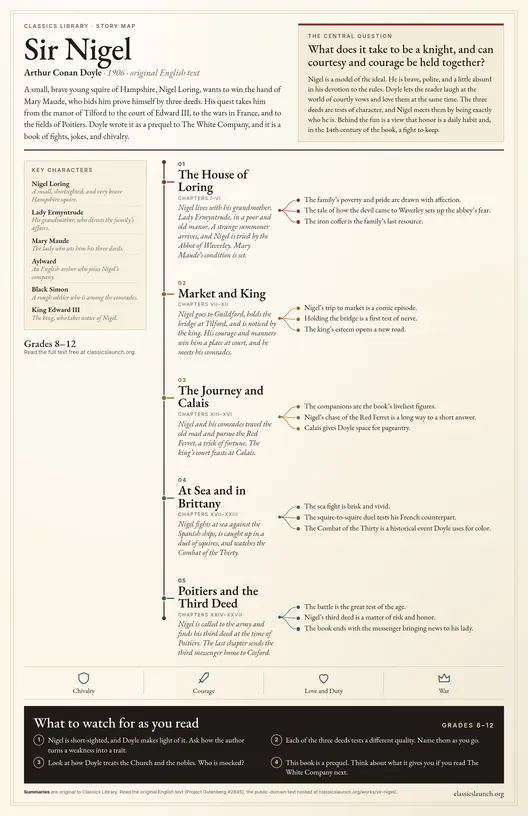 Story mapSee the story mapThe whole book on one page: the story in movements, the characters, and what to watch for. Free to print.
Abstract
Background. Conan Doyle wrote this book in 1906 as the earlier history of the knight of The White Company. It was serialised in The Strand Magazine and was published soon after as a volume.
Plot. A poor squire of Surrey swears an oath at a shrine to perform three deeds for the girl he loves. His oath takes him into the French war, from a spy-chase to the capture of a king, and the Prince of Wales rewards him with a knighthood.
Ideas. The book considers vows, humility and the patience of those who wait. Its Introduction asks the reader to understand the Middle Ages on their own terms, and its last pages close with thanks for the lives of the people it describes. Readers follow a poor squire from a manor under plague to the field where a king is taken, and see what a promise can ask of a man.
Text. The hosted text is the full novel from Project Gutenberg. Use it for reading aloud, for studying a historical romance and for pairing with The White Company. Teachers can use the library's study guide, seminar questions and memory-work selection to prepare a discussion, a short essay or a recitation. Every quotation in the guide has been checked against the hosted text.
Main characters
- Nigel Loring: A small, humble squire who becomes a knight
- Lady Ermyntrude: His proud and generous grandmother
- Lady Mary: The girl who waits for his three deeds
- Sir John Chandos: His lord and teacher in arms
- Samkin Aylward: An archer in his company
Summary
Sir Nigel is Arthur Conan Doyle's second novel of the fourteenth century and the prequel to The White Company. It tells how the little squire Nigel Loring, a small and slight young man who is poor and has a name to make, won his knighthood and his wife. In July 1348 the black cloud of the pestilence lies on Hampshire and Surrey. Nigel lives at Tilford with his grandmother, the Lady Ermyntrude, a proud old lady whose family has been, as the book says, doubly impoverished by law and by pestilence. The Abbey of Waverley has a claim against them, and the book opens with the feud between the manor and the abbey, and with Nigel's trial before the Abbot. Nigel is eager for the French wars, and Lady Ermyntrude opens her iron coffer to equip him. He holds the bridge at Tilford, rides to Calais, and enters the service of Sir John Chandos, the Black Prince's friend and teacher. At the hall of the Knight of Duplin, Sir John Buttesthorn, he meets the Lady Mary, whom he loves. Her elder sister is thought the beauty, but Nigel chooses Mary. At the shrine of St. Catharine near Guildford he swears to do three deeds in her honor before he sees her face again, and she swears to wait and, if he falls, to take the veil in Shalford nunnery. The three deeds carry him from Hampshire to the coast of France. Nigel and Chandos chase the French spy known as the Red Ferret, and after each deed a messenger rides to Cosford with news for Mary. The war takes him to Calais, to the sea fight with the Spaniards, to Brittany, and to the Combat of the Thirty between the knights of Josselin and Ploermel. At last, in 1356, he finds his third deed at Maupertuis, in the great defeat of the French that ended with the capture of their king, and there the Prince of Wales dubs him a knight. After two months the third messenger arrives at Cosford. The book is full of cheerful fighting, but its centre is Nigel's character: courteous, humble, careful of his word and entirely without vanity. Doyle ends on the Surrey hills with a view of the ruined shrine, and a plain thanks to the men and women of the age.
Virtues in this work
- Honor: Nigel keeps his oath of three deeds and wins the Prince's praise for the honor he has gathered rather than for ransom.
- Humility: Nigel is small, poor and without conceit, and he receives the Prince's praise with a murmur of thanks.
- Fortitude: Mary waits at Cosford for the three deeds, and the narrator calls her waiting a heroism no valor of man can attain.
- Faith: Nigel and Mary swear their oaths in the name of St. Catharine, and the book gives a picture of a society that felt Heaven close above its head.
Plot or Argument
- Introduction and Chapters I-V: Tilford and Waverley
The Introduction explains Doyle's liberties with history. The book opens in 1348 with the pestilence and the house of Loring, the feud with the Abbey of Waverley, and Nigel's trial before the Abbot.
- Chapters VI-X: Equipment and the bridge
Lady Ermyntrude opens the iron coffer to equip her grandson. Nigel goes to Guildford, meets the King on Crooksbury Heath, holds the bridge at Tilford, and enters the service of Chandos.
- Chapters XI-XIII: The Knight of Duplin and the oath
At the hall of Sir John Buttesthorn Nigel meets Lady Mary. After a fight with the Twisted Man of Shalford he takes his oath of three deeds at the shrine of St. Catharine.
- Chapters XIV-XVIII: The Red Ferret and Calais
Nigel chases the Red Ferret, a French spy, and a messenger rides to Cosford. The court feasts in Calais Castle, the English fight the Spaniards on the sea, and Black Simon claims a forfeit from the King of Sark.
- Chapters XIX-XXIII: Brittany
Nigel meets a squire of France, the English attempt the Castle of La Brohinière, a second messenger goes to Cosford, and the thirty of Josselin meet the thirty of Ploermel in the Combat of the Thirty.
- Chapters XXIV-XXVII: Maupertuis and the knighting
Nigel is called to his master and goes to Poitiers. At Maupertuis he finds his third deed, is knighted by the Prince, and the third messenger comes to Cosford.
Characters
- Nigel Loring, hero
A small, courteous squire of Tilford who is poor, careful of his vows and unafraid, and who becomes a knight.
- Lady Ermyntrude Loring, grandmother
The proud, stern old lady of Tilford who opens her coffer to send her grandson to war.
- Lady Mary Buttesthorn, Nigel's lady
The younger daughter of the Knight of Duplin, who swears to wait for Nigel's three deeds.
- Sir John Buttesthorn, Knight of Duplin
Mary's stout father, the master of Cosford, who received his name from his part in a famous battle.
- Sir John Chandos, Nigel's lord
A famous English knight, friend and teacher of the Black Prince, whom Nigel serves as squire.
- Samkin Aylward, archer
A Hampshire archer who goes to the wars with Nigel's company.
- Black Simon, man-at-arms
A grim old soldier who serves in Nigel's band and claims a forfeit from the King of Sark.
- The Red Ferret, French spy
A small, quick and daring spy in French service whom Chandos knows from earlier campaigns.
Lessons
The vow and the kept word
Nigel's three deeds are an oath, and he treats it as binding. Mary's oath is no less serious. Doyle uses the ancient idea of the vow to show how a promise can steady a young man's will and give his love a shape. Ecclesiastes 5:4-5 and Psalm 15:4 can be read beside the book.
- What does Nigel promise at the shrine, and what does Mary promise?
- Why does Nigel say love will not stand betwixt him and honorable achievement?
- How does Doyle show that keeping a vow can cost something?
Humility in the brave
Nigel is small, poor and without conceit. He has no desire to win a name for itself and does not claim credit when the Prince praises him. The book suggests that real courage and humility belong together.
- What do other characters think of Nigel when they first meet him?
- How does Nigel answer the Prince's praise at Maupertuis?
- Why might Doyle choose a small and humble hero?
Judging an earlier age fairly
Doyle's Introduction asks the reader not to judge the fourteenth century by the habits of the twentieth. The book gives a world of simple faith and rough fighting and expects the reader to see both its virtues and its faults. The method is one a historian needs: understand first, judge afterwards.
- What does Doyle say about the word 'Twentieth Century' and the Fourteenth?
- What does the passage on 'wonder and mystery' say about medieval faith?
- How does a reader judge fairly a time very different from his own?
The patience of women
Mary waits at Cosford while Nigel fights, and the book calls her waiting a heroism that no valor of man can attain. Lady Ermyntrude gives up her treasures to make Nigel a soldier. The book makes the women's part in the story as important as the knight's.
- What does Mary do while Nigel is away?
- What does Lady Ermyntrude give, and why?
- Why does Doyle say that women's heroism is greater than man's valor?
Context
The book begins in the year of the Black Death, 1348, in the country around Guildford, and goes through the early years of the Hundred Years' War to the battle of Poitiers (Maupertuis) in 1356, when the Black Prince captured the French king, John. Doyle uses real events and people such as Chandos, Sir Robert Knolles, the Combat of the Thirty and the Prince of Wales, and mixes them with his own invented squire and his friends. Waverley Abbey, a Cistercian house near Farnham, was a real foundation.
Composition
Doyle wrote Sir Nigel in 1905 and 1906 as a companion to The White Company, which he had published fifteen years before. It ran in The Strand Magazine from December 1905 and appeared in book form in 1906. In the Introduction he admits that he has moved some events by a few months for the sake of the story.
Reception
Doyle is often reported to have thought the two Nigel books among his best work, and the novel has stayed in print as a companion to The White Company. It is less famous than the Holmes stories but is still read as a model of the historical romance of chivalry and archery.
Comparisons
- The White Company
The sequel in story order, in which the older Sir Nigel leads English archers in France and Spain.
- Ivanhoe
Scott's novel set the pattern for the Victorian tale of English knights, and Doyle follows its way of mixing history with romance.
- The Canterbury Tales
Chaucer's Knight lived in the same world of French campaigns and vows, and the two characters make a good pair.
- Le Morte d'Arthur
Malory's book is the source of many of the ideas of chivalry and the quest, which Doyle recasts for the real wars of Edward III.
- Henry V
Shakespeare's play shows another English king in France and the part that archers and common soldiers play in an English victory.
- Sir Gawain and the Green Knight
The Gawain poet's story is another fourteenth-century picture of knightly honor tested by a vow.
- Micah Clarke
Doyle's earlier historical novel gives a Puritan view of a lost cause in the seventeenth century.
Quotes
Frequently cited
“It is useless, however, to draw the Twentieth Century and label it the Fourteenth.”
Frequently cited
“In those simple times there was a great wonder and mystery in life. Man walked in fear and solemnity, with Heaven very close above his head, and Hell below his very feet.”
Frequently cited
“Here at the shrine of the holy Catharine, on this, the Feast of Saint Margaret, I take my oath that I will do three deeds in your honor as a proof of my high love before I set eyes upon your face again, and these three deeds shall stand as a proof to you that if I love you dearly, still I will not let the thought of you stand betwixt me and honorable achievement!”
Frequently cited
“England has lost a brave Squire, and has gained a gallant knight. Nay, linger not, I pray! Rise up, Sir Nigel!”
Frequently cited
“but the rumor of noble lives, the record of valor and truth, can never die, but lives on in the soul of the people.”
“Dame History is so austere a lady that if one, has been so ill-advised as to take a liberty with her, one should hasten to make amends by repentance and confession.”
“I swear that I will hold myself for you until these three deeds be done and we meet once more; also that if—which may dear Christ forfend! you fall in doing them then I shall take the veil in Shalford nunnery and look upon no man’s face again!”
“But for my part I swear by my father’s soul that I had rather have the honor this Squire has gathered than all the richest ransoms of France.”
“There is a heroism of women to which no valor of man can attain.”
For Students
A reading companion for classical Christian high school students. See the student guide.
Reading Guide
Watch for
- How Nigel acts when he is given credit, and how that differs from the vanity of other knights.
- What each of the three deeds teaches Nigel, and how each messenger's visit to Cosford changes Mary.
- How Doyle mixes real history, such as Chandos and Maupertuis, with invented characters.
- The picture of fourteenth-century faith in the passages about the abbey, the shrine and the feud.
Key terms and names
- Squire
- A young man training to become a knight, who serves a knight and carries his arms and armor.
- Vow
- A solemn promise made before God or at a shrine, as in Nigel's oath of three deeds.
- Pestilence
- The Black Death, which struck England in 1348-49 and killed a large part of the population.
- Seneschal
- A steward or governor placed in charge of a lord's lands or a town, such as the English governor of Calais.
- Ransom
- The money paid for a captured knight or noble, which was an important reward of war in the fourteenth century.
Seminar Questions
- Comprehension What is the feud between the house of Loring and the Abbey of Waverley, and how is it settled?
- Comprehension What do Nigel and Mary each swear at the shrine of St. Catharine?
- Interpretation Why does Doyle make his hero small, poor and humble?
- Interpretation What does the Prince's praise of Nigel's honor say about how the knights judged worth?
- Interpretation How does the closing section on women's heroism change the way we read the rest of the book?
- Big Question Is a vow like Nigel's a good way for a young man to find his character?
- Big Question How should a reader judge a time whose beliefs and habits are very different from his own?
Faith Connections
- Psalm 15:4 (Scripture)
He that sweareth to his own hurt, and changeth not. The verse describes the man who keeps his oath, as Nigel does, even when it costs him dearly.
- Ecclesiastes 5:4-5 (Scripture)
When thou vowest a vow unto God, defer not to pay it: better is it that thou shouldest not vow, than that thou shouldest vow and not pay. The book is a long picture of a kept vow.
- Philippians 2:3 (Scripture)
In lowliness of mind let each esteem other better than themselves. Nigel's humility in the face of praise is the picture of this teaching.
- the-canterbury-tales (Great Conversation)
Chaucer's Knight is described as a perfect gentle knight who loved chivalry, truth and honor, and he belongs to the same age and the same ideal as Nigel.
Logic and Rhetoric
Central argument: A man's worth lies in the oaths he keeps and the humility with which he serves, and an earlier age should be understood on its own terms, with its virtues held in thanks and its vices outgrown.
Rhetorical device: apology to the reader in the Introduction. Doyle begins by addressing 'Dame History' as a lady who has been wronged and by promising repentance and confession.
Debate: Resolved: That a young man is best formed by a solemn oath that tests his character.
Memory Work
Here at the shrine of the holy Catharine, on this, the Feast of Saint Margaret, I take my oath that I will do three deeds in your honor as a proof of my high love before I set eyes upon your face again, and these three deeds shall stand as a proof to you that if I love you dearly, still I will not let the thought of you stand betwixt me and honorable achievement!
but the rumor of noble lives, the record of valor and truth, can never die, but lives on in the soul of the people.
Writing Prompts
Essay: Explain how Doyle shows that Nigel is brave and humble at once, using the oath at the shrine and the scene of the knighting at Maupertuis.
Comparison with The White Company: Compare the young Nigel of this book with the older knight of The White Company, and say what has stayed the same and what has changed.
Medical Lens
The story opens under the cloud of the pestilence of 1348-49, and the Loring family's poverty is partly the result of it; the plague is a background and not a theme. The fighting at Calais, in Brittany and at Maupertuis gives many wounds, which Doyle, a doctor, treats without relish.
- Chapter I
The opening of the book places the story under the black pestilence of 1348 and tells how the plague and the law have impoverished the house of Loring.
- Chapter XXIII
The Combat of the Thirty is told as a long fight between two groups of knights, with wounds and exhaustion.
Creative Prompts
- Essay
Explain why Doyle's Introduction warns against judging the fourteenth century by the standards of the twentieth, and decide whether the book follows its own advice.
- Fiction
Write a letter from Lady Mary at Cosford to Nigel, after the second messenger arrives, in which she says what she has done while waiting.
- Dialogue
Write a conversation between Nigel and Chandos on the night before Maupertuis in which the older knight tells him what to look for.
- Classroom
Hold a debate on the resolution that a vow like Nigel's three deeds is a good way for a young man to prove himself.
Further Reading
- The White Company, Arthur Conan Doyle
The companion novel, set some years later in the life of Nigel Loring.
- Memories and Adventures, Arthur Conan Doyle
- Chronicles, Jean Froissart
The fourteenth-century chronicle that supplies the Combat of the Thirty and other events.
- Teller of Tales: The Life of Arthur Conan Doyle, Daniel Stashower
Verification notes
The plot, the names and the quotations are checked against the hosted Project Gutenberg text. The dates of the Strand serial and the report that Doyle valued the Nigel books highly follow standard reference accounts and should be checked before they are quoted. The historical sources Doyle used are not named in the text.
- The dates of the Strand serial and of the first book edition.
- Doyle's own later judgment of Sir Nigel and The White Company.
- Which chronicles Doyle used for the Combat of the Thirty and for Poitiers.