Work record
The Tale of Johnny Town-Mouse
Beatrix PotterThe Tale of Johnny Town-Mouse by Beatrix Potter (1918)The Tale of Johnny Town-Mouse (1918) is Potter's late retelling of Aesop's town mouse and country mouse, dedicated 'To Aesop, in the Shadows.'1918 · Early 20th Century · Short Stories · English
Read this when town comfort and country quiet are set side by side.
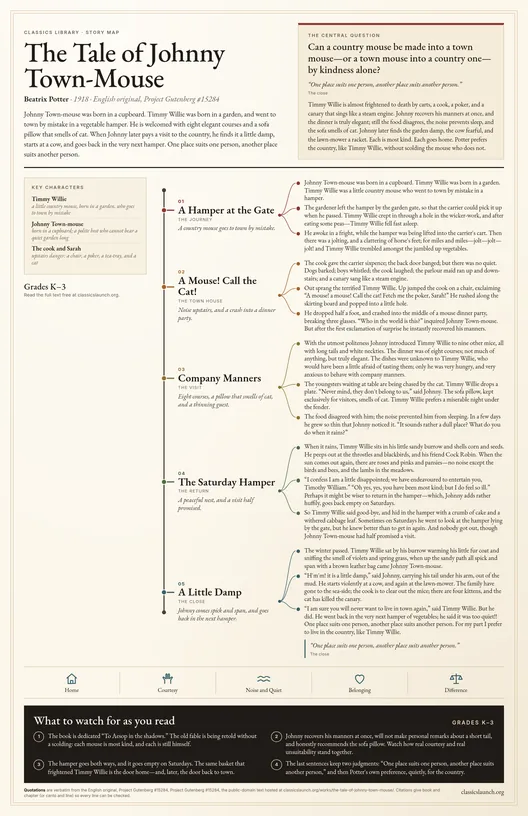 Story mapSee the story mapThe whole book on one page: the story in movements, the characters, and what to watch for. Free to print.
Abstract
The hamper. A garden mouse is carried to town by mistake among the vegetables. The house is loud with carts, a cook, and a canary; town mice offer him dinner under the boards.
The cat and the quiet. There is good food in town and also a cat. Timmy Willie cannot be at ease, and he goes home in the hamper to rain, peas, and stillness.
The return visit. Johnny later visits the garden, dislikes the wet and the quiet, and hurries back. Each mouse prefers his own life. The book is a finished little comedy after Aesop, with a hamper and two kinds of fear. Young listeners can retell the events in order and talk about the choices without needing a lecture from the narrator. A text-only reading is well paired with an illustrated copy whenever one is at hand. The complete English text of The Tale of Johnny Town-Mouse is hosted here from a verified public-domain transcription of the 1918 book, so families can read the words freely. Families can linger over the pictures and retell the events in their own words. The sequence is short enough to narrate after a single sitting. Nothing essential is left to a later sequel.
Main characters
- Timmy Willie: A country mouse who goes to town in a hamper and cannot settle there.
- Johnny Town-mouse: A polished town mouse who later finds the garden wet and dull.
Summary
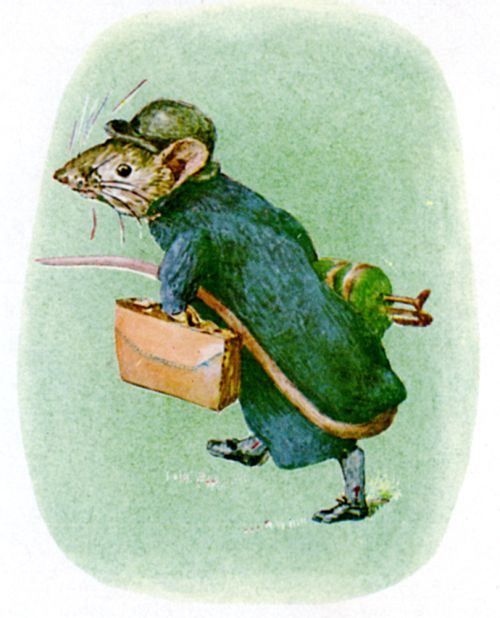
The Tale of Johnny Town-Mouse (1918) is Potter's late retelling of Aesop's town mouse and country mouse, dedicated 'To Aesop, in the Shadows.' Johnny Town-mouse is born in a cupboard. Timmy Willie is born in a garden and goes to town by mistake in a vegetable hamper. He wakes to carts, dogs, a laughing cook, and a canary that sings like a steam engine. The cook screams; he is rescued by Johnny and the town mice, who offer him a polished dinner under the boards and take his rustic manners for a joke. There is good food, and there is also the cat. Timmy Willie cannot settle. When the hamper goes back he hides in it and returns to the garden, to rain, peas, and quiet. Later Johnny comes to visit, is soaked and unimpressed by the country, and goes home as soon as he can. Each mouse prefers the life he knows. The book is one of Potter's most finished little comedies of manners: noise against stillness, gravy against vegetables, courage of two different kinds. Children can talk about home, about being a guest, and about not having to win the argument. The Aesop dedication is a chance to set the old fable beside this picture-book version and see what Potter adds — the hamper, the cook, the canary, and the rain. The library hosts the complete public-domain English text of the 1918 Warne book. The plates make the two houses and the two kinds of fear visible, and they should be used whenever the tale is read aloud, especially if the fable has already been heard in another telling. That pairing of old fable and small picture book is one of the very best reasons to read this tale slowly with a whole family. It rewards a slow reading beside the older fable.
Virtues in this work
- Temperance: Willie will not stay for rich food that comes with fear; Johnny will not pretend to love the rain.
- Friendship: Johnny takes the stranger in; the friendship holds even though neither can live the other's life.
Plot or Argument
- A hamper to town
Timmy Willie goes to town by mistake and is taken in by Johnny Town-mouse.
- Dinner and a cat
The town meal is fine, the house is noisy, and the cat is too much for the visitor.
- Each to his own
Willie goes home; Johnny later visits the garden and is glad to leave.
Characters
- Timmy Willie, protagonist
A country mouse who goes to town in a hamper and cannot settle there.
- Johnny Town-mouse, host
A polished town mouse who later finds the garden wet and dull.
Lessons
Aesop in a hamper
Potter retells a known fable with new furniture: a cook, a canary, and rain.
- How does Timmy Willie get to town?
- What does he dislike there?
A good host, a poor fit
Johnny is generous, and the visit still fails.
- How do the town mice treat their guest?
- Why does he go home?
No need to win
The ending does not crown town or country; each returns to what he can bear.
- What happens when Johnny visits the garden?
- Does the book say one life is better?
Context
Potter, late in the small-book series, retells Aesop's town mouse and country mouse with a vegetable hamper, a cook, and a canary, and dedicates the tale to Aesop.
Composition
First published by Frederick Warne in 1918. The local text follows a Project Gutenberg transcription of the English original.
Reception
It is often used to set a picture book beside the older fable and to talk about home and hospitality.
Comparisons
- Aesop's Fables
The same argument about town and country; Potter adds the hamper, the cook, the canary, and a rain-soaked return visit.
- The Tale of Two Bad Mice
Both take a close interest in a house's food and manners, one from under the boards of a doll's house, one from a town cupboard.
Quotes
“Johnny Town-mouse was born in a cupboard. Timmy Willie was born in a garden.”
“Timmy Willie was a little country mouse who went to town by mistake in a hamper.”
For Students
A reading companion for classical Christian high school students. See the student guide.
Reading Guide
Watch for
- How Timmy Willie travels, and what he hears in town.
- What is pleasant at Johnny's table, and what is not.
- How the return visit completes the fable.
Key terms and names
- Hamper
- A large basket for vegetables; Timmy Willie travels in one by mistake.
- Fable
- A short tale, often of animals, that shows a truth about human life; this book follows Aesop's.
- Hospitality
- The welcome a host gives; Johnny's welcome is real, and it still cannot make Willie happy.
- Country
- The garden life of rain, peas, and quiet, which suits Willie and not Johnny.
Seminar Questions
- Comprehension How does Timmy Willie get to town, and how does he get home?
- Comprehension What does Johnny think of the garden when he visits?
- Interpretation Is Johnny a good host? Why does that not settle the question?
- Interpretation What does Potter add to Aesop that a child can see or hear?
- Big Question Must one way of life be shown as better than the other?
- Big Question How does Philippians 4:11 help a family talk about being content in the place that fits you?
Faith Connections
- Philippians 4:11 (Scripture)
Learning to be content in whatever state you are: a frame for two mice who cannot thrive in one another's houses.
- Romans 12:13 (Scripture)
Contribute to the needs of the saints and show hospitality: Johnny's table can be praised even if Willie cannot stay.
Logic and Rhetoric
Central argument: A generous table cannot make a guest at home if the life around it is the wrong shape, and there is no need to declare a winner.
Rhetorical device: Contrast. Town noise and garden rain are set in matching visits so that each mouse's preference is visible.
Debate: Resolved: It is not ungrateful to prefer your own quiet after a fine dinner in a loud house.
Writing Prompts
Essay: Compare the two visits in order. Use two details from town and two from the garden.
Comparison with Aesop's Fables: Read Aesop's town mouse and country mouse beside this book. What does Potter keep, and what do the hamper, the cook, and the canary add?
Creative Prompts
- Classroom
Make two lists, Town and Garden, of sounds, foods, and fears from the book. Then read an Aesop version and add a third list of what Potter invented.
- Essay
Why does each mouse go home? Use two details for Willie and two for Johnny.
- Fiction
Write the cook's account of the morning the hamper was unpacked.
Further Reading
Verification notes
Primary text checked against the edition identified in fullText. No unverified quotations or page numbers supplied. Recommended grades concern teaching suitability, not a mechanical reading score.
No verification flags recorded.